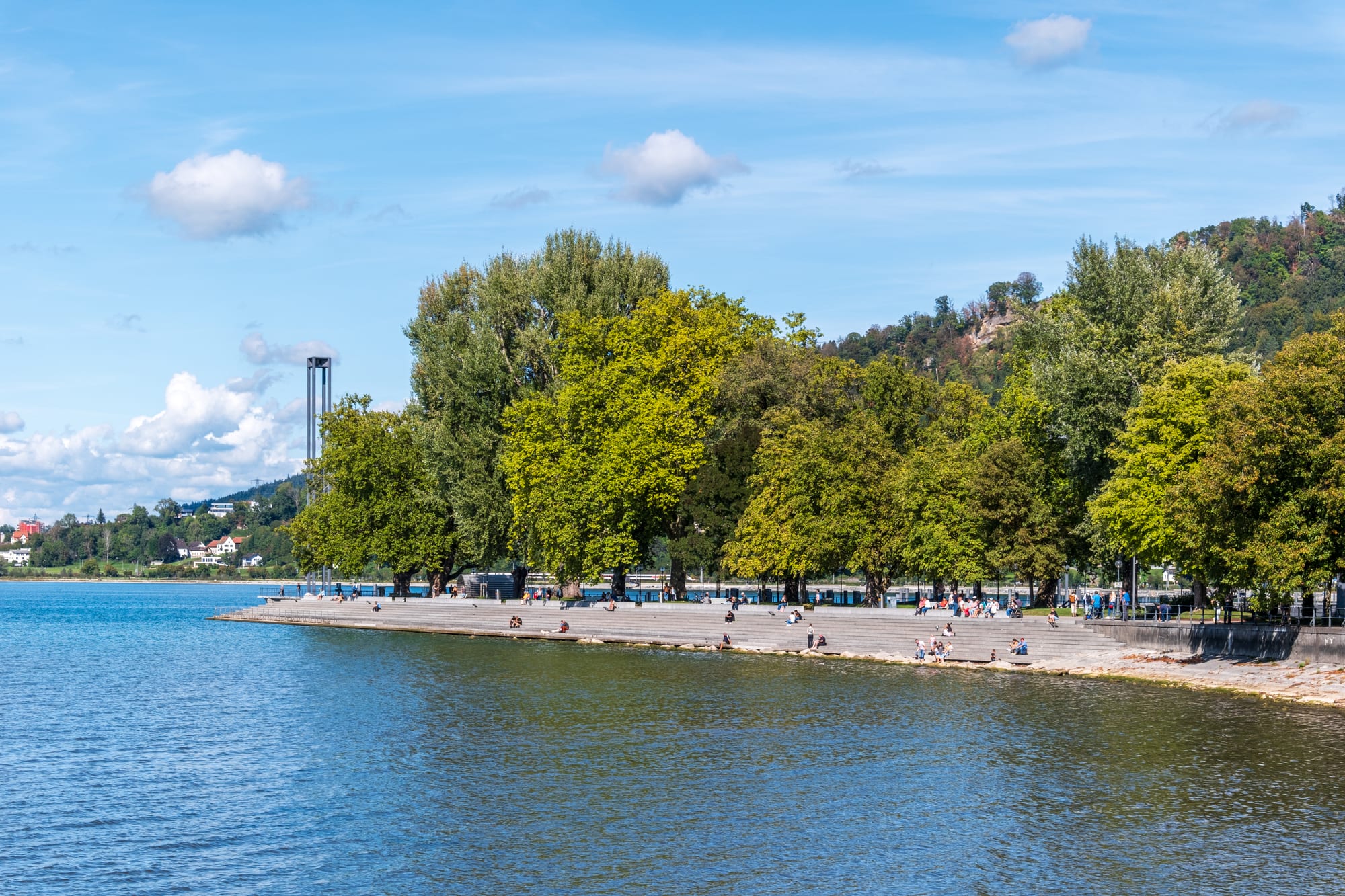
Broad stone steps under tall green trees leading down to the blue water of Lake Constance, with wooded hills behind

Tyrol & Vorarlberg, Austria

Bregenz

The lake promenade in Bregenz, on the eastern shore of Lake Constance. (Dietmar Rabich / Wikimedia Commons · CC BY-SA 4.0)

The capital of Vorarlberg, on the eastern shore of Lake Constance between the lake and the Pfänder, with Germany and Switzerland a short distance away. Celtic Brigantion and Roman Brigantium, it kept a walled upper town while the lower town spread along the water, and today it is a small administrative city known for opera on a floating stage and the Kunsthaus.

Neighbourhoods

  • Upper town (Oberstadt)
    • Historic district
    • Quiet and residential

    The old town on its terrace above the lake, inside a roughly rectangular ring of walls built between the 13th and 16th centuries and still largely preserved. The Martinsturm with its huge onion dome, the old town hall of 1662 and quiet lanes give it a village feel a few minutes' climb from the centre.

    Open in Maps
  • Lower town and the Kornmarkt
    • First-time visitors
    • Best for food
    • Arts and culture

    The centre between the upper town and the lake, which grew around the market at the Leutbühel and the Kornmarkt square laid out in the 1650s. The vorarlberg museum, the Landestheater, the Kunsthaus and most shops and restaurants are here, close to the main station.

    Open in Maps
  • Lakefront and the harbour
    • Waterfront
    • Families
    • Close to public transport

    The promenade running from the boat harbour past the marina to the lake stage and the festival house, laid out from 1842 and remodelled in 2009–10 with new harbour buildings, a lighthouse and concrete sunset steps on the Molo. Lake boats leave from here.

    Open in Maps
  • Vorkloster and Rieden
    • Quiet and residential
    • Local life

    The districts that grew up as the city spread south-west, with the Cistercian abbey of Mehrerau, Clemens Holzmeister's Mariahilf church and much of the city's housing. They are less visited but give a sense of everyday Bregenz.

    Open in Maps
  • Fluh
    • Mountain views
    • Quiet and rural

    A separate hillside district high on the slopes of the Pfänder and the Gebhardsberg, with a few hundred residents, and its own pilgrimage church.

    Open in Maps

Things to do

Famous landmarks

  • Martinsturmlandmark

    The city's landmark in the upper town, a former granary of the counts of Bregenz built as a tower in the corner of the town wall in 1601, with a chapel founded in 1362 and what is described as the largest baroque onion dome in Central Europe.

    Open in Maps
  • Upper town wallslandmark

    The ring of 13th- to 16th-century walls around the Oberstadt, largely preserved around the old town.

    Open in Maps
  • Gebhardsbergviewpoint

    The rock above the city with the ruins of the Hohenbregenz fortress, blown up by the Swedes in 1647, and a pilgrimage church that grew out of a hermitage founded there in 1720.

    Open in Maps
  • Mehrerau Abbeylandmark

    The Cistercian monastery in Vorkloster, a Benedictine house until the Cistercians took it over in 1854.

    Open in Maps

Museums and the arts

  • Kunsthaus Bregenzmuseum

    Peter Zumthor's glass-clad cube for contemporary art, built in 1990–1997 and opened in 1997 with an exhibition by James Turrell.

    Open in Maps
  • vorarlberg museummuseum

    The state museum on the Kornmarkt, until 2011 the Vorarlberger Landesmuseum, with collections on Roman Brigantium and on Vorarlberg's art and culture.

    Open in Maps
  • Künstlerhaus Bregenzmuseum

    The Palais Thurn und Taxis, used for changing exhibitions of contemporary Austrian and international art.

    Open in Maps
  • Vorarlberger Landestheaterattraction

    The state theatre in the former Kornhaus on the Kornmarkt, known for both classics and premieres.

    Open in Maps

The lake and the Pfänder

  • The lake stageattraction

    The Seebühne, the world's largest open-air lake stage, with seats for about 7,000 facing the water; scenes of the James Bond film Quantum of Solace were filmed here during Tosca in 2008.

    Open in Maps
  • Lake promenadepark

    The Seepromenade from the harbour past the marina to the festival house, with the Molo, its lighthouse and sunset steps for watching evening light over the lake.

    Open in Maps
  • Pipeline beach and the Milibeach

    The 1.7-km shore path between the harbour and Lochau, named after an oil pipeline and being remodelled since 2014 with new beaches, and the Mili, a historic wooden lake bath on piles beside it.

    Open in Maps
  • Pfänderviewpoint

    The mountain above the city, one of the region's most famous lookouts, with views from the Allgäu Alps across the lake to the Swiss Alps.

    Open in Maps
  • Pfänderbahntransit hub

    The aerial cable car from the centre to the Pfänder summit, opened in 1927, climbing more than 600 metres in about six minutes.

    Open in Maps

Short trips from the city

  • Lindauattraction

    The Bavarian island town just across the German border on Lake Constance, reached by regional train.

    Open in Maps
  • Bregenz Forestattraction

    The hill and mountain country east of the city, known for its timber farmhouses, modern wooden architecture and a cheese road of dairies.

    Open in Maps
  • Dornbirnattraction

    Vorarlberg's largest town, to the south in the Rhine valley, with which Bregenz is growing into one continuous urban area.

    Open in Maps

Seasonal events

  • Bregenz FestivalJuly and August

    Opera on the lake stage, with a new production every two years, plus orchestral concerts and operas in the festival house — drawing well over 100,000 visitors a year.

  • Bregenzer FrühlingMarch to June

    A dance festival held since 1987 in the Festspielhaus, bringing ensembles from around the world with new productions and Austrian premieres.

  • Bregenz Jazz FestivalJune

    A jazz festival on the Kornmarktplatz, held every year since 2014 as the successor of an earlier New Orleans festival.

Eat and drink

Long-standing places and food districts in Bregenz. Hours, ratings and directions come from your maps app, always current.

Bregenz classics

  • Kornmarkt and the lower townneighborhood

    The streets around the Kornmarkt hold most of the city's inns and restaurants, where Vorarlberg's Käsespätzle and mountain cheese are standard fare.

    Open in Maps
  • Lake promenade cafésneighborhood

    Lakeside inns, a beach bar and garden terraces along the promenade, busiest on summer evenings and before festival performances.

    Open in Maps

Cafés and kiosks

  • Milchpilz kioskcafe

    Near the harbour, one of the last eight surviving mushroom-shaped kiosks of its type, known as a Milchpilz because it sells milk drinks.

    Open in Maps
  • Upper townneighborhood

    A handful of inns in the lanes of the walled old town, a quieter alternative to the lakefront.

    Open in Maps

Experience Bregenz

History

People lived at the foot of the Gebhardsberg in the early Bronze Age, and in the 5th century BC the Celtic Brigantii fortified Brigantion here, one of their strongest sites. Rome took it in 15 BC; Brigantium became a municipality around 50 AD, with a forum, temples, market halls and the Roman admiralty for Lake Constance, and remains of a theatre were found in excavations in 2013 and 2019. The Alemanni sacked the town in 259/60, and the better-protected upper town was rebuilt as a fort guarding the frontier on the Rhine and the lake. The missionaries Columbanus and Gall worked here in 610–612.

From 917 the counts of Bregenz ruled from its castle, and around 1170 Hugo of Tübingen, of the Montfort line, founded the walled town on the upper terrace. The Habsburgs bought it in 1451 and 1523. Swedish troops occupied it in the Thirty Years' War and blew up the Hohenbregenz fortress in 1647, and from 1805 to 1814 it was Bavarian. In 1726 it became the main seat of Austrian administration in Vorarlberg, and the parliament has met here since 1861.

The harbour was built from 1842, Austrian lake shipping began in 1884, and the railway arrived in 1872, crossing the Arlberg from 1884. Allied bombing destroyed 72 houses in 1945, and French troops ran the military government after the war. In 1946 the first Bregenz Festival was held, and from 1949 opera was staged on the lake. The Social Democrat Michael Ritsch was re-elected mayor in 2025.

Culture & Customs

Bregenz has a far richer cultural life than its size suggests. The Bregenz Festival, played on the world's largest lake stage, is its signature: a new production every two years, and an audience that reached 400,000 over the two summers of Carmen in 2017 and 2018. The Festspielhaus beside it hosts orchestral concerts and the Bregenzer Frühling dance festival, and the Kornmarkt square has its own jazz festival each June.

Contemporary art and architecture are the other strands. Peter Zumthor's Kunsthaus, opened in 1997 with James Turrell, belongs to what locals call the Kulturmeile, the culture mile, with the vorarlberg museum and the Landestheater, and the Künstlerhaus in the Palais Thurn und Taxis shows living artists. The city shares Vorarlberg's confidence in modern building in glass and wood.

Daily speech is Alemannic, close to Swiss German and famously hard for other Austrians to follow, and people look west to Switzerland and Germany across the lake as much as east to Vienna. A memorial stone in the lakeside gardens recalls local resistance to a planned nuclear reprocessing plant in Bavaria, and the city's handball and football clubs, A1 Bregenz HB and SC Bregenz, have loyal followings.

Daily Life

About 29,000 people lived in the main part of the city at the start of 2026, with a few hundred more in hillside Fluh. Bregenz is only the third-largest town in Vorarlberg, after Dornbirn and Feldkirch, but its built-up area with Hard, Lauterach, Wolfurt and neighbouring villages is more than twice the size of the city, and a ribbon of settlement increasingly joins it to Dornbirn in an urban area of well over 100,000.

As the state capital it is home to the parliament and most of Vorarlberg's authorities, and its economy is made up largely of services, trade and industry, including the hosiery maker Wolford and the fittings manufacturer Julius Blum. Tourism comes in two seasons, with the festival in summer and the Pfänder in winter.

The city has grown from the upper town down to the lake and then south-west, where Rieden and Vorkloster grew up and post-war housing filled the plain of Weidach. Summer life moves to the water — the promenade, the Pipeline beaches and the old wooden Mili bath.

Food

Bregenz eats the food of Vorarlberg, in which cheese and other dairy products play a major role. Käsespätzle — soft egg noodles layered with grated cheese and fried onions — is the everyday dish, and the Bregenz Forest behind the city runs a cheese road of dairies making Bergkäse, a hard mountain cheese with a strong, sometimes nutty taste, alongside the sharp, semi-hard Räßkäse.

Riebel, maize and wheat semolina cooked in milk to a firm mash, was traditionally eaten for breakfast across Vorarlberg, and Öpfelküachle, apples baked in pancake dough and topped with sugar and cinnamon, are a simple sweet. Vorarlberg has its own breweries, among them Fohrenburg in Bludenz, and a fruit schnapps sometimes ends a meal.

The streets around the Kornmarkt hold most of the traditional inns, while the lake promenade has its terraces and beach bars. Near the harbour, one of the last eight mushroom-shaped Milchpilz kiosks still sells milk drinks, and the hillsides behind the upper town were once covered with vineyards and orchards held from the Counts of Montfort.

Planning tools

Budget

Bregenz is far cheaper than the Arlberg ski resorts but in line with the rest of prosperous western Austria. Prices rise sharply during the festival in July and August. Lake boats, the cable car and festival tickets are the main extras.

Daily Budget Midrange
USD 170–300 (city hotel, restaurant dinners, museum entries, the Pfänderbahn; more in festival season)
Daily Budget Shoestring
USD 80–130 (hostel or simple guesthouse, bakery and supermarket food, regional trains and buses)

Rooms are easier to find and cheaper outside the July and August festival season.

Best Time to Visit

June to September, when the lake is at its best for swimming, walking and boat trips, and the festival plays on the lake stage in July and August. Spring brings the dance festival. Winter is quiet and grey by the lake, though the Pfänder has some winter sport.

Suggested Number of Days

One or two days cover the city. Allow three to five to take in the surrounding lake shore and hill country as well, and plan around festival dates in summer.

First Visit
1–2 days
With Surroundings
3–5 days

Transportation

The centre is small enough to walk. Bregenz has three railway stations on the Vorarlberg line — the main station, Hafen by the harbour and Riedenburg — served by the Vorarlberg S-Bahn and regional trains, which also cross into Germany and Switzerland, and city buses fill in the gaps. Lake boats of the Vorarlberg Lines leave from the harbour.

A car is no help for the centre or the festival; trains and buses cover the Rhine valley well.

Airport & Station Connections

Bregenz has no airport of its own. The nearest are St. Gallen–Altenrhein, about 23 km to the west in Switzerland, Friedrichshafen in Germany, about 35 km to the north-west, and Zürich, about 120 km away. EuroCity and Railjet trains stop at the main station, and the A14 motorway runs past the city.

Walkability

Very walkable: the station, the lake promenade, the Kunsthaus, the Kornmarkt and the upper town are all within a few minutes of each other. The upper town involves a short climb, and the Pfänder is reached by cable car.

Safety

Austria is very safe, with low levels of violent crime. Bregenz is a calm, orderly city; the main risks are on the water and in the mountains — sudden storms on Lake Constance and changeable weather on the Pfänder.

Watch for storm warnings before swimming or boating on the lake, and keep an eye on bags in the festival crowds. Check current official travel advice before travelling.

Climate

A temperate climate moderated by Lake Constance, milder than the mountain valleys inland, with rain spread through the year and warm summers.

Summer
warm, with valley days in western Austria typically between 22 and 30°C; afternoon thunderstorms are common
Winter
cool and often grey by the lake; in the valleys of western Austria winter days typically range from -8 to 3°C

Local Customs

Tipping is expected in restaurants and cafés: rounding the bill up to the next euro or so is usual, and nothing is added at counters or street stalls. Vorarlbergers speak an Alemannic dialect close to Swiss German, hard for other Austrians to follow. Shops close on Sundays.

Give the tip when paying rather than leaving it on the table.

Common Payment Methods

Austria uses the euro. Cards and contactless are accepted in most places, but small cafés, bakeries and market stalls often prefer or require cash.