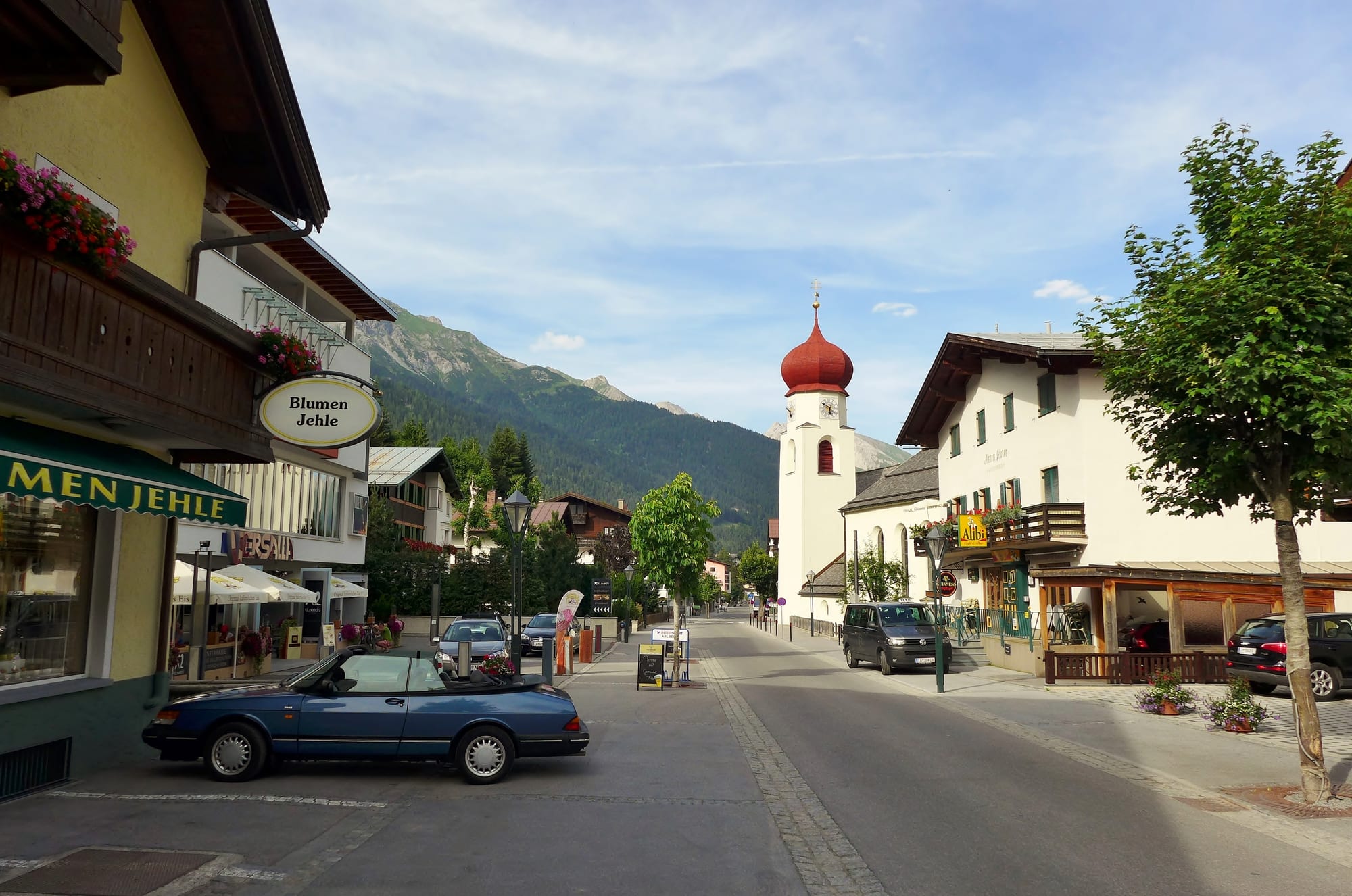
A village street of shops and chalets leading to a white church with a red onion dome, below forested mountain slopes in summer

Tyrol & Vorarlberg, Austria

St. Anton am Arlberg

The Dorfstraße in St. Anton am Arlberg, with the parish church on the right. (Bahnfrend / Wikimedia Commons · CC BY-SA 4.0)

A village on the Rosanna at the top of the Stanzertal, at the foot of the Arlberg pass on Tyrol's border with Vorarlberg. Once a stop on the salt road over the pass, it became one of the cradles of alpine skiing after the railway arrived in 1884, and is now part of the vast Ski Arlberg area, known for demanding runs, deep off-piste terrain and lively après-ski.

Neighbourhoods

  • Village centre
    • First-time visitors
    • Nightlife
    • Close to the lifts

    The Dorfstraße, largely pedestrianised since the Arlberg road tunnel took through traffic away in 1978, lined with shops, restaurants, pubs and bars and closed by the parish church. The Galzig gondola and the Rendl lift start at its western end, beside the railway station and the West bus terminal.

    Open in Maps
  • Nasserein
    • Close to the lifts
    • Quieter stays

    The old district between St. Anton and St. Jakob, which gave the whole municipality its name for more than a century. The Nasserein gondola, built for the 2001 World Championships, climbs from here, and the East bus terminal serves it.

    Open in Maps
  • St. Jakob am Arlberg
    • Quiet and residential
    • Historic church

    The second village of the municipality, east of St. Anton, with about 650 residents. Its baroque parish church of the 1770s, with a large painting of St. Christopher on its façade, replaced the oldest church of the upper Stanzertal.

    Open in Maps
  • St. Christoph am Arlberg
    • Ski-in
    • ski-out
    • Quiet and remote

    A hamlet high on the Arlberg pass road, where a shepherd built a hospice for travellers crossing the pass in the 14th century and the Arlberg Ski Club was founded in 1901. It sits within the ski area, linked to St. Anton by lifts and pistes.

    Open in Maps

Things to do

Mountains and skiing

  • Vallugaviewpoint

    At 2,811 metres the highest point of the ski area that lifts reach, and the start of the 10-km run down to St. Anton.

    Open in Maps
  • Ski Arlbergattraction

    The ski area spanning Tyrol and Vorarlberg, covered by one lift pass, which since 2013–14 has been Austria's largest connected ski area, linking St. Anton with Lech, Zürs and Warth-Schröcken.

    Open in Maps
  • Arlberg Passviewpoint

    The pass west of the village between Tyrol and Vorarlberg, for centuries a road for salt, trade and troops, and the watershed between the Rhine and the Danube.

    Open in Maps

The village

  • Parish church of St. Antonlandmark

    Consecrated in 1698 and enlarged in 1932 by Clemens Holzmeister, it looks baroque from outside but has a modern interior of architecture, painting and fittings.

    Open in Maps
  • Ski and local history museummuseum

    The village museum in the Trier villa, covering the history of skiing at the Arlberg and of the valley.

    Open in Maps

Walks and short trips

  • Verwall Alpstrail

    The mountain group south of the village, with alpine club huts and marked walking routes, and in winter cross-country tracks in the Verwall valley.

    Open in Maps
  • Lechattraction

    The Vorarlberg ski village on the far side of the Arlberg, joined to St. Anton by the Ski Arlberg lifts and reached by road over the Flexen road through Zürs.

    Open in Maps
  • Landeckattraction

    The town at the entrance to the Stanzertal where it meets the Inn valley, linked to St. Anton by frequent buses all year round.

    Open in Maps

Eat and drink

Long-standing places and food districts in St. Anton am Arlberg. Hours, ratings and directions come from your maps app, always current.

St. Anton classics

  • Après-ski on the home runsneighborhood

    Bars on the slopes just above the village, along the runs down to it, fill in the late afternoon — the après-ski scene for which the resort is known.

    Open in Maps
  • Dorfstraße pubs and restaurantsneighborhood

    The pedestrian village street holds most of the restaurants, pubs and late bars, where English is often the language at the counter.

    Open in Maps

Mountain huts

  • Ski huts of the Arlbergrestaurant

    Huts and mountain restaurants are spread across the whole ski area, and some also open in summer for walkers.

    Open in Maps

Experience St. Anton am Arlberg

History

The upper Stanzertal was first recorded around 1275 as Vallis taberna, and the settlement's fortunes followed the traffic over the Arlberg pass. After Tyrol passed to the Habsburgs in 1363, salt, trade goods and troops crossed here, and the villages on both sides flourished. Decline set in after 1450, when the city of Lindau bought the Arlberg pastures and diverted the salt trade; from about 1450 until the new road of 1787 the pass could not be crossed by cart. When railways in the lowlands took the salt traffic again around 1860, many men left to work abroad as builders, and from about 1815 until 1914 poor families sent their children each summer to work on farms in Swabia.

The Arlberg railway and its tunnel, built from 1880 and opened in 1884, brought the first tourists. The Arlberg Ski Club was founded at St. Christoph in 1901, and in 1907 Hannes Schneider arrived as a ski instructor; his Arlberg technique transformed modern skiing, and in 1922 he founded the St. Anton ski school. With Rudolf Gomperz, who ran the tourist office from 1926, he made the village a leading resort, and the first Arlberg-Kandahar race was held here in 1928. The municipality took the name St. Anton am Arlberg in 1927.

The Nazi years brought arrests and antisemitic signs at the village edge; Gomperz was deported and murdered, and Schneider was persecuted until he was brought to the United States in 1939. After 1947 tourism grew fast, the road tunnel opened in 1978, and the village hosted the 2001 Alpine World Ski Championships, for which the railway was moved to the village's southern edge. The village was quarantined in March 2020 during the COVID-19 pandemic, and a mudflow buried part of its centre in 2024.

Culture & Customs

St. Anton thinks of itself as a cradle of alpine skiing. Hannes Schneider's teaching method, the ski school he founded and the instructors who emigrated to the United States in the 1930s carried the Arlberg's way of skiing around the world, and Arnold Fanck's films of the 1920s and 1930s, among them The White Ecstasy of 1931 with Leni Riefenstahl and Schneider himself, made the village's slopes famous. Later films such as Downhill Racer and Chalet Girl were shot here too. The ski and local history museum in the Trier villa keeps that story.

The resort's other reputation is for après-ski. Bars on the slopes just above the village and along the Dorfstraße fill from late afternoon, and with more than half the visitors coming from outside the German-speaking world, the language at the bar is often English.

Beneath that, the village keeps the habits of a Catholic Tyrolean community. The parish churches of St. Anton and St. Jakob are its old centres — St. Anton's consecrated in 1698 and given a modern interior by Clemens Holzmeister in 1932, St. Jakob's a closed baroque ensemble with a valuable pulpit. St. Anton's cemetery, below the village, is a listed monument.

Daily Life

The municipality had about 2,300 residents at the start of 2026, about 1,650 of them in St. Anton itself and the rest in St. Jakob. Its area of about 166 square kilometres is larger than Liechtenstein. Tourism dominates an almost single-track economy: around 10,000 guest beds bring about a million overnight stays each winter, and the craftsmen, shops and services that remain largely depend on the ski trade. The Arlberger Bergbahnen, the largest lift company in the Ski Arlberg pass network, runs 31 cable cars and lifts.

Life follows the seasons. In winter the village is crowded and loud, the days built around the lifts and the evenings around the bars. Summer, once quieter, has grown again since the 1990s with mountain biking and walking on about 96 km of marked trails, and an outdoor pool and wellness centre opened in 2002.

Natural hazards are part of local life. Avalanche barriers built after the deadly Wolfsgrube avalanche of 1988 were only completed in 2014, the 2005 floods destroyed the main road, and the 2024 mudflow buried streets and cars around the station and the Rendl lift, cutting road links from Vorarlberg for a week.

Food

St. Anton eats the food of Tyrol, which leans on milk, cheese, flour and bacon. Tiroler Gröstl — boiled potatoes, onion and leftover beef or pork fried in a pan, often served with a fried egg — and Speckknödel, dumplings with pieces of bacon, are staples of Tyrolean cooking. Käsespätzle, soft egg noodles layered with grated cheese and fried onions, is eaten on both sides of the Arlberg, and Tyrolean speck, a juniper-flavoured ham that is salt-cured and smoked, is sliced on boards with bread.

Kaiserschmarrn, a lightly sweetened shredded pancake named after Emperor Franz Joseph, is one of Austria's best-known dishes. On the mountain, huts and mountain restaurants are spread across the ski area, and some of them also open for summer walkers. Schlutzkrapfen, half-moon pasta filled with potato, meat or spinach and curd, come from the same old Tyrolean kitchen.

Evenings centre on the Dorfstraße, where restaurants, pubs and late bars share the pedestrian street. Beer is the usual drink, and a fruit schnapps sometimes closes a meal.

Planning tools

Budget

St. Anton is one of the most expensive places in the Alps in winter. Rooms between Christmas and the end of the ski season cost several times their summer price, and the Ski Arlberg pass is a large fixed cost. Summer is much cheaper, with hut nights and walking on marked trails.

Daily Budget Midrange
USD 240–450 (Gasthof or hotel in season, restaurant dinners, a Ski Arlberg lift pass)
Daily Budget Shoestring
USD 110–170 (guesthouse or apartment share, supermarket meals, free village buses; more in high winter)

Summer and the early and late weeks of the ski season are far cheaper than the Christmas to February peak.

Best Time to Visit

The ski season runs from early December to late April, with snowmaking making the pistes reliable and the busiest weeks between Christmas and February. Summer, from late June to September, brings hiking, mountain biking and the alpine club huts in the Verwall and Lechtal Alps. Late spring and November are quiet, and many lifts and huts close.

Suggested Number of Days

Two or three days give a taste of the village and the slopes. Most skiers stay a week to cover the whole Arlberg, and a summer walking holiday with hut nights needs about as long.

First Visit
2–3 days
With Surroundings
5–7 days

Transportation

The village is compact, and free buses link its parts with St. Jakob and with Pettneu, Schnann and Flirsch further down the valley. Two bus hubs, Terminal West by the station and the Galzig and Rendl lifts and Terminal Ost by the Nasserein gondola, organise the network, and a year-round route runs to Landeck. In winter the lifts and pistes are the way around the Arlberg.

Bad weather can close the roads and the railway: the 1988 avalanche, the 2005 flood and the 2024 mudflow each cut the village's road links for days.

Airport & Station Connections

St. Anton station, at the southern edge of the village, is on the Arlberg railway between Innsbruck and Bludenz and is served by Railjet, EuroCity, InterCity and Nightjet trains, including services between Zürich and Budapest. Innsbruck is about 100 km to the east. By car the Arlberg road tunnel leads from Vorarlberg and the S16 expressway from Landeck; the airports used most are Innsbruck, Munich, Zürich and Friedrichshafen.

Walkability

The village centre is a pedestrian zone and easy to walk end to end; the station, the Galzig gondola and the Rendl lift are close together at the western end. Nasserein and St. Jakob are a walk or a short bus ride east. Paths and streets are often icy in winter.

Safety

Austria is very safe, with low levels of violent crime. St. Anton's real dangers are natural ones: avalanches off the pistes, where much of the famous terrain lies, and in the valley — one in 1988 killed seven people in Nasserein — as well as floods and mudflows such as the debris flow that buried the western village centre in August 2024.

Read the daily avalanche bulletin, carry transceiver, probe and shovel off piste, and hire a guide for any glacier route. Ski off-piste only with a guide, and watch for weather warnings in summer. Check current official travel advice before travelling.

Climate

An alpine climate at about 1,300 metres, with long snowy winters and short summers. Heavy summer thunderstorms are a real hazard: in August 2024 the Galzig weather station recorded 88 mm of rain in two hours.

Summer
warm in the Tyrolean valleys, 22–30°C by day, cooler and stormy in the afternoons above 2,000 metres
Winter
cold and snowy, with valley temperatures across Tyrol typically between -8 and 3°C and reliable snow cover from December

Local Customs

Tipping is expected in restaurants and bars: rounding the bill up to the next euro or so is usual. More than half the visitors do not speak German, so English is widely heard in bars. Shops generally close on Sundays, as across Austria.

Give the tip when paying rather than leaving it on the table; nothing is added at counters or street stalls.

Common Payment Methods

Austria uses the euro. Cards and contactless are accepted in most places, but small cafés, bakeries and alpine huts often prefer or require cash.