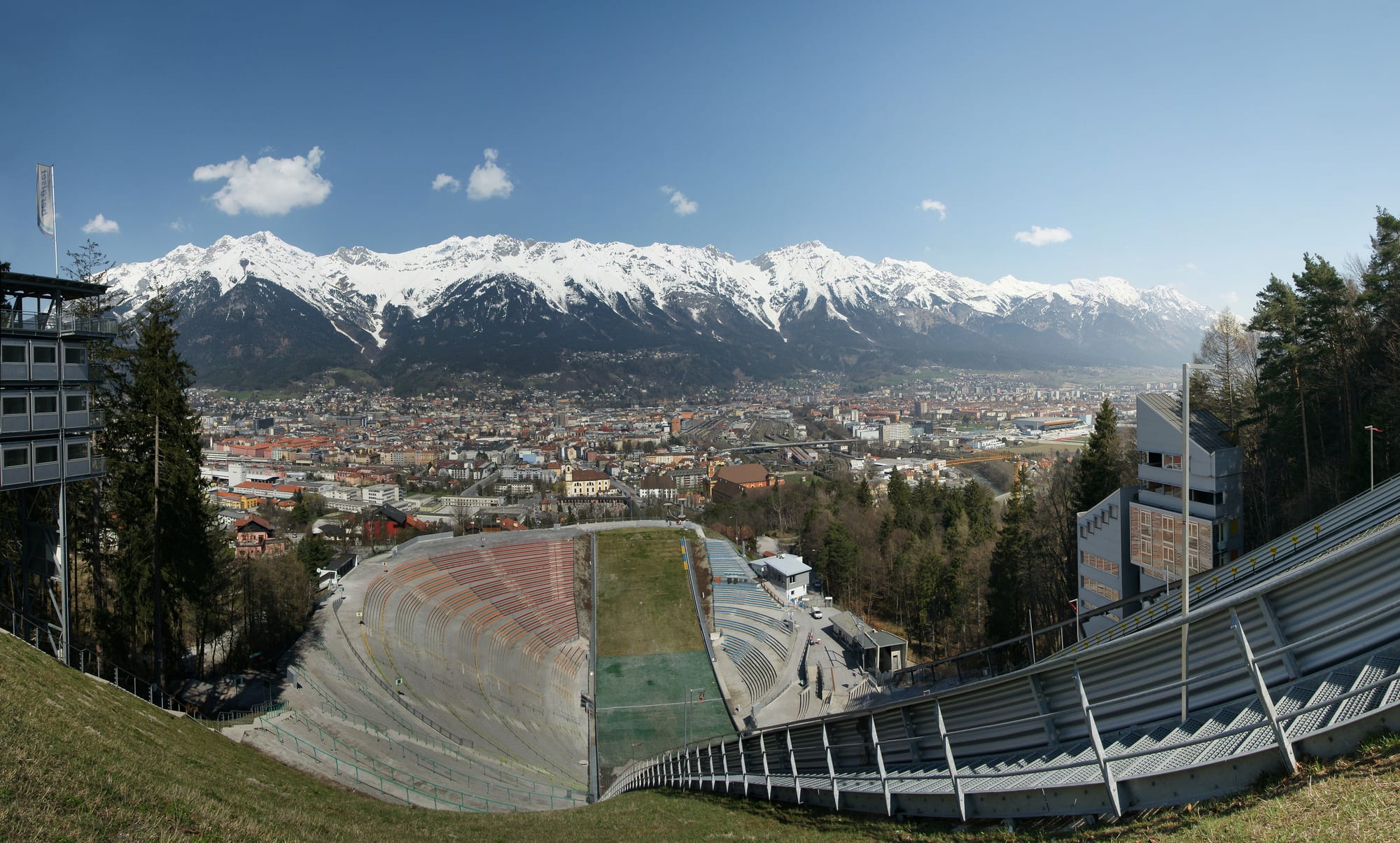
Innsbruck filling the Inn valley below the long snow-covered wall of the Nordkette, seen over a ski-jump arena

Austria

Tyrol & Vorarlberg

Innsbruck in the Inn valley beneath the Nordkette range, seen from the Bergisel ski jump. (böhringer friedrich / Wikimedia Commons · CC BY-SA 2.5)

Austria's two westernmost states, filling the high Alps between Germany, Switzerland and Italy. Tyrol runs along the Inn valley from Innsbruck to the glacier resorts of the Ötztal and Zillertal, with the detached district of East Tyrol beyond the Felbertauern; Vorarlberg drops from the Arlberg and the Bregenzerwald to Lake Constance.

Explore Tyrol & Vorarlberg

History

The valleys were settled long before any state existed here, as the 1991 discovery of Ötzi — a man who died around 3,300 BC high on the Ötztal ridge at the Italian border — made plain. Celtic and Raetic peoples held the mountains until Rome absorbed them in 15 BC and later built roads over the Reschen and the Brenner, two of the main crossings of the Eastern Alps. Roman Brigantium stood where Bregenz stands now.

Alemannic settlers moved into the Lake Constance basin after Rome withdrew, Bavarians into the Inn valley, and the linguistic border between them still runs along the Arlberg. The Counts of Tyrol built up a territory from their castle above Merano, and in 1363 Margarete Maultasch handed it to the Habsburgs. Innsbruck became a Habsburg residence under Maximilian I, who is remembered by the gilded loggia of the Goldenes Dachl and by the black bronze statues of ancestors, relatives and heroes around his empty tomb. Tyrol kept a distinctive constitution in which peasants carried arms and sat in the diet, and the militia tradition it created produced the rising of 1809, when the innkeeper Andreas Hofer led Tyrolean riflemen against Bavarian and French rule and won at Bergisel before being caught and shot.

Vorarlberg's lands were acquired piecemeal by the Habsburgs and only became a separate province in 1861, and after 1918 a large majority there voted to join Switzerland — a union that Vienna, the Allies and many Swiss opposed. The 1919 Treaty of Saint-Germain cut Tyrol apart, giving South Tyrol and Trentino to Italy and leaving East Tyrol an exclave cut off from North Tyrol; today the state forms a cross-border Euroregion with South Tyrol and Trentino. Vorarlberg industrialised early, its textile and embroidery works drawing in workers from elsewhere by the 19th century, while mass tourism later transformed the Tyrolean valleys.

Culture & Customs

The Arlberg separates two peoples who both call themselves Austrian. Tyroleans speak Bavarian dialects; Vorarlbergers speak Alemannic, closer to Swiss German and famously hard for other Austrians to follow, and they look west to Switzerland and the Rhine valley as much as east to Vienna. Both are strongly Catholic, with roadside shrines, Corpus Christi processions and church towers that still set the rhythm of a village.

Folk custom is lived rather than staged. Herds come down from the high pastures in late September or early October in the Almabtrieb, the lead cow crowned with flowers and mirrors; masked figures run through villages on the Krampus nights of early December and in the Perchten runs after Christmas; and the masked carnival processions of Imst, Nassereith and Telfs are held only every few years, Imst's Schemenlaufen being on UNESCO's intangible heritage list. Schützen companies parade in historic uniform, brass bands play at every occasion, and Kitzbühel's Hahnenkamm weekend in January is as much a national event as a race.

The region is also unusually confident about design. Vorarlberg has built a reputation for contemporary architecture in glass and local wood, from village museums and bus shelters in the Bregenzerwald to the glass-clad Kunsthaus Bregenz, and it sits comfortably beside the old craft economy of joinery, embroidery in Lustenau, glass at Rattenberg and the Swarovski works at Wattens.

Daily Life

Roughly 760,000 people live in Tyrol and 400,000 in Vorarlberg. Innsbruck, with about 130,000 residents and a large university, is the only city of any size in Tyrol; Kufstein, Schwaz, Wörgl, Hall, Telfs and Lienz in East Tyrol are smaller towns. Vorarlberg's population is packed into the Rhine valley strip of Bregenz, Dornbirn and Feldkirch, a near-continuous urban ribbon of around 300,000 people that is the most densely settled region of Austria after Vienna; Bludenz lies further up the Ill.

Tourism dominates Tyrol: the state records more overnight stays than any other in Austria, and in resorts like Ischgl or Sölden winter visitors far outnumber the residents. Vorarlberg's economy is industrial — lighting, packaging, engineering, cable cars and textiles — and many residents commute across the border to jobs in Switzerland and Liechtenstein.

The working day starts early and ends early; shops shut on Sundays, and in the ski season two working shifts revolve around the lifts. The pressures under discussion are familiar: housing costs driven up by holiday apartments, water and energy demand from snowmaking, lorry traffic on the Brenner corridor, and whether glacier resorts can plan for a warmer century.

Food

Western cooking leans on dairy, flour and smoked meat. Käsespätzle — soft egg noodles layered with grated cheese and fried onions — is an everyday dish, and Tyrol adds Tiroler Gröstl, a pan of fried potatoes, onion and leftover beef or pork with an egg on top, and Speckknödel, bread dumplings studded with cured bacon. Schlutzkrapfen, half-moon pasta filled with anything from potato or meat to spinach and curd, come from the old Tyrolean kitchen, and Tiroler Speck, cured and smoked pork, has protected geographical indication status.

Cheese is the serious product. The Bregenzerwald runs a Käsestrasse of dairies making Bergkäse, matured for three months to two years, alongside the sharp, semi-hard Räßkäse and the sour-milk Sura Kees of the Montafon valley. Vorarlberg's Riebel, maize and wheat semolina cooked in milk to a firm mash, was traditionally eaten at breakfast, and parts of East Tyrol fill their Schlutzkrapfen with potato and call them Schlipfkrapfen.

Sweets are simple and filling: Kaiserschmarrn eaten at midday in a hut and Apfelradln, apple rings fried in batter, while the Zillertal's own Krapfen are savoury, fried rye pastries filled with potato and grey cheese. Beer outweighs wine — Zillertal Bier, Fohrenburger from Bludenz, Starkenberger at Tarrenz — and the spirit is clear fruit schnapps.

Attractions & Natural Wonders

Innsbruck compresses a lot into a small centre: the Goldenes Dachl, the Maria-Theresien-Strasse under the Nordkette, the Hofburg and the Hofkirche with Maximilian's bronzes, Ambras Castle, the Bergisel jump with Zaha Hadid's tower, and the Hungerburg funicular and cable cars that climb from the old town to about 2,300 metres. East along the Inn are Schwaz's silver mine, Hall's medieval salt town, Rattenberg's glassworks and Kufstein's fortress, and beyond them the medieval town and ski slopes of Kitzbühel, between the Hahnenkamm and the Kitzbüheler Horn.

The side valleys carry the high country. The Zillertal runs south into the Zillertal Alps, a granite-gneiss range of 3,000-metre peaks along the Italian border, with the Berliner Höhenweg long-distance trail and, at the head of the Tux side valley, the Hintertux glacier. The Ötztal climbs past the Stuibenfall waterfall and Sölden to Obergurgl, Austria's highest parish, with the Timmelsjoch pass into Italy and the ridge where Ötzi was found; the neighbouring Stubai and Pitztal valleys hold more glacier terrain. The Karwendel to the north is a vast protected limestone range above Seefeld, and East Tyrol reaches into Hohe Tauern National Park below the Grossglockner, where the Umbal waterfalls lie, and also takes in the Lienz Dolomites of the Gailtal Alps.

Vorarlberg begins at Bregenz on Lake Constance, where the Seebühne stages opera over the water, the Kunsthaus shows contemporary art and the Pfänder cable car looks across three countries. Inland lie the Bregenzerwald's timber villages, the Rappenlochschlucht gorge at Dornbirn, Feldkirch's Schattenburg castle, the Silvretta high road above the Montafon, and the Arlberg resorts of Lech, Zürs and St Anton.

Cities in Tyrol & Vorarlberg

Planning basics

Budget

The west is the most expensive part of Austria, and the gap is seasonal rather than constant. A bed in Lech, Ischgl, Sölden or Kitzbühel between Christmas and March costs several times what the same room costs in June, and lift passes are a large fixed expense. Innsbruck, Bregenz, Dornbirn and the farming valleys of East Tyrol and the Bregenzerwald are far more reasonable, and summer walking with hut nights is cheap by Austrian standards.

Daily Budget Midrange
USD 170–320 (Gasthof or hotel, restaurant dinners, cable cars; far higher in ski resorts in high season)
Daily Budget Shoestring
USD 80–130 (hostel, alpine hut half-board, valley bus, supermarket lunches)

Alpine Club membership cuts hut prices sharply, and guest cards handed out by valley hotels often include local buses and lifts.

Safety

Crime is very low, and the serious risks are mountain risks: avalanches off piste and on ski tours, sudden storms and lightning on ridges, rockfall in thawing terrain, crevasses on the glaciers, and underestimated walking times. Resort weekends bring alcohol-related incidents and road accidents on the valley roads.

Read the daily avalanche bulletin, carry transceiver, probe and shovel off piste, and hire a guide for any glacier route. Check current official travel advice before travelling.

Climate

Alpine and strongly shaped by altitude and aspect. The valley floors are comparatively mild, while the glacier ski areas above 3,000 metres are in snow all year. The northern ranges catch heavy rain and snow, while the inner valleys are drier, down to about 600 mm a year in the uppermost Inn valley, and the warm föhn wind can bring pronounced thaws to Innsbruck even in winter.

Summer
warm in the valleys, 22–30°C, cooler and stormy in the afternoons above 2,000 metres
Winter
cold and snowy, -8 to 3°C in the valleys, with reliable snow cover on the high resorts from December

Transportation

The Inn valley carries the main railway and motorway west from Salzburg to the Arlberg tunnel and on into Vorarlberg, where trains continue through the Rhine valley to Bregenz on Lake Constance and across the German border to Lindau. The Brenner line and motorway cross south to Italy, and buses run up the side valleys. East Tyrol is the awkward exception: an exclave, it is reached from the rest of Tyrol through Salzburg and the tolled Felbertauern tunnel, or through Italy by road and rail along the Puster valley.

Winter tyres are legally required in snow conditions, and high passes close for the winter: the Timmelsjoch is open only from about June to October, and the Silvretta road is closed from November to April.

Best Time to Visit

Two clear seasons. December to early April for skiing, with the highest prices and fullest villages between Christmas and the end of February. Late June to September for walking, huts, cable cars and lake swimming, when the high passes are open and the Bregenz Festival plays over the water in July and August. Late April to early June and November are the quiet shoulder weeks, when many lifts, huts and hotels close entirely.