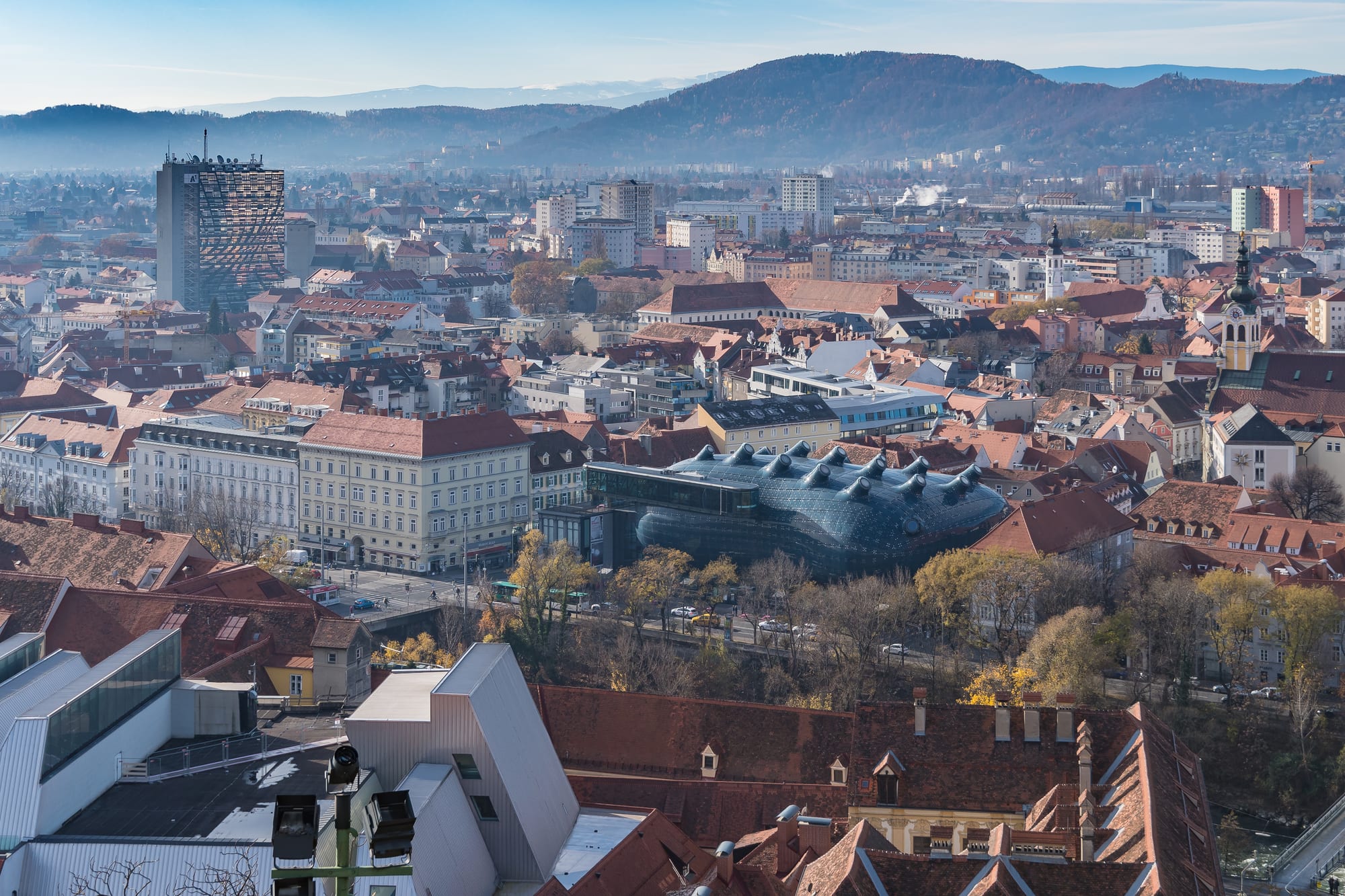
Red-tiled rooftops of Graz seen from above, with the blue curved Kunsthaus in the centre and wooded hills beyond

Austria

Styria & Carinthia

Graz seen from the Schlossberg, with the Kunsthaus art museum beside the River Mur. (Isiwal / Wikimedia Commons · CC BY-SA 4.0)

Austria's south, running from the forested "green heart" of Styria and its university city of Graz down to the warm lakes of Carinthia and the Grossglockner on the Hohe Tauern ridge — a region of vineyards on the Slovenian border, pumpkin-seed oil, spa towns and summer swimming.

Explore Styria & Carinthia

History

Before the Romans, this was the heart of Noricum, a Celtic kingdom rich in iron, and its trading town on the Magdalensberg above the Zollfeld plain in Carinthia was absorbed into the Roman Empire in 16 BC; Roman Virunum later grew nearby. From the 6th century Slavs settled the valleys, forming the principality of Carantania, whose princes were installed in a Slovene rite at the Prince's Stone; the later dukes' stone Duke's Chair still stands on the Zollfeld. Bavarian and Frankish rule followed, and Carinthia became a separate duchy in 976, Styria in 1180. Both passed to the Habsburgs by the 14th century.

Graz rose as a residence city. From 1564 it was the capital of Inner Austria, the Habsburg lands facing the Ottoman frontier, and its armoury, university and Renaissance courtyards date from that era, when Turkish raids repeatedly swept through eastern Styria. Iron from the Erzberg made Styria an industrial province early, and Archduke Johann, a Habsburg who settled in Graz in the early 19th century, founded the Joanneum museum and promoted railways, farming and schools.

The end of the empire in 1918 cut both provinces in two. Lower Styria, with Maribor, went to the new Yugoslav state, while southern Carinthia, disputed by Yugoslav forces, voted to stay with Austria in the plebiscite of 10 October 1920 — a date still marked as a Carinthian holiday. After 1945 the British occupied both provinces until 1955. Carinthia's politics were long shaped by Jörg Haider, its governor until his death in 2008, and by the dispute over bilingual German–Slovene place-name signs, settled by compromise in 2011.

Culture & Customs

Styrians and Carinthians both regard themselves as southerners — warmer, slower and more easy-going than the Viennese — and their dialects are Southern Bavarian with a sing-song lilt that other Austrians imitate readily. Carinthia's great folk tradition is singing: the melancholy Kärntnerlied is sung in parts in inns and at festivals. The Slovene-speaking minority of the southern valleys has its own schools, press and cultural life, and bilingual signs now stand in many villages.

Styria dresses in green: the Steireranzug suit and the local dirndl, promoted by Archduke Johann, are worn at weddings and church festivals, and the Aufsteirern folk festival fills Graz each September. Graz itself is a student city with a contemporary edge, a European Capital of Culture in 2003 and the home of the Steirischer Herbst avant-garde arts festival. In the wine hills the Klapotetz, a wooden wind rattle meant to scare birds from the grapes, clatters on the ridges from late summer.

Catholicism is strong, with Mariazell as the spiritual centre of Austria's pilgrims, and Carinthia has Austria's second-highest Protestant share after Burgenland. Villach has held its carnival since at least 1867.

Daily Life

About 1.27 million people live in Styria; Carinthia is the least densely populated Austrian state. Graz, with about 300,000 residents and several universities, is Austria's second-largest city; Leoben, Kapfenberg and Bruck an der Mur form the old industrial belt of the Mur and Mürz valleys. Klagenfurt, with about 100,000 people, and Villach, with around 65,000, are Carinthia's two main towns, both in the Klagenfurt basin.

The Styrian economy mixes cars, engineering and research — Magna Steyr assembles vehicles for other brands in Graz — with heavy industry in the Mur valley, the Spielberg motor-racing circuit, spa tourism in the east and farming and wine in the south. Carinthia leans more on tourism, timber and a microelectronics cluster around Infineon's plant in Villach. Rural valleys in both provinces are losing young people to Graz and Vienna.

Days start early, with a Jause, a snack of bread and cold meats, in mid-morning. In summer life in Carinthia moves to the lake lidos after work, and in autumn Styrians drive out to the Buschenschanken at weekends. Graz's cafés and bars fill with students late into the evening.

Food

Styria's signature is Kürbiskernöl, a dark green oil pressed from roasted pumpkin seeds that holds EU protected status as Steirisches Kürbiskernöl. It is poured over salads and potato salad. Heidensterz is a crumbly buckwheat dish, long a staple of farmers and farm workers, and Verhackert, a spread of finely chopped bacon, is a staple of the Buschenschank cold platter along with cold meats, horseradish and bread.

Carinthia's best-known dish is Kärntner Kasnudeln, large pasta pockets filled with curd cheese, potato and mint, their edges crimped by hand. Reindling, a yeast cake filled with cinnamon, sugar, walnuts and raisins, is another local speciality, and lake fish — whitefish, char and trout — appear on lakeside menus.

The wines are mostly white: Sauvignon Blanc, Welschriesling and Morillon (Chardonnay) from the South Styrian hills, with Traminer around Klöch in the Vulkanland. West Styria makes Schilcher, a sharp pink wine from the Blauer Wildbacher grape, and its young Schilchersturm is an autumn favourite.

Attractions & Natural Wonders

Graz is the region's cultural capital. Its old town and Schloss Eggenberg are a UNESCO World Heritage Site; the Schlossberg, reached by funicular, lift or steps, carries the Uhrturm clock tower above the rooftops. Below lie the Landeszeughaus armoury with its thousands of historic weapons, the Kunsthaus art museum, the floating Murinsel in the river, and the Renaissance Landhaus courtyard. North of the city are the Austrian Open-Air Museum at Stübing, the Lipizzaner stud at Piber, and further into the mountains the pilgrimage basilica of Mariazell, the Gesäuse National Park and the red iron-ore terraces of the Erzberg above Eisenerz.

South and east of Graz lies the wine and spa country. The South Styrian Wine Road winds along the Slovenian border around Ehrenhausen and Gamlitz; the Schilcher road crosses West Styria; the Styrian Vulkanland has the hilltop Riegersburg castle; and the thermal spas include Bad Blumau, designed by Hundertwasser. In the north-west, Schladming and Ramsau sit beneath the Dachstein.

Carinthia is lake country. Klagenfurt has its Lindwurm dragon fountain and Minimundus miniature park at the eastern end of the Wörthersee, whose shores hold Velden and Maria Wörth with the Pyramidenkogel tower above. Millstätter See, Ossiacher See, Faaker See and the unspoilt Weissensee lie further west, with Hochosterwitz Castle and Gurk Cathedral inland. In the far north-west, the Grossglockner High Alpine Road climbs from Heiligenblut into Hohe Tauern National Park to the Kaiser-Franz-Josefs-Höhe, facing the 3,798-metre Grossglockner and the Pasterze, Austria's longest glacier.

Cities in Styria & Carinthia

Planning basics

Budget

Styria and Carinthia are cheaper than Vienna, Salzburg or the Tyrolean ski resorts. Graz has student-priced food and good-value hotels, and rooms in the wine country and the smaller Carinthian lakes are moderate. The exceptions are the Wörthersee resorts in July and August, especially Velden and Pörtschach, and the Schladming ski area in winter.

Daily Budget Midrange
USD 150–250 (mid-range hotel or winery room, restaurant dinners, lake lidos, a hire car for the wine roads)
Daily Budget Shoestring
USD 70–110 (hostel or simple guesthouse, Buschenschank platters, regional trains and buses)

A Buschenschank cold platter with a glass of local wine is one of the best-value meals in Austria; book lakeside rooms early for high summer.

Safety

The region is very safe. The risks are natural ones: storms and rockfall in the Hohe Tauern and Dachstein, avalanche danger off-piste in winter, sudden thunderstorms over the lakes, and narrow, steep, winding lanes in the wine hills, where drink-driving after tastings is a real hazard.

Check the mountain weather before driving or hiking high, and arrange a lift or taxi after wine tastings. Check current official travel advice before travelling.

Climate

The south of Austria is sunnier and warmer in summer than the north, shielded from Atlantic weather by the Alps. The Carinthian lakes warm up to well over 20°C by July, while the Klagenfurt basin is known for cold, foggy winter inversions. Southern Styria has a mild, almost sub-Mediterranean touch that suits vines, and the high Tauern and Dachstein ranges carry snow for half the year.

Summer
warm to hot in the valleys, 25–32°C, with afternoon thunderstorms; cooler in the mountains
Winter
cold, often -5 to 3°C, with fog in the basins and reliable snow in the mountains

Transportation

Graz is the rail hub of the south, with trains to Vienna in about two and a half hours; the Koralm railway, opened at the end of 2025, links Graz and Klagenfurt directly in well under an hour. Villach is the junction for trains to Salzburg, Italy and Slovenia. Both capitals have small airports. A car is the practical choice for the wine roads, the smaller lakes and the Grossglockner, which is a toll road.

Buy the motorway vignette before driving; the Grossglockner road charges a separate toll and closes in bad weather.

Best Time to Visit

June to September for lake swimming in Carinthia and for the Grossglockner road, which is closed by snow for much of the year and usually opens in early May. September and October are the wine roads' high season, with the harvest, Sturm and the autumn colours. December to March is for skiing at Schladming, Nassfeld and Bad Kleinkirchheim; Graz is pleasant at any time.