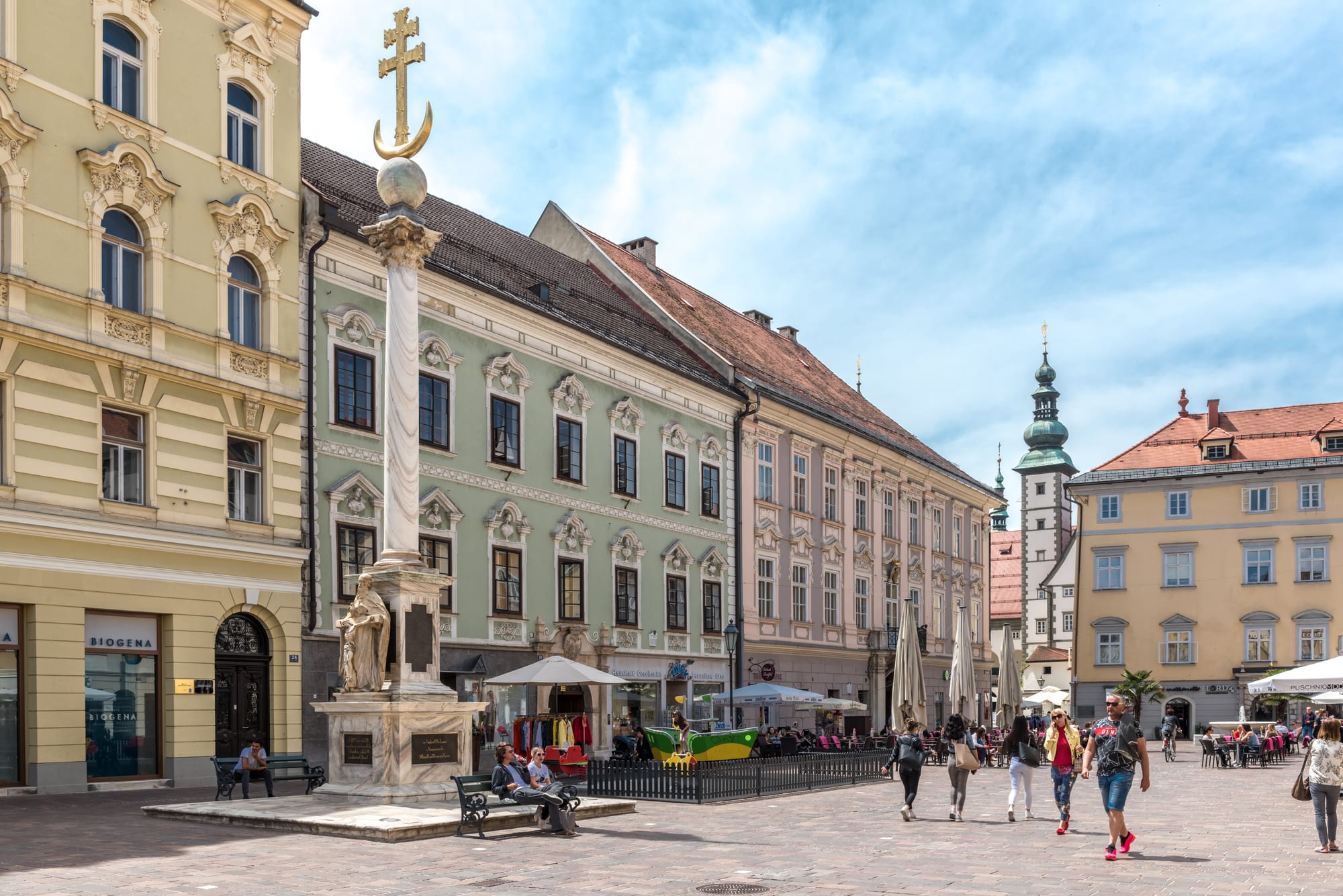
A cobbled square of pastel town houses with a white column topped by a golden cross and a green-domed tower behind

Styria & Carinthia, Austria

Klagenfurt

The western end of the Alter Platz in Klagenfurt's old town, with the Holy Trinity column. (Johann Jaritz / Wikimedia Commons · CC BY-SA 4.0)

The capital of Carinthia, at the eastern end of the Wörthersee in southern Austria. A Renaissance city rebuilt by the Carinthian nobility after a fire in 1514, it keeps a chequerboard old town of arcaded courtyards around its dragon fountain, and today combines a university and state government with summer life on the lake and a strong Carinthian Slovene cultural presence.

Neighbourhoods

  • Innere Stadt (old town)
    • First-time visitors
    • Historic district
    • Close to public transport

    The Renaissance core, laid out on a chequerboard plan after the fire of 1514, with the Alter Platz, the Neuer Platz and its dragon fountain, the Landhaus and the cathedral. Austria's first pedestrian zone opened here in 1961, and many burghers' houses hide arcaded courtyards behind their façades.

    Open in Maps
  • Europapark and the lakeshore
    • Beaches
    • Families
    • Parks

    The western edge of the city where it meets the Wörthersee. The large Strandbad lido, the Europapark gardens, Minimundus and the planetarium sit side by side, with the university campus close by.

    Open in Maps
  • Villacher Vorstadt and the Lend canal
    • Walks and cycling
    • Quiet and residential

    One of the historic suburbs outside the old town, on the side of the Lendkanal, the canal dug in the 16th century to bring timber from the lake. A cycle path follows the canal from the centre to the shore, and the old canal port, the Lendhafen, hosts a harbour festival in summer.

    Open in Maps
  • Viktring
    • Quiet and residential
    • History

    A former municipality on the south-western edge of the city, joined to Klagenfurt in 1973 and built around its large former Cistercian abbey, where summer concerts are held.

    Open in Maps

Things to do

Famous landmarks

  • Lindwurmbrunnenlandmark

    The dragon fountain on the Neuer Platz, the city's emblem, begun in 1590 and finished in 1636, with a statue of Hercules facing the winged lindworm of the founding legend.

    Open in Maps
  • Landhauslandmark

    The palace of the Carinthian Estates, built between 1574 and 1594 at the edge of the oldest part of the town and still the seat of the state parliament.

    Open in Maps
  • Klagenfurt Cathedrallandmark

    Built by the Protestant Estates and dedicated in 1581, when it was the largest Protestant church in Austria; it is now the cathedral of the Catholic Diocese of Gurk-Klagenfurt.

    Open in Maps
  • Stadttheaterlandmark

    The municipal theatre and opera house, completed in 1910 to a design by the Viennese firm Fellner & Helmer.

    Open in Maps
  • Viktring Abbeylandmark

    A former Cistercian monastery on the south-western edge of the city, now a parish, where an international summer music programme and the Gustav Mahler award are held.

    Open in Maps

Museums and attractions

  • kärnten.museummuseum

    The state museum of Carinthia, formerly the Kärntner Landesmuseum, covering the province's cultural and natural history.

    Open in Maps
  • Robert Musil Literature Museummuseum

    A museum in the house on Bahnhofstraße where the novelist Robert Musil, author of The Man Without Qualities, was born.

    Open in Maps
  • Museum Moderner Kunst Kärntenmuseum

    Carinthia's museum of modern and contemporary art, in the old town.

    Open in Maps
  • Minimundusattraction

    A miniature park near the lake showing more than 150 models of buildings from around the world, built at a scale of 1:25.

    Open in Maps

Parks and the lake

  • Strandbad Klagenfurtbeach

    The city's lido on the eastern shore of the Wörthersee, described as the largest lake beach in Europe, with room for about 12,000 bathers on a summer day.

    Open in Maps
  • Europaparkpark

    A park beside the lido and Minimundus, with gardens and space to stroll and play chess.

    Open in Maps
  • Kreuzberglpark

    The wooded hill that serves as the town forest, a walk from the centre, with a viewing tower, an observatory and a botanical garden with a mining museum at its foot.

    Open in Maps
  • Lendkanal cycle pathtrail

    A path along the 16th-century canal from the city centre to the lake, continuing along the northern shore of the Wörthersee to Velden.

    Open in Maps

Sport

  • Wörthersee Stadionattraction

    The football stadium of Austria Klagenfurt, rebuilt for UEFA Euro 2008, when it hosted three matches.

    Open in Maps

Short trips from the city

  • Pyramidenkogelviewpoint

    An 851-metre hill above the southern shore of the Wörthersee, a viewpoint since at least the late 19th century.

    Open in Maps
  • Maria Wörthattraction

    A resort whose centre sits on a peninsula on the southern shore of the lake.

    Open in Maps
  • Maria Saalattraction

    A market town on the historic Zollfeld plain north of the city.

    Open in Maps
  • Hochosterwitz Castlelandmark

    Considered one of Austria's most impressive medieval castles, on a 172-metre dolomite rock east of Sankt Veit an der Glan.

    Open in Maps

Seasonal events

  • World Bodypainting FestivalJuly

    An international bodypainting competition held in Klagenfurt since 2017, drawing artists from many countries.

  • Altstadtzaubersecond weekend of August

    A music and arts festival in the streets and squares of the old town.

  • ChristkindlmarktAdvent, late November–December

    The Christmas market on the Neuer Platz.

Eat and drink

Long-standing places and food districts in Klagenfurt. Hours, ratings and directions come from your maps app, always current.

Klagenfurt classics

  • Benediktinerplatz marketmarket

    The city's main market square since 1948, with a twice-weekly food market and stalls serving traditional Austrian dishes in the indoor hall.

    Open in Maps
  • Old town restaurantsneighborhood

    The inns and cafés around the Alter Platz and its side streets, the place to look for Carinthian Kasnudeln and lake fish.

    Open in Maps
  • Schweizerhaus on the Kreuzberglrestaurant

    A restaurant in the Kreuzbergl town forest, an uphill walk from the centre, serving a refined version of regional cooking.

    Open in Maps

Experience Klagenfurt

History

Legend says Klagenfurt was founded after brave men killed a winged lindworm that lived in the marshes by the lake, baiting it with a bull on a chain and hook; a village grew up on the spot. In fact the Spanheim dukes of Carinthia founded a stronghold here across the trade routes, first mentioned in the late 12th century as a market called "Chlagenvurth". The site flooded so often that in 1246 Duke Bernhard von Spanheim moved it to safer ground, and the new market town received a city charter in 1252.

Fires, earthquakes, locusts, Ottoman raids and peasant wars followed. After a fire almost destroyed the town in 1514, Emperor Maximilian I, unable to rebuild it, handed Klagenfurt to the Carinthian Estates in 1518 over the citizens' protests. The nobles made it their capital: they dug a canal to the lake to bring timber, laid out new streets on a Renaissance chequerboard plan, built town houses, the Landhaus and a large Protestant church that is now the cathedral, and set up the dragon fountain. Napoleon's troops pulled down most of the walls in 1809. Railways arrived from 1863, and in the 19th century the city became an important centre of Slovene culture, where the Hermagoras Society publishing house was founded in 1851.

In 1919 forces of the new South Slav kingdom occupied the city, withdrawing after the Carinthian plebiscite of October 1920. Neighbouring municipalities were merged into the city in 1938, and in the Second World War 41 bombing raids killed 612 people. British troops entered on 8 May 1945, and Klagenfurt became the headquarters of the British forces in Austria. In 1961 it opened Austria's first pedestrian zone, in 1973 it absorbed Viktring and three other municipalities, and in 2007 it took the official name Klagenfurt am Wörthersee.

Culture & Customs

Klagenfurt is considered the cultural centre of the Carinthian Slovenes, one of Austria's indigenous minorities. The Hermagoras Society, the oldest Slovene publishing house, returned here in 1947, and the city has a Slovene-language gymnasium, opened in 1957, a Slovene commercial high school and several Slovene cultural and political associations. Its Slovene name is Celovec.

Literature has a special place. Robert Musil was born here, and every year the city hosts the Festival of German-Language Literature, televised live since 1977, whose main award, the Ingeborg Bachmann Prize, honours one of the most distinguished Austrian writers. The city also has a theatre and opera house, a professional symphony orchestra, the Gustav Mahler University of Music, the Musikverein founded in 1826, galleries and several small publishing houses; regional daily newspapers are published here.

Sport runs through the calendar. EC KAC, founded in 1909, has won more Austrian ice hockey championships than any other club; Austria Klagenfurt plays football at the Wörthersee Stadion, which hosted three matches at Euro 2008; and the Ironman Austria triathlon starts and finishes in the city. In summer the Altstadtzauber festival fills the old town, and the World Bodypainting Festival draws artists from many countries.

Daily Life

About 106,000 people lived in Klagenfurt at the start of 2026, making it Austria's sixth-largest city. Around a fifth of residents were born abroad, most of them in the Balkans or Germany. As capital of Carinthia and seat of the Diocese of Gurk-Klagenfurt it is an administrative city, home to the state government and parliament, the University of Klagenfurt and a campus of the Carinthia University of Applied Sciences.

It is also Carinthia's economic centre, with about a fifth of the province's industrial companies; light industry, electronics, printing and tourism are the main sectors, and the Lakeside Science and Technology Park stands beside the university. Shopping is split between the old town and malls such as City-Arkaden, opened in 2006 at the northern edge of the centre. The city was planned for the car in the 1960s, its trams and trolleybuses were withdrawn in 1963, car ownership is high, and traffic jams are common.

Life follows the seasons. In summer the lido and the lakeshore fill after work, and the canal path is busy with cyclists; in winter the basin is often wrapped in fog. The market on Benediktinerplatz sets the rhythm of the week for many households.

Food

Carinthian cooking leans on grain, dairy and meat, and the many lakes put fish on the menu. Kärntner Kasnudeln, the province's best-known dish, are pockets of noodle dough filled with quark and mint; Schlickkrapfen are smaller pockets, mainly with a meat filling. Klachlsuppe is a soup of pig's trotters, and Reindling is a yeast-dough cake filled with cinnamon, sugar, walnuts and raisins.

The market on Benediktinerplatz, the city's main market place since 1948, is the place to see local produce, and in its indoor hall stalls serve traditional Austrian dishes. Around the Alter Platz and in the old town lanes the inns and cafés serve Kasnudeln, lake fish and Austrian standards.

In the surrounding countryside, as across Carinthia and Styria, country taverns called Buschenschanken serve local wine and cold platters. Most, the fresh juice of apples or grapes, is made here, and after the grape harvest people drink Sturm, a semi-fermented grape juice.

Planning tools

Budget

Klagenfurt is cheaper than Vienna or Salzburg, and food and transport are moderately priced. Rooms cost most in July and August, when the Wörthersee is at its busiest, and around big events such as the Ironman race.

Daily Budget Midrange
USD 150–240 (mid-range hotel, restaurant dinners, lido and museum entry)
Daily Budget Shoestring
USD 70–110 (hostel or simple guesthouse, market lunches, city buses)

Book summer rooms early; the old town, the Kreuzbergl and the canal path cost nothing to enjoy.

Best Time to Visit

June to September for swimming in the Wörthersee, the lake boats and the summer festivals. Spring and early autumn are quieter and mild for walking. Winters are rather cold and often foggy in the basin, but the Christmas market fills the Neuer Platz in Advent.

Suggested Number of Days

The city itself takes a day or two. Allow three to five days to include the lake resorts, the hills above the lake and the castles and old towns of central Carinthia; summer swimming and boat trips stretch the stay.

First Visit
1–2 days
With Surroundings
3–5 days

Transportation

The city has no trams; an extensive network of city buses meets at Heiligengeistplatz in the centre. Several S-Bahn stations serve the districts, and lake boats link the resorts around the Wörthersee. Traffic is heavy at peak times, and a cycle path along the Lend canal is the pleasant way to reach the lake.

Bus tickets can be bought on board; a bike is often quicker than a car between the old town and the lakeshore.

Airport & Station Connections

Klagenfurt Airport lies in the Annabichl district, about 3 km north-north-east of the centre, with flights to several European cities. The main railway station is about 1 km south of the centre, with the bus station opposite. The Koralm Railway, fully opened on 14 December 2025, brings the fastest trains from Graz in 45 minutes, against about three hours on the old mountain route. The A2 motorway passes the city, and Ljubljana is 88 km away over the Loibl Pass.

Walkability

The old town is compact, flat and largely pedestrianised, and most landmarks are a few minutes apart. The lakeshore lies to the west, a longer walk, but easy by bus or by bike along the canal.

Safety

Austria is very safe, with low levels of violent crime. Klagenfurt is a calm provincial city. The main hazards are natural: thunderstorms build quickly over the lake in summer, and fog and ice can make winter roads slippery.

Leave the water when a storm approaches and watch for cyclists on the canal path. Check current official travel advice before travelling.

Climate

A humid continental climate. Summers are warm and wet, with frequent thunderstorms; winters are rather cold, broken by occasional mild spells when the foehn blows from the Karawanks, and fog is common in autumn and winter.

Summer
warm — the temperature reaches 25°C on about 71 days a year and 30°C on about 19, with thunderstorms on about 44 days
Winter
rather cold and often foggy — across the Carinthian basins days are often -5 to 3°C; fog occurs on about 106 days a year, and snow lies on the ground on about 53

Local Customs

Greetings are 'Grüß Gott' or, more casually, 'Servus', and titles and courtesies still matter. Klagenfurt is the cultural centre of the Carinthian Slovenes, and both German and Slovene may be heard. Shops close on Sundays.

Round up the bill or add about 10 per cent in restaurants; dress modestly in churches and keep voices low during services.

Common Payment Methods

The currency is the euro. Cards and contactless payment are widely accepted, but market stalls, bakeries and small cafés often prefer cash, and cash machines are easy to find in the centre.