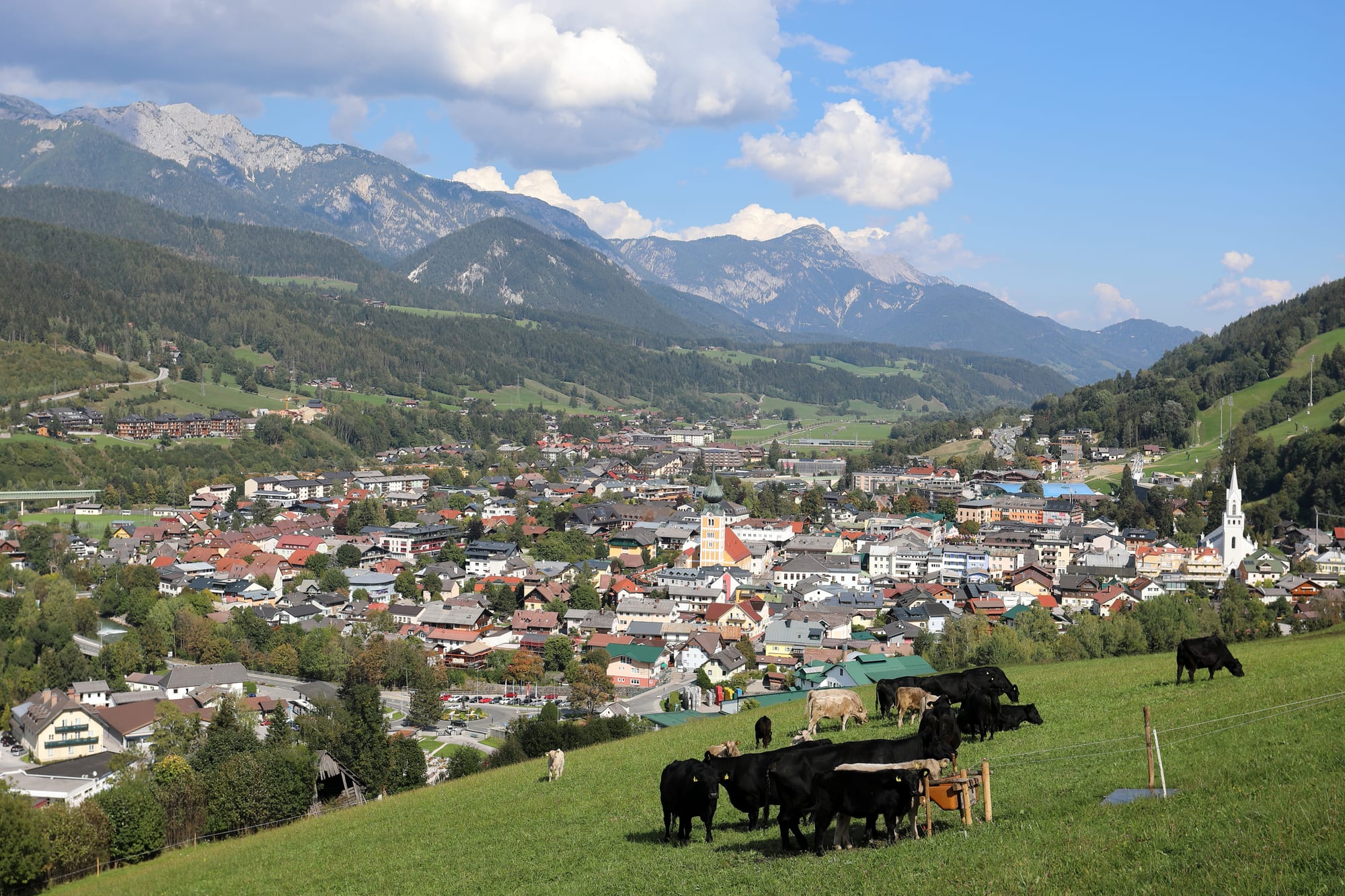
A valley town of red and grey roofs with two church towers, seen from a pasture with black cattle, beneath rocky peaks

Styria & Carinthia, Austria

Schladming

Schladming in the Enns valley, seen from the south-west. (C.Stadler/Bwag / Wikimedia Commons · CC BY-SA 4.0)

A small town in the upper Enns valley of north-western Styria, between the Dachstein massif to the north and the Schladming Tauern to the south. Silver, lead and copper mining made it a medieval mining town; today it is a large winter-sports resort, host of two Alpine World Ski Championships and an annual floodlit night slalom, and a base for summer hiking.

Neighbourhoods

  • Old town
    • First-time visitors
    • Historic district
    • Best for food

    The small centre where the Talbach meets the Enns, easily covered on foot. The Hauptplatz, the parish churches, the town hall in a former hunting lodge and the Salzburger Tor of 1629 sit among shops, cafés and restaurants.

    Open in Maps
  • Rohrmoos and Untertal
    • Skiing
    • Walks
    • Quiet and residential

    The former municipality of Rohrmoos-Untertal, merged into Schladming in 2015, with mountains to its south that were once mined for silver, nickel and zinc. The Alpine skiing and snowboard venues of the 2017 Special Olympics lay here.

    Open in Maps
  • Pichl
    • Skiing
    • Quiet and residential

    The former municipality of Pichl-Preunegg, also part of Schladming since 2015, a quieter base away from the old town.

    Open in Maps

Things to do

Ski mountains

  • Planaiattraction

    Schladming's main mountain, reached by a ten-seater cable car with a middle station, venue of the 2013 World Championships and a regular stop on the Alpine Ski World Cup since 1973.

    Open in Maps
  • Hochwurzenattraction

    The town's second ski mountain, with red runs suited to experienced skiers and boarders and a sledge run.

    Open in Maps
  • Reiteralmattraction

    One of the four connected mountains of the Schladminger 4-Berge-Schaukel, host of the 2019 Ski Cross Junior World Championships.

    Open in Maps
  • Hauser Kaiblingattraction

    One of the four linked ski mountains, above the village of Haus im Ennstal, which hosted the women's events of the 1982 World Championships.

    Open in Maps

The old town

  • Stadtmuseummuseum

    The town museum, in a building of 1661 that housed sick miners and the families of those killed in the mines, with displays on mining and on the peasant wars of the Reformation.

    Open in Maps
  • Rathaus (former Palais Coburg)landmark

    The town hall, built in 1884 as a hunting lodge for Prince August of Saxe-Coburg and Gotha and bought by the town in 1940.

    Open in Maps
  • Salzburger Torlandmark

    A gate of 1629, the surviving part of the old town fortifications.

    Open in Maps
  • Parish Church of St. Achatiuslandmark

    The Catholic town parish church in the centre; Schladming also has a Protestant parish church, a legacy of the Reformation in the valley.

    Open in Maps

Short trips from the town

  • Ramsau am Dachsteinattraction

    A village on the high plateau between the Dachstein range and the Enns valley, co-host with Schladming of the 2017 Special Olympics World Winter Games.

    Open in Maps
  • Dachstein Glacierviewpoint

    The glacier of the Dachstein massif between Ramsau and Hallstatt, with snow at its top all year round.

    Open in Maps
  • Hoher Dachsteinviewpoint

    At 2,995 metres the highest peak of the Dachstein massif and of both Styria and Upper Austria, dominated by glaciers when seen from the north.

    Open in Maps

Seasonal events

  • NightraceJanuary

    A men's World Cup slalom on the Planai, run at night under floodlights since 1997 and watched by about 50,000 spectators.

  • UCI Mountain Bike World Cupsummer

    A round of the mountain bike World Cup, held in Schladming since 2004.

Eat and drink

Long-standing places and food districts in Schladming. Hours, ratings and directions come from your maps app, always current.

Schladming classics

  • Gasthaus Brunnerrestaurant

    A traditional inn on the Hauptplatz, once a butcher's shop, serving regional Styrian cooking.

    Open in Maps
  • Mountain huts on the Planai and Hochwurzenneighborhood

    The mountain huts on the slopes, where skiers and hikers stop for lunch and Styrian dishes.

    Open in Maps
  • Old town restaurants and cafésneighborhood

    The many restaurants and cafés of the small old town around the Hauptplatz, where Schladminger beer from the town's own brewery is poured.

    Open in Maps

Experience Schladming

History

A settlement on the site is first recorded in 1180 under the name Slaebnich, which is of Slavic origin. In the early Middle Ages the area, like the rest of Styria, was settled by Alpine Slavs and belonged to the principality of Carantania; during German colonisation it gradually took on a Germanic character while keeping Slavic traces in its culture and language. Town rights are first documented in 1322, the product of a flourishing mining industry in the Schladming Tauern, where up to 1,500 miners worked. Silver, lead and copper were mined, and in 1408 the mining judge Leonhard Egkelzain set down the miners' rights and customs in the Schladminger Bergbrief.

The Reformation brought disaster. When the miners joined the peasant uprisings of 1524–1526 against the Salzburg authorities, Schladming was almost completely destroyed in 1525 under Archduke Ferdinand I and lost its town rights, which were restored only in 1925. In 1629 the Salzburger Tor was built into the town's fortifications, and in 1661 a house for sick miners and the families of miners killed underground went up; it is now the town museum. Mining, which had shaped the town for centuries, was gradually given up during the 19th century.

Tourism took its place. Prince August of Saxe-Coburg and Gotha built a hunting lodge here in 1884, which the town bought in 1940 and uses as its town hall. The Planai joined the World Cup circuit in 1973, and Schladming hosted the Alpine World Ski Championships in 1982 and 2013 and the Special Olympics World Winter Games in 1993 and 2017. On 1 January 2015 the neighbouring municipalities of Pichl-Preunegg and Rohrmoos-Untertal were merged with the town, despite an unsuccessful challenge in the Constitutional Court.

Culture & Customs

Skiing is the town's identity. The Planai has been a regular World Cup venue since 1973, and since 1997 its men's slalom has been run at night as the Nightrace, which draws about 50,000 spectators each January and fills the town. The Special Olympics World Winter Games of 2017 were shared with Ramsau am Dachstein and Graz. In summer the UCI Mountain Bike World Cup, held here since 2004, brings a different crowd.

The mining past and the peasant wars of the Reformation remain part of local memory, told in the town museum, and Schladming has both a Catholic town parish church and a Protestant parish church. Since 1977 the Mid Kultur festival, formerly the Schladminger Musiksommer, has offered concerts and master classes in July and August.

An unusual visitor has come every year since the 1960s: the Schladming Winter School for Theoretical Physics, whose lecturers have included Murray Gell-Mann, Sheldon Glashow and Abdus Salam. Locals know the participants as the "Kernphysiker", the nuclear physicists. Schladming is twinned with Felletin in France, Wetzlar in Germany and Furano in Japan.

Daily Life

About 6,600 people lived in the enlarged municipality at the start of 2026, making it the second-largest town in the Liezen district. It sits in the upper Enns valley where the Talbach joins the river, framed by the Dachstein to the north and the Low Tauern to the south, and the merger of 2015 added the scattered settlements of Rohrmoos, Untertal and Pichl to the old town.

Tourism is the most important part of the economy: the 2014–15 tourist year recorded about 1.5 million overnight stays, 56 per cent of them in winter, organised through the Schladming–Dachstein holiday region and the Ski amadé network. The year divides into two seasons, with the ski months the busier, and the town is full of ski schools and sports shops. Since 1974 it has also been a sports-school town, with a ski commercial school and a boarding house for its pupils.

In winter the town is crowded with skiers from home and abroad, and the rhythm of the day follows the lifts, and the old town fills in the evenings. Summer brings walkers, climbers and mountain bikers.

Food

A local speciality is Graukäse, a special kind of Steirerkas cheese, eaten on bread or with Nockerl. Traditional inns on the Hauptplatz serve regional Styrian cooking, and the mountain huts on the Planai and Hochwurzen feed skiers and hikers through the day; some take pride in serving higher-quality food rather than fast food.

Styria's wider kitchen is found here too. Kürbiskernöl, the oil pressed from roasted pumpkin seeds and protected in the EU as Steirisches Kürbiskernöl, dresses salads. Sterz, a crumbly dish such as Heidensterz made from buckwheat flour, was once typical poor people's food and is still often eaten by farmers and farm workers in Styria, and Verhackert, a spread of smoked, finely chopped bacon, is served on the cold platters of Styria's Buschenschanken alongside smoked meat, dried sausages and cheese.

The town has its own beer. The Schladminger brewery was founded in 1909 as the "Erste Alpenländische Volksbrauerei", and its beers are poured in the old town and on the slopes. As across Styria, Most, the fresh juice of apples or grapes, is made, and Sturm, a semi-fermented grape juice, is drunk after the grape harvest.

Planning tools

Budget

Schladming is one of the more expensive places in southern Austria in the ski season, when lift passes, equipment hire and rooms push up the bill. Summer is cheaper, and rooms in Pichl or Rohrmoos usually cost less than the centre.

Daily Budget Midrange
USD 180–300 (mid-range room, restaurant dinners, ski pass or summer lifts)
Daily Budget Shoestring
USD 90–140 (guesthouse or apartment, supermarket food, hut lunches; more with a lift pass)

Book rooms early for Nightrace week in January and the Christmas holidays; supermarkets keep self-catering costs down.

Best Time to Visit

December to March for skiing on the Planai and the linked mountains, with the Nightrace in January the busiest moment. June to September is the season for hiking, climbing, mountain biking and the summer lifts.

Suggested Number of Days

The town itself needs only a day, but most visitors come for a ski week or a walking holiday of five to seven days. Two or three days give a taste of the mountains; weather and snow conditions decide how much can be done.

First Visit
2–3 days
With Surroundings
5–7 days

Transportation

The old town is small and walkable. Lifts link the four ski mountains of the 4-Berge-Schaukel, and a bus runs up and down the Planai and the surrounding mountains all year. Schladming station lies on the Enns Valley Railway between Salzburg and Graz.

In winter, roads in the side valleys can be snowy or icy; the ski bus and lifts avoid the driving.

Airport & Station Connections

The nearest airport is Salzburg, roughly an hour away by car; Munich Airport is about 260 km away and Vienna about 300 km. Trains on the Enns Valley Railway reach Schladming in about one and a half hours from Salzburg, two hours forty minutes from Graz and a little over four hours from Vienna, and night trains run from Munich.

Walkability

The old town is compact and easy on foot. Rohrmoos, Untertal and Pichl are spread over the slopes and valleys and need the bus, a car or a long walk.

Safety

Austria is very safe, with low levels of violent crime. In Schladming the risks are the mountain ones: storms and rockfall in the Dachstein, avalanche danger off-piste in winter, and fast-changing weather on high trails.

Check avalanche and weather bulletins, stay on marked pistes and trails unless experienced, and tell someone the planned route before heading high. Check current official travel advice before travelling.

Climate

An Alpine valley climate. Summers are warm in the valley and cool on the mountains, with afternoon thunderstorms; winters are cold with reliable snow, and the high Dachstein carries snow for much of the year.

Summer
warm in the valleys of the region, often 25–32°C, with afternoon thunderstorms; much cooler on the peaks
Winter
cold, often -5 to 3°C in the valleys, with reliable snow in the mountains

Local Customs

A greeting on entering a shop, inn or mountain hut is expected, and on mountain trails walkers greet each other. Schladming has both Catholic and Protestant parishes. Shops close on Sundays.

Dress modestly in churches and keep voices low during services; follow piste and trail rules and give way to slower skiers below.

Common Payment Methods

The currency is the euro. Cards are widely accepted in shops, lift offices and most restaurants, but some mountain huts and small cafés prefer cash, and cash machines are found in the centre.