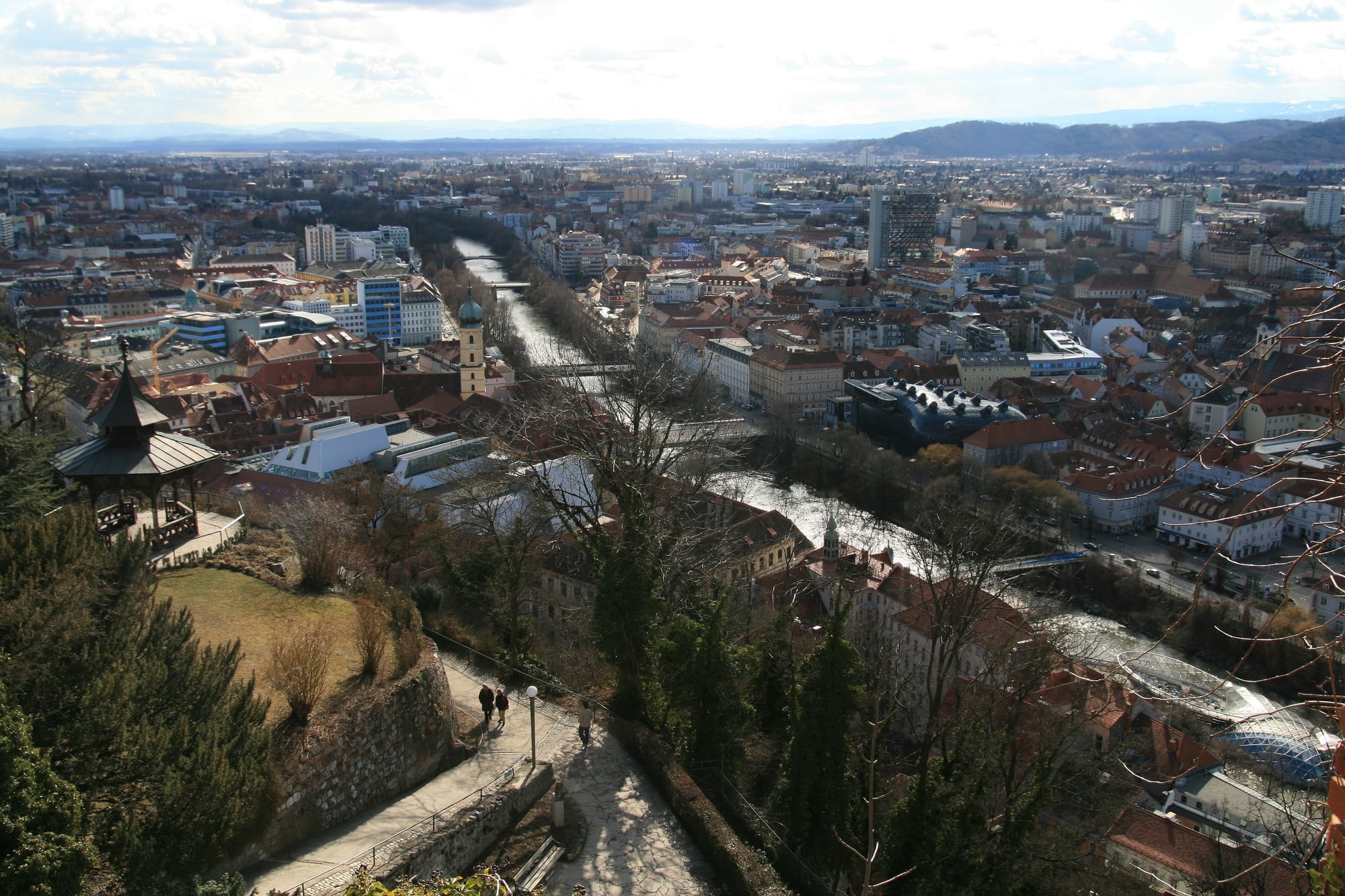
Red-roofed city spread along the River Mur seen from a wooded hill path with a small pavilion, low hills on the horizon

Styria & Carinthia, Austria

Graz

Graz seen south-west from the Schlossberg, with the River Mur, the Kunsthaus and the Murinsel. (Manfred Werner - Tsui / Wikimedia Commons · CC BY-SA 3.0)

Austria's second-largest city and the capital of Styria, on both banks of the Mur at the head of the Graz basin. A Habsburg residence and bulwark against the Ottomans, it keeps one of Central Europe's best-preserved old towns below the Schlossberg and its clock tower, and today is a university city of more than 60,000 students known for contemporary design and Styrian food.

Neighbourhoods

  • Innere Stadt
    • First-time visitors
    • Historic district
    • Close to public transport

    The first district, the heart of the UNESCO-listed old town between the Mur and the Stadtpark, holding the Schlossberg, the Hauptplatz and town hall, the Landhaus, the cathedral and the armoury. Its lanes and Renaissance courtyards are full of shops, cafés and bars.

    Open in Maps
  • Lend
    • Best for food
    • Nightlife
    • Arts and culture

    The district on the west bank across from the old town, with about 33,000 residents. Mariahilferstraße has design shops, retro furniture and bars, Lendplatz holds one of the city's two main farmers' markets, and the Mariahilf church and the Kalvarienberg are its landmarks.

    Open in Maps
  • Gries
    • Local life
    • Multicultural

    The district south of Lend on the west bank, an everyday residential neighbourhood around Griesplatz with its own one-day street festival each October.

    Open in Maps
  • Jakomini
    • Close to public transport
    • Students

    The most populous district, south-east of the old town, named after Kaspar Andreas von Jacomini. Jakominiplatz, where all tram lines meet, is the hub of the city's transport, and the Stadthalle and the University of Technology are here.

    Open in Maps
  • Geidorf
    • Quiet and residential
    • Students

    The third district, north of the old town and St. Leonhard, stretching from the Mur east to the university hospital, the largest hospital in Europe by surface area.

    Open in Maps

Things to do

Famous landmarks

  • Schlossberg and the Uhrturmviewpoint

    The hill above the old town, site of a fortress that never fell to the Ottomans and was demolished in 1809 — except the clock tower and bell tower, saved by a ransom paid by the citizens. The Uhrturm's large hand shows the hours.

    Open in Maps
  • Graz Cathedrallandmark

    A Gothic church whose surviving exterior frescoes include the Landplagenbild of 1485, showing the Turkish attack, locusts and pestilence that struck Graz in 1480 as divine punishment.

    Open in Maps
  • Mausoleum of Emperor Ferdinand IIlandmark

    Next to the cathedral, a Mannerist building holding the tombs of Ferdinand II and his wife Eleonore, together with St Catherine's Church.

    Open in Maps
  • Landhauslandmark

    The seat of the Styrian parliament, a Lombardic palace built in 1557–1565 by Domenico dell'Allio, one of the most important Renaissance buildings in Austria, with an arcaded courtyard.

    Open in Maps
  • Hauptplatz and the town halllandmark

    The main square at the centre of the old town, overlooked by the town hall and linked to Jakominiplatz by Herrengasse, where the Painted House is covered in frescoes of 1742.

    Open in Maps
  • Murinselattraction

    Vito Acconci's floating island in the Mur, built for the 2003 Capital of Culture year — a 47-metre shell holding a café, an amphitheatre and a playground, lit blue at night.

    Open in Maps

Museums

  • Eggenberg Palacemuseum

    The baroque palace on the western edge of the city, added to the World Heritage Site in 2010, with state rooms, the Old Gallery of art from the Middle Ages to the 18th century, a coin collection and a Roman lapidarium.

    Open in Maps
  • Styrian Armourymuseum

    The Landeszeughaus, preserved since 1551, the world's largest historic armoury, with some 32,000 pieces of weaponry and armour.

    Open in Maps
  • Kunsthaus Grazmuseum

    Peter Cook and Colin Fournier's blue, bulging contemporary art museum beside the Mur, nicknamed the Friendly Alien, opened for the 2003 Capital of Culture year.

    Open in Maps
  • Universalmuseum Joanneummuseum

    The museum group founded by Archduke Johann in 1811, with 12 locations including the history museum, the New Gallery of 19th- and 20th-century art and the natural history museum.

    Open in Maps

Parks, churches and the river

  • Stadtparkpark

    The city park in the Innere Stadt, beside the old town, home of the Forum Stadtpark contemporary art space.

    Open in Maps
  • Mariatrost Basilicalandmark

    A baroque pilgrimage church on the Purberg hill in the north-east of Graz, with two towers and a dome visible from far away.

    Open in Maps
  • Graz Operaattraction

    The second-largest opera house in Austria, staging opera, ballet and operetta.

    Open in Maps

Markets

  • Kaiser-Josef-Platz marketmarket

    The open-air farmers' market opposite the opera house, where small farmers from around Graz sell fruit, vegetables and Styrian pumpkin-seed oil.

    Open in Maps
  • Lendplatz marketmarket

    The other main farmers' market of Graz, on the west bank in Lend.

    Open in Maps

Short trips from the city

  • Schöcklviewpoint

    The mountain about 14 km north of the city, rising to 1,445 metres, with a cable car to the summit from St. Radegund.

    Open in Maps
  • Lurgrotteattraction

    The largest cave in the Eastern Alps of Styria, north of Graz, with a great hall that is one of Central Europe's largest underground rooms.

    Open in Maps

Seasonal events

  • LendwirbelMay

    A large free street festival in Lend lasting several days, with live music, DJs, workshops, art installations and political discussions.

  • AufsteirernSeptember

    A Styrian folk festival that fills Graz each September.

  • Steirischer Herbstautumn

    The avant-garde arts festival whose name means 'Styrian Autumn'.

  • GrieskramOctober

    A one-day free street festival in Gries, with live bands, DJs, street food and a flea market.

Eat and drink

Long-standing places and food districts in Graz. Hours, ratings and directions come from your maps app, always current.

Graz classics

  • Kaiser-Josef-Platz farmers' marketmarket

    Fruit, vegetables and pumpkin-seed oil from the farms around Graz, sold by the growers themselves opposite the opera house.

    Open in Maps
  • Lendplatz farmers' marketmarket

    The west bank's farmers' market, a good place to buy Kürbiskernöl of protected-origin quality.

    Open in Maps
  • Schlossberg caféscafe

    A café beside the Uhrturm looks over the old-town roofs, and a hilltop restaurant by the funicular terminus faces western Graz.

    Open in Maps

Food districts and bars

  • Mariahilferstraße and Lendneighborhood

    Bars, cafés and restaurants among the design shops of Lend, with a mixed crowd.

    Open in Maps
  • University quarterneighborhood

    Student pubs and cafés around the Karl-Franzens University, busy late into the night.

    Open in Maps

Experience Graz

History

The name most likely comes from the Slavic gradec, "small castle", after a fort built by Alpine Slavs, but the town itself was founded by Bavarian settlers and first appears in records in 1128. Under the Babenbergs it became a commercial centre in the 12th century, and the Habsburgs granted it privileges in 1281. From the 15th century it was the residence of a younger Habsburg line, and the capital of Inner Austria, ruling Styria, Carinthia, most of today's Slovenia and parts of today's Italy. Italian architects shaped the city: Domenico dell'Allio built the Landhaus in 1557–1565, Archduke Karl II founded the university in 1585, and Johannes Kepler taught here from 1594 until Protestants were banned in 1600.

Graz stood on the frontier. Matthias Corvinus's Hungarians came in 1481 and the Ottomans in 1529 and 1532, but the Schlossberg fortress never fell, and the armoury has kept its weapons since 1551. When Ferdinand II became emperor in 1619 he moved the court to Vienna. Napoleon's troops occupied the city in 1797; in 1809 the fortress held out until the emperor ordered surrender, after which it was blown up, leaving only the clock and bell towers the citizens had ransomed.

Industrialisation and urban growth made Graz a major industrial, educational and cultural centre of southern Austria in the 19th and 20th centuries; Archduke Franz Ferdinand was born here. On 2 April 1945, during the heaviest Allied air raid, the Gestapo and Waffen-SS murdered resistance fighters, Hungarian Jewish forced labourers and prisoners of war at the Wetzelsdorf barracks. The old town became a UNESCO World Heritage Site in 1999, Eggenberg Palace was added in 2010, and Graz was European Capital of Culture in 2003.

Culture & Customs

Graz pairs one of Central Europe's best-preserved old towns with a taste for the contemporary. The Capital of Culture year left the Kunsthaus — the "Friendly Alien" — and the Murinsel, the Graz School of architecture had already put experimental buildings around the universities, and in 2011 the city joined UNESCO's network as a City of Design. The Steirischer Herbst festival brings avant-garde art every autumn, and the Styriarte classical festival was founded in 1985 around the conductor Nikolaus Harnoncourt.

Science runs deep: Ludwig Boltzmann taught here, Nikola Tesla studied at the polytechnic, Otto Loewi taught at the university, and Erwin Schrödinger was briefly its chancellor. The city was also a centre of Slovene culture — the first Slovene Catholic book was published here in 1574.

Locals call their dialect Steirisch and take pride in it. The Aufsteirern folk festival, a showcase for folk dance, costume and music, sits alongside a young street culture of festivals such as Lendwirbel and Grieskram. Football divides the city between SK Sturm Graz, several times Austrian champions, and the old rival Grazer AK, while the Graz 99ers play top-flight ice hockey.

Daily Life

Graz had about 308,000 residents with a main home in the city on 1 January 2026, and around 660,000 lived in its functional urban area in 2023. About 70 per cent of residents are Austrian citizens. With four universities and four other colleges, the city had more than 63,000 students in 2023, and their presence is felt in the cafés, bars and housing market.

The economy mixes cars, engineering and research — Magna Steyr assembles vehicles for other brands here — with the universities, the large university hospital, government and congresses. Tourism has grown since the World Heritage listing; after the pandemic, leisure and culture became the largest share of overnight stays, ahead of business travel.

People live across 17 districts, from the old-town Innere Stadt to the populous Jakomini and Lend and the quieter hillside suburbs. Politics stand out: the Communist Party (KPÖ) under Elke Kahr became the largest party in 2021, she was elected mayor that November, and in June 2026 the party won almost 36 per cent of the vote. A two-line metro was proposed in 2021, and the Koralm railway, fully opened on 14 December 2025, links the city with Klagenfurt.

Food

Graz was named Austria's Capital of Culinary Delights, the GenussHauptstadt, for its place at the centre of a rich farming and wine region. Styria's signature product is Kürbiskernöl, a dark green oil pressed from roasted pumpkin seeds that holds EU protected status as Steirisches Kürbiskernöl and suits salads particularly well for its nutty flavour. The Grazer Krauthäuptel, a butterhead lettuce introduced from Carniola in the early 20th century, is the city's own salad leaf.

Heidensterz, a dry, almost crumbly buckwheat dish, is eaten in cold weather, and the Brettljause of a Buschenschank — the taverns where local winemakers serve their new wine — brings cold meats on a wooden board and Verhackertes, a spread of finely chopped raw white bacon. West Styria makes Schilcher, a very dry rosé from the indigenous Blauer Wildbacher grape, and Sturm, a semi-fermented grape juice, is drunk after the grape harvest.

The two farmers' markets on Kaiser-Josef-Platz and Lendplatz are where locals buy produce and oil, and the bars and cafés of the old town, Lend and the university quarter fill with students late into the evening.

Planning tools

Budget

Graz is one of Austria's better-value cities: the student population keeps plenty of food and drink cheap, and hotels cost less than in Vienna or Salzburg. Prices rise for big congresses and festivals. A day pass for the trams covers most needs.

Daily Budget Midrange
USD 140–240 (mid-range hotel, restaurant dinners, museum entries, a day trip to the wine roads)
Daily Budget Shoestring
USD 70–120 (hostel bed, market and bakery food, student cafés, a day ticket for trams and buses)

Buy pumpkin-seed oil and picnic food at the farmers' markets rather than in shops around the old town.

Best Time to Visit

Graz is pleasant at any time. Spring and summer bring street festivals and café life on the squares; September and October are the high season for the Styrian wine roads to the south, with the harvest and Sturm, the new wine. Winters are cold, sometimes foggy, but the city is less crowded.

Suggested Number of Days

Two or three days cover the old town, the hill and the main museums. Allow four to six to add the wine and spa country to the south and east and the valleys to the north.

First Visit
2–3 days
With Surroundings
4–6 days

Transportation

An extensive network makes Graz easy without a car. Six tram lines and a comprehensive bus network meet at Jakominiplatz, four lines run through the underground stop at the main station, and night buses run at weekends and before public holidays. The Schlossberg has a funicular and a lift from the old town, and the Styria S-Bahn links the suburbs and nearby towns.

Cycling is a good way round the flat centre and the river paths; the tourist office and the station's cycle centre hand out maps.

Airport & Station Connections

Graz Airport is about 9 km south of the centre, a few minutes' walk from its own railway station and also linked to the city by bus. Trains leave for Vienna every hour, taking about two and a half hours, and direct services reach Salzburg, Innsbruck, Ljubljana, Zagreb, Budapest, Prague and Zürich. The Koralm railway, fully opened on 14 December 2025, links Graz with Klagenfurt in Carinthia. Maribor in Slovenia is about 50 km south.

Walkability

The old town is compact and best seen on foot, with Herrengasse linking the Hauptplatz to Jakominiplatz and bridges and the Murinsel crossing to Lend. The Schlossberg is a steep climb by steps, or a ride by funicular or lift. Eggenberg Palace, Mariatrost and the outer districts are a tram ride away.

Safety

Austria is very safe, with low levels of violent crime. Graz is a calm city, with busy nightlife around the old town and the university. Outside the city, the narrow, steep lanes of the wine hills are the greater hazard, where drink-driving after tastings is a real risk.

Watch bags in crowded bars and on night buses, and arrange a lift or taxi after wine tastings. Check current official travel advice before travelling.

Climate

Shielded by the Alps from Atlantic weather and open only to the south, Graz is warmer than its latitude suggests, with more sunshine and less wind and rain than Vienna or Salzburg — about 2,000 hours of sun and roughly 820 mm of rain a year. The average annual temperature is about 9°C.

Summer
warm to hot; across the valleys of southern Austria days typically reach 25–32°C, with afternoon thunderstorms
Winter
cold, with valley temperatures across the south often between -5 and 3°C and fog in the basins

Local Customs

Tipping is expected in restaurants and cafés: rounding the bill up to the next euro or so is usual, and nothing is added at counters or street stalls. Most shops close on Sundays. Locals speak Steirisch, the Styrian form of Bavarian dialect, and are proud of it.

Give the tip when paying rather than leaving it on the table.

Common Payment Methods

Austria uses the euro. Cards and contactless are accepted in most places, but small cafés, bakeries and market stalls often prefer or require cash.