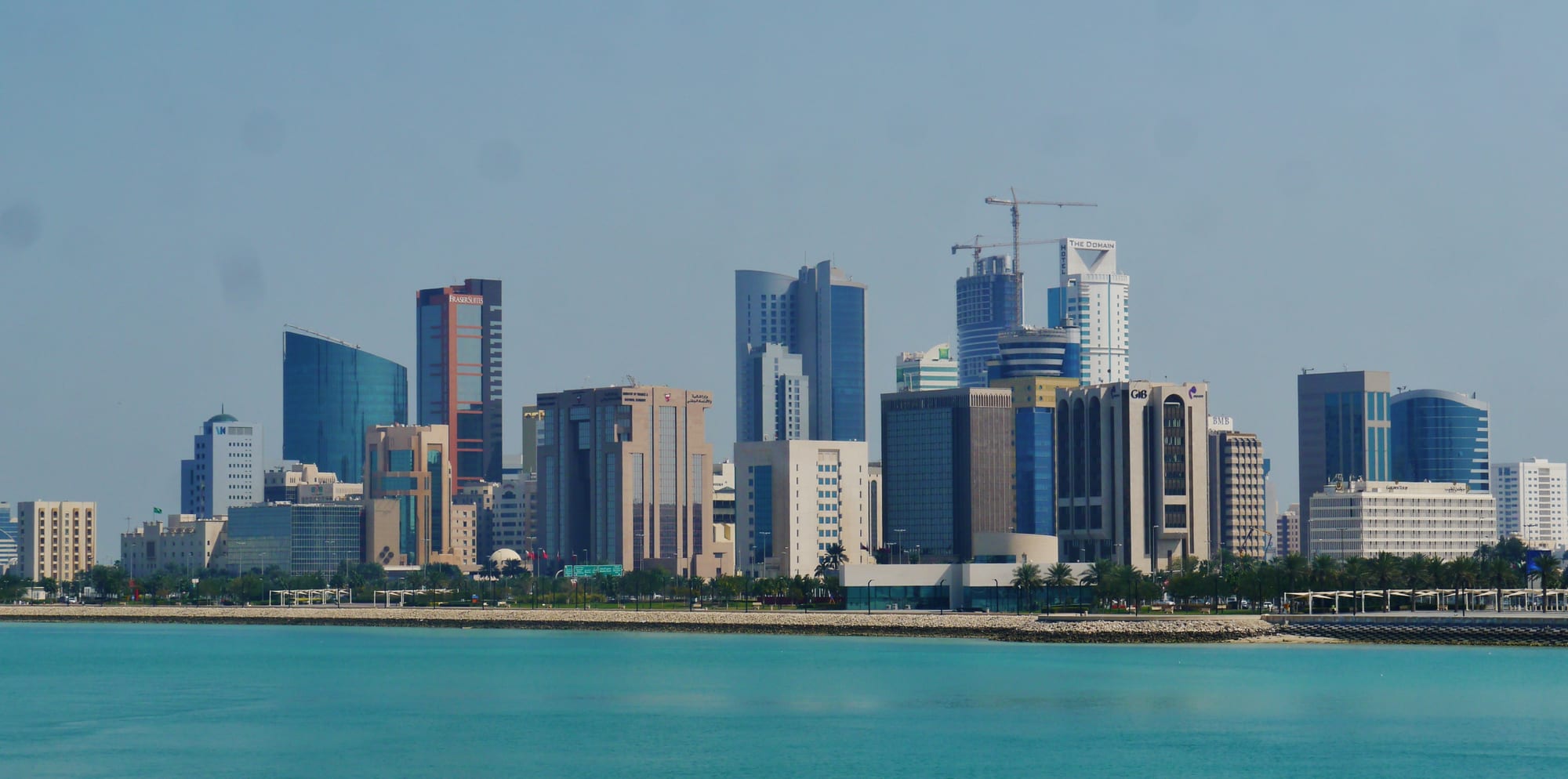
The Manama skyline of glass and stone towers seen across turquoise Gulf water, with a low stone breakwater along the shore

Bahrain

Manama

The Manama skyline seen from the water, with the towers of the business district along the shore. (Zairon / Wikimedia Commons · CC BY-SA 4.0)

Bahrain's capital and largest city, on the north-east shore of the main island. A pearling and trading port that grew into one of the Gulf's financial centres after oil arrived in the 1930s, it now spreads over reclaimed land in a mix of low old souq lanes, glass towers on the waterfront, and mosques, malls and restaurant streets serving a largely expatriate population.

Neighbourhoods

  • Manama Souq and Bab Al Bahrain
    • First-time visitors
    • Historic district
    • Markets

    The old commercial core just inland from the original waterfront, entered through the Bab Al Bahrain arch. Narrow lanes hold gold shops, spice and textile traders, tailors, cafeterias and small mosques, and the crowd is largely Indian, Bangladeshi and Bahraini rather than touristic.

    Open in Maps
  • Diplomatic Area
    • Business
    • Close to public transport
    • Waterfront

    The banking and embassy district built on reclaimed land north of the souq, with the Bahrain World Trade Center, the Financial Harbour towers and many of the city's larger hotels. It is functional rather than charming, but close to everything and easy to reach.

    Open in Maps
  • Seef
    • Shopping
    • Families
    • Hotels

    A district of malls, hotels and offices on reclaimed land west of the centre, where much of the city shops and spends summer evenings indoors. The Bahrain Fort and the north-west coast are a short drive further on.

    Open in Maps
  • Adliya
    • Best for food
    • Nightlife
    • Art and galleries

    A low-rise older quarter south of the centre that holds most of Manama's independent restaurants, cafés and galleries, clustered around the walkable lanes known as Block 338. It is the part of the city people go to in the evening rather than to sleep.

    Open in Maps
  • Juffair
    • Hotels
    • Nightlife
    • Close to the sea

    A dense grid of apartment towers, hotels and bars on reclaimed land east of the centre, next to the naval base that hosts the United States Fifth Fleet. Popular with short-stay visitors and with Saudi weekenders for its restaurants and nightlife.

    Open in Maps
  • Hoora
    • Nightlife
    • Close to public transport

    A busy district between the souq and the Diplomatic Area, known for hotel bars, clubs and late-night cafés along Exhibition Avenue, and for cheap eating places serving the city's workers.

    Open in Maps

Things to do

Famous landmarks

  • Bab Al Bahrainlandmark

    The 1949 arched gateway that once stood on the shoreline and now marks the entrance to the souq, built as a customs and government building and later given an Islamic-style facade.

    Open in Maps
  • Al Fateh Grand Mosquelandmark

    One of the largest mosques in the country, built in 1987, with a dome made entirely of fibreglass and Italian marble underfoot, and open to non-Muslim visitors with guides who explain Islam and Bahraini custom.

    Open in Maps
  • Bahrain World Trade Centerlandmark

    Twin sail-shaped towers joined by three bridges, each carrying a wind turbine — among the first skyscrapers in the world to build turbines into the structure.

    Open in Maps
  • Bahrain Financial Harbourlandmark

    A pair of curved towers on reclaimed land at the waterfront, built as the centrepiece of Manama's banking district.

    Open in Maps

Museums and culture

  • Bahrain National Museummuseum

    The oldest national museum in the Gulf, opened in 1988, covering Dilmun archaeology, the pearl trade, burial mounds, manuscripts and traditional daily life.

    Open in Maps
  • Beit Al Quranmuseum

    A museum and library devoted to Qur'anic manuscripts, holding copies from across the Islamic world on parchment, paper and even a grain of rice.

    Open in Maps
  • Bahrain National Theatreattraction

    A waterfront theatre opened in 2012 beside the National Museum, seating just over a thousand in its main auditorium, with a programme of concerts and drama.

    Open in Maps
  • Al Khamis Mosquelandmark

    The twin-minaret ruins of one of the oldest mosques in the region, on the edge of the capital, with foundations dating from the early Islamic centuries.

    Open in Maps

Markets and streets

  • Manama Souqmarket

    The old market behind Bab Al Bahrain, with a gold quarter, spice and perfume sellers, fabric shops and cafeterias along lanes that were the city's original commercial centre.

    Open in Maps

Short trips from the city

  • Qal'at al-Bahrainlandmark

    The Bahrain Fort, a UNESCO World Heritage Site inscribed in 2005, standing on a tell that holds more than four thousand years of occupation and was the capital of ancient Dilmun; a modern museum sits beside it, about 7 km west of the centre.

    Open in Maps
  • Pearling, Testimony of an Island Economyattraction

    The Pearling Path in Muharraq, inscribed by UNESCO in 2012 — a walking route linking merchant houses, warehouses, a fort and oyster beds that tells the story of the pearl economy, just across the causeway.

    Open in Maps
  • Tree of Lifelandmark

    A lone mesquite reckoned to be more than four hundred years old, standing in open desert in the south of the island with no obvious source of water.

    Open in Maps
  • Dilmun Burial Moundslandmark

    Tens of thousands of low earth mounds from the Dilmun period, the best known at A'ali; several fields are inscribed as a UNESCO World Heritage Site.

    Open in Maps
  • Arad Fortlandmark

    A small square fort with corner towers on Muharraq island, built in the typical style of Islamic forts in the fifteenth century, before the Portuguese invasion, and restored with coral stone, lime and tree trunks.

    Open in Maps
  • Barbar Templelandmark

    The excavated remains of three Bronze Age temples built one above the other, associated with Dilmun and with a spring reached by stone steps, on the north coast.

    Open in Maps
  • Bahrain International Circuitattraction

    The motor-racing circuit at Sakhir in the desert south of the capital, about 23 km away, which has hosted the Bahrain Grand Prix since 2004 and has six separate tracks, including a test oval and a drag strip.

    Open in Maps
  • Al Areen Wildlife Parkpark

    A reserve and breeding centre in the south-west of the island for Arabian oryx, gazelles and other desert species, reached by road in under an hour.

    Open in Maps

Seasonal events

  • Ashurathe month of Muharram, moving through the Islamic calendar

    Bahrain's large Shia population marks the mourning of Husayn with black banners, night processions and public food distribution in Manama and the surrounding villages.

  • Ramadan and Eid al-Fitrthe ninth Islamic month and the days after it

    Daytime eating and drinking in public stop, restaurants open after sunset, and majlis tents, late shopping and family visits fill the nights.

  • Bahrain National Daymid-December

    The national holiday on 16 December, which marks the accession of Emir Isa bin Salman Al Khalifa, with flags, fireworks and public events across the capital.

  • Bahrain Grand Prixspring

    The Formula One race at the Sakhir circuit south of the city, run since 2004, which fills Manama's hotels when it is held. The 2026 race was cancelled in Bahrain and rescheduled at Sepang in Malaysia.

Eat and drink

Long-standing places and food districts in Manama. Hours, ratings and directions come from your maps app, always current.

Manama classics

  • Machboos and Gulf seafoodrestaurant

    Spiced rice with fish or meat is the national dish, served with grilled hamour and safi from the Gulf; traditional Bahraini restaurants around the centre cook it alongside tomato-tamarind fish stews and flatbread from the tannour oven.

    Open in Maps
  • Karak tea cafeteriascafe

    Small roadside cafeterias across the city sell strong, milky, cardamom-scented karak tea day and night, usually with a samboosa or an egg sandwich, and much of Manama stops at one at some point in the day.

    Open in Maps

Food districts and markets

  • Manama Souqmarket

    Spice and nut sellers, date shops, halwa stalls and cheap South Asian and Bahraini cafeterias fill the lanes behind Bab Al Bahrain.

    Open in Maps
  • Block 338, Adliyaneighborhood

    A walkable cluster of independent restaurants, cafés and galleries in a low-rise quarter, covering Bahraini, Levantine, Indian, Japanese and Italian cooking in a few streets.

    Open in Maps
  • Juffair restaurantsneighborhood

    Dense blocks of international chains, shisha lounges, grill houses and bars serving hotel guests, residents and weekend visitors from Saudi Arabia.

    Open in Maps

Experience Manama

History

Manama appears in Islamic chronicles by the middle of the fourteenth century, a small port on the northern shore where fresh springs met a sheltered anchorage. The Portuguese took the islands in 1521 and built at nearby Qal'at al-Bahrain; Persian rule followed early in the seventeenth century, and in 1783 the Al Khalifa family crossed from the Arabian mainland and took control. Manama grew as their commercial town while the ruling family long kept its seat on Muharraq across the water.

Pearls made the modern city. Through the nineteenth century Manama handled the Gulf's pearl trade and the re-export business that came with it, drawing Persian, Indian, Jewish and Arab merchants whose houses and warehouses still stand in the lanes behind the waterfront. Treaties with Britain from 1820 onwards brought a political agency and a measure of order; a customs administration was reorganised in the 1920s, and the port's free-trading habits date from that period.

The pearl trade collapsed in the early 1930s under competition from Japanese cultured pearls and the Great Depression, just as oil was struck at Jebel Dukhan in 1932 — the first strike on the Arabian side of the Gulf. Oil revenue paid for roads, schools, a deepwater harbour and, from the 1970s, a banking sector that made Manama one of the Gulf's leading financial centres. Reclamation pushed the shoreline far out into the bay, so that Bab Al Bahrain, once a customs house at the water's edge, now stands well inland. The capital was also the focus of the large protests of 2011, centred on the Pearl Roundabout, which were put down and the monument demolished.

Culture & Customs

Manama is the most cosmopolitan city on the Arabian side of the Gulf, and has been for a century. Roughly half of Bahrain's residents are foreign workers, and the capital is where that shows most: Malayalam, Urdu, Tagalog, Bengali and English are heard as often as Arabic, and Hindu temples and churches stand within a short walk of mosques in and around the old centre. Shia and Sunni Muslims live in the same city, and Ashura processions through the streets each Muharram are among its most visible public occasions.

Pearl-diving heritage runs through local identity — the fidjeri work chants sung by divers' crews, dhow building, and the museums and restored houses that record it. Majlis hospitality, in which guests are received with cardamom coffee and dates, remains the basic social form, and Ramadan and the two Eids shape the calendar more than anything else.

The city is also comparatively liberal by regional standards. Cinemas, art galleries and licensed bars operate openly, women drive and work throughout the economy, and weekend crowds come across the causeway from Saudi Arabia for restaurants and entertainment. Visitors are still expected to dress modestly in public, to avoid eating in daylight during Ramadan, and to treat religion and the ruling family as subjects for respect rather than debate.

Daily Life

Manama itself has something over 700,000 residents, and most of Bahrain's roughly 1.6 million people live in the continuous built-up area that runs from the capital west to Seef and east across the causeway to Muharraq. Housing spreads over reclaimed land, and new towers keep rising at Bahrain Bay and along the Financial Harbour while the older souq blocks stay low, crowded and cheap.

The working week runs Sunday to Thursday. Banking, insurance, government, retail and hospitality dominate employment in the capital, with heavy industry — the aluminium smelter, the refinery — placed elsewhere on the island. In summer the day splits in two, with errands done early and social life resuming after dark in malls, restaurants and parks. Friday is quiet until after midday prayers.

Everyday concerns are the cost of imported goods, housing pressure, traffic, and, for many Bahrainis, the sectarian tilt of public-sector hiring. Migrant workers from South Asia and the Philippines make up a large share of the workforce and live mainly in the older central districts. The causeway to Saudi Arabia works as a social artery in both directions, and its weekend queues are a fixed part of the city's rhythm.

Food

Manama eats Gulf food with strong Persian and South Asian accents. Machboos — spiced rice cooked with fish or meat, close to a biryani — is the national dish, and ghoozi, whole roast lamb over rice, is the feast version. Gulf seafood is central: hamour, which is grouper, and safi, or rabbitfish, grilled whole or stewed with tomato and tamarind, alongside the local prawns. Flatbread comes straight from the tannour, a clay oven whose walls the dough is slapped against.

Balaleet, sweet vermicelli under a thin omelette, is a standard breakfast; samboosa are the usual iftar snack during Ramadan, when harees and thareed reappear on tables. The city's best-known sweet is halwa Bahraini, a dense, chewy, translucent paste flavoured with saffron and rosewater and studded with nuts, made in long-established shops in Muharraq and sold across the souq.

The everyday drink is karak: strong tea boiled with milk, sugar and cardamom, sold for small change at roadside cafeterias at any hour. Indian, Filipino, Lebanese, Iranian and Yemeni restaurants are as much a part of the city's food as Bahraini cooking, and Adliya's restaurant streets add a further layer of international kitchens. Alcohol is served in licensed hotels and restaurants but is not sold in ordinary shops.

Planning tools

Budget

Manama is mid-range to expensive by Gulf standards, cheaper than Dubai or Doha but not a budget city. Hotel rooms and taxis are the main costs, while cafeteria food, fuel and the souq are cheap. Prices and availability tighten around large international events and on weekends, when visitors arrive from Saudi Arabia.

Daily Budget Midrange
USD 130–260 (4-star hotel, restaurants, car hire, sightseeing)
Daily Budget Shoestring
USD 60–100 (simple hotel, cafeteria food, buses and shared taxis)

Sunday to Thursday is the working week, and hotel rates are usually lower then than on Friday and Saturday nights.

Best Time to Visit

November to March, and especially December to February, when walking the souq, the forts and Muharraq is comfortable. From May to September the heat and humidity confine most activity to air-conditioned spaces and the early morning. During Ramadan daytime cafés and restaurants largely close and eating in public is not done.

Suggested Number of Days

Two days cover the capital itself. Three or four take in the rest of the island, which is small enough to cross in an hour. Summer heat slows everything down and adds time; Ramadan changes opening hours.

First Visit
2 days
With Surroundings
3–4 days

Transportation

Metered taxis and ride-hailing apps are how most visitors move around, and car hire is cheap on good roads. A public bus network links the main districts but is slow and little used by visitors. There is no passenger rail. Distances are short — most of the capital is within twenty minutes of the centre outside rush hour.

Traffic is fast and assertive, and ride-hailing apps are usually the simplest option; the King Fahd Causeway to Saudi Arabia can queue for hours on weekend evenings.

Airport & Station Connections

Bahrain International Airport sits on Muharraq island about 7 km from the centre, roughly fifteen to twenty minutes by road across the causeway, and is the hub of Gulf Air. Many arrivals instead come overland from Saudi Arabia on the 25 km King Fahd Causeway, which carries a heavy weekend flow of cars.

Walkability

The souq, Bab Al Bahrain and the streets around them are best seen on foot, and Adliya's Block 338 is walkable in the evening. Beyond that the city is built for cars: wide roads, long blocks, reclaimed land and few shaded pavements. From May to September walking outside in the middle of the day is unpleasant and can be dangerous.

Safety

Crime is low and the central districts are safe day and night. Two wider caveats apply. The first is regional: since February 2026 the United States and Israel have been at war with Iran, Iranian missile and drone strikes have hit targets in Bahrain causing material damage and civilian casualties, and Bahrain has taken part in strikes on Iran; the war is ongoing. The second is political: occasional unrest and clashes between protesters and police flare in the Shia villages ringing Manama, away from the hotel and business districts, particularly around the Ashura period and political anniversaries.

Avoid demonstrations and village flashpoints, don't photograph protests or security forces, and take the summer heat seriously. Check current official travel advice before travelling.

Climate

Hot desert, with the sea adding humidity rather than relief. Rain falls only in small amounts between December and March. The dusty shamal wind blows from the north-west and can cut visibility for a day or two at a time.

Summer
May to October is extreme — daytime highs of 40°C and above, high humidity off the Gulf, and warm nights
Winter
December to February is mild and pleasant at about 15–20°C, with the occasional shower

Local Customs

Bahrain is more relaxed than most of its neighbours, but it is a Muslim country. Modest dress covering shoulders and knees is expected away from hotel pools and beaches, and headscarves are provided at the Al Fateh Grand Mosque. Alcohol is legally served in licensed hotels, bars and restaurants but not in ordinary shops and cafés. Greetings are unhurried, the right hand is used for eating and giving, and hospitality is offered readily.

Tipping is not obligatory but small amounts are appreciated; ask before photographing people, and never photograph military sites or security forces. During Ramadan do not eat, drink or smoke in public in daylight.

Common Payment Methods

The currency is the Bahraini dinar, pegged to the US dollar and divided into 1,000 fils, so small prices are written in fils and can confuse at first. Cards and contactless payment work almost everywhere; ATMs are common. Cash is still useful in the souq, in cafeterias and for taxis.