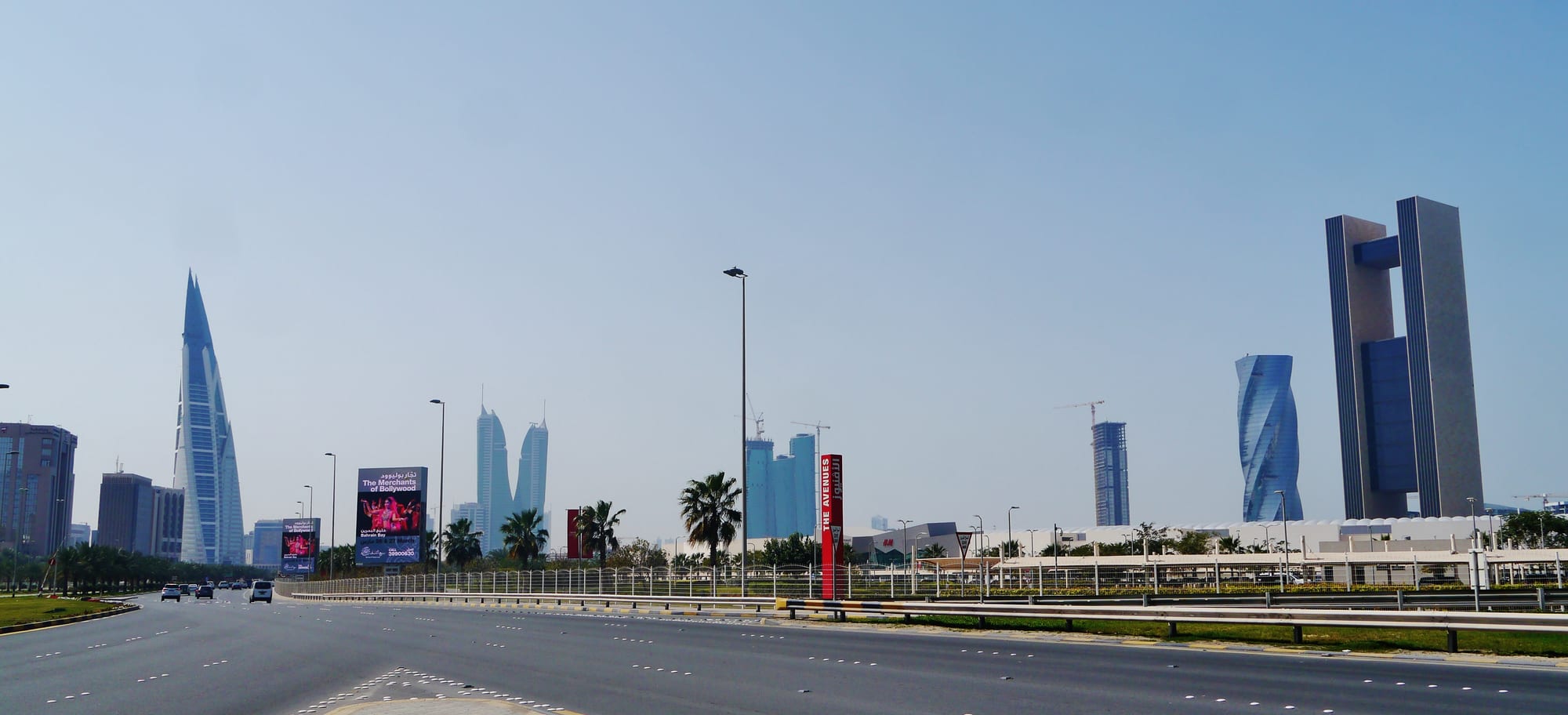
The Manama waterfront skyline with the twin sail-shaped towers of the Bahrain World Trade Center among glass high-rises

Bahrain

The Manama skyline, with the Bahrain World Trade Center's wind-turbine-bearing towers at its centre. (Zairon / Wikimedia Commons · CC BY-SA 4.0)

A small, densely built island kingdom in the Persian Gulf — the site of ancient Dilmun, a former pearling centre, the first place on the Arabian side of the Gulf to strike oil, and now a banking and refining hub linked to Saudi Arabia by causeway.

Explore Bahrain

History

Bahrain is the heartland of Dilmun, a Bronze Age trading civilisation that linked Mesopotamia and the Indus Valley and appears in Sumerian myth as a garden paradise. The great tell at Qal'at al-Bahrain holds more than four thousand years of occupation, and thousands of Dilmun burial mounds still dot the island.

For millennia the economy rested on natural pearls from the Gulf oyster beds. The trade made Bahrain famous and, at times, wealthy, until Japanese cultured pearls and the Great Depression collapsed it in the early 1930s — just as oil was discovered, the first strike on the Arabian side of the Gulf, in 1932. The Al Khalifa family, who took the islands in 1783, ruled under British protection from the nineteenth century until independence in 1971.

Modest oil reserves pushed Bahrain to diversify early into banking, aluminium smelting, and refining Saudi crude. Shia and Sunni Muslims are present in roughly equal numbers — the Shia were long the majority, though recent estimates put Sunnis marginally ahead — while the ruling family and establishment are Sunni, and that divide drove large Arab Spring protests in 2011, centred on Manama's Pearl Roundabout. They were put down with Saudi troops and Emirati police sent under the Gulf Cooperation Council's Peninsula Shield Force; the Pearl Monument was demolished and the main opposition society was dissolved in 2016. Bahrain hosts the US Navy's Fifth Fleet and normalised relations with Israel under the Abraham Accords in 2020. Since February 2026 it has been drawn into the war between Iran and the United States and Israel, taking Iranian strikes on its territory and joining retaliatory strikes on Iran in July 2026.

  • Bahrain: Dilmun, Pearls, and Oil — An ancient trading island in the Gulf — the sacred land of Dilmun, a pearling power, the first place on the Arab side of the Gulf to strike oil, and a divided modern kingdom

Culture & Customs

Bahrain is Gulf Arab but noticeably more relaxed and cosmopolitan than most of its neighbours, the legacy of a long merchant and pearling history and a large expatriate population. Alcohol is legally served, there are cinemas and a broad restaurant scene, and weekend visitors pour across the causeway from Saudi Arabia.

Pearl-diving heritage is a strong thread of identity, kept alive in songs, the fidjeri work chants, and the old pearling dhows. Majlis hospitality — receiving guests with cardamom coffee and dates — Ramadan, and the two Eids structure the year. Ashura is marked publicly with processions and black banners in Manama and the villages.

Dress is smart but not severe; visitors dress modestly away from hotel pools and beaches. Formula 1 is the country's biggest international event, run at the Sakhir circuit since 2004, though the 2026 Grand Prix was cancelled because of the war with Iran and rehoused at Sepang in Malaysia.

  • Bahrain: The Open Majlis — Doors thrown open on Ramadan nights, coffee that is never refused, songs first sung by pearl divers, and a Gulf society that pairs deep religious observance with a merchant's ease among strangers

Daily Life

Roughly half of Bahrain's residents are foreign workers — Indian, Filipino, other Arab, Western — and daily life reflects that mix, from the languages on the street to the food courts and places of worship. Most people live in and around Manama and the built-up northern third of the island; the south is desert, with the oil field and large tracts of restricted land.

Work follows the Gulf pattern, with an early-morning, late-evening rhythm in summer to avoid the heat. The cost of imported goods, housing pressure, and — for many Bahrainis — the sectarian tilt of public-sector hiring are everyday concerns.

The King Fahd Causeway is a social and economic artery: Bahrainis shop and work in both directions, and Saudi families arrive each weekend for the restaurants, hotels, and comparative freedoms.

  • Bahrain: The Weekend That Crosses the Causeway — A country small enough to cross in about an hour, where roughly half the people living there are foreign nationals, and where the working week ends with a tide of cars over a bridge to Saudi Arabia

Food

Bahraini food is Gulf cooking with strong Persian and South Asian notes. The national dish is machboos — spiced rice with fish or meat, close to a biryani — and its relative ghoozi, roast lamb stuffed with rice, meat and eggs for a feast. Fresh Gulf seafood is central: hamour (grouper) and other Gulf fish, and local shrimp.

Balaleet, sweet vermicelli topped with a thin omelette, is a breakfast dish; harees and thareed appear in Ramadan.

Bahrain is known across the Gulf for halwa Bahraini, a dense, chewy, translucent sweet flavoured with saffron, rosewater, and spices and studded with nuts, sold from long-established shops in Muharraq. Strong, milky, cardamom-scented karak tea is widely drunk, alongside Arabic coffee, the national beverage.

  • Bahrain: Food and the National Dish — Spiced rice piled with meat, a sweet-and-savoury breakfast eaten side by side, and a halwa still stirred for hours in copper pots in the old pearling town of Muharraq

Attractions & Natural Wonders

Distances are tiny, so a lot fits into a couple of days. Qal'at al-Bahrain, the Bahrain Fort, is a UNESCO World Heritage Site built on the tell of the ancient Dilmun capital, with a good museum. The Dilmun Burial Mounds, also UNESCO, form one of the largest prehistoric cemeteries of their kind anywhere.

Muharraq, the old capital across the water from Manama, holds the Pearling Path, a restored walking trail through merchant houses and oyster-warehouses that tells the story of the pearl economy — another UNESCO listing — along with traditional houses open to visitors, and, back across the water in Manama, the Bahrain National Museum, the oldest national museum in the Gulf. The Bab Al Bahrain gateway leads into the Manama Souq for gold, spices, and textiles.

Out in the desert stands the Tree of Life, a lone mesquite reckoned to be more than 400 years old, surviving with no obvious water source. Other stops include the vast Al Fateh Grand Mosque, open to visitors; the first oil well and its museum; and the Sakhir Formula 1 circuit, a six-track venue with its own drag strip. Beaches and diving are modest, mostly at resorts.

  • Bahrain: Seven Attractions and Natural Wonders — Four thousand years of trade condensed onto one small island — a Bronze Age harbour city, ancient burial fields, a lone desert tree, and a sail-shaped skyscraper that makes some of its own power

Planning basics

Budget

Bahrain is mid-range to expensive by Gulf standards, cheaper than Dubai but not a budget destination. Hotels, taxis, and restaurants are the main costs; fuel and the souq are cheap. Cards are accepted almost everywhere.

Karak Tea
under USD 0.50 at a roadside cafeteria
Daily Budget Midrange
USD 130–260 (4-star hotel, restaurants, car hire, sightseeing)
Daily Budget Shoestring
USD 60–100 (simple hotel, cafeteria food, buses and shared taxis)

Prices and hotel availability tighten sharply around big international events; the 2026 Formula 1 Grand Prix, though, was not held in Bahrain.

Visa Requirements

Many nationalities — including the US, the UK, the EU, and others — can get a visa on arrival or an eVisa online, typically a two-week or one-month stay, extendable, with longer multiple-entry options. Citizens of the Gulf Cooperation Council states enter freely.

Typical Validity
2 weeks or 1 month on arrival or eVisa, extendable

Check the official eVisa portal for your passport before travelling.

Safety

Bahrain is generally very safe for visitors, with low crime. Two caveats. The first is regional: since February 2026 the United States and Israel have been at war with Iran, Iranian missile and drone strikes have hit targets in Bahrain causing material damage and civilian casualties, and Bahrain has taken part in strikes on Iran. The war is ongoing, so check official travel advice before you book. The second is political: occasional unrest and clashes between protesters and police flare in the Shia villages ringing Manama — away from the hotel and business districts — particularly around the Ashura period and political anniversaries.

Source
US Department of State and UK FCDO travel advisories — check for the latest wording.

Avoid demonstrations and village flashpoints, don't photograph protests or security forces, and take the summer heat seriously.

Source: US Department of State and UK FCDO travel advisories — check for the latest wording.

Climate

Hot desert. Summers, roughly May to October, are extreme — daytime highs reaching 40°C and above, with high humidity off the Gulf and warm nights. Winters, December to February, are mild and pleasant at 15–20°C with the occasional shower. The dusty shamal wind blows from the north-west.

Summer
40°C and above, very humid
Winter
15–20°C, comfortable, little rain

Between May and September, plan around air-conditioned spaces and the early morning.

Transportation

Bahrain International Airport, on Muharraq near Manama, is the hub of Gulf Air. There is no passenger rail. Getting around means metered taxis and ride-hailing apps, cheap car hire on good roads, and a limited public bus network. The King Fahd Causeway connects to Saudi Arabia.

Driving
On the right; fuel is cheap and the whole country is about an hour end to end

Traffic is fast and assertive; ride-hailing apps are the easiest option for visitors.

Best Time to Visit

November to March, and especially December to February, when the weather is comfortable for walking the forts, Muharraq, and the souq. The Formula 1 Grand Prix, normally a spring fixture that fills hotels and raises prices, was cancelled in Bahrain in 2026 and rescheduled in Malaysia instead.

Ramadan Note
During Ramadan, daytime cafés and restaurants largely close and eating in public is not done.

Currency

The currency is the Bahraini dinar (BHD), pegged to the US dollar and one of the highest-valued currencies in the world; it divides into 1,000 fils. Small purchases are priced in fils, which can be confusing at first.

Cards
Accepted almost everywhere; keep a little cash for the souq and taxis
Symbol
.د.ب / BD
Currency Code
BHD — Bahraini dinar (1 BHD ≈ 2.65 USD)

Language

Arabic is the official language, spoken locally in a Bahraini dialect. English is very widely used — in business, signage, shops, and government — and a visitor can get by entirely in English. Persian, Urdu, Hindi, Malayalam, and Tagalog are all commonly heard given the workforce.

English
Near-universal in Manama
Working Language
English, very widely spoken
Official Language
Arabic