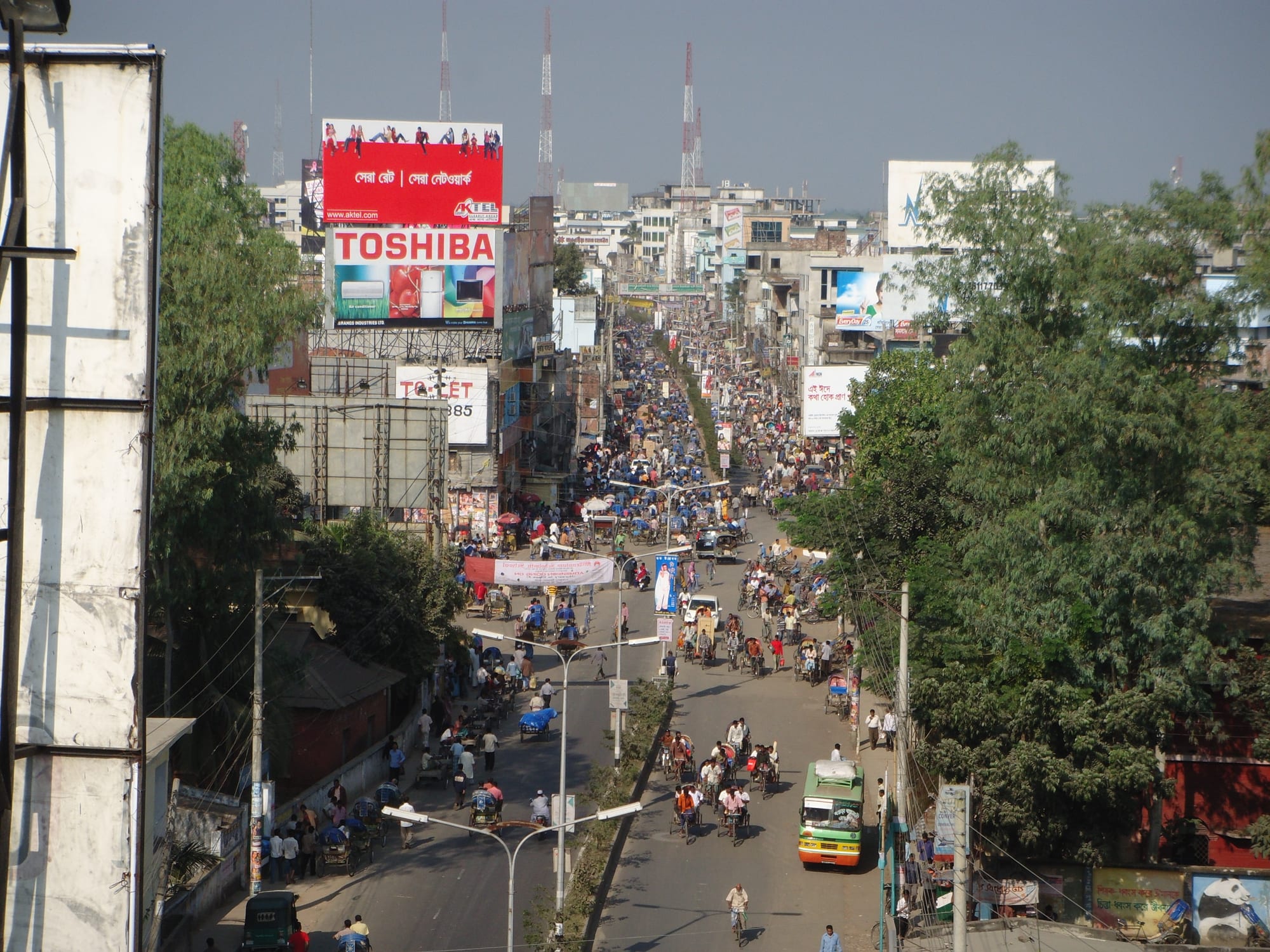
A crowded main road in Bogra seen from above, with rickshaws, a green bus, market stalls and shop hoardings along both sides

Rajshahi, Rangpur & the North, Bangladesh

Bogra

The main road at Sathmatha, the central crossroads of Bogra, seen from Sherpur Road. (User:Nobin / Wikimedia Commons · CC BY 3.0)

A busy commercial town in northern Bangladesh, officially spelled Bogura, standing on the Karatoya river at the junction of the northern highways. Just outside it lie the ramparts of Mahasthangarh, the oldest known city site in the country, and the town is the usual base for the Pala-era monastery at Paharpur. It is known nationally for its thick sweetened curd.

Neighbourhoods

  • Sathmatha and the town centre
    • First-time visitors
    • Shopping
    • Best for food

    The seven-way crossroads at the heart of Bogra, ringed by shopping plazas, sweet shops and small restaurants. Rickshaws and auto-rickshaws converge here, and most of the town's hotels stand within a few streets of it.

    Open in Maps
  • Sherpur Road and Jaleshwaritala
    • Shopping
    • Local life

    The main commercial axis running south from Sathmatha, lined with cloth shops, electronics stores and curd sellers. It is where the town does its everyday buying, and it stays busy into the evening.

    Open in Maps
  • Station Road and the railway quarter
    • Close to public transport
    • Budget stays

    The streets around Bogura railway station, with cheap hotels, tea stalls and transport agents. Trains north to Rangpur and south towards Santahar leave from here, and the bus stands for the northern highways are not far away.

    Open in Maps
  • Chelopara and the Karatoya riverside
    • Quiet and residential
    • Local life

    The older quarter along the Karatoya on the eastern side of town, with ghats, small workshops and lanes of low houses. The river is much reduced from the great waterway of the chronicles, but it still shapes this side of Bogra.

    Open in Maps
  • The Mahasthan road, north of town
    • Historic district
    • Day trips

    The highway running north towards Mokamtala passes the mounds and ramparts of Mahasthangarh about twelve kilometres out, with the site museum and several outlying ruins along it. Villages, rice fields and roadside tea stalls fill the ground between.

    Open in Maps

Things to do

Ancient sites

  • Mahasthangarhlandmark

    The earthen and brick ramparts of Pundranagara, capital of the ancient Pundra region and the oldest known urban site in Bangladesh, with finds dating back to about the third century BC.

    Open in Maps
  • Gokul Medhlandmark

    A tall brick mound of terraced cells about two kilometres south-west of Mahasthangarh, the base of a Buddhist shrine and known locally as the bridal chamber of Behula and Lakshindar.

    Open in Maps
  • Vasu Viharalandmark

    An excavated Buddhist monastery site in the fields near Mahasthangarh, known locally as Narapatir Dhap.

    Open in Maps

Town landmarks

  • Mohammed Ali Palace Museummuseum

    The Nawab Palace on the west bank of the Karatoya, listed as a protected antiquity in 2016, with a museum and a park in its grounds.

    Open in Maps
  • Shaheed Chandu Stadiumattraction

    Bogra's cricket ground, which staged a Test match and one-day internationals up to 2006 and has held domestic cricket since.

    Open in Maps

Short trips from the town

  • Somapura Mahavihara, Paharpurlandmark

    The enormous brick Buddhist monastery founded under the Pala kings in Naogaon district, a UNESCO World Heritage Site and one of the best known ancient monuments in Bangladesh.

    Open in Maps
  • Kusumba Mosquelandmark

    A stone-faced mosque of 1558–59 beside a large tank in Naogaon district, built during the Suri period and carved with decorative panels.

    Open in Maps
  • Jamuna Bridgelandmark

    The road bridge over the Jamuna east of Bogra, opened in 1998, which ended the north-west's isolation from Dhaka; its railway tracks were taken up after a separate rail bridge opened alongside it in 2025.

    Open in Maps
  • Jagaddala Mahaviharalandmark

    The remains of a Buddhist monastery founded by the later Pala kings, at Dhamoirhat in Naogaon district north-west of Bogra, close to the Indian border.

    Open in Maps
  • Halud Viharalandmark

    A brick mound and monastery site in Naogaon district, south-west of Bogra, excavated in part and little visited.

    Open in Maps

Seasonal events

  • Pohela Boishakhmid-April

    The Bengali New Year, marked in Bogra with fairs, processions, sweets and new account books opened in the shops.

  • Eid al-Fitr and Eid al-Adhadates move through the year with the lunar calendar

    The two great Muslim festivals empty the offices and fill the roads, as people working in Dhaka return to family homes across the north.

  • Durga PujaSeptember or October

    The main Hindu festival of Bengal, celebrated at pandals in the town and in the surrounding villages over several days.

  • Winter pitha seasonDecember to February

    Cold-weather months when date-palm molasses appears in the markets and rice cakes are made and sold at street stalls.

Eat and drink

Long-standing places and food districts in Bogra. Hours, ratings and directions come from your maps app, always current.

Bogra classics

  • Bogura doimarket

    The town's famous sweetened curd, set in shallow clay pots until thick and faintly caramelised, sold by the pot in sweet shops around Sathmatha and along Sherpur Road.

    Open in Maps

Food streets and markets

  • Sathmatha food stallsneighborhood

    The crossroads and the plazas around it hold most of the town's restaurants, biryani counters and snack stalls, busiest in the early evening.

    Open in Maps
  • Sherpur Road sweet shopsneighborhood

    A run of confectioners selling curd, rosogolla, sandesh and milk sweets, many of them packing pots for travellers heading to Dhaka.

    Open in Maps
  • Bogra town bazaarmarket

    The produce market for the surrounding farmland, with rice, potatoes, winter vegetables, river fish and, in early summer, mangoes and litchis from the north.

    Open in Maps

Experience Bogra

History

Bogra's importance comes from what lies just outside it. Twelve kilometres to the north, on the old bank of the Karatoya, stand the ramparts of Mahasthangarh, identified with Pundranagara, the capital of the ancient land of Pundravardhana. Excavation there has produced material from about the third century BC, including a stone slab with one of the oldest inscriptions found in Bangladesh, and the citadel remained in use through Maurya, Gupta, Pala and Sena times. The Karatoya, now a modest river, was then a major waterway and is treated in Sanskrit texts as a sacred boundary of Bengal.

The town of Bogra itself is far younger. It grew as an administrative and market centre and was made the headquarters of a district in 1821, during British rule, taking its name by tradition from Nasiruddin Bughra Khan, governor of Bengal in the 1280s. The district lay on the trading routes between the Padma and the Jamuna, and the railway linked it south to Santahar and north towards Rangpur.

In the 20th century Bogra's position at the meeting of the northern highways made it a commercial hub rather than a political one, and the opening of the Jamuna Bridge in 1998 cut the journey to Dhaka sharply and pulled trade and industry towards the town. It has grown steadily since, spreading along the roads out of Sathmatha, while the sites on its northern edge have become the most visited archaeological landscape in the country.

Culture & Customs

Bogra is a market town first, and its culture is the culture of the northern plain: mosque and madrasa on one side, folk song, village fairs and river legend on the other. The Gokul Medh mound outside town is known to almost every Bengali child as Behula's bridal chamber, from the story of Behula and Lakhindar in the Manasamangal poems, in which a bride takes her dead husband's body down the river to win his life back. The tale is retold in jatra theatre and in song.

The shrine culture of the north is strong here. Mahasthangarh holds the tomb of the saint Shah Sultan Balkhi Mahisawar, and fairs held at shrines and temples in the district draw crowds from the villages. Bogra also has an old Hindu minority whose Durga Puja pandals fill the autumn, and the calendar of Eid, Pohela Boishakh and the harvest months orders the year for everyone.

People in Bogra speak a northern Bengali with its own vocabulary and intonation, noticeably different from Dhaka speech. The town takes an outsized pride in two things: its curd, which has carried the name across the country, and its cricket ground, which brought international matches to a district town. Manners are formal and hospitable, elders are addressed with respect, and visitors are usually invited to sit and take tea long before they have explained themselves.

Daily Life

About 490,000 people live in Bogura city, with about a million in the wider urban area, and the district around it is one of the most densely farmed in Bangladesh. The economy rests on trade and agriculture: rice, potatoes, maize, vegetables and mustard come in from the surrounding upazilas, and the town's wholesale markets send them south to Dhaka. Bogra has a long-established light-engineering trade, with foundries and workshops turning out irrigation pumps, shallow-tube-well parts and agricultural machinery sold across the north.

The day starts early. Traders open around sunrise, the bazaars are at their busiest in the morning and again after dusk, and the roads stay choked with rickshaws, battery-powered easy-bikes and trucks through the middle of the day. Most people live in low houses along lanes off the main roads, and the newer flats cluster near Sherpur Road and the highway ring. Many households have a member working in Dhaka or in the Gulf, and remittance money pays for much of the building visible on the edges of town.

The standing worries are familiar ones for the north: the price of fertiliser and diesel, groundwater levels in the dry Barind country to the west, seasonal unemployment between harvests, and the condition of the highways on which the town's trade depends. Political life is followed closely and argued over in tea stalls, which serve as the town's real public space.

Food

Bogra's fame is its doi — thick sweetened yoghurt set in shallow unglazed clay pots, the milk reduced and caramelised so that the curd turns pale brown and dense enough to hold a spoon. It is bought by the pot at sweet shops around Sathmatha and along Sherpur Road, eaten at the end of a meal or with chira, flattened rice, and it travels to Dhaka in stacks of pots on the back of buses. The same shops sell rosogolla, sandesh and milk sweets.

Everyday eating is northern Bengali: rice with dal, a fish or vegetable curry, and bhorta, vegetables or dried fish mashed with mustard oil, onion and green chilli. Beef and mutton curries appear on holidays and at restaurants, and biryani and tehari counters do good trade in the evening. Chicken roast with plain paratha is standard hotel fare, and every crossroads has a stall frying singara and piyaju.

The countryside supplies the rest of the table. Litchis and mangoes arrive in early summer from Rajshahi and Dinajpur, winter brings cauliflower, radish and mustard greens, and date-palm molasses from the season's tapping is stirred into rice cakes and payesh. Tea is drunk strong, sweet and milky at stalls on every corner, often with a dry biscuit, and the stalls stay open well into the night.

Planning tools

Budget

Bogra is inexpensive even by Bangladeshi standards. Hotels are modest and cheap, meals cost very little, and the largest single expense for most visitors is a car with driver to reach Mahasthangarh, Paharpur and the outlying ruins, since public transport to them is slow and scattered.

Daily Budget Midrange
USD 40–80 (best hotel in town, restaurant meals, car with driver for the sites)
Daily Budget Shoestring
USD 15–30 (simple hotel, local food, buses and rickshaws)

A hired car for a full day covers Mahasthangarh, its museum and Paharpur comfortably; agree the price before setting off.

Best Time to Visit

November to February, when the days are dry and mild and the archaeological sites are pleasant to walk. Morning fog can delay road and rail travel in December and January. April and May are very hot, and the monsoon from June to September brings heavy rain and flooding in the riverside districts.

Suggested Number of Days

Short stays are usual: the town and the ancient site on its northern edge fill a night and a morning. Longer visits are for the wider scatter of Pala-era ruins and monasteries in the districts around, which are slow to reach on rural roads.

First Visit
1–2 days
With Surroundings
3 days

Transportation

Cycle rickshaws and CNG auto-rickshaws handle everything inside the town, and fares are agreed before setting off. Buses leave from the stands on the highways for Dhaka, Rangpur, Rajshahi and Dinajpur, and trains run from Bogura station. For the sites outside town, shared auto-rickshaws run along the main roads, but a hired car saves hours.

Bogra sits at a junction of the northern highways, so long-distance buses are frequent in most directions without booking far ahead.

Airport & Station Connections

Most people arrive by road from Dhaka, about 200 kilometres south-east across the Jamuna Bridge, which takes roughly five to six hours by bus depending on traffic. Trains serve Bogura station on the Santahar–Rangpur line. The nearest airports with domestic flights are at Saidpur to the north and Rajshahi to the south-west, each a few hours away by road.

Walkability

The centre is small enough to cross on foot, and the shops and hotels cluster within a few streets of Sathmatha. Pavements are uneven or absent and the traffic of rickshaws, vans and buses is constant, so walking is slow and noisy rather than relaxing. Everything beyond the centre, including the ancient sites, needs wheels.

Safety

Bogra is a calm provincial town where foreign visitors are rare and attract friendly curiosity rather than trouble. The realistic risks are traffic on the fast northern highways, winter fog on the roads, heat before the monsoon, and the usual petty theft in crowded markets.

Avoid night-time road journeys in the fog of December and January, carry water in the hot months, and keep valuables close at Sathmatha and in the bazaar. Check current official travel advice before travelling.

Climate

Northern Bangladesh has sharper seasons than the coast. The pre-monsoon months are very hot, the monsoon from June to September is wet and humid, and winter is dry, cool and often foggy at dawn.

Summer
hot and humid, commonly 30–38°C before the monsoon, with heavy rain and high humidity from June
Winter
cool and dry, about 10–25°C, with thick morning fog and occasional cold spells in January

Local Customs

This is a conservative, mostly Muslim town, and modest dress is expected of everyone — covered shoulders and knees, and a scarf for women at mosques and shrines. Shoes come off at religious buildings. Greetings are verbal rather than physical between men and women. Hospitality is pressing, and refusing tea outright can seem unfriendly.

Ask before photographing people, especially women; alcohol is not sold openly and is best left alone here; tipping is not expected, though small change for a driver or porter is welcome.

Common Payment Methods

The currency is the Bangladeshi taka. Cash is used for almost everything, including hotels, drivers and site entry. ATMs are available in the town centre and accept international cards at some banks, but not all; card acceptance is limited to larger hotels and a few shops. Mobile payment services are widespread among residents but usually need a local number.