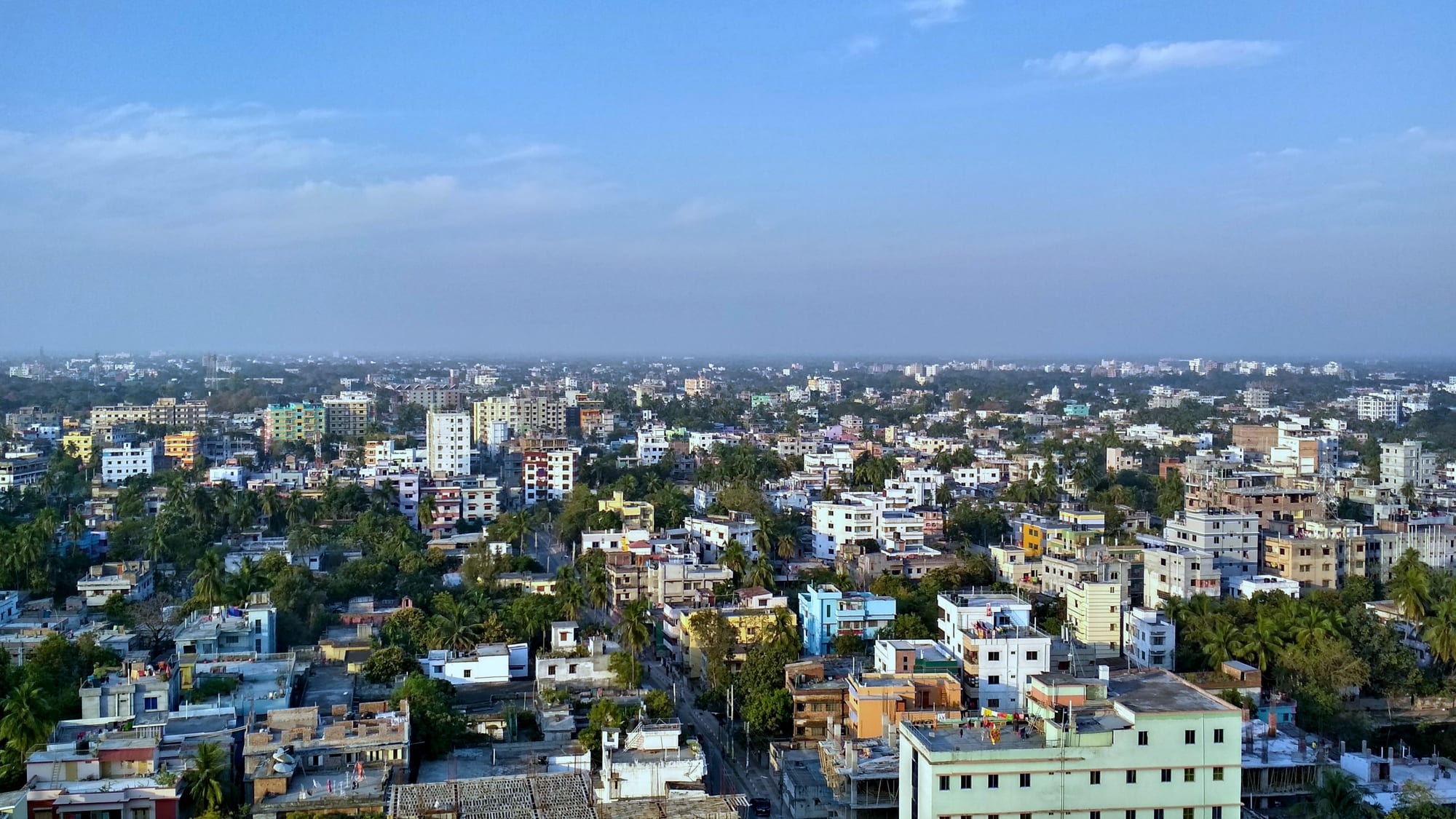
A wide aerial view over the low white and coloured rooftops of Rajshahi, with palms and trees between the buildings under a blue sky

Rajshahi, Rangpur & the North, Bangladesh

Rajshahi

Rajshahi seen from above, its low buildings broken up by trees and palms. (RockyMasum / Wikimedia Commons · CC BY-SA 4.0)

A divisional city on the north bank of the Padma in north-western Bangladesh, close to the Indian border. It grew as a silk-trading town on the river and is now known for its mango orchards, its universities and colleges, and a long riverside embankment where the city walks in the evening. The archaeological sites and temple towns of the north lie within easy reach.

Neighbourhoods

  • Shaheb Bazar
    • First-time visitors
    • Shopping
    • Best for food

    The commercial centre, a grid of shopping streets around the main market with cloth shops, silk showrooms, sweet shops and restaurants. Most of the city's hotels stand within a few minutes of the zero point crossing here, and the streets stay busy until late.

    Open in Maps
  • The Padma embankment
    • Walks
    • Sunsets
    • Local life

    The long flood embankment along the river south of the centre, laid out with gardens, benches and tea stalls. Families, students and vendors fill it in the late afternoon, and in the dry season the exposed sandbanks stretch far out towards the Indian bank.

    Open in Maps
  • Motihar and the university quarter
    • Students
    • Quiet and residential
    • Parks

    The east of the city around the University of Rajshahi's large wooded campus, with cheap canteens, bookshops and halls of residence. It is green, spacious and quieter than the centre, and the university has run the Varendra Research Museum, in the city centre, since 1964.

    Open in Maps
  • Uposhohor
    • Quiet and residential
    • Modern hotels

    A planned residential district of numbered sectors north-west of the centre, with wide streets, schools, clinics and newer apartment buildings, and a growing number of cafés and restaurants.

    Open in Maps
  • Laxmipur and Rajpara
    • Close to public transport
    • Local life

    The northern approach to the city around the medical college and hospital, with clinics, pharmacies, bus routes and busy roadside markets. Practical rather than scenic, and useful for transport out of the city.

    Open in Maps

Things to do

Museums and the old colleges

  • Varendra Research Museummuseum

    Founded in 1910, the oldest museum in Bangladesh, holding Hindu and Buddhist sculpture, inscriptions and terracotta from ancient Varendra.

    Open in Maps
  • Rajshahi Collegelandmark

    Established in 1873, the third oldest college in the country, with colonial brick buildings and a large campus near the centre.

    Open in Maps
  • University of Rajshahiattraction

    A large wooded campus east of the city, founded in 1953, with sculpture, memorials and long tree-lined avenues open to walkers.

    Open in Maps
  • Rajshahi University of Engineering & Technologyattraction

    The city's engineering university, on a green campus on the northern edge of town, founded in 1964 as the second engineering college in what was then East Pakistan.

    Open in Maps
  • Rajshahi Collegiate Schoollandmark

    Founded in 1828 and the oldest school in the country, its brick buildings standing in Shaheb Bazar in the centre.

    Open in Maps

Temples, mosques and palaces nearby

  • Puthia Temple Complexlandmark

    A village east of the city with the largest group of old Hindu temples in Bangladesh, including the Shiva temple of 1823 beside its tank and the terracotta-covered Govinda temple.

    Open in Maps
  • Bagha Mosquelandmark

    A sultanate mosque of 1523 south-east of the city, its brick walls covered with terracotta floral panels, standing beside a large tank.

    Open in Maps
  • Kusumba Mosquelandmark

    A stone mosque of the 1550s in Naogaon district, built of dark grey stone with carved mihrabs, beside a wide tank.

    Open in Maps
  • Choto Sona Mosquelandmark

    A sultanate mosque near the border in Chapai Nawabganj, part of the remains of the old capital of Gaur, faced in carved stone.

    Open in Maps
  • Natore Rajbarilandmark

    The palace and grounds of the Rajshahi Raj zamindars at Natore, north-east of the city, where Rani Bhabani lived and enlarged both the estate and the palace in the 18th century.

    Open in Maps

Short trips from the city

  • Uttara Gano Bhabanlandmark

    The Dighapatia palace of 1734 at Natore, set in gardens of imported trees and marble statues, used as an official state residence in northern Bangladesh and holding a museum.

    Open in Maps
  • Somapura Mahaviharalandmark

    The brick ruins of a great Buddhist monastery at Paharpur in Naogaon, a UNESCO World Heritage Site, with monks' cells around a towering central temple.

    Open in Maps
  • Mahasthangarhlandmark

    The ramparts and museum of ancient Pundranagara north of Bogura, the oldest known city site in the country.

    Open in Maps

Seasonal events

  • Mango seasonlate May to July

    The orchards of Rajshahi and Chapai Nawabganj come into fruit, filling the city's wholesale markets with Fazli, Langra and Khirsapat mangoes and the roads with courier trucks.

  • Pohela Boishakhmid-April

    The Bengali new year, marked with processions, fairs and music, with large gatherings on the university campus and along the river.

  • Eid al-Fitr and Eid al-Adhadates move through the year with the Islamic calendar

    The two main Muslim festivals, when mass prayers fill the eidgahs and students leave the city for their home districts.

  • Durga Pujaautumn, September or October

    The principal Hindu festival, celebrated at pavilions in the city and at the temples of Puthia nearby.

Eat and drink

Long-standing places and food districts in Rajshahi. Hours, ratings and directions come from your maps app, always current.

Rajshahi classics

  • Mango marketsmarket

    In early summer the wholesale mango markets of the district trade in Fazli, Langra, Gopalbhog and Khirsapat fruit by the basket, with fruit sold on roadsides across the city.

    Open in Maps
  • Kalai ruti stallsneighborhood

    Stalls and small kitchens serving the thick black-gram flatbread of the north-west, eaten with mashed chilli, onion or aubergine.

    Open in Maps
  • Sweet shops of Shaheb Bazarneighborhood

    Milk sweets, curd set in clay pots and syrup-soaked confections, including kachagolla brought from nearby Natore.

    Open in Maps

Markets and food streets

  • Shaheb Bazarmarket

    The city's main market and eating quarter, with rice-and-curry kitchens, biryani houses, fruit sellers and tea stalls packed into a few streets.

    Open in Maps
  • Padma embankment food stallsneighborhood

    Carts and open-air stalls along the riverside selling fried snacks, chotpoti, grilled corn and tea to the evening crowds.

    Open in Maps

Experience Rajshahi

History

The city grew from Rampur Boalia, a river settlement that became a trading post in the 18th century when Dutch and then English merchants set up silk factories on the bank of the Padma; the surviving Baro Kuthi belongs to that trade. The district was established in 1772, and the name Rajshahi, usually traced to the raja families whose zamindar estates dominated the surrounding countryside, above all that of Rani Bhabani of Natore, came to be used for the town as well. Silk, indigo and sugar moved down the river, and the town acquired courts, a jail and, in the 19th century, the schools and colleges that still define it.

Education arrived early. Rajshahi Collegiate School dates from 1828 and Rajshahi College from the 1870s, and in 1910 local scholars founded the Varendra Research Museum to collect the sculpture and inscriptions being turned up across the Barind. The University of Rajshahi followed in 1953, the second university in what was then East Pakistan, and gave the city a student population that has shaped its politics ever since.

Partition in 1947 cut Rajshahi off from Murshidabad and Malda across the river, severing old trade routes and leaving it on a closed border. The city saw heavy fighting and killings during the war of 1971, commemorated on the university campus and at sites around the town. Since then it has grown steadily rather than explosively, without heavy industry; a switch to cleaner fuels and battery-powered vehicles, the paving of earth streets and a campaign of tree planting brought international notice in the 2010s for the sharp fall in its air pollution.

Culture & Customs

Rajshahi's identity is bound up with silk, mangoes and study. Silk weaving has been practised here for centuries, and the city's showrooms sell saris and scarves from local mills, and the city has been known for its silk textiles since the British period. The mango harvest is the year's great collective event, discussed, graded and argued over from the first flowering to the last basket shipped to Dhaka.

The student city gives it a second character. Three large campuses, a medical college and an engineering university fill the eastern side with young people, and the university has a long record of political activity, theatre, music and poetry, with cultural evenings and book fairs through the cooler months. Rabindra and Nazrul songs are staples of these occasions, and gambhira, the satirical folk dialogue of nearby Chapai Nawabganj, is performed here too.

Socially the city is conservative and quiet. Evenings are spent walking on the embankment, in the tea stalls and at family gatherings rather than in nightlife; the Hindu minority is significant, and Durga Puja and the Muslim festivals are both public occasions. People take visible pride in the city's cleanliness and its trees, and in being calmer and greener than the rest of urban Bangladesh — a comparison a visitor will hear often.

Daily Life

About 550,000 people live in the city corporation area, and roughly a million in the wider urban area that takes in Nowhata and Katakhali. There is little large industry: the economy runs on government offices, the universities and colleges, hospitals, the silk mills, and above all on agriculture and its trade — mangoes, rice, wheat, pulses and vegetables from the Barind, sold through markets in the city and trucked east. Many families also depend on relatives working in Dhaka or the Gulf.

Neighbourhoods are low-rise and green, with houses set among trees; Uposhohor and the roads near the university hold the newer apartment blocks, while the old quarters near the river are denser and poorer. Rickshaws outnumber cars, the streets are swept, and the city is notably less noisy than others of its size. Students set the rhythm in term time, and the market day, the school run and evening prayers order the rest.

Water and land are the long-term worries. The Padma's dry-season flow is much reduced, blamed locally on the Farakka Barrage upstream in India, leaving broad sandbanks in winter, while groundwater under the Barind is falling as deep tube wells irrigate the dry soil. Riverbank erosion and the flooding of char islands displace families most years, and heat waves before the monsoon are becoming a serious public health issue.

Food

Mangoes come first. The orchards around the city produce Fazli, Langra, Gopalbhog and Khirsapat, also called Himsagar, each with its own weeks in early summer, and they are eaten fresh, pulped into juice, pickled green with mustard oil and chilli, and dried into amsotto, a chewy sheet of mango leather. Whole households turn to the harvest, and boxes are couriered across the country as gifts.

The staple cooking is rice with dal, vegetables and fish from the Padma — katla, rui, boal and, in season, hilsa — with bhorta, mashed vegetables or dried fish with mustard oil, green chilli and onion, at almost every meal. The local speciality of the wider north-west is kalai ruti, a thick, chewy flatbread of black gram baked on a clay pan and eaten with fiery chilli paste and aubergine bhorta, sold at stalls in the evening.

Sweets are a serious business. Curd set in clay pots comes from Bogura, kachagolla, a loose fresh-cheese sweet, from Natore, and the city's own shops make milk sweets, syrupy jilapi and sandesh. Tea is drunk strong and milky at stalls all day, and winter brings pitha, rice cakes with date-palm molasses, cooked at home and sold from carts.

Planning tools

Budget

Rajshahi is among the cheaper cities in Bangladesh. Hotels are modest and inexpensive, street food and market meals cost very little, and the main expense for most visitors is a car with driver to reach Puthia, Bagha, Paharpur and the other sites, which are scattered across the countryside and poorly served by public transport.

Daily Budget Midrange
USD 40–85 (best hotel in town, restaurant meals, car with driver for the temple and mosque sites)
Daily Budget Shoestring
USD 15–30 (simple hotel, local food, rickshaws and buses)

Hire a car for a full day to combine several sites in one direction, and expect prices for rooms and transport to rise sharply in mango season and around Eid.

Best Time to Visit

November to February is the pleasantest time, dry and cool, though morning fog in December and January can delay trains and buses. Late May to July is mango season, hot and humid but at its liveliest in the markets and orchards. April and May before the rains are the hottest months in the country, with temperatures in the high thirties.

Suggested Number of Days

Two days cover the city, the museum and the riverside. Three to five allow the temple and mosque sites of the surrounding districts and the archaeological sites further north, all of which need road travel over slow country roads.

First Visit
2 days
With Surroundings
3–5 days

Transportation

Rajshahi is a rickshaw city; battery-powered and cycle rickshaws handle most journeys, with auto-rickshaws and buses for longer distances and the route out to the university. The centre has less traffic and cleaner air than most Bangladeshi cities, which makes short trips quick. Cars with drivers are hired through hotels for sites outside town.

Agree the fare before getting into a rickshaw or auto-rickshaw, and arrange out-of-town trips the day before, as local buses to the smaller sites run infrequently.

Airport & Station Connections

Shah Makhdum Airport at Nowhata, about ten kilometres north of the city, has domestic flights from Dhaka taking about an hour. Trains from Dhaka cross the Jamuna bridge and take roughly six hours to Rajshahi station in the centre, and buses on the highway take about the same. The Indian border crossing at Sona Masjid, in Chapai Nawabganj, is about 60 kilometres west.

Walkability

One of the easier Bangladeshi cities to walk. The centre around Shaheb Bazar is compact, traffic is lighter than in Dhaka or Chattogram, and the embankment gives a long, level, traffic-free riverside walk of several kilometres. The university campus is also pleasant on foot. Summer heat is the main limit, and pavements give out on the outer roads.

Safety

Rajshahi is calm and sees few foreign visitors, who attract curiosity rather than trouble. Petty theft in crowded markets is the main crime risk, and traffic and the pre-monsoon heat are the real dangers. Political demonstrations and strikes can close roads at short notice. Winter fog makes night driving on the highways hazardous.

Take local advice before going close to the Indian border, which is patrolled on both sides, avoid night road travel in the winter fog, and carry water and cover up in the hot months. Check current official travel advice before travelling.

Climate

A climate of extremes by Bangladeshi standards, because the Barind tract here is drier than the delta. Pre-monsoon heat can be severe, the monsoon from June to September brings most of the year's rain, and winter nights are genuinely cool with dense fog in the river valley.

Summer
very hot, often 30–40°C before the monsoon, then humid with rain from June to September
Winter
cool and foggy, about 9–26°C, with chilly early mornings

Local Customs

The north is more conservative and slower-paced than Dhaka. Modest dress covering shoulders and knees is expected, shoes are removed at mosques, temples and in homes, and the right hand is used for eating and giving. Alcohol is not generally sold. Hospitality is warm and insistent, and foreign visitors are often invited for tea.

Ask before photographing people, particularly women and worshippers, and dress conservatively when visiting the shrines, mosques and temples of the surrounding districts.

Common Payment Methods

The currency is the Bangladeshi taka. Cash is used for nearly everything, and ATMs are easy to find around Shaheb Bazar and the main roads, though not all take foreign cards. A few hotels, silk showrooms and larger restaurants accept cards. Carry small notes for rickshaws, stalls and entry fees at the archaeological sites.