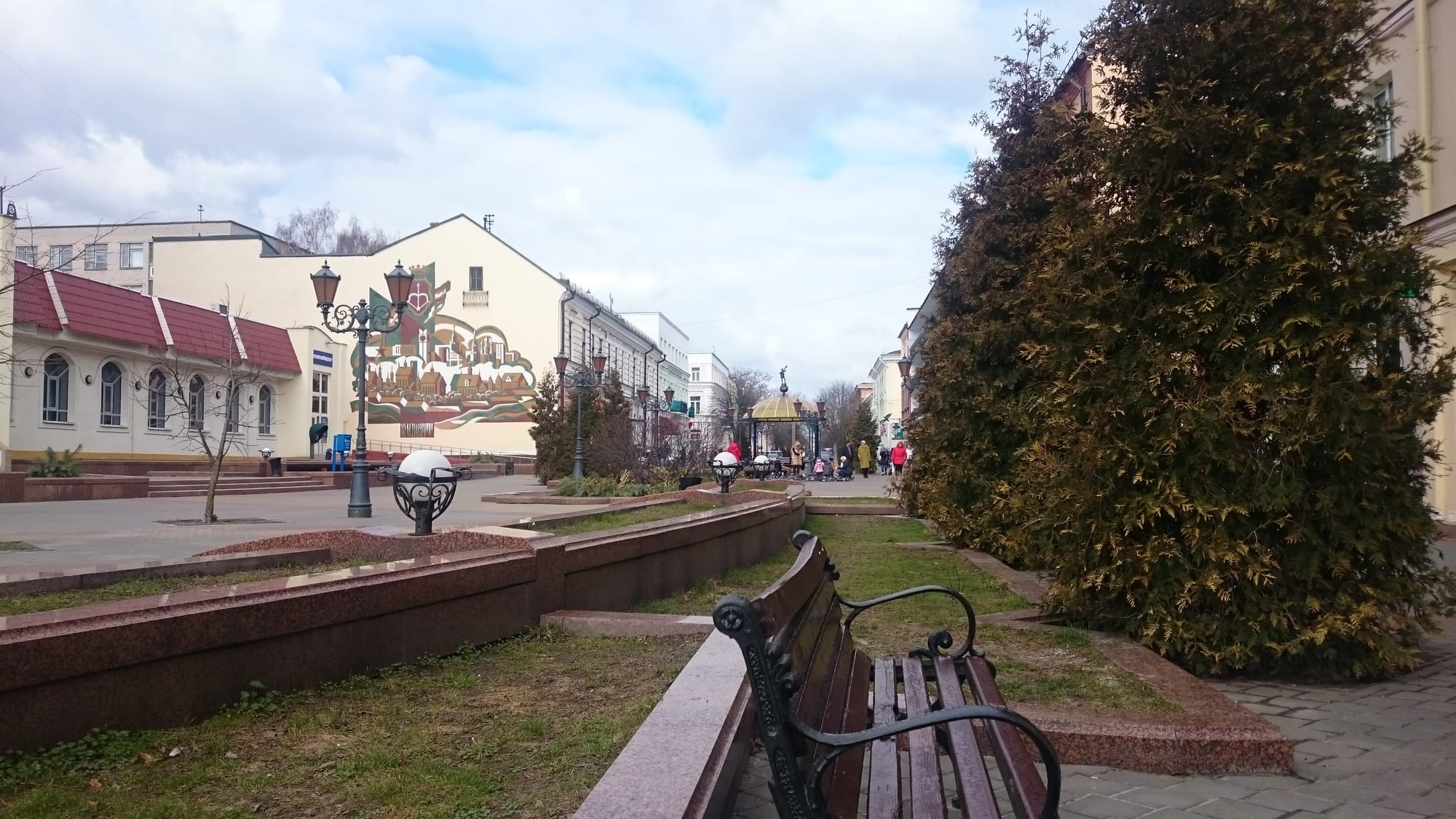
Pedestrian Sovetskaya Street in Brest with lamp posts, granite planters, a bench and pastel buildings under a cloudy sky

Brest, Grodno & the West, Belarus

Brest

Sovetskaya Street, the pedestrian main street of Brest. (Mmkay / Wikimedia Commons · CC BY-SA 4.0)

A city of about 347,000 people in the far south-west of Belarus, where the Mukhavets meets the Bug on the border with Poland. First recorded in 1019 as Berestye, it hosted the Union of Brest in 1596 and the treaty of 1918, and is known for the vast Soviet war memorial at its 19th-century fortress and a lamplit pedestrian street.

Neighbourhoods

  • City centre and Sovetskaya Street
    • First-time visitors
    • Best for food
    • Cafés and bars

    The centre between the railway and the Mukhavets, built up after the old town was cleared for the fortress. Pedestrian Sovetskaya Street, rebuilt in 2007–2009, runs through it with cafés, shops and old gas lamps lit by hand, past the Millennium Monument at the corner of Gogol Street.

    Open in Maps
  • Brest Fortress
    • History
    • Memorials
    • Walks

    The great 19th-century fortress on the city's western edge, at the meeting of the Bug and the Mukhavets, spread over islands, ramparts and moats. Its memorial complex, the museums and the excavated old town of Berestye fill much of a visit.

    Open in Maps
  • Around the railway station
    • Close to public transport
    • Architecture

    North of the centre, the grand Brest-Tsentralny station and the bus station beside it are the city's gateways to Minsk, Warsaw and the east, with long-distance trains to the east starting here.

    Open in Maps

Things to do

Brest Fortress

  • Brest Fortress memoriallandmark

    A Soviet war memorial opened in 1971 on the site of the fortress attacked at the start of the German invasion on 22 June 1941, with the Main Entrance, an obelisk, the giant Main Monument and the ruined barracks.

    Open in Maps
  • Berestye Archeological Museummuseum

    A museum on the southern island of the fortress built over the excavated wooden streets and houses of medieval Berestye.

    Open in Maps
  • Kholm and Terespol gateslandmark

    The two gates that survive from the fortress's ring of barracks, most of which lies in ruins.

    Open in Maps

The city

  • Sovetskaya Streetneighborhood

    The pedestrian main street, rebuilt in 2007–2009, where since 2009 a lamplighter in Petrine-era uniform climbs a ladder to light and put out its 19 gas lamps by hand every day.

    Open in Maps
  • Millennium Monument of Brestlandmark

    A monument at the corner of Sovetskaya and Gogol streets, unveiled in July 2009, depicting episodes from the city's history.

    Open in Maps
  • Brest City Parkpark

    A park more than a hundred years old by the Mukhavets, renovated in 2004–2006 for its centenary.

    Open in Maps

Museums

  • Brest Railway Museummuseum

    The only outdoor railway museum in Belarus, with more than 50 locomotives and other rolling stock on three tracks.

    Open in Maps
  • Museum of Rescued Art Treasuresmuseum

    A collection of art objects confiscated by the Brest border customs service, whose original owners could not be traced.

    Open in Maps

Short trips from the city

  • Tower of Kamyenyetslandmark

    A 30-metre red-brick tower built between 1271 and 1289 as a frontier stronghold, in the small town of Kamyenyets.

    Open in Maps
  • Belovezhskaya Pushcha National Parkpark

    The Belarusian part of the ancient Białowieża forest, a UNESCO World Heritage Site shared with Poland and home to free-roaming European bison.

    Open in Maps

Seasonal events

  • Anniversary of the 1941 attack22 June

    A mourning ceremony at Brest Fortress at 4 a.m., the minutes when the war began in 1941, with a metronome sounding and a historical re-enactment of the eve of the war.

Eat and drink

Long-standing places and food districts in Brest. Hours, ratings and directions come from your maps app, always current.

Brest eating

  • Sovetskaya Streetneighborhood

    The pedestrian main street and the streets around it hold most of the city's cafés and restaurants, serving Belarusian dishes such as draniki and kalduny.

    Open in Maps
  • Central marketmarket

    The city-centre market, with meat, cheese and bread in the covered hall and fruit and vegetables outside, where people also sell what they grow at their dachas or gather in the forest.

    Open in Maps

Experience Brest

History

Brest — Berestye in the chronicles — appears in the Primary Chronicle in 1019, when Kievan Rus' took the stronghold from the Poles. It grew as a trading town on the Bug between Rus', Poland and Lithuania, was burned by Crimean Tatars in 1500 and became an important town of the Grand Duchy of Lithuania. In 1594 and 1596 it hosted councils of Catholic and Orthodox bishops, and the second created the Uniate, or Greek Catholic, Church. King John II Casimir founded a royal mint here in 1665.

The partitions of the late 18th century brought Brest into the Russian Empire. In the 19th century the Russians demolished the royal castle and most of the old town to make room for the great fortress. Brest was overwhelmingly Jewish: the 1897 census counted 30,000 Jews among 45,000 residents. In 1915 the German army captured the town, and in March 1918 Soviet Russia signed the Treaty of Brest-Litovsk with the Central Powers in the fortress. Between the wars the city, renamed Brześć nad Bugiem, belonged to Poland.

In 1939 the Germans captured the city and handed it to the Soviet Union, which subjected its Polish population to arrests and mass deportations. On 22 June 1941, at the start of the German invasion of the Soviet Union, the fortress was attacked; it held out for six days, and its defence became a central Soviet war legend. About 20,000 Jews were confined in a ghetto and murdered in October 1942. The Red Army returned in July 1944, and the city became part of Soviet Belorussia. The memorial complex opened in 1971, and Sovetskaya Street was rebuilt in 2007–2009.

Culture & Customs

Brest's identity rests on the fortress. Recognised by the Soviet Union as a Hero Fortress, it is the setting for school trips, state ceremonies and the night-time commemoration each 22 June at the hour the 1941 attack began. The city is largely Russian-speaking and Soviet-built, but its streets also keep Orthodox and Catholic churches and reminders of the Polish interwar years, such as officials' housing in manor-house style and the Warburg housing colony built for Jewish families who lost their homes in the First World War.

The city's Jewish past, once the majority of its population, is less visible. An independent theatre, Kryly Khalopa, has staged an audio performance in public space, the Brest Stories Guide, on the history of anti-Semitism and the Shoah in the city.

Daily culture leans towards the street. Sovetskaya Street, with its lamps lit by hand each evening by a lamplighter in historical uniform, is where people stroll, meet and sit in cafés, and the Millennium Monument recalls figures from a thousand years of history. Two universities, Pushkin Brest State University and Brest State Technical University, give the city a student population.

Daily Life

About 347,000 people live in Brest, according to a 2026 figure, making it one of the largest cities in Belarus and the administrative centre of the Brest Region. The Mukhavets divides it into a northern and a southern half, and most people live in the Soviet-era districts of apartment blocks spread around the compact grid of the centre.

The border shapes the economy. On the main railway between Berlin and Moscow and on the M1 highway, Brest became a principal border crossing, and it still links the European Union with the countries to the east. Sanctions and border closures in recent years have squeezed cross-border trade, and queues at the crossings can be very long. Universities, colleges, services and light industry provide much of the remaining work.

The rhythm of the day is calm: buses and trolleybuses at rush hour, lunch in canteens and cafés, evening walks along Sovetskaya Street and in the City Park by the river. At the central market, older women sell what they grow at their dachas or gather in the forest.

Food

Brest shares the national potato repertoire of Belarusian cooking. Draniki, crisp potato pancakes, are served with sour cream or with verashchaka, a thick meat gravy with pieces of meat and sausage; kalduny are small boiled dumplings with a range of fillings; and babka is a potato dish of German origin brought in through Jewish cooking in the 19th century. Beet and cabbage soups, rye bread and cured pork fat are everyday food.

Pork dishes are usually fried or stewed and garnished with cheese or mushrooms, and sour cream is used both in cooking and as a garnish. In front of the central market, older women sell vegetables from their dachas and berries and mushrooms gathered in the forest, while the covered hall sells meat, cheese and bread.

Cafés and restaurants cluster on Sovetskaya Street and the streets around it. Kvass remains the main local non-alcoholic drink, and the traditional hard drink is vodka, including varieties flavoured with forest herbs.

Planning tools

Budget

Brest is cheaper than Minsk, with good-value hotels, inexpensive cafés and low museum fees; a trip to the Białowieża forest is the main extra. Foreign cards may not work because of sanctions, so bring cash in euros or US dollars to change.

Daily Budget Midrange
USD 50–100 (central hotel, restaurants, a forest excursion or hired car)
Daily Budget Shoestring
USD 25–40 (budget hotel, canteen food, buses and trolleybuses)

Change money at banks in the centre and keep enough cash for the forest trip.

Best Time to Visit

May to September, when the Mukhavets riverside and the fortress grounds are pleasant and the Białowieża forest is green; 22 June brings the night-time ceremony at the fortress. Early October is the season for autumn colour in the forest. Winters are among the mildest in Belarus.

Suggested Number of Days

Two days cover the fortress and the city centre without hurrying. Three or four allow for the Białowieża forest and other places in the countryside nearby, which are easiest by car or organised excursion.

First Visit
2 days
With Surroundings
3–4 days

Transportation

Buses and trolleybuses run frequently across the city, and taxis are inexpensive. The centre and Sovetskaya Street are easily walked; the fortress is on the western edge, a long walk or a short bus or taxi ride from the centre.

Use a car or an organised excursion for the forest and the smaller towns, where buses are infrequent.

Airport & Station Connections

Brest lies on the main railway from Warsaw to Minsk and Moscow, with fast trains to Minsk from Brest-Tsentralny station, and the bus station beside it handles domestic and international buses. The crossing to Terespol in Poland can involve very long queues and has closed at short notice in recent years. Brest Airport, 15 km east of the centre, has only a few seasonal flights; most visitors fly to Minsk.

Walkability

The centre is flat and compact, and Sovetskaya Street is pedestrianised for much of its length. The fortress grounds are large and best covered on foot at a steady pace, with paths across the islands and ramparts.

Safety

Setting aside politics, Belarus has low street crime and is an orderly place to travel. Brest is a militarised border city: photographing border posts, military sites and the frontier can lead to detention, the authorities detain people, including foreigners, on vague charges, and there is no tolerance of protest. Several Western governments advise against all or all-but-essential travel to Belarus.

Stay out of marked border zones without a permit, do not photograph military or border installations, keep a low profile and check for ticks after forest walks. Check current official travel advice before travelling.

Climate

A humid continental climate leaning towards oceanic, with winter temperatures that mostly hover around freezing. This south-western corner is the mildest part of Belarus, with a longer growing season than the north and east.

Summer
warm across western Belarus, 19–26°C, occasionally above 30°C around Brest, with thunderstorms
Winter
cold but milder than the east, around −2 to −5°C across western Belarus, with less reliable snow

Local Customs

Brest is mostly Russian-speaking. The fortress is a war memorial and cemetery as well as a sight: quiet, respectful behaviour is expected there. Orthodox and Catholic churches expect modest dress. Tipping is not expected in most situations; in sit-down restaurants around 10 per cent is usual if no service charge is added.

Behave respectfully at the memorials, and never photograph border installations or soldiers.

Common Payment Methods

The currency is the Belarusian ruble (BYN). Cards are accepted in shops, restaurants and hotels where foreign cards work at all, but sanctions block many, so carry enough cash, exchanged at banks, for the stay.