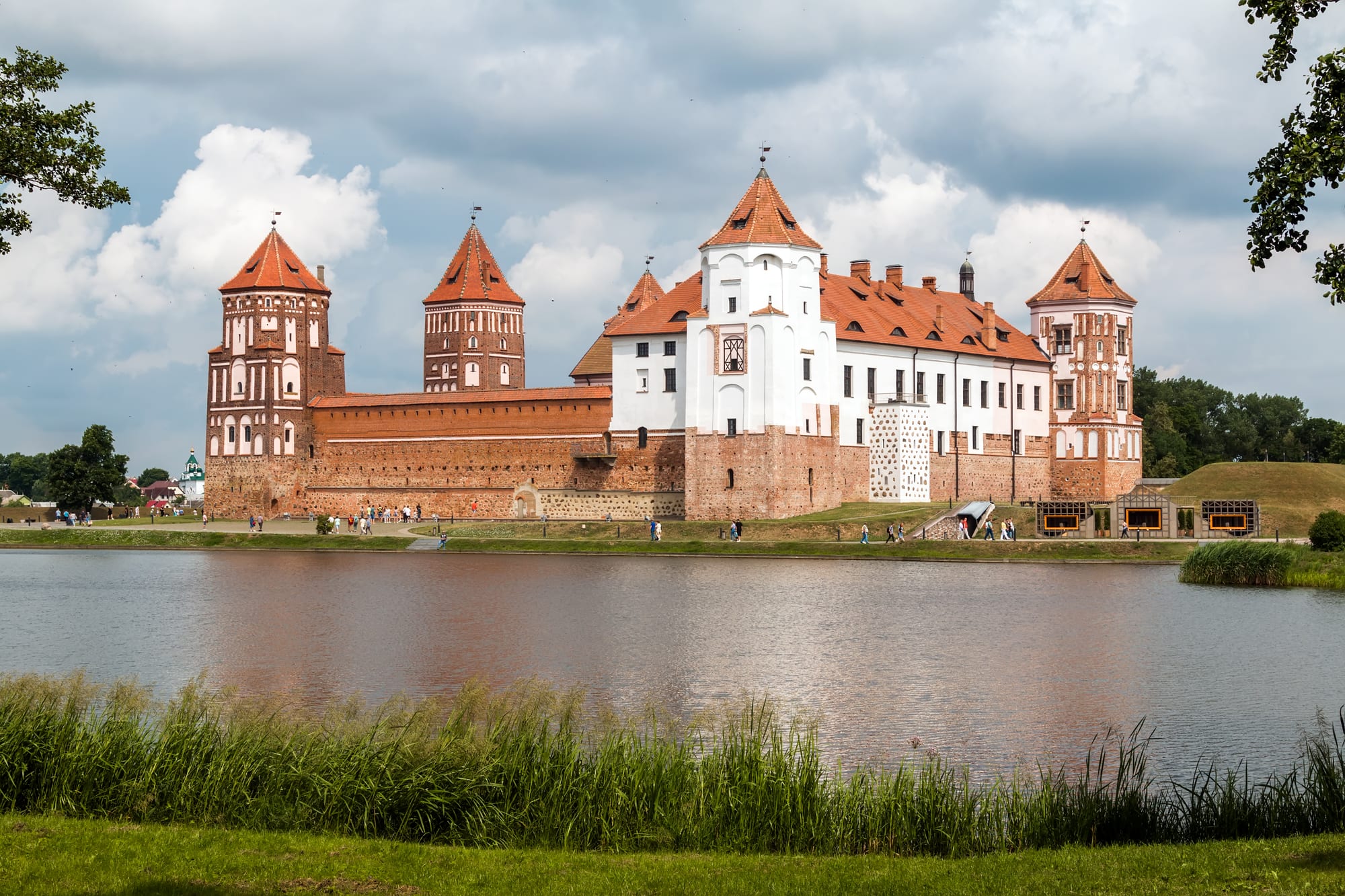
Mir Castle's red-brick towers and white-walled palace wing reflected in a pond under a cloudy summer sky

Belarus

Brest, Grodno & the West

Mir Castle, the 16th-century fortress-residence in the Grodno Region, seen across its pond. (Mike1979 Russia / Wikimedia Commons · CC BY-SA 3.0)

The western third of Belarus along the Polish and Lithuanian borders, from the fortress city of Brest and the marsh town of Pinsk north to Grodno on the Neman — the country's most Central European corner, with a large Catholic and Polish minority, the castles of Mir and Navahrudak and the primeval Białowieża forest.

Explore Brest, Grodno & the West

History

The west is the part of Belarus most tied to Central Europe. Brest, first mentioned as Berestye in the early 11th century, was a trading town on the Bug between Kyiv, Poland and Lithuania, and its excavated wooden streets are now under a museum roof. Grodno appears in the chronicles in the 1120s; its Kalozha church dates from that century. Both passed into the Grand Duchy of Lithuania, whose princes built the castles of Navahrudak and Lida, and Kamyanets gained its tall brick watchtower in the late 13th century.

Under the Commonwealth the region was the heart of the state rather than its edge. King Stefan Batory made Grodno a royal residence and died there in 1586, the Union of Brest in 1596 created the Greek Catholic church, and the Radziwiłłs took Mir. The Commonwealth's last Sejm met in Grodno in 1793, and Stanisław August abdicated there in 1795 as the partitions handed the region to Russia, which razed Brest's old town in the 1830s to build its fortress. Adam Mickiewicz, Poland's national poet, was born in or near Navahrudak in 1798, and Tadeusz Kościuszko near Kosava.

The 20th century was catastrophic. Bolshevik Russia signed the Treaty of Brest-Litovsk in the fortress in 1918; between the wars the region belonged to Poland; in 1939 it was annexed by the Soviet Union. On 22 June 1941 the German invasion began here, the fortress garrison resisting for weeks, and the Jewish communities of Brest, Grodno, Pinsk and hundreds of smaller towns were murdered. In December 1991 the agreement dissolving the Soviet Union was signed at Viskuli in the Belovezhskaya Pushcha.

Culture & Customs

The west is where the Belarusian mosaic is most visible. Grodno Region has the country's largest Polish minority and a strong Catholic presence, and Catholic and Orthodox churches often stand side by side, with both Christmases — 25 December and 7 January — kept by many families. Polish is heard on the streets of Grodno and in villages near the Lithuanian border, and the Belarusian spoken in the west carries Polish loanwords. Brest, a Soviet-built border city, is more Russian-speaking and shaped by the memory of 1941.

Polesia, the marshland of southern Brest Region around Pinsk, has its own dialects and a village culture that survived longer than elsewhere, with embroidered linen, weaving and wedding songs still collected by folklorists. The region's history is also Jewish: towns such as Pinsk, Brest and Mir once had large Jewish populations, and the yeshiva of Mir became famous across the Jewish world before the war.

Literary pilgrimages matter here — to Mickiewicz's Navahrudak and to the Kościuszko birthplace near Kosava — and castle festivals such as those at Lida stage jousts, music and medieval crafts in summer. Hospitality is generous and a little formal, with Polish-style courtesies of address still used by older people.

Daily Life

Grodno, with about 360,000 people, and Brest, with about 340,000, are the two regional capitals, followed by Baranavichy, a railway junction of about 170,000, Pinsk with about 125,000, and Lida with about 100,000. Both cities are greener and more compact than Minsk, and Grodno's old centre keeps the largest ensemble of historical buildings in the country.

The economy rests on farming — dairy, potatoes, grain and vegetables on the warmer southern plain — food processing, the Grodno Azot fertiliser works, and above all cross-border trade. For decades Brest and Grodno lived off shopping trips, transit trucks and visitors from Poland and Lithuania; closures and sanctions since 2020 have hit that trade hard, and queues of lorries at the frontier have become a fixture of news reports.

Life follows the familiar Belarusian rhythm of early starts, cheap canteens and weekends at the dacha, with the difference that the border is always close: relatives on the other side, Polish television on some roofs, and in Grodno a local pride in being the most European city in the country.

Food

Western cooking shares the national potato repertoire but shows its Polish and Lithuanian neighbours. Grodno Region's cooks make babka, grated potato baked with bacon and onion, and kalduny, while the Catholic Christmas Eve supper of twelve meatless dishes — beetroot soup, fish, mushrooms, kutia, a wheat-and-poppy-seed porridge — is kept in many homes. Kumpiak, a cured pork ham, and home-made sausages hang in village larders.

The Pushcha contributes forest food: wild mushrooms, honey, cranberries and bilberries, and game such as boar and venison on hotel menus near Kamyanyuki. In Polesia fish from the Pripyat and Pina rivers — pike, tench, crucian carp — is baked, fried or cooked into fish soup, and the marsh villages are known for cranberries.

Among drinks, Lida has brewed beer since the 19th century and Lidskae is one of the country's best-known brands. Kvass is sold from kegs on summer streets, and strong home-distilled samahon is still offered in the villages. Grodno's cafés, more Central European than Soviet, are known for coffee and cakes.

Attractions & Natural Wonders

Brest's great site is the Brest Fortress, entered through a monumental concrete gateway, with the vast stone head of the monument "Courage", an eternal flame, the ruined barracks and the restored garrison church on its island between the Bug and the Mukhavets. The city also has the Berestye archaeological museum and a pedestrian Savetskaya Street whose lamps are lit each evening by a lamplighter. North of the city, Kamyanets keeps its 13th-century White Tower, and to the east Kobryn has a museum to the general Suvorov.

North of Brest lies the ancient Białowieża forest, protected in Belarus as Belovezhskaya Pushcha National Park and shared with Poland as a UNESCO World Heritage Site: oak, lime and hornbeam woodland, bison enclosures, cycling routes from Kamyanyuki, and a Father Frost estate popular with Belarusian families. In the south, Pinsk has its former Jesuit college and riverfront churches, and Kosava a neo-Gothic palace, now under restoration, near Kościuszko's birthplace, while Ruzhany has the ruins of a Sapieha palace.

In Grodno Region, Grodno's old town keeps the Farny Church, the Old and New Castles, the Great Synagogue and the Kalozha church above the Neman; the Augustów Canal runs through forest towards the Polish border. Mir Castle, with its five towers, palace and Svyatopolk-Mirsky burial chapel, is a UNESCO World Heritage Site; Navahrudak has castle ruins and the Mickiewicz museum; and Lida a restored 14th-century castle.

Cities in Brest, Grodno & the West

Planning basics

Budget

The west is cheaper than Minsk, with good-value hotels in Brest and Grodno, inexpensive guesthouses near the Pushcha and in the Mir area, and low museum fees. Tours of the Białowieża forest by bicycle or excursion vehicle are a modest extra. Foreign cards may not work, so bring cash.

Daily Budget Midrange
USD 50–100 (central hotel, restaurants, forest excursions, a hired car between castles)
Daily Budget Shoestring
USD 25–40 (budget hotel or agrousadba farm-stay, canteen food, buses and trains)

Farm-stays, known as agrousadby, near the Pushcha and Mir offer cheap rooms and home cooking.

Safety

Everyday crime is low, but this is a militarised border region. The frontier with Poland and Lithuania has seen crises over migrants and closures since 2021, border zones require permits and are patrolled, and photography of border posts, military sites and the frontier itself can lead to detention. Ticks in the forests and deep water in the marshes are the natural hazards.

Stay out of marked border zones without a permit, keep to official trails in the Pushcha and check for ticks after forest walks. Check current official travel advice before travelling.

Climate

The mildest part of Belarus, with shorter, less severe winters and a longer growing season than the north and east, especially around Brest. Summers are warm and often wet, and the Polesian marshes around Pinsk are humid and full of mosquitoes in June and July.

Summer
warm, 19–26°C, occasionally above 30°C around Brest, with thunderstorms
Winter
cold but milder than the east, around -2 to -5°C, with less reliable snow

Transportation

Brest lies on the main railway from Warsaw to Minsk and Moscow and is linked to Minsk by fast trains; Grodno is reached by train or bus. Crossings from Poland at Brest and from Lithuania near Grodno can involve very long queues. Mir lies close to the Minsk–Brest highway and is often visited from Minsk with Nesvizh. The Belovezhskaya Pushcha park centre at Kamyanyuki is about an hour north of Brest by car or bus.

Use a car or organised excursion for Mir, Navahrudak and the Pushcha; buses between smaller towns are infrequent.

Best Time to Visit

May to September for the forest, the castles and the Neman and Mukhavets riverfronts; late May and June are green and bird-rich in Polesia. 22 June is marked at Brest Fortress with a night-time ceremony at the hour the 1941 attack began. Autumn colours in the Pushcha are at their best in early October.