History
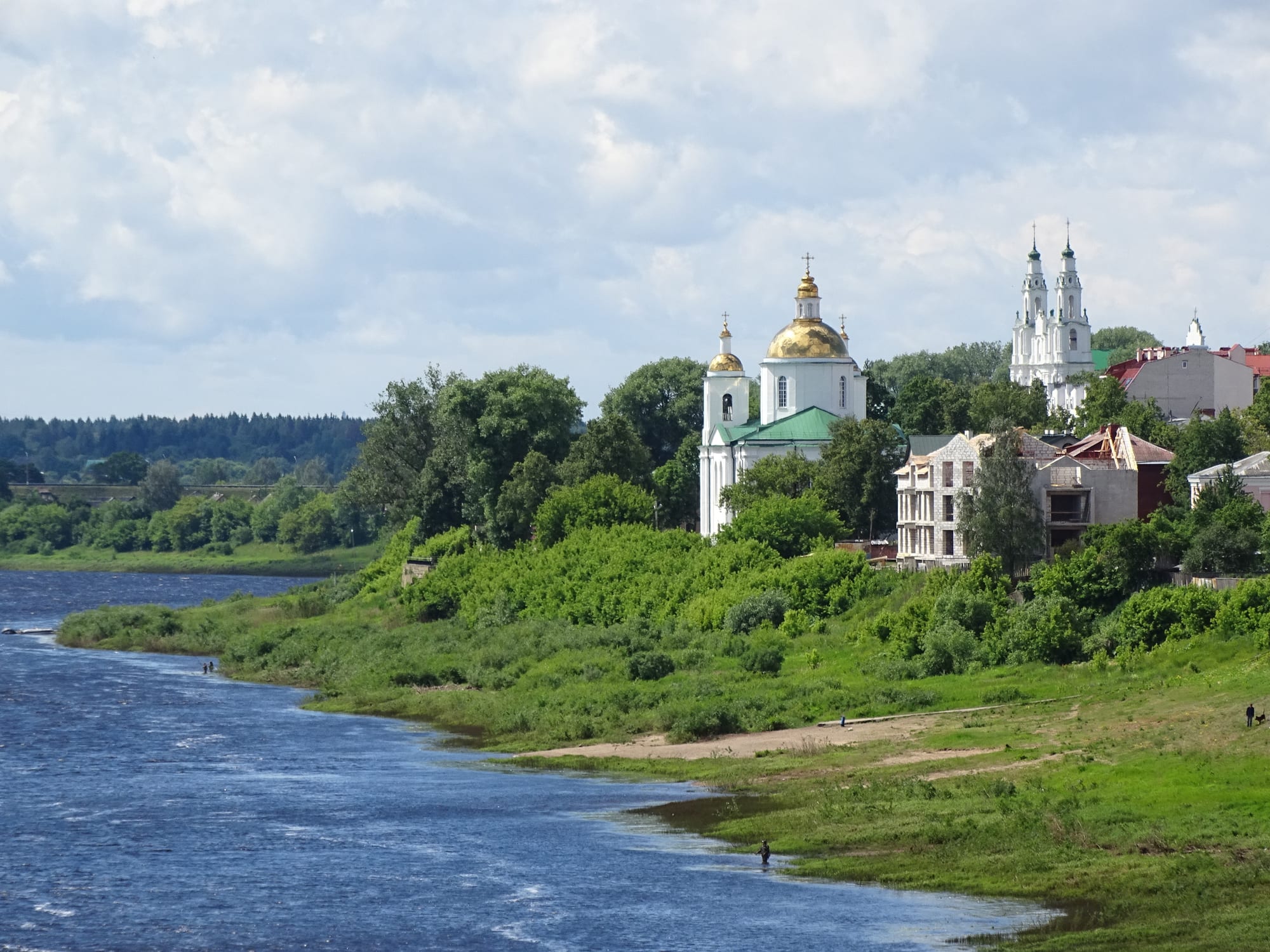
The north is where Belarusian history begins. Polotsk, on the Western Dvina, is recorded in the chronicles in 862, and by the 10th century it was the seat of a principality ruled by Rogvolod, whose daughter Rogneda was forcibly married to Vladimir of Kyiv. Under Vseslav, remembered as "the Sorcerer", Polotsk rivalled Kyiv and Novgorod in the 11th century and built its own Cathedral of St Sophia. In the 12th century the princess Euphrosyne founded a convent, a school and a scriptorium, and she is now one of the country's most revered saints. Vitebsk, upstream, grew as a trading town on the Dvina route to the Baltic.
Both towns passed into the Grand Duchy of Lithuania and then the Commonwealth. Francysk Skaryna, born in Polotsk, printed his Bible translations in Prague from 1517, the start of Belarusian printing. Ivan the Terrible took Polotsk in 1563 until Stefan Batory recovered it in 1579, and the battle of Orsha in 1514, a Lithuanian victory over Muscovy, remains a touchstone of national memory. The first partition of 1772 brought the region into the Russian Empire.
Vitebsk became a busy Jewish town in the Pale of Settlement, where Marc Chagall, born nearby in 1887, grew up. After 1917 he founded a People's Art School there, and Kazimir Malevich and El Lissitzky briefly made it a centre of the Russian avant-garde. In the Second World War the region's forests sheltered large partisan forces and the Jewish population was destroyed; much of old Vitebsk was destroyed before its liberation in June 1944.