History
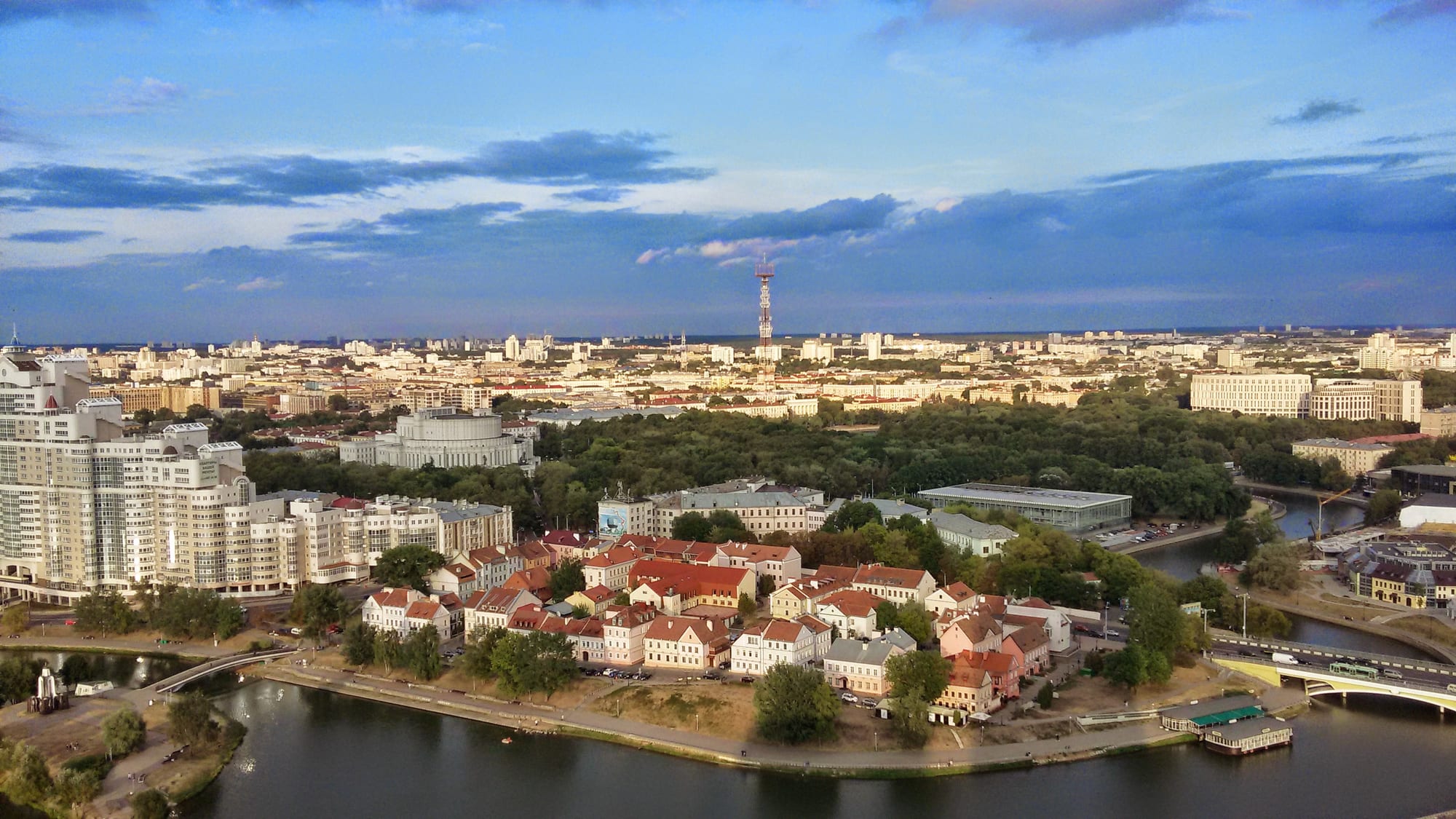
Minsk enters the chronicles in 1067, when the princes of Kyiv defeated Vseslav of Polotsk at the Battle on the Nemiga River, now a stream buried under a Minsk avenue. The town grew as a fortified trading post of the Polotsk lands and passed with them into the Grand Duchy of Lithuania, receiving Magdeburg rights of self-government in 1499. Nearby Zaslawye, one of the oldest settlements in the region, is tied in legend to Rogneda of Polotsk and her son Iziaslav.
Under the Polish–Lithuanian Commonwealth the great landowning families shaped the countryside, above all the Radziwiłłs of Nesvizh, whose Mikołaj Krzysztof "the Orphan" rebuilt the castle from 1582 and commissioned the Corpus Christi Church, an early Baroque work by the Italian Jesuit Giovanni Maria Bernardoni. Slutsk became famous for its woven silk sashes. The second partition of 1793 brought Minsk into the Russian Empire, and in 1812 Napoleon's retreating army crossed the Berezina near Barysaw at huge cost.
By the late 19th century Minsk was a railway junction and a largely Jewish city. It became the capital of Soviet Belorussia, and in 1941–44 German occupation destroyed it: the Minsk ghetto was among the largest in occupied Europe, and tens of thousands were murdered at Maly Trostenets. Liberation came on 3 July 1944, now Independence Day. The ruined city was rebuilt as a showcase of Stalinist planning and industry, became the capital of independent Belarus in 1991, and is one of the administrative centres of the Commonwealth of Independent States.