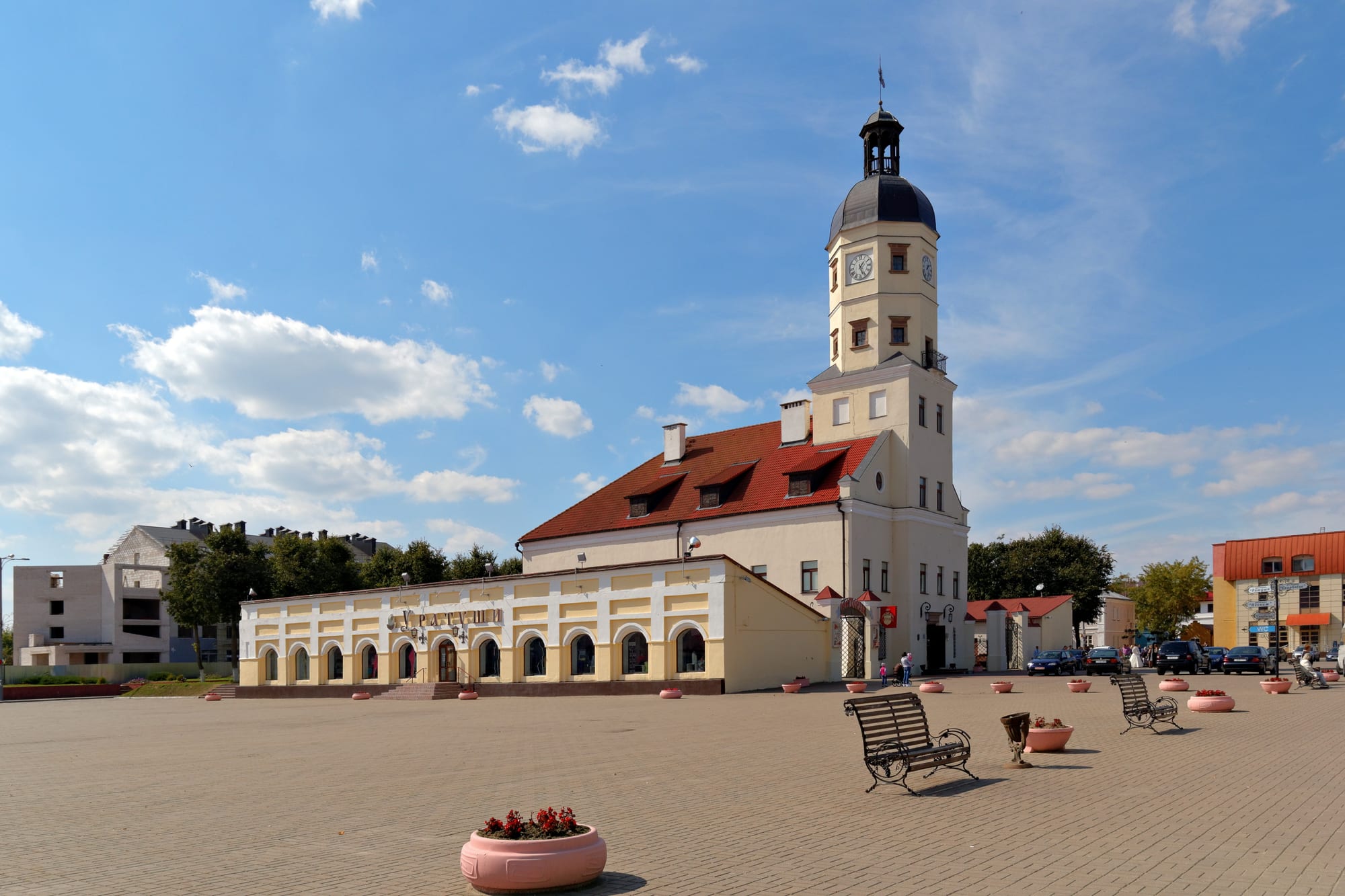
Nesvizh town hall with its cream clock tower, dark dome and red roof beside an arcaded row on a paved square

Minsk & Central Belarus, Belarus

Nesvizh

The town hall and its arcaded trading row on the main square of Nesvizh. (Alexxx1979 / Wikimedia Commons · CC BY-SA 4.0)

A small town of about 16,000 people in the Minsk Region, south-west of the capital, that grew up as the seat of the Radziwiłł princes. Their palace, set behind a moat among ponds and a large landscape park, forms a UNESCO World Heritage Site with the Corpus Christi Church, and the compact town keeps its town hall and an old city gate.

Neighbourhoods

  • Town centre
    • First-time visitors
    • Historic district
    • Close to the bus station

    The small grid around the town hall square, with the bus station nearby, the Slutsk Gate at the end of one of the old streets and low houses along the roads leading out. Quick-service restaurants line the street from the town hall towards the castle, and souvenir shops cluster near the castle.

    Open in Maps
  • Castle and park
    • Sightseeing
    • Parks
    • Walks

    The Radziwiłł palace stands on its own island behind earth ramparts with bastions and a moat, reached by a bridge. Around it lie ponds and an English-style landscape park of more than a square kilometre, with paths along the water.

    Open in Maps

Things to do

The Radziwiłł complex

  • Nesvizh Castlelandmark

    The Radziwiłł residence, begun in the early 1580s on the site of a medieval castle and turned into a Renaissance-Baroque palace, used as a sanatorium in Soviet times and extensively restored in 2004–2012; it is a UNESCO World Heritage Site.

    Open in Maps
  • Corpus Christi Churchlandmark

    An early Jesuit church built in 1587–93 by Giovanni Maria Bernardoni, one of the oldest Baroque buildings outside Italy, with the crypt where many Radziwiłłs are buried.

    Open in Maps
  • Castle park and pondspark

    The English-style landscape park laid out around the castle in the late 19th century, with lakes and paths for walks around the palace.

    Open in Maps

The old town

  • Town halllandmark

    A building with Renaissance and Baroque features on the main square, one of the few historic town halls preserved in Belarus.

    Open in Maps
  • Slutsk Gatelandmark

    An old city gate built around 1700, named after the nearby town of Slutsk, and the only one of the town's gates to survive.

    Open in Maps
  • Nesvizh District Local History Museummuseum

    The town's local museum on Leninskaya Street, covering the history of Nesvizh and its district.

    Open in Maps

Short trips from the town

  • Mir Castlelandmark

    The Brick Gothic fortified castle at Mir, another Radziwiłł property and a UNESCO World Heritage Site, often visited on the same day as Nesvizh.

    Open in Maps

Eat and drink

Long-standing places and food districts in Nesvizh. Hours, ratings and directions come from your maps app, always current.

Nesvizh eating

  • Restaurants between the town hall and the castleneighborhood

    Quick-service restaurants and cafés along the street from the town hall and bus station to the castle, serving Belarusian staples such as draniki, potato pancakes with sour cream.

    Open in Maps
  • The castle restaurantrestaurant

    A restaurant inside the castle complex, convenient for a meal during a visit to the palace.

    Open in Maps

Experience Nesvizh

History

Nesvizh was a minor town in the 15th century, when it belonged to the Kiszka family, before it passed to the Radziwiłłs, who made it their seat until 1813. In 1561 or 1562 a press of the Polish Brethren was founded here. Mikołaj Krzysztof Radziwiłł, known as "the Orphan", began the castle in the early 1580s, and between 1584 and 1598 Benedictines and Jesuits founded monasteries and a college; at his request King Stephen Báthory granted the town Magdeburg rights in 1586. The Jesuit Corpus Christi Church, built in 1587–93 by Giovanni Maria Bernardoni, replaced a wooden church of 1510.

After wartime damage, Michał Kazimierz "Rybeńko" Radziwiłł rebuilt the castle in the 1720s, and his wife, Franciszka Urszula Radziwiłłowa, founded the Radziwiłł theatre with a choir and ballet school. Between 1881 and 1886 Prince Antoni Wilhelm Radziwiłł and his wife Marie de Castellane renovated the interiors and laid out the landscape park.

In the 1921 census, 45.4 per cent of the townspeople declared Jewish nationality. On 30 October 1941 about 4,000 of the town's Jews were murdered and the rest confined to a ghetto, whose underground rose up when the Germans moved to destroy it in July 1942; most were killed, and a few escaped to the forests to join partisan units. Under Soviet rule the castle served as a sanatorium while the park fell into neglect. In 2005 the castle, church and surroundings were inscribed on the UNESCO World Heritage List, and the castle was restored between 2004 and 2012.

Culture & Customs

Nesvizh's identity is bound up with the Radziwiłłs, one of the most powerful noble families of the Polish–Lithuanian Commonwealth. Their palace, theatre, printing and patronage made the town a cultural centre for more than two centuries, and the restored palace interiors and the family crypt beneath the Corpus Christi Church now draw visitors from across Belarus and abroad. The last burial in the crypt took place in 2000, when the ashes of Antoni Mikołaj Radziwiłł were brought from London.

The town's history reflects the old mix of the region. In the 1921 census, 45.4 per cent of residents declared Jewish nationality, 44.4 per cent Polish and 9.4 per cent Belarusian — a mix that disappeared with the killings of 1941–42 and the post-war border changes.

Daily culture is that of a small Belarusian district town: Russian is the language of everyday life, Belarusian appears on signs and in official naming as Niasviž, and the town is used to visitors who arrive in tour groups by bus from Minsk. Manners are polite and reserved, and the Corpus Christi Church remains an active parish where services are held.

Daily Life

About 16,000 people live in Nesvizh, according to a 2026 figure, up from about 14,300 in 2009. It is the administrative centre of the Nyasvizh District of the Minsk Region, so the district offices, schools and services employ many residents, and the castle and its visitors support museum staff, guides, cafés, souvenir shops and guesthouses.

The town is compact: low houses and gardens line the streets around the centre, with Soviet-era blocks on the edges and farmland beyond. The rhythm is set by the buses to Minsk, Pinsk and the railway at Haradzeya, and by the stream of visitors to the castle, many of whom continue to Mir the same day. Souvenir shops cluster near the castle, while the town's own shops, schools and offices sit around the town hall square and the main streets. Most residents' lives revolve around district jobs, gardens and the routines of a quiet provincial town rather than the tourist trade.

Food

Nesvizh eats the national repertoire of Belarusian cooking, which is hearty and built above all on the potato. Draniki, crisp potato pancakes, are served with sour cream or with verashchaka, a thick meat gravy with pieces of meat and sausage, and kalduny are small boiled dumplings with a range of fillings. Beet and cabbage soups, rye bread and salo, which is cured pork fat, complete the table. Pork dishes are usually fried or stewed and garnished with cheese or mushrooms, and sour cream is used both in cooking and as a garnish.

Restaurants and quick-service cafés line the street from the town hall to the castle, and the castle complex has its own restaurant, so most visitors eat within a few minutes' walk of the sights. Kvass remains the main local non-alcoholic drink, and the traditional hard drink is vodka, including varieties flavoured with forest herbs, alongside krambambula, vodka mixed with honey and spices, which is enjoying a revival. Meals are substantial and plainly seasoned, and kissel, a jelly drink made from forest berries or cooked fruit, is a traditional accompaniment.

Planning tools

Budget

Nesvizh is cheaper than Minsk. The castle ticket is the main cost of a visit, and the town's cafés and guesthouses are inexpensive. Foreign cards are often blocked by sanctions, so bring enough cash, changed in Minsk, for the visit.

Daily Budget Midrange
USD 60–120 (hotel room, restaurant meals, castle tickets, a hired car or tour for Mir)
Daily Budget Shoestring
USD 25–45 (guesthouse or budget hotel, café meals, buses from Minsk)

Most visitors come for the day from Minsk; combining Nesvizh with Mir Castle makes the trip worthwhile.

Best Time to Visit

May to September, when the park is green, walks around the ponds are pleasant and buses and tours from Minsk run most often. Early autumn brings colour to the park. The palace interiors can be visited all year, but the grounds are bleak and cold in winter.

Suggested Number of Days

Most visitors see the town in a single day, often from Minsk. Staying overnight allows a slower pace and makes it easy to add nearby Mir; relying on buses rather than a car adds time.

First Visit
1 day
With Surroundings
2 days

Transportation

The town is easily covered on foot. Buses from the bus station run to Minsk, Pinsk and nearby towns, and local buses connect with suburban trains at Haradzeya station. Mir can be reached by bus; otherwise a taxi or hired car is needed.

Check the times of the last buses back to Minsk or to Haradzeya before setting out.

Airport & Station Connections

Nesvizh lies south-east of the M1 highway between Minsk and Baranavichy. A few buses a day run from Minsk's central and eastern bus stations, a journey of about an hour and a half; the cheaper alternative is a suburban train to Haradzeya and a connecting bus of about 25 minutes. Minsk National Airport is the nearest international airport.

Walkability

Very walkable. The town hall, the Slutsk Gate, the Corpus Christi Church and the castle are all within a short walk of one another and of the bus station, and the park's paths lead around the ponds.

Safety

Setting aside politics, Belarus has low street crime and is an orderly place to travel. Nesvizh is a quiet small town; the serious risks in Belarus are political and legal, since the authorities detain people, including foreigners, on vague charges and there is no tolerance of protest or of photography of security and government sites. Several Western governments advise against all or all-but-essential travel to Belarus.

Carry a passport, keep a low profile and avoid anything touching on politics. Check current official travel advice before travelling.

Climate

A humid continental climate, as across central Belarus: cold, snowy winters and warm, showery summers with thunderstorms.

Summer
warm across central Belarus, mostly 18–25°C, with thunderstorms and occasional hot spells above 30°C
Winter
cold and grey across central Belarus, around −4 to −8°C, with snow cover for much of December to March

Local Customs

Russian is the everyday language, with Belarusian on signs. The Corpus Christi Church is an active Catholic church, so quiet behaviour and modest dress are expected inside. Manners are formal with strangers. Tipping is not expected in most situations; in sit-down restaurants around 10 per cent is usual if no service charge is added.

Avoid photographing police or official buildings, and ask before photographing people.

Common Payment Methods

The currency is the Belarusian ruble (BYN). Cards work at the castle and larger places when the card itself is not blocked by sanctions, but cash is needed in small cafés and shops; change money in Minsk beforehand.