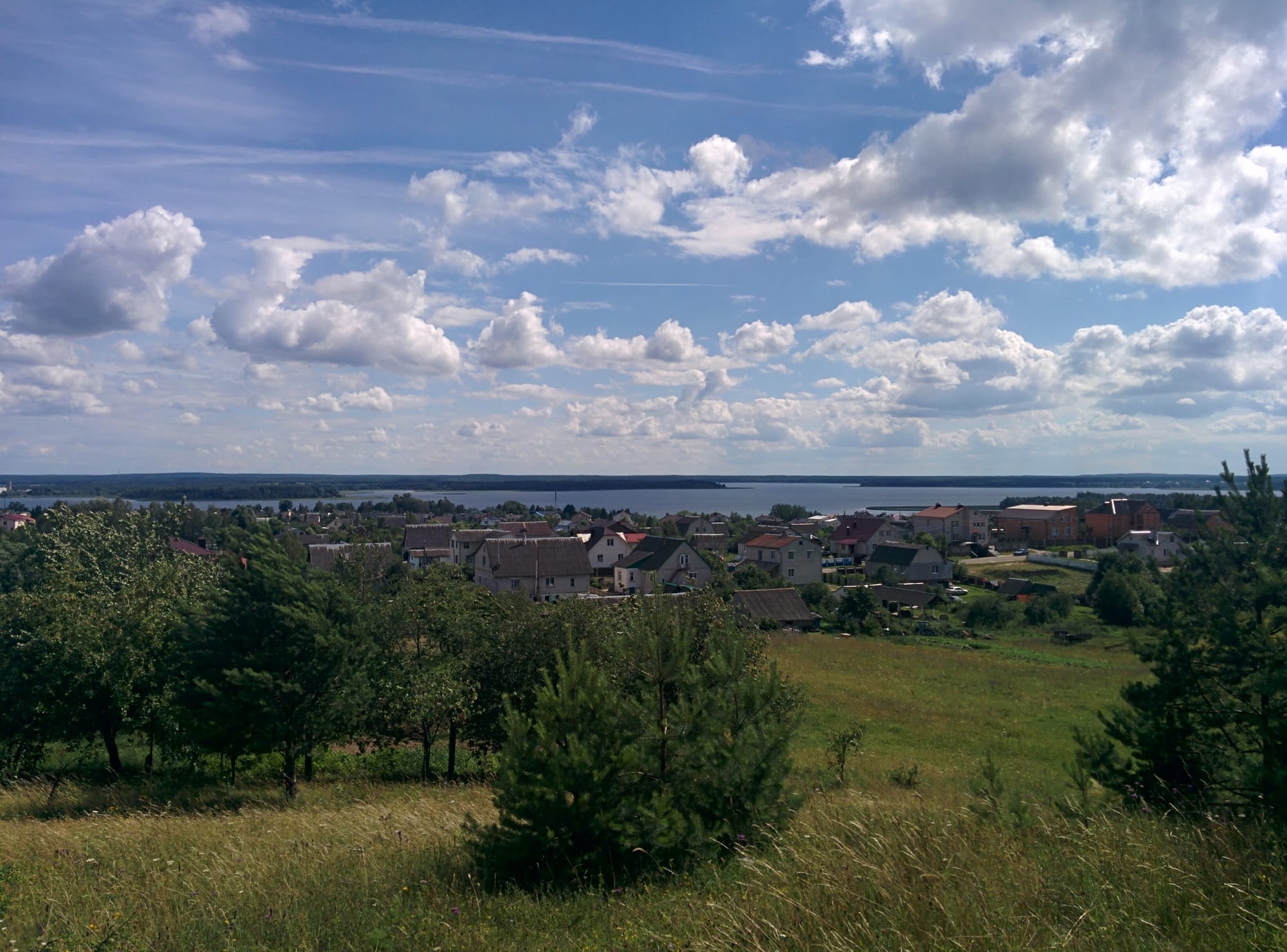
Houses and gardens of Myadzyel on a slope above a wide lake, with pine trees and a meadow in the foreground

Minsk & Central Belarus, Belarus

Myadzyel

Houses of Myadzyel above the lakeshore in summer. (Viktar Palstsiuk / Wikimedia Commons · CC BY-SA 4.0)

A small lake town of about 6,800 people in the north-west of the Minsk Region, on the shore of Lake Miastra inside Narachanski National Park. First recorded in 1325, it keeps the ruins of a grand-ducal castle and an 18th-century Carmelite church, and serves as the district centre for the lakes around Narach, the largest lake in Belarus.

Neighbourhoods

  • New Myadzyel
    • First-time visitors
    • Close to public transport

    The southern part of the town, once enclosed by a rampart, now the district centre with its offices, shops, the Holy Trinity Church consecrated in 2006 and the main road towards Minsk and Narach.

    Open in Maps
  • Old Myadzyel
    • Historic district
    • Quiet and residential
    • Lakeside walks

    The northern, older part of the town by the lake. Low houses and gardens run down towards the water, and the forested peninsula with the castle ruins is close by.

    Open in Maps

Things to do

In the town

  • Church of Our Lady of the Scapularlandmark

    A late Baroque church with rococo elements, built in 1754 for the Carmelite monastery and now in the care of the Discalced Carmelites.

    Open in Maps
  • Myadzyel Calvarylandmark

    A Way of the Cross first built in 1765 and destroyed in 1942, rebuilt in 2014 with a Gate of Forgiveness and 14 chapels.

    Open in Maps
  • Castle ruinsviewpoint

    The scant remains of the 16th-century stone grand-ducal castle on a forested peninsula of Lake Miastra, worth the walk for the lake views.

    Open in Maps

Lakes and forest

  • Lake Narachpark

    The largest lake in Belarus, 79.6 square kilometres and up to about 25 metres deep, home to eel, pike and burbot, and a resort area since the 1950s.

    Open in Maps
  • Narachanski National Parkpark

    A national park created in 1999 and covering more than 87,000 hectares of lakes and forest, home to red deer, badgers, martens and otters.

    Open in Maps
  • Narach resortattraction

    The resort settlement on the shore of Lake Narach, established in 1964, with the area's sanatoriums and beaches.

    Open in Maps

Eat and drink

Long-standing places and food districts in Myadzyel. Hours, ratings and directions come from your maps app, always current.

Lakeside eating

  • Cafés in the town centreneighborhood

    Simple cafés and canteens in New Myadzyel serving Belarusian staples such as draniki, potato pancakes with sour cream.

    Open in Maps
  • Narach resort cafésneighborhood

    Cafés and restaurants in the resort settlement on Lake Narach, busiest in summer.

    Open in Maps

Experience Myadzyel

History

The town's name is thought to be of Finno-Ugric origin, related to Estonian mänd and Finnish mänty, "pine". The first fortified wooden settlement stood on the largest island of Lake Myadzyel, where traces of its defences survive, and in about the 11th century it was probably a border town of the Polotsk lands. Myadzyel is first mentioned in 1325, in a Latin letter from Grand Duke Gediminas of Lithuania to the Archbishop of Riga complaining about the Teutonic Knights. Later the settlement moved to the north-eastern shore of Lake Miastra.

By the mid-15th century the town was divided into Old Myadzyel to the north and New Myadzyel to the south, the latter surrounded by a rampart, and in the 16th century a stone grand-ducal castle stood on a peninsula of Lake Miastra; its ruins survive. Within the Grand Duchy of Lithuania the town belonged to the Vilnius Voivodeship. A battle was fought nearby in February 1659, and in 1754 the Baroque church of Saint Mary was founded for the Carmelites.

The Second Partition of Poland brought Myadzyel into the Russian Empire in 1793. Between 1921 and 1939 it belonged to Poland, and the 1921 census recorded a mostly Polish and Belarusian population with a Jewish minority. The Red Army occupied the town in September 1939, and it was incorporated into Soviet Belorussia that November. German occupation lasted from July 1941 to July 1944. Since 1999 the town has lain within Narachanski National Park.

Culture & Customs

Myadzyel belongs to the historically mixed north-west of Belarus, where Catholic and Orthodox traditions meet. The Carmelite church and the Calvary, first built in 1765 and rebuilt in 2014 with its 14 chapels, mark the town's Catholic heritage, and the Holy Trinity Church was consecrated in 2006. Before the war the town had Polish, Belarusian and Jewish communities.

The town honours the Belarusian Soviet poet Maksim Tank with a monument unveiled in 2014. A gallery of wooden sculptures on children's and Narach themes, made in 2013 by students of the Belarusian State Academy of Arts at a wood carvers' plein air held in the town, decorates the centre, and war memorials recall the soldiers and partisans of the Second World War.

The lakes shape local identity. Since the 1950s Narach has been one of the main holiday areas of Belarus, with sanatoriums and beaches, and the town fills each summer with families from Minsk and across the country. Kupalle, the midsummer festival of bonfires and garlands set on the water, is celebrated across Belarus on the night of 6–7 July.

Daily Life

About 6,800 people live in Myadzyel, according to a 2026 figure. It is the administrative centre of the Myadzyel District, so district offices, schools, health services and shops employ many residents, and the national park and the holiday trade around Lake Narach provide much of the rest of the local work.

The town lies between Lake Miastra and Lake Batoryn, and daily life follows the seasons of the lakes. In summer the roads fill with holidaymakers heading to the Narach resort settlement, founded in 1964 on the site of the former village of Kupa, and to guesthouses and camps around the water; in winter the town returns to a quiet provincial pace.

Since the Middle Ages people around Narach have lived mainly by fishing and farming. Crayfish were the most profitable catch in the 19th century and eel in the 20th, and fishing remains part of local life on Lake Narach, the largest lake in Belarus.

Food

Myadzyel eats the national repertoire of Belarusian cooking, which is hearty and built above all on the potato. Draniki, crisp potato pancakes, are served with sour cream or with verashchaka, a thick meat gravy with pieces of meat and sausage, and kalduny are small boiled dumplings with a range of fillings. Beet and cabbage soups, rye bread and cured pork fat are everyday food, and pork dishes are usually fried or stewed and garnished with cheese or mushrooms.

The lakes add fish. Lake Narach holds 22 genera of fish, including eel, pike and burbot, and the national park's waters also have bream and crucian carp. Khaladnik, a cold borscht of beets, beet leaves or sorrel served with sour cream, hard-boiled eggs and boiled potatoes, is a Belarusian favourite, and sour cream is used both in cooking and as a garnish.

Kvass remains the main local non-alcoholic drink, and the traditional hard drink is vodka, including varieties flavoured with forest herbs.

Planning tools

Budget

The Narach lakes are cheaper than Minsk. Sanatoriums and guesthouses are the main cost and fill up in summer, while cafés and buses cost little. Foreign cards are often blocked by sanctions, so bring enough cash, changed in Minsk, for the whole stay.

Daily Budget Midrange
USD 60–120 (sanatorium or hotel room, restaurant meals, boat or bicycle hire, a hired car)
Daily Budget Shoestring
USD 25–45 (guesthouse room, café meals, buses from Minsk)

Farm-stays and guesthouses around the lakes are often better value than the resort settlement in high summer.

Best Time to Visit

June to August for swimming, boating and long evenings by the lakes, when the resort area is busiest; May and September are quieter and good for walking and cycling in the forest. Winter is cold and snowy and the town is quiet.

Suggested Number of Days

Two or three days are enough for the town and a taste of the lakes. Many Belarusians stay a week or more for a lake or sanatorium holiday, and the number grows with time spent on the water or in the forest.

First Visit
2–3 days
With Surroundings
4–7 days

Transportation

The town itself is small and walkable. Buses serve the town, but a car or bicycle gives much more freedom for getting around the lakes. Cycling is popular on the quiet roads around the lakes.

Check bus times in advance for trips between the lakes, especially outside summer.

Airport & Station Connections

Myadzyel is 143 km from Minsk on the Minsk–Naroch highway. The nearest railway station is Knyaginin on the Maladzyechna–Polatsk line, 31 km away. Minsk National Airport is the nearest international airport.

Walkability

The town is compact enough to cross on foot, with the church, the Calvary and the lakeside within easy reach of the centre and a walk to the castle peninsula through the forest. The wider lake district needs wheels.

Safety

Setting aside politics, Belarus has low street crime and is an orderly place to travel. Myadzyel is a quiet lake town; the serious risks in Belarus are political and legal, since the authorities detain people, including foreigners, on vague charges and there is no tolerance of protest or of photography of security and government sites. On the lakes, wind and cold water are the natural hazards. Several Western governments advise against all or all-but-essential travel to Belarus.

Swim at recognised beaches, take care on boats in wind, check for ticks after forest walks, and keep a low profile on political matters. Check current official travel advice before travelling.

Climate

A humid continental climate, as across central Belarus, with the Narach lakes staying a little cooler in the north of the region: cold, snowy winters and warm, showery summers.

Summer
warm across central Belarus, mostly 18–25°C, with thunderstorms; a little cooler by the Narach lakes
Winter
cold and grey across central Belarus, around −4 to −8°C, with snow cover for much of December to March

Local Customs

Russian is the everyday language, with Belarusian on signs. The Carmelite church is an active Catholic church, so quiet behaviour and modest dress are expected inside. Tipping is not expected in most places; in sit-down restaurants around 10 per cent is usual if no service charge is added. Lakeside life is relaxed, but manners with strangers are reserved.

Leave no litter in the national park, keep to marked paths and ask before photographing people.

Common Payment Methods

The currency is the Belarusian ruble (BYN). Cards work in larger shops and sanatoriums when the card itself is not blocked by sanctions, but cash is needed in small cafés, markets and guesthouses; change money in Minsk beforehand.