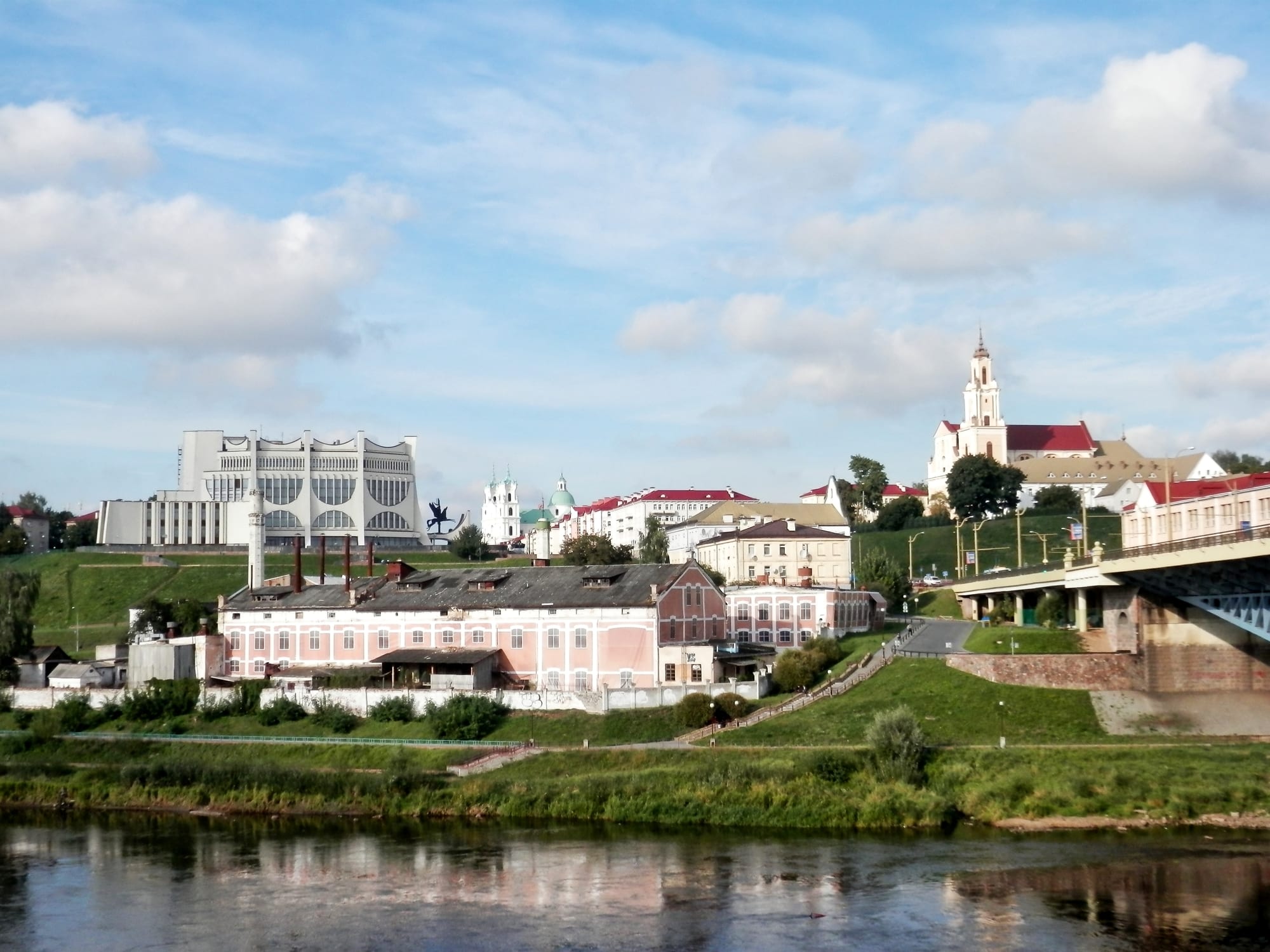
Grodno's centre on the high bank of the Neman, seen across the river

Brest, Grodno & the West, Belarus

Grodno

The centre of Grodno on its high bank above the Neman River. (Fczarnowski / Wikimedia Commons · CC BY-SA 4.0)

A city of about 364,000 people on the Neman in western Belarus, close to the Polish and Lithuanian borders. A royal residence of the Polish–Lithuanian Commonwealth, where the last Sejm met in 1793, it keeps two castles, a 12th-century church and Baroque monasteries above the river, and is a centre of Roman Catholicism and Polish culture in Belarus.

Neighbourhoods

  • Old town and Sovetskaya Square
    • First-time visitors
    • Historic district
    • Best for food

    The hilltop centre around Sovetskaya Square, where the Jesuit cathedral stands, with a long pedestrian street of cafés and shops leading away from it. Baroque monasteries, the Great Synagogue and old houses fill the surrounding streets.

    Open in Maps
  • Castle Hill
    • History
    • Viewpoints
    • Museums

    The high bank of the Neman where the Old Castle, rebuilt in stone by Vytautas and in Renaissance style for Stephen Báthory, stands a little distance from the 18th-century New Castle. The Kalozha church stands a short walk away on the same high bank.

    Open in Maps
  • The Neman riverside
    • Walks
    • Parks
    • Quiet and residential

    Paths and green slopes below the old town along the Neman, crossed by the bridges that link the centre with the districts on the far bank, with views up to the castles and church towers.

    Open in Maps

Things to do

Castles and landmarks

  • Old Grodno Castlemuseum

    The castle at the meeting of the Neman and the Gorodnichanka, rebuilt in stone with Gothic towers by Vytautas in the 1390s and later a residence of Stephen Báthory; it houses a historical and archaeological museum with more than 200,000 objects.

    Open in Maps
  • New Grodno Castlelandmark

    The royal palace of Augustus III and Stanisław August Poniatowski, built in 1734–51 on the high bank of the Neman, where Poniatowski, the last Polish king, abdicated in 1795.

    Open in Maps
  • Kalozha Churchlandmark

    The Church of Sts Boris and Gleb, built before 1183 and the oldest standing structure in Grodno, its walls set with pitchers; part of it collapsed into the Neman in 1853.

    Open in Maps
  • St Francis Xavier Cathedrallandmark

    The Baroque Jesuit church on Sovetskaya Square, consecrated in 1705, with frescoes, altars and a tower clock that is among the oldest working clocks in Europe.

    Open in Maps
  • Bernardine monasterylandmark

    The monastery of 1602–18, renovated in 1680 and 1738, whose buildings show every style of the 17th century from Gothic to Baroque.

    Open in Maps
  • Bridgettine churchlandmark

    The church of the Bridgettine convent, completed in 1642 and one of the earliest Baroque buildings in the region, with a wooden two-storey dormitory of the 1630s still standing beside it.

    Open in Maps
  • Great Synagoguelandmark

    A synagogue built in an eclectic and Moorish style in 1902–05 by a community whose first Great Synagogue dates from the 16th century, returned to the Jewish community in 1991 and restored.

    Open in Maps

Parks and family visits

  • Grodno Zoopark

    Founded in 1927 by the teacher Jan Kochanowski and his pupils, the first zoo in what is now Belarus.

    Open in Maps
  • Pedestrian Sovetskaya Streetneighborhood

    The long pedestrian street leading down from the main square, lined with cafés, shops and restored façades.

    Open in Maps

Short trips from the city

  • Augustów Canalattraction

    A 19th-century cross-border canal with locks and weirs linking the Neman with the Vistula basin in Poland, proposed by Poland and Belarus for World Heritage listing.

    Open in Maps

Eat and drink

Long-standing places and food districts in Grodno. Hours, ratings and directions come from your maps app, always current.

Grodno eating

  • Sovetskaya Streetneighborhood

    The pedestrian street from the main square holds a number of the city's cafés and restaurants.

    Open in Maps
  • Restaurants around Sovetskaya Squareneighborhood

    Restaurants around the central square include places serving Belarusian dishes such as babka, grated potato baked with bacon and onion, and kalduny, small boiled dumplings.

    Open in Maps

Experience Grodno

History

Grodno was founded in 1127 as a small fortress and trading post on the Neman, at the northern edge of the Slavic lands facing the Baltic Yotvingians. Its Kalozha church was standing before 1183, the year a fire burned the town and its stone churches. In the 1390s Grand Duke Vytautas rebuilt the castle in stone with Gothic towers and made it one of his main residences, and the city became part of the Grand Duchy of Lithuania and the Polish–Lithuanian union.

Under the Commonwealth Grodno was a royal city. In the 1580s King Stephen Báthory made it his main residence and military headquarters, rebuilt the Old Castle in Renaissance style and died there in 1586. Sejms met in the city, including the last in the Commonwealth's history in 1793, and in the New Castle, built under the Saxon king Augustus III, Stanisław August Poniatowski abdicated in 1795 as the partitions handed the city to Russia. The Russian Empire banned Polish in public places in 1865, while the Jewish population grew until Grodno was about half Jewish: in 1907 there were 25,000 Jews among 47,000 people.

After the First World War the city passed to Poland. Heavy fighting followed the Soviet invasion in September 1939, after which many Polish defenders were massacred and thousands of residents deported. German occupation lasted from June 1941 to July 1944, and the city's Jews were confined to ghettos and murdered. Most of the Polish inhabitants were expelled or fled to Poland in 1944–46 and 1955–59. Soviet authorities demolished several historic churches, including the Bernardine church of the Nativity in 1951 and Vytautas' Church in 1961. Reconstruction of the Old Castle began in 2017 and has been criticised for lacking historical authenticity.

Culture & Customs

Grodno's centre can feel more western European than Soviet, and the city has one of the largest concentrations of Roman Catholics in the country. It is a centre of Polish culture, with a large share of Belarus's Poles living in and around the city, and Orthodox believers are also widely present. The city's Catholic and Orthodox churches are among its architectural treasures.

Its Jewish past is part of the city's fabric. Before the Holocaust about half the population was Jewish; today several hundred Jews remain, with the community's life centred on the Great Synagogue, returned in the 1990s. The Polish writer Eliza Orzeszkowa, born nearby, lived and worked in the city.

Festivals give the cultural year its shape. Every two years since 1996 the Festival of National Cultures, the largest in Belarus, draws performers and visitors from the country's many communities, and the city also holds the student festival Student's Spring, an international celebration of piano music and a national festival of youth theatre. The Grodno Regional Drama Theatre stands on the site of the Bernardine church demolished in 1951.

Daily Life

About 364,000 people live in Grodno, according to a 2025 figure, and the city is the administrative centre of the Grodno Region. The city lies about 15 km from the Polish border and 30 km from the Lithuanian one, and the Neman, joined in town by the Lasosna and the Haradničanka, divides the old hilltop centre from districts on the far bank.

Industry includes Grodno Azot, the state-run producer of nitrogen compounds and fertilisers. The Grodno State Medical University draws students from across Belarus and from abroad, and a Polish school, opened in 1995, teaches every subject in Polish. Getting around the city relies on buses and on trolleybuses, which have run since 1974; in 2009 the trolleybus system had 12 routes and carried around 66.5 million passengers a year.

The border is close, and Poles remain the second most numerous nationality after Belarusians, at 22 per cent in 2019; Poland keeps a consulate general in the city. Evenings bring people to the pedestrian street and the riverside.

Food

Western Belarusian cooking shares dishes with its Polish neighbours. Potato babka, grated potato baked with eggs, onion and bacon, is popular in Belarus and north-eastern Poland, and kalduny are small boiled dumplings made with a wide range of fillings. Draniki, pancakes of grated potato, are eaten with sour cream or dipped in machanka, a thick meat-and-sausage gravy. Raw pork sausage seasoned with salt, pepper and garlic is a long-standing Belarusian staple.

Among Polish Catholics the Christmas Eve supper, Wigilia, is twelve meatless dishes: borscht or wild mushroom soup, herring and other fish, and kutia, a grain dish with poppy seeds and honey. Local mushrooms and forest berries are long-standing Belarusian ingredients.

The pedestrian street leading from the main square is where a number of Grodno's cafés and restaurants cluster. Among drinks, beer has been brewed in nearby Lida since the 19th century, and Lidskae is one of the beers with a strong share of the Belarusian market; kvass remains the main local non-alcoholic drink.

Planning tools

Budget

Grodno is cheaper than Minsk, with good-value hotels, inexpensive cafés and low museum fees. Foreign cards may not work because of sanctions, so bring cash in euros or US dollars to change.

Daily Budget Midrange
USD 50–100 (central hotel, restaurants, museum tickets, a hired car for the canal or the castles)
Daily Budget Shoestring
USD 25–40 (budget hotel, canteen food, buses and trolleybuses)

Most of the sights are free to see from outside; change money at banks in the centre.

Best Time to Visit

May to September, when the riverside paths and the pedestrian street are at their best and the Augustów Canal is green; the Festival of National Cultures, held every two years, attracts many visitors. Winter is cold but milder than in eastern Belarus.

Suggested Number of Days

Two days are enough for the old town, the castles and the churches. Three or four allow for the canal and the forest towards the border, which need a car or an organised excursion.

First Visit
2 days
With Surroundings
3–4 days

Transportation

The centre is compact, and plenty of buses and trolleybuses run across the city, with tickets sold at kiosks near the stops. Taxis are inexpensive. The canal and the countryside are best reached by car or excursion.

Buy bus and trolleybus tickets at kiosks before boarding and validate them on board.

Airport & Station Connections

Grodno is 300 km from Minsk, reached by daily trains taking about five hours or by express buses of about four hours. The station is where carriages change wheels between the different track gauges, and trains run to Moscow and to Białystok in Poland. Grodno Airport lies 18 km south-east of the city.

Walkability

The old town is compact and best seen on foot, with the castles, the cathedral, the synagogue and the pedestrian street close together on the high bank. Slopes down to the Neman are steep in places, and the bridges make good viewpoints.

Safety

Setting aside politics, Belarus has low street crime and is an orderly place to travel. Grodno lies in a militarised border region: border zones require permits and are patrolled, photographing border posts or military sites can lead to detention, and the authorities detain people, including foreigners, on vague charges. Several Western governments advise against all or all-but-essential travel to Belarus.

Stay out of marked border zones without a permit, avoid anything touching on politics and do not photograph security sites. Check current official travel advice before travelling.

Climate

A humid continental climate, milder across western Belarus than in the north and east, with shorter winters and warm, often wet summers.

Summer
warm across western Belarus, 19–26°C, with thunderstorms
Winter
cold but milder than the east, around −2 to −5°C across western Belarus, with less reliable snow

Local Customs

Grodno has one of the largest concentrations of Roman Catholics in Belarus and is a centre of Polish culture; Christmas is a holiday on both 25 December, for Catholics, and 7 January, for Orthodox Christians. Churches expect modest dress. Tipping is not expected in most situations; in sit-down restaurants around 10 per cent is usual if no service charge is added.

Behave quietly in churches during services and avoid photographing police, border posts or official buildings.

Common Payment Methods

The currency is the Belarusian ruble (BYN). Cards are accepted in shops, restaurants and hotels where foreign cards work at all, but sanctions block many, so carry enough cash, exchanged at banks, for the stay.