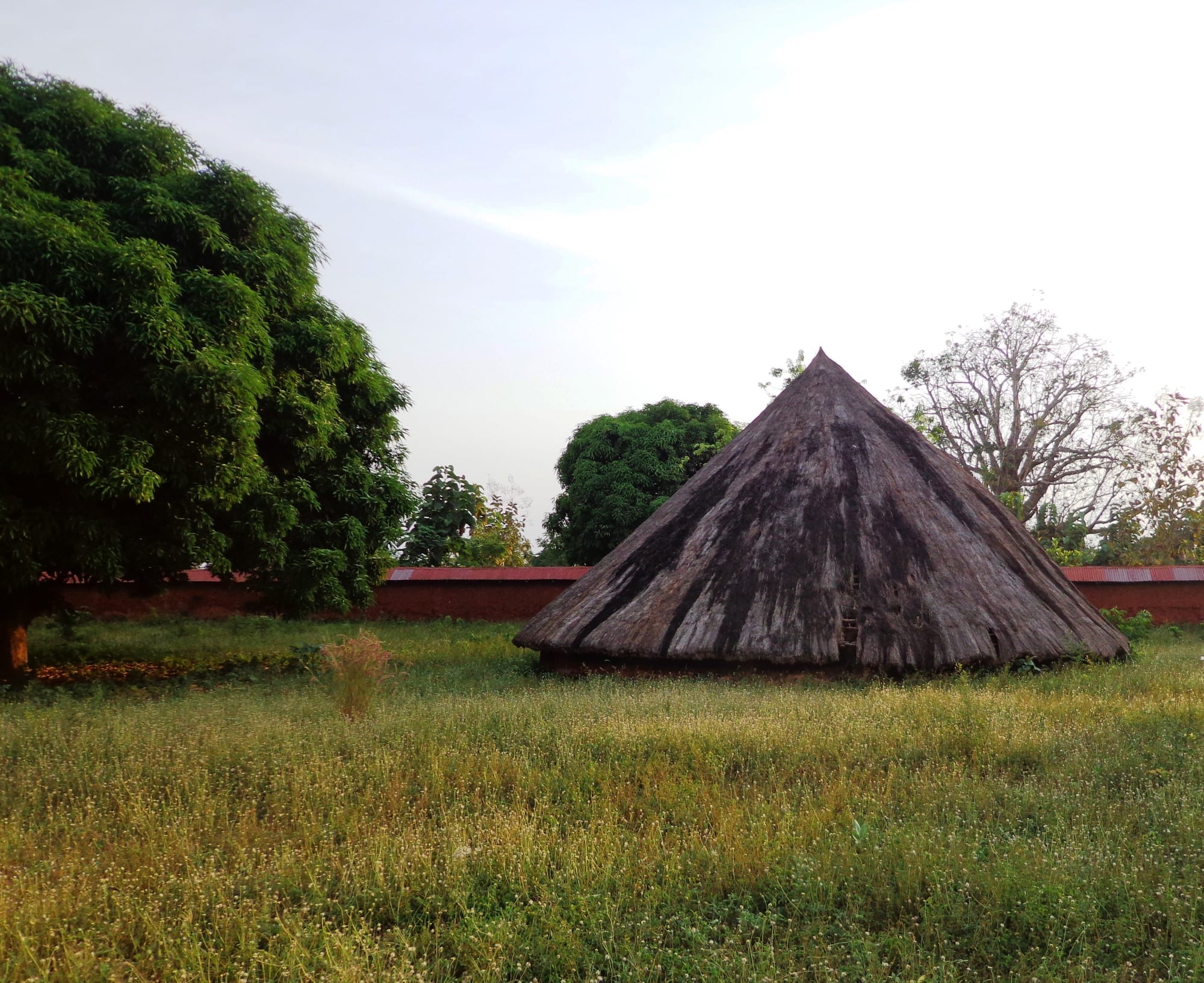
A long earthen building with a pitched metal roof and rows of small relief panels set into its red clay wall

Abomey & the Centre, Benin

Abomey

A palace building with relief panels inside the Royal Palaces of Abomey. (Karalyn Monteil / Wikimedia Commons · CC BY-SA 3.0 igo)

The old capital of the Kingdom of Dahomey, on a plateau about a hundred kilometres north of the Atlantic coast. From the 17th century each king built his own earthen palace beside his predecessor's, leaving a walled complex of courtyards and painted bas-reliefs that is now a World Heritage Site and museum. The modern town around it is quiet and provincial.

Neighbourhoods

  • The palace quarter
    • First-time visitors
    • Historic district
    • Museums

    The centre of the old royal city, where the walled palace complex and its museum stand behind long earthen walls. Craft workshops, guides and a few small hotels are within walking distance, and the streets are wide, dusty and low-rise.

    Open in Maps
  • Goho and the market area
    • Markets
    • Local life

    The commercial side of town around the market and the main junction, busy with traders, motorcycle taxis and roadside stalls. Place Goho, with its statue of King Behanzin, marks the road out towards Bohicon.

    Open in Maps
  • The outer quarters
    • Quiet and residential
    • Vodun shrines

    Compounds and small farms spreading over the plateau beyond the centre, with royal temples, Vodun convents and family shrines among the houses. Life here is agricultural and slow, and distances are covered by zemidjan.

    Open in Maps
  • Bohicon
    • Close to public transport
    • Markets

    The larger, busier town about 10 kilometres east, grown up around the railway and the main north–south highway. It has the region's transport connections, banks and a large market, and many visitors sleep or change vehicles here.

    Open in Maps

Things to do

The royal city

  • Royal Palaces of Abomeylandmark

    The walled complex of earthen palaces raised by successive kings of Dahomey from the 17th century, inscribed as a UNESCO World Heritage Site in 1985; the palaces of Ghezo and Glele house the historical museum, with thrones, weapons, appliqué hangings and painted bas-reliefs.

    Open in Maps
  • Craft workshops of the palace quarterattraction

    Families of appliqué-cloth makers and brass casters who once worked only for the court still have workshops near the palace, stitching banners of royal symbols and casting small figures.

    Open in Maps

Markets and crafts

  • Abomey marketmarket

    The town's produce and goods market, where yams, maize, palm oil, cloth and Vodun ritual items are sold, and one of the stops on the rotating market cycle of the plateau.

    Open in Maps

Short trips from the town

  • Agongointo-Zoungoudo Underground Townattraction

    Underground chambers about ten metres deep, dug into the laterite near Bohicon, discovered in 1998 and thought to have sheltered warriors in the Dahomey period.

    Open in Maps
  • Bohicontransit hub

    The busy highway town a short ride east, on the railway line from Cotonou to Parakou, with the area's largest market and the region's transport connections.

    Open in Maps
  • Dassa-Zouméattraction

    A town among granite domes in the Collines, known as a place of Catholic pilgrimage to the Grotte Notre-Dame d'Arigbo, around which a basilica has been built.

    Open in Maps
  • Savalouattraction

    A hill town west of the highway, capital of a kingdom founded in the sixteenth century by Soha Gbaguidi I and long a neighbour and rival of Abomey.

    Open in Maps

Seasonal events

  • Vodun DaysJanuary

    The national Vodun holiday on 10 January is a public holiday here as across Benin, marked with ceremonies and drumming at the town's temples and convents, though the largest gathering is at Ouidah on the coast.

  • Royal and Vodun ceremoniesdry season, roughly December to April

    Ceremonies at the royal temples and the annual rites of Vodun convents cluster in the dry months, and the anniversaries of the kings bring the royal family and the town's quarters together.

  • Yam harvest festivalsAugust

    The new-yam festivals of the plateau and the Collines mark the point at which the new harvest may be eaten, and are kept by families and royal courts alike.

Eat and drink

Long-standing places and food districts in Abomey. Hours, ratings and directions come from your maps app, always current.

Markets and street food

  • Abomey marketmarket

    Yams and yam flour, maize, gari, red palm oil, groundnuts, fried wagasi cheese and bush meat, with cooked-food sellers working among the stalls.

    Open in Maps
  • Roadside stalls towards Bohiconmarket

    Stands along the road sell grilled maize, roasted groundnuts, kuli-kuli peanut sticks, fried plantain and yams to passing drivers.

    Open in Maps

Kitchens and bars

  • Maquis of the town centreneighborhood

    Open-air eateries serving pounded yam and maize dough with peanut or leafy-green sauces, grilled chicken and agouti, with beer, palm wine and sodabi in the evening.

    Open in Maps
  • Bohicon's market eateriesneighborhood

    Simple places around the market and the bus stops of the highway town, cooking rice, beans, maize dough and grilled meat for traders and travellers.

    Open in Maps

Experience Abomey

History

Abomey was founded on the plateau by a branch of the royal line of Allada, and Fon tradition names Houegbadja, in the second half of the 17th century, as the king who established the capital and the custom that shaped it: each ruler built his own palace beside those of his predecessors, so that the royal enclosure grew outwards into a walled city within the town. The dynasty traced itself to Agasu, a leopard in the founding story, and the leopard remained a royal symbol.

Dahomey became a highly organised military state. It fought almost continuously, raiding the Mahi to the north and the Yoruba to the east, and sold large numbers of captives to European traders at Ouidah, which King Agaja seized in 1727 to reach the coast directly. The annual royal ceremonies at Abomey included human sacrifice, recorded by European visitors, and the army included a corps of women soldiers, the Agojie, whom Europeans called Amazons. Ghezo, in the 19th century, and his son Glele were the strongest of the later kings.

When France invaded in 1892, King Behanzin resisted and burned much of Abomey before it fell; he surrendered in 1894 and was exiled to Martinique, and French troops carried off thrones, statues and carved doors. Under colonial rule Bohicon grew around the railway while Abomey became a quiet provincial town. The palaces were inscribed as a UNESCO World Heritage Site in 1985 and placed at once on the list of World Heritage in Danger, a tornado having damaged them in 1984; they were taken off that list in July 2007. In 2021 France returned 26 statues looted in 1892, shown in Cotonou from the following year and celebrated across Benin.

Culture & Customs

Abomey lives with its royal past as a present institution. The royal family still names a king of Abomey, whose authority today is traditional and ceremonial, and the lineages of former kings maintain temples where rites for the ancestors are performed. Vodun is strong here, as it is on the coast, and the town has many convents where initiates are trained; Vodun, Catholicism and Islam coexist, often in the same families.

The court's crafts are the town's best-known art. Appliqué cloths, cut and stitched in bright colours, carry the emblem by which each king is remembered, and are made by families who once worked for the palace alone. Brass casters use the lost-wax method to make small figures of daily life and royal history, and the bas-reliefs on the palace walls, painted clay panels of battles, animals and proverbs, functioned as the kingdom's record.

The Agojie, the women soldiers of the kingdom, have become a strong element of Beninese national memory, and the town is part of a wider national conversation about how a state that grew rich on the slave trade should be remembered. Visitors are expected to treat the palace, temples and ceremonies with the seriousness given to a royal site, and guides mediate access to most of them.

Daily Life

About 97,000 people live in the commune of Abomey, against some 149,000 in neighbouring Bohicon at the 2012 count, which long ago overtook the old capital as the region's commercial centre. The contrast shapes daily life: Bohicon has the highway, the buses, the wholesale trade and the banks, while Abomey has the palaces, the schools and administrative offices of the Zou department, and a much slower pace.

Most households farm. Maize, cassava, yams, groundnuts and beans are grown on the plateau, oil palms supply palm oil and palm wine, and produce moves down to Cotonou through Bohicon's market. Craft work, teaching, small trade and the visitors who come for the palaces provide most of the rest of the town's income, and many young people leave for Cotonou or abroad, sending money home.

The week follows the rotating markets that move between the plateau towns on a fixed cycle, and the day follows the heat: early mornings in the fields and the market, a quiet middle of the day, and the evening at the maquis, at church or mosque, or around a television. Water supply in the dry season, the state of the earthen palace walls and the pull of the larger towns are steady local concerns.

Food

The plateau eats from the farm, and yam is the prestige food. Pounded yam, igname pilée, is beaten to a smooth, elastic dough and eaten by hand with a peanut sauce, a leafy-green sauce or a tomato and palm-oil sauce, often with chicken, smoked fish or bush meat. Dried yam ground to flour makes télibo, a dark, stiff paste that is one of Benin's staple dishes and distinctly a food of the interior.

Maize is the everyday base: akassa, fermented maize dough wrapped in leaves, and amiwo, the red dough cooked in a tomato and palm-oil stock, usually with chicken. Sauces lean on groundnut, okra, baobab leaf and the fermented néré seed. Wagasi, the soft Fulani cow's-milk cheese brought down from the north, is fried in slices and sold at the market or cooked in sauce, and grilled agouti, the grasscutter rodent, is a valued bush meat along the roads.

Snacks are roasted groundnuts, kuli-kuli — fried sticks of pressed peanut paste — grilled maize cobs in season and fried plantain. Palm wine is tapped fresh in the morning and distilled into sodabi, the clear spirit poured at ceremonies, and the market sells bissap made from hibiscus and, in the season, cheap pineapple and mangoes.

Planning tools

Budget

Abomey is among the cheaper places to stay in Benin. Hotels are simple and inexpensive, market and maquis meals cost little, and the main sightseeing expense is palace entry with a guide. What raises a daily total is transport: a car with driver from the coast, or the fares and time involved in reaching the town by bush taxi.

Daily Budget Midrange
USD 60–140 (best local hotel, restaurant meals, museum and guide fees, a car with driver)
Daily Budget Shoestring
USD 20–45 (basic hotel, market food, bush taxis and zemidjan)

Carry cash from Cotonou or draw it at the machines in Bohicon; cards are rarely accepted in the town.

Best Time to Visit

November to February is the most comfortable period, dry and a little cooler, before the heat of March and April. The plateau still has two wetter spells, the longer one from about April to July, which makes minor roads to villages slow. August brings the pilgrimage and harvest festivals to the towns further north, when rooms are scarce.

Suggested Number of Days

A day is enough for the palace complex and the workshops with a guide, and this is how most people visit, often as a stop on the way north. Two or three days suit anyone wanting the surrounding towns, the market cycle and the royal temples as well.

First Visit
1 day
With Surroundings
2–3 days

Transportation

Bohicon, about 10 kilometres east, is the transport hub: bush taxis and intercity coaches on the north–south highway stop there, and zemidjan motorcycle taxis cover the last stretch into Abomey and everything inside the town. Distances within Abomey are short but spread out, and hired cars come with a driver.

Agree fares with zemidjan riders in advance, and avoid travelling the highway after dark, when heavy lorry traffic makes it dangerous.

Airport & Station Connections

The paved highway north from Cotonou reaches Bohicon in about two to three hours, and Abomey is a short ride further west; coaches and bush taxis run the route through the day. The nearest airport is Cadjehoun in Cotonou, roughly 130 kilometres south. Rail is not a practical way to reach the town.

Walkability

The palace complex and the streets of craft workshops around it are flat and easily walked, and the centre is small. The town as a whole is spread thinly over the plateau, with long dusty stretches between quarters, little shade and few pavements, so most people use a motorcycle taxi to reach the market, the temples or the road to Bohicon.

Safety

Abomey is calm and lies well south of the areas affected by the insurgency in Benin's far north. The main danger is the road, above all the busy highway through Bohicon, where lorries and night driving cause frequent crashes. Petty theft is a risk at Bohicon's market and bus stations, and royal temples and Vodun convents have their own rules on entry and photography.

Avoid road travel after dark, keep valuables close at bus stations, and ask before photographing shrines or palace ceremonies. Hire a guide at the palace museum itself rather than from touts outside. Check current official travel advice before travelling.

Climate

Hotter by day and less humid than the coast. The plateau keeps two wetter periods, a long one from about April to July and a second around September and October, with a dry season from November to March and hazy Harmattan skies from December to February.

Summer
wet from about April to October, around 24–30°C, with heavy storms
Winter
dry and hot from November to March, 30–35°C by day, dusty and hazy in the Harmattan

Local Customs

This is a royal town and the Fon court tradition still matters: the royal family names a king of Abomey whose role is ceremonial, and palace spaces, temples and convents are entered with permission and usually with a guide. Greetings come before any request, French is the language of business and Fon the everyday one, and dress in town is modest. Bargaining is normal in the market.

Ask before photographing shrines, ceremonies or people, and follow the museum's rules, which restrict photography inside parts of the palace complex.

Common Payment Methods

The currency is the West African CFA franc, pegged to the euro. Cash runs everything here: entry fees, guides, motorcycle taxis, the market and the maquis. The nearest reliable cash machines are in Bohicon, and cards are accepted almost nowhere in the town. Mobile money is widely used by residents.