Rounded bare granite domes rising above thick green trees and shrubs under a clear blue sky

Benin

Abomey & the Centre

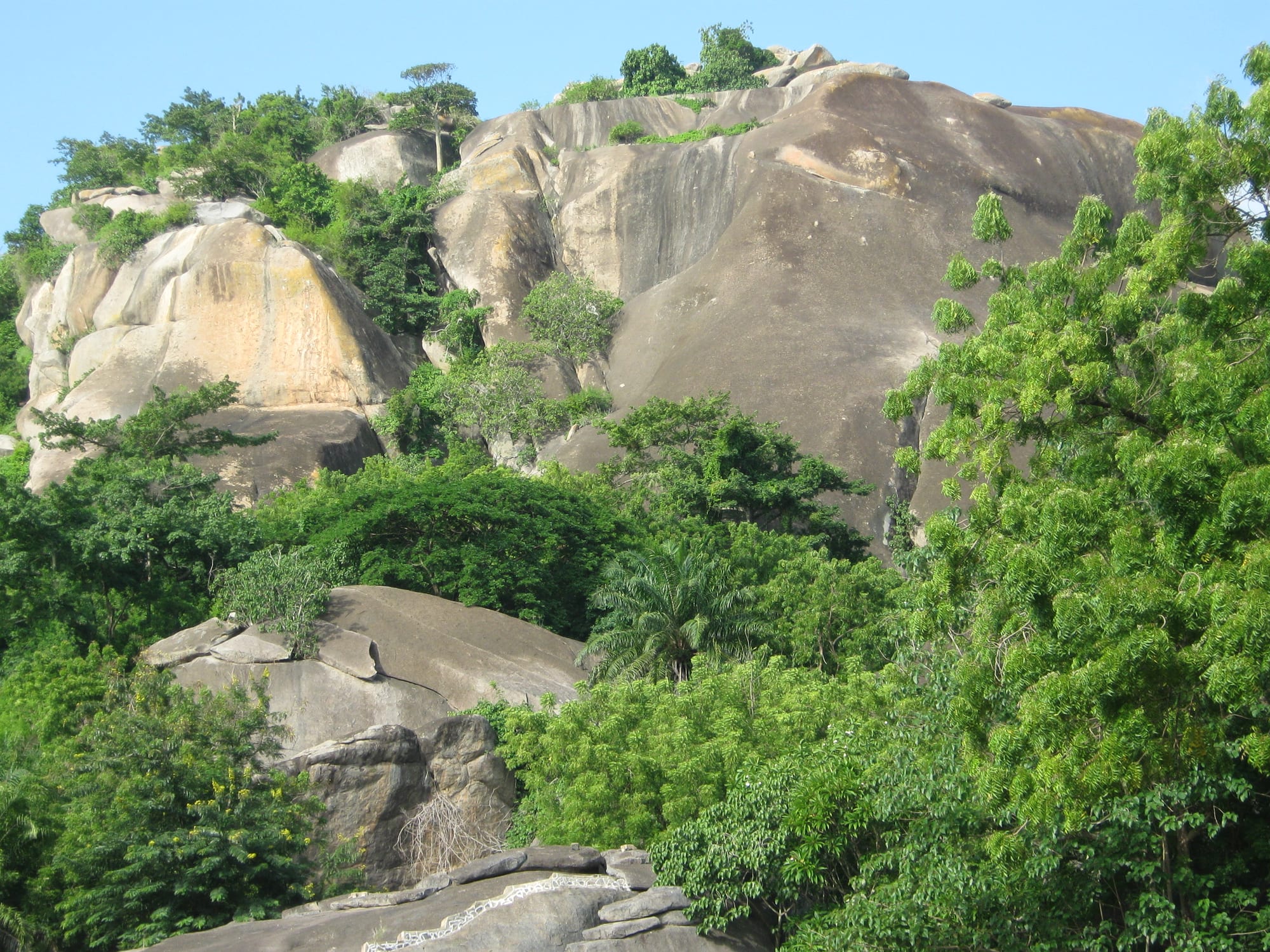
Granite hills at Dassa-Zoumé in the Collines department of central Benin. (Rachad sanoussi / Wikimedia Commons · CC BY-SA 4.0)

The middle belt of Benin, from the Abomey plateau, once the heart of the Kingdom of Dahomey, north into the granite hills of the Collines and east to the Yoruba towns of the Plateau department on the Nigerian border — a land of royal palaces, market crossroads, pilgrimage and yam farming.

Explore Abomey & the Centre

History

Abomey was the capital of the Kingdom of Dahomey from the 17th century. By tradition the dynasty was founded by migrants from Allada, and Houegbadja is remembered as the first king to build on the plateau. Each ruler raised a new palace beside those of his predecessors, so the royal enclosure grew into a walled city. Dahomey expanded through constant warfare, raiding the Mahi of the Collines and the Yoruba to the east for captives, many of whom were sold at Ouidah; the annual royal ceremonies included human sacrifice, which European visitors recorded. Its army included a corps of women soldiers, the Agojie.

King Ghezo, in the 19th century, and his son Glele were the kingdom's strongest later rulers. The Yoruba kingdom of Kétou on the Plateau suffered badly from Dahomey's attacks and was sacked in the 1880s. When France invaded in 1892, King Behanzin fought back and set fire to Abomey before it fell; he surrendered in 1894 and was exiled to Martinique. The French installed a successor and carried off royal thrones, statues and doors.

Under colonial rule the capital's importance faded while Bohicon grew around the railway. In 1985 the Royal Palaces of Abomey became a UNESCO World Heritage Site, and in 2021 France returned 26 treasures taken in 1892, a moment celebrated in Abomey and across Benin.

Culture & Customs

The Fon of the Abomey plateau still keep a royal culture. The royal family still names a king of Abomey, whose role today is traditional and ceremonial. Vodun is as present here as on the coast, and the town has many temples and convents.

The court's crafts survive. Appliqué cloths, stitched with symbols of each king, such as Glele's lion and Behanzin's shark, are made by families who once worked only for the palace, and brass casters make small figures depicting daily life and royal history. The bas-reliefs on the palace walls, painted clay panels showing battles, animals and proverbs, served as the kingdom's history book.

North of Abomey live the Mahi, around Savalou and in the hills, and the Idaatcha, a Yoruba-speaking people, around Dassa-Zoumé; eastwards, the Plateau department is Yoruba and Nago country, with Kétou's palace and the Egungun and Gelede masquerades. Catholicism has deep roots in the hills: Dassa-Zoumé's grotto draws tens of thousands of pilgrims each mid-August. Savalou's yam festival, held on 15 August, celebrates the new harvest.

Daily Life

Bohicon, with around 170,000 people, is the busiest town in the centre: a crossroads on the north–south highway, with a large market and wholesale trade in food heading south. Abomey itself has about 90,000 and a slower, provincial pace. Dassa-Zoumé, Savalou and Savè are the main towns of the Collines, and Pobè, Kétou and Sakété the centres of the Plateau.

Most people farm. Maize, cassava, yam and groundnuts are the staples, and oil palms and cotton are also grown on the Plateau. Proximity to Nigeria makes trade along the Plateau border lively, much of it informal. Young people move to Cotonou for work, and money sent back supports many households.

Days follow the markets, which rotate between towns on a fixed cycle, and the farming calendar. Roadside stalls along the highway sell yams, charcoal, bush meat and palm oil to passing drivers, and the evenings gather around the maquis and the mosque or church.

Food

The centre eats from the farm. Yams from the Collines are pounded into igname pilée, a smooth, stretchy dough served with a peanut or leafy-green sauce, or dried and ground into flour for télibo, a dark, stiff paste that is one of Benin's staple foods. Maize dough — akassa and the red amiwo — is the everyday base, with smoked fish brought up from the coast or bush meat such as grilled agouti.

Wagasi, the soft Fulani cow's-milk cheese, is sold fried in slices at markets and eaten in sauces. Groundnuts are roasted, pressed or turned into kuli-kuli, a fried peanut-paste snack. Palm oil, fresh and red, from the Plateau flavours most sauces, and the oil palm also gives palm wine, drunk fresh in the morning, and the distilled sodabi.

At Savalou's yam festival, the king formally permits the eating of the newly harvested yams.

Attractions & Natural Wonders

The Royal Palaces of Abomey are the region's centrepiece: a large complex of earthen walls and courtyards, of which the palaces of Ghezo and Glele house the Historical Museum of Abomey, with thrones, weapons, appliqué hangings and the famous bas-reliefs. In the town, Place Goho has a statue of Behanzin, and several royal temples and the workshops of appliqué makers and brass casters can be visited with a guide. Bohicon, a short ride away, has one of the region's largest markets.

North, the Collines department takes its name from its hills: granite domes and wooded ridges that break the savanna around Dassa-Zoumé, Glazoué, Savalou and Bantè. Dassa-Zoumé has the grotto of Notre-Dame d'Arigbo, a Marian pilgrimage site where a basilica with several shrines has been built. Savalou keeps its old royal dynasty and the yam festival.

To the east, Kétou keeps its old royal palace and the Akaba Idena gate, and the Plateau countryside between Pobè and Sakété offers palm groves, rivers and Yoruba market towns near the Nigerian border.

Cities in Abomey & the Centre

Planning basics

Budget

The centre is cheaper than the coast. Abomey, Bohicon and Dassa-Zoumé have simple hotels and guesthouses at modest prices, food in the markets and maquis costs little, and bush taxis on the main highway are inexpensive. Palace entry and a guide in Abomey are the main sightseeing costs; comfort and choice are limited, so a car with driver from Cotonou is what raises the budget.

Daily Budget Midrange
USD 60–140 (best local hotel, restaurant meals, museum and guide fees, a car with driver)
Daily Budget Shoestring
USD 20–45 (basic hotel, market food, bush taxis and zémidjan)

Carry cash from Cotonou or use the cash machines in Bohicon; smaller towns in the Collines and Plateau rarely take cards.

Safety

The centre is generally calm and outside the areas affected by the northern insurgency. Road accidents are the main danger, above all on the busy north–south highway, where heavy lorries and night driving cause frequent crashes. Petty theft is a risk in Bohicon's markets and bus stations, and Vodun convents and royal ceremonies have rules on entry and photography.

Avoid road travel after dark, keep valuables close at bus stations, and ask before photographing shrines or palace ceremonies. Check current official travel advice before travelling.

Climate

The centre is a transition zone. Around Abomey and the Plateau there are still two rainy seasons, as on the coast, while north into the Collines the pattern shifts towards a single long wet season from about May to October. It is less humid than Cotonou and hotter by day in the dry months, with hazy Harmattan skies from December to February.

Summer
wet from about April or May to October, 24–30°C, with heavy storms
Winter
dry and hot from November to March, 30–35°C by day, dusty and hazy in the Harmattan

Transportation

The paved highway north from Cotonou runs through the region: Bohicon, the transport hub a short ride from Abomey, is about two to three hours away, and Dassa-Zoumé a further hour or so, with Savalou reached on a branch road to the west. The Plateau towns of Pobè and Kétou lie on a separate road north from Porto-Novo. Bush taxis and coaches run the main routes; zémidjan cover the last kilometres.

Base in Abomey or Bohicon for the palaces, travel in daylight, and hire a guide at the palace museum rather than from touts outside.

Best Time to Visit

November to February is the most comfortable period, before the heat of March and April. Dassa-Zoumé's pilgrimage fills the town in August, and the yam harvest festivals of the Collines fall in the same season, so rooms are scarce then. Heavy rains make minor roads to villages slow in mid-year.