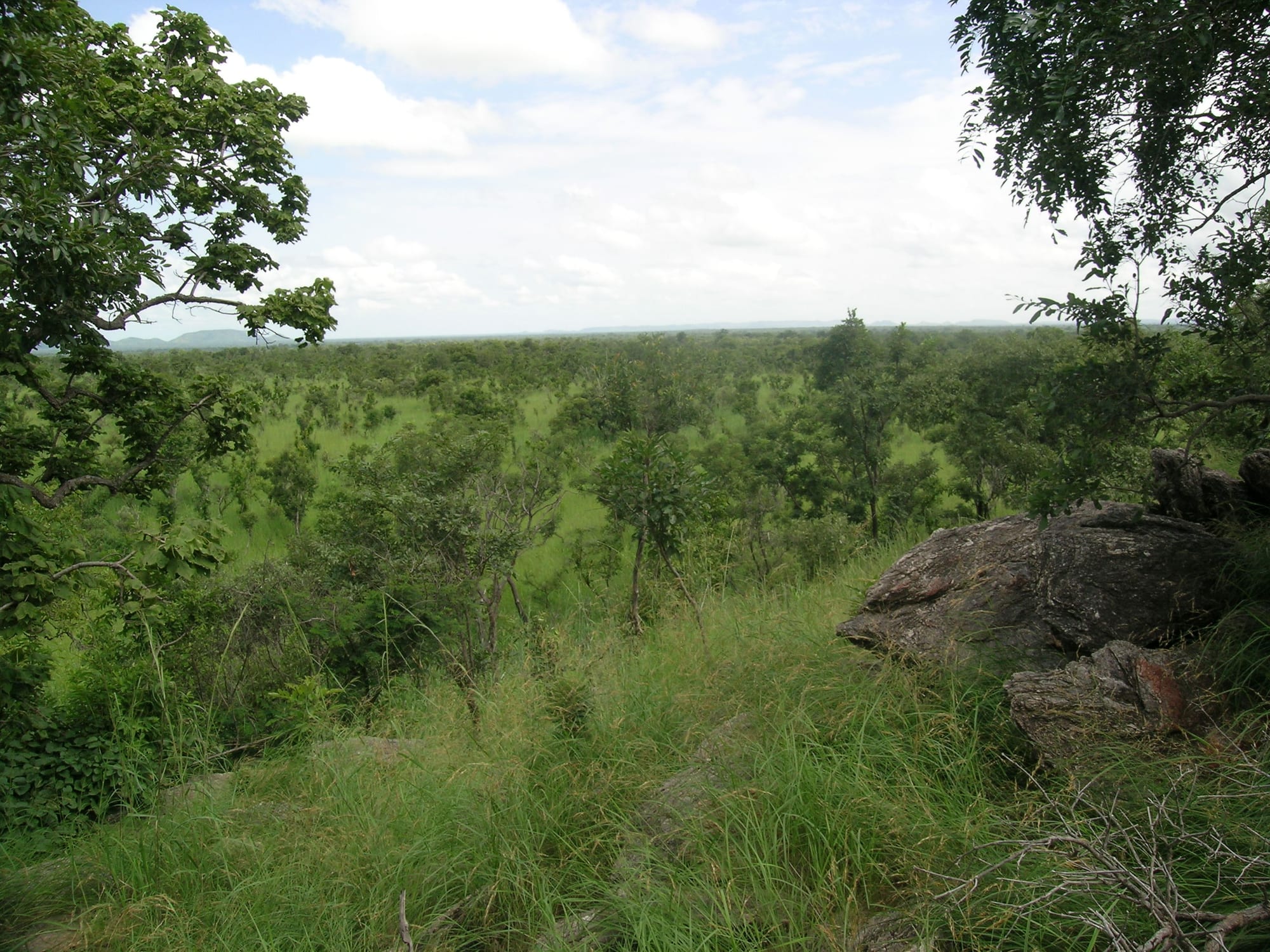
Green grassy savanna dotted with trees stretching to low hills on the horizon, seen past a boulder and overhanging branches

Benin

Natitingou, Pendjari & the North

Wooded savanna in Pendjari National Park, seen from a foothill of the Atacora range. (Martin Wegmann / Wikimedia Commons · CC BY-SA 3.0)

The northern half of Benin, from the Atacora range and its Betammaribe tower-houses east through the Bariba lands of Borgou to the cotton fields of Alibori and the Niger River — a savanna region of old kingdoms and some of West Africa's most important wildlife parks, where armed groups from the Sahel now carry out attacks.

Explore Natitingou, Pendjari & the North

History

Before colonial rule the north was divided among several powers. The Bariba, or Baatombu, founded horse-riding kingdoms in Borgou, of which Nikki was the most prestigious; their warrior aristocracy raided neighbours and taxed trade. Along the Niger, Dendi traders linked the region to the Songhai world, while Djougou grew as a Muslim market town at a crossroads of trade. Fulani herders moved through with their cattle, and in the Atacora hills the Betammaribe and neighbouring peoples lived in scattered, fortified homesteads without kings.

France took control in the 1890s, partly in competition with Britain, which held the neighbouring Borgu lands in what became Nigeria. Colonial conscription during the First World War provoked resistance, above all the rebellion led by Kaba in the Atacora in 1916–17, which was suppressed by force. The north was long neglected in favour of the coast, and its cotton and groundnuts were grown for export.

After independence northern politicians rose to power: Mathieu Kérékou, from the Atacora, ruled for most of the period from 1972 to 2006, and Thomas Boni Yayi, from Borgou, was president from 2006 to 2016. The Pendjari and W parks became the heart of a vast savanna reserve system, shared with Burkina Faso and Niger and inscribed as a UNESCO World Heritage Site. Since 2019, and especially from 2021, the Sahel conflict has spread across the border into the parks and the far north.

Culture & Customs

The north is more Muslim than the south, especially among the Bariba, Dendi and Fulani, though Christianity and traditional religions are strong in the Atacora. The Bariba of Nikki keep the Gani festival, a celebration of the kingdom's horsemen and the king's authority, with parades of mounted riders in robes and turbans. The Fulani hold their own gatherings, and cattle and horsemanship carry prestige across the region.

The Betammaribe, often called Somba, are best known for the tata, a two-storey fortress-house of earth and wood with a flat roof terrace and conical granaries, built for defence and for the rituals of the household; the Batammariba landscape of Koutammakou, first inscribed by UNESCO on the Togolese side, became a cross-border World Heritage Site in 2023 when sites in Benin were added. Initiation ceremonies for young men and women remain important in the Atacora villages.

Languages are many: Bariba in Borgou, Dendi along the Niger and in Djougou, Fulfulde among herders, Ditammari and several other languages in the hills. Traditional hunters' societies and the respect paid to local kings and chiefs remain part of village life.

Daily Life

Parakou, with more than 200,000 people, is the north's commercial and university city and its main transport hub. Djougou, the capital of Donga, is a large Muslim market town; Natitingou, the capital of Atacora, is smaller, with around 100,000 in its commune; and Kandi and Malanville are the main towns of Alibori, the latter a border market facing Niger across the river.

Cotton is the economic backbone: Alibori and Borgou are the heart of Benin's cotton growing, the country's leading export, with Banikoara among the biggest producing communes. Yams, maize, sorghum and millet feed families, shea nuts are gathered by women for butter, and Fulani herders move cattle across the savanna, sometimes clashing with farmers over land and water. Trade with Niger through Malanville is vital to both sides.

The insurgency has changed daily life near the borders and the parks: army deployments have grown, some villages have emptied, and tourism, once an important source of income around Tanguiéta and Natitingou, has almost stopped. Elsewhere days still follow the market cycle and the call to prayer.

Food

Pounded yam is the pride of the north, and Parakou is known for it: boiled yam beaten in a mortar into a smooth, elastic ball and eaten with a sauce of peanut, greens or tomato and meat. Where rain is less reliable, millet and sorghum are turned into tô, a stiff porridge eaten with okra or baobab-leaf sauce.

Wagasi, the soft cow's-milk cheese made by the Fulani, comes from the north and is eaten fresh, fried or in sauce. Afitin, fermented néré seeds, gives sauces a pungent flavour, and shea butter is used for cooking as well as skin care. Grilled meat is sold at roadside stalls, and kilishi, thin spiced dried meat, is a Hausa speciality sold in the markets.

Tchoukoutou, a cloudy millet beer brewed by women and served in calabashes, is the traditional drink of the Atacora and many non-Muslim communities. In Muslim towns, drinks are more often ginger juice, bissap hibiscus and sweetened milk.

Attractions & Natural Wonders

Pendjari National Park, on the Burkina Faso border beneath the Atacora escarpment, shelters some of West Africa's last big game, with lions, elephants, buffalo, hippos and many antelope, and it is part of the W-Arly-Pendjari UNESCO World Heritage Site. W National Park in Alibori, shared with Niger and Burkina Faso, covers a vast area of savanna and river forest along the Niger. Both parks have been hit by attacks and are largely closed; any visit depends entirely on current security advice.

Around Natitingou and Boukombé, the tata houses of the Betammaribe stand among the fields of the Atacora hills; the Natitingou museum explains their architecture and the region's history. The hills also have the Kota falls near Natitingou and the Tanougou falls near Tanguiéta, as well as hilltop villages of the Taneka country in Donga.

Parakou has its markets, mosques and the palace of the local Bariba king, and serves as a base for Nikki, the old royal town of the Gani festival. Further north, Malanville's market on the Niger shows the scale of cross-border trade.

Cities in Natitingou, Pendjari & the North

Planning basics

Budget

Day-to-day costs in the north are low: simple hotels in Parakou, Natitingou and Djougou, market food and bush taxis are all cheap. The region's former safari economy, with park fees, lodges and hired four-wheel drives, made Pendjari the expensive part of any trip, but park tourism has largely halted. Parakou has the north's banks and cash machines.

Daily Budget Midrange
USD 70–160 (best hotel in Parakou or Natitingou, restaurant meals, a car with driver)
Daily Budget Shoestring
USD 20–45 (basic hotel, market food, bush taxis)

Take enough cash from Parakou or Cotonou; cards and cash machines are scarce further north.

Safety

The north is where Benin's serious security problem lies. Since around 2021, armed groups linked to al-Qaeda and the Islamic State, active in neighbouring Burkina Faso and Niger, have attacked army posts, park rangers and villages in and around the Pendjari and W national parks and along the borders of Atacora and Alibori, killing many soldiers. Two French tourists were kidnapped in Pendjari in 2019. Kidnapping and road ambushes remain risks; Parakou and Djougou are calmer but not immune.

Most governments advise against all travel to the parks and the northern border areas and against all but essential travel to much of the rest of the north. Check current official travel advice before travelling.

Climate

The north is drier and hotter than the south, with a single rainy season from about May or June to September. The Harmattan blows from roughly December to February, bringing dust, haze and cool nights, and March to May are the hottest months, with Alibori and the Niger valley regularly near 40°C. The Atacora hills are a little cooler.

Summer
the rainy season, 24–32°C, with storms that cut dirt roads
Winter
dry and dusty in the Harmattan, 30–35°C by day and cool nights; very hot from March to May

Transportation

The paved highway north from Cotonou reaches Parakou in roughly seven to eight hours and continues to Kandi and Malanville on the Niger border. A second road runs through Djougou to Natitingou and Tanguiéta. Coaches and bush taxis link the main towns; minor roads are unpaved and slow in the rains. The railway from Cotonou to Parakou carries no regular passengers.

Travel only in daylight, follow local security advice on which roads are open, and do not attempt the parks or border roads.

Best Time to Visit

November to February is the most comfortable season, and late in the dry season, from February to April, wildlife gathers at the remaining water in the parks. Nikki's Gani festival follows the Bariba lunar calendar. At present the security situation, not the weather, decides whether a visit makes sense, and most governments advise against travel to much of the north.