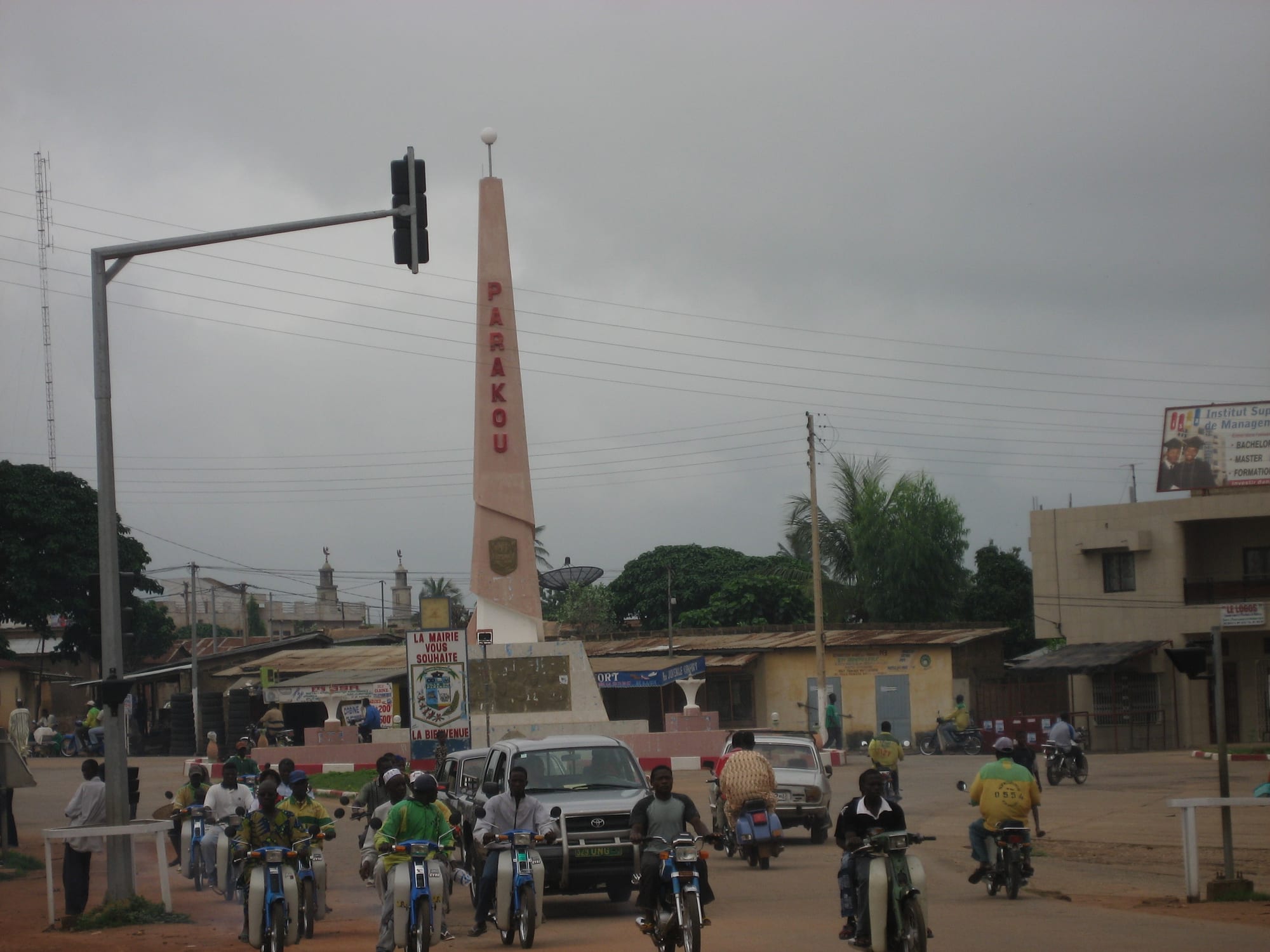
Motorcycles crossing a wide junction beside a tall pink obelisk lettered Parakou, under a grey sky

Natitingou, Pendjari & the North, Benin

Parakou

The obelisk marking the entrance to Parakou, with the motorcycle traffic that fills the city's junctions. (UXrocks / Wikimedia Commons · CC BY 3.0)

Northern Benin's largest city and the capital of Borgou department, set in savanna roughly halfway between the Atlantic coast and the Niger River. Built up around the terminus of the railway from Cotonou, it is a Bariba and Muslim trading city of markets, lorry parks and a university, and the point where goods bound for Niger and Nigeria change hands.

Neighbourhoods

  • The centre and the Arzèkè market
    • First-time visitors
    • Markets
    • Close to public transport

    The commercial core around the great market, where traders, banks, shops and coach offices crowd together. It is the noisiest and busiest part of the city, thick with motorcycle taxis, and most hotels and restaurants are within reach of it.

    Open in Maps
  • Zongo
    • Local life
    • Best for food

    The old quarter of Hausa and Dendi trading families, with its own market and mosque and a strong Muslim character. Narrow lanes, tailors, butchers and tea stalls give it a different feel from the modern avenues.

    Open in Maps
  • The station quarter
    • Historic district
    • Quiet and residential

    The area around the railway terminus and the old goods yards, where the colonial town began. Warehouses, depots and low houses spread out from the tracks, and freight still shapes the streets around it.

    Open in Maps
  • The university district
    • Students and nightlife
    • Quiet and residential

    The newer quarters near the University of Parakou, with student housing, cheap eating places and small bars. It is calmer and greener than the centre, and busiest in term time.

    Open in Maps
  • The northern outskirts
    • Local life
    • Close to public transport

    Spreading suburbs along the roads towards Kandi and Nikki, where lorry parks, fuel depots, workshops and new compounds mark the city's growth outwards into the savanna.

    Open in Maps

Things to do

Markets and streets

  • Arzèkè marketmarket

    The city's great market, a dense grid of stalls selling grain, yams, cloth, hardware and imported goods, and the hub of trade for the whole north.

    Open in Maps
  • Zongo market and mosquemarket

    The smaller market of the Hausa and Dendi quarter, gathered around its mosque, good for spices, dried fish, kilishi and everyday goods.

    Open in Maps
  • The wholesale depot marketmarket

    The yard where lorries load and unload sacks of grain, yams, onions and cashew nuts moving between the farms of the north and the coast.

    Open in Maps
  • The lorry parkstransit hub

    The yards on the edges of the city where long-distance coaches, bush taxis and freight lorries bound for Niger and Nigeria gather, a spectacle of West African road trade.

    Open in Maps

Landmarks and institutions

  • Parakou railway stationtransit hub

    The northern terminus of the colonial-era line up from Cotonou, around which the modern city grew; the line no longer carries regular passenger services.

    Open in Maps
  • University of Parakouattraction

    The public university founded in 2001, the main centre of higher education in northern Benin, with faculties spread across a campus on the city's edge.

    Open in Maps
  • The central mosquelandmark

    The main mosque of a strongly Muslim city, the focus of Friday prayer and of the Eid gatherings that fill the surrounding streets.

    Open in Maps
  • The palace of the Bariba chieflandmark

    The residence of the city's traditional ruler, still a point of authority in Bariba custom and the setting for ceremonies and receptions.

    Open in Maps
  • The Catholic cathedrallandmark

    The seat of the Catholic archdiocese of Parakou, serving the Christian minority in a mainly Muslim city.

    Open in Maps

Water and green space

  • The Okpara riverattraction

    The river east of the city, with wooded banks and fishing villages along it, rising in the Borgou and running south to the Ouémé.

    Open in Maps
  • Roadside savanna and shea parklandviewpoint

    The wooded farmland beyond the outskirts, dotted with shea and néré trees left standing in the fields, typical of the Borgou countryside.

    Open in Maps

Short trips from the city

  • Nikkiattraction

    A leading Bariba royal town, seat of a traditional king, where the annual Gaani festival is held.

    Open in Maps
  • N'Daliattraction

    A farming and junction town in the Borgou, surrounded by cotton fields and cashew orchards.

    Open in Maps

Seasonal events

  • Gaanivaries with the Bariba lunar calendar

    The Bariba festival of the kingdom's horsemen and the authority of its kings, celebrated with parades of mounted riders in robes and turbans, drumming and praise singing, centred on Nikki and marked in Parakou.

  • Eid al-Fitr and Eid al-Adhadates move through the year with the Islamic calendar

    The two great Muslim festivals fill the mosques and streets of a largely Muslim city with prayer, new clothes, visiting and shared meat.

  • The new yam seasonAugust and September

    The arrival of the new yam harvest, marked with family meals and village ceremonies across the Borgou before the crop is eaten freely.

  • National Vodun DayJanuary

    A public holiday on 10 January observed across Benin, though the great ceremonies are held on the southern coast rather than in the north.

Eat and drink

Long-standing places and food districts in Parakou. Hours, ratings and directions come from your maps app, always current.

Parakou classics

  • Pounded yam kitchensrestaurant

    Eating houses serving igname pilée, yam beaten in a mortar into a smooth elastic dough and eaten with peanut, tomato or leafy-green sauce.

    Open in Maps
  • Grilled meat standsrestaurant

    Charcoal grills near the market and the lorry parks selling mutton, beef and chicken with chilli and raw onion, busiest after dark.

    Open in Maps
  • Maquis on the avenuesrestaurant

    Open-air bar-restaurants serving rice, amiwo maize dough, grilled fish and cold drinks, the standard evening meal out.

    Open in Maps

Markets and street food

  • Arzèkè marketmarket

    Yams by the heap, millet and sorghum, dried fish, shea butter, discs of wagasi cheese and sheets of spiced kilishi dried meat.

    Open in Maps
  • Zongo tea and fritter stallscafe

    Stands in the Hausa quarter serving strong sweet tea, akara bean fritters and fried dough from early morning.

    Open in Maps

Experience Parakou

History

Parakou began as a Bariba settlement on the trade routes that crossed the Borgou, in country dominated by the horse-riding kingdoms of which Nikki was one of the most important. Its site, on the watershed between the coastal rivers and those running to the Niger, made it a staging point for caravans moving kola nuts, salt, cloth and captives between the Hausa and Yoruba lands and the Sahel, and Dendi and Hausa traders settled beside the Bariba in the quarter still called Zongo, the West African name for a strangers' trading ward.

The French took control of the Borgou in the 1890s, in competition with the British, who held the neighbouring Borgu lands in what became Nigeria. What transformed the town was the railway: the line built north from Cotonou reached Parakou in the mid-1930s and stopped there, making the town the point where everything bound for the north and for landlocked Niger changed from rail to road. Warehouses, transport companies and an administrative centre followed, and the population grew far beyond that of the older royal towns.

Independence in 1960 confirmed the city's role. As Niger's traffic through the port of Cotonou grew, so did Parakou's lorry parks and depots, and the city became the capital of Borgou department and the seat of northern politics; Thomas Boni Yayi, president from 2006 to 2016, came from this region. A university opened in 2001. Rail traffic declined and the station closed to passengers, leaving road haulage to carry the trade, and the city has continued to spread outwards while the insurgency in the far north has pushed soldiers, displaced families and aid operations into it.

Culture & Customs

Parakou is a Bariba city with a strong Dendi and Hausa presence, and Fulani, Yoruba, Otammari and southern Beninese communities besides. Bariba, or Baatonum, is the language most heard, with Dendi serving as a trade language and French in offices and schools. Islam is the majority religion and shapes the calendar — the fast of Ramadan, the two Eids, and Friday prayer that empties the market for an hour — while Catholic and Protestant churches serve a substantial minority and older customs persist alongside both.

The Bariba are known for horsemanship. At the Gaani festival, whose date moves with the Bariba lunar calendar, riders in heavy robes and turbans parade before their king with drums, trumpets and praise singers; the ceremony's home is Nikki, east of the city, but Parakou families take part and the festival is the great expression of northern identity. Griots and praise poets still attach themselves to notable families, and horses remain a mark of status in the region.

Authority is layered. The traditional chief of Parakou holds a recognised place beside elected mayors and state officials, and disputes over land, marriage and inheritance are often settled in his court before they reach any other. Hospitality is obligatory and greetings are extended: it is normal to ask after a household, its health and its work before any business begins.

Daily Life

About 255,000 people were counted in the commune at the 2013 census, and the city has grown since, making it the largest in northern Benin. It is low-built and wide, with a dense commercial core and quarters spreading along the highways, and the noise of motorcycles from dawn is the constant background.

The economy is trade and transport. Goods for Niger and the northern departments pass through the depots and lorry parks; cotton from the Borgou and Alibori is ginned and shipped; cashew nuts, shea, yams and grain are bought from farmers and sent south. A brewery, cotton processing and small workshops provide the manufacturing, and the university, hospital and government offices provide the salaried jobs. Around all of it works a large informal economy of market traders, mechanics, tailors and motorcycle-taxi riders.

Life outside work runs on the market, the mosque and the compound. Households are large and often multi-generational, water and electricity can be unreliable in the outer quarters, and the afternoon heat empties the streets before the evening fills the maquis and the tea stalls. The insurgency further north is felt here indirectly: more soldiers, more displaced families, fewer travellers, and a constant awareness of what is happening on the borders.

Food

Pounded yam is the pride of Parakou. Boiled yam is beaten in a tall wooden mortar until it becomes a smooth, elastic dough, then torn by hand and dipped in a sauce of groundnut, tomato with meat, or dark leaves, and it is what eating houses and households come back to. Where yams give way to grain, millet and sorghum are cooked into tô, a stiff porridge eaten with okra or baobab-leaf sauce, and rice dishes including the coastal ayimolou, rice and beans, are everyday food.

Northern specialities fill the market. Wagasi, the soft cow's-milk cheese of the north, is sold in abundance here in pale discs and fried in slices until it browns; kilishi, thin sheets of spiced dried meat of Hausa origin, is a Parakou staple and a traveller's gift; afitin, made from fermented néré seeds, gives sauces their pungent depth; and shea butter from the surrounding parkland is used for frying. Grilled mutton and beef, sold by the skewer near the market and the lorry parks, is the classic evening food.

Drinks divide along religious lines. In Muslim households and the Zongo quarter it is strong sweet tea, ginger juice, bissap from hibiscus and sweetened milk; in the maquis it is bottled beer and soft drinks, and in the surrounding villages the cloudy millet beer tchoukoutou is still brewed by women and served in calabashes. Mangoes, oranges and cashew apples come in season from the orchards of the Borgou.

Planning tools

Budget

Parakou is inexpensive and has more choice than anywhere else in the north: a range of simple and mid-range hotels, restaurants, banks and the region's most reliable cash machines. Market food and motorcycle taxis cost very little, and the main expense for a visitor is a hired car with driver for trips out into the Borgou.

Daily Budget Midrange
USD 70–160 (best hotel in the city, restaurant meals, a car with driver)
Daily Budget Shoestring
USD 20–45 (basic hotel, market food, bush taxis and motorcycle taxis)

Draw cash here before heading further north or into the countryside, where machines are scarce and cards are not accepted.

Best Time to Visit

November to February is the most comfortable season, dry with cooler nights, though the Harmattan brings dust and haze. March to May is severely hot, often near 40°C, and the rains from about June to September leave the savanna green but make unpaved roads slow. Security in the far north matters more than season for anything beyond the city.

Suggested Number of Days

One or two days are enough for the markets, the station quarter and the city's street life. Two or three allow trips into the Borgou or a stop on the way north or south. Parakou is more often a staging point on a longer journey than a destination in itself.

First Visit
1–2 days
With Surroundings
2–3 days

Transportation

Zémidjan motorcycle taxis are the city's transport, swarming at every junction and cheap for any distance within town; shared taxis cover longer hops and there are no scheduled city buses. Coaches and bush taxis leave from the lorry parks for Cotonou, Natitingou, Kandi and Malanville, and a hired car with driver is the practical way to reach villages off the paved roads.

Agree the fare with a motorcycle-taxi rider before setting off, and avoid road travel after dark on the highways.

Airport & Station Connections

Parakou sits on the paved highway from Cotonou, roughly seven to eight hours away by coach, with several companies running daily; Natitingou is four to five hours west and Malanville, on the Niger border, some five hours north. The railway from Cotonou ends here but carries no regular passengers. The city has an airport, though almost everyone arrives by road, and the nearest international airport is at Cotonou.

Walkability

The centre around the market can be walked, and the station quarter is not far, but Parakou is spread out and hot, with long distances between the market, the university and the outer quarters. Pavements are intermittent and motorcycle traffic is dense, so most people ride rather than walk. Early morning and evening are the comfortable times on foot.

Safety

Parakou lies south of the worst-affected areas and is calmer than the border zone, though not untouched by it. Since around 2021 armed groups have attacked army posts, rangers and villages around the northern parks and along the Atacora and Alibori borders. In the city itself, petty theft in the market and at the lorry parks and the danger of night driving on the highways are the everyday concerns.

Most governments advise against all travel to the parks and the northern border areas and against all but essential travel to much of the rest of the north. Travel by road only in daylight, keep valuables close in the market and at bus stations, and do not photograph soldiers, checkpoints or government buildings. Check current official travel advice before travelling.

Climate

A Sudanian climate with one rainy season, from about May or June to September, and a long dry season the rest of the year. March to May is the hottest period, and the Harmattan carries dust and haze down from the Sahara between roughly December and February, with cool nights and warm days.

Summer
the rainy season, roughly 23–32°C, humid with heavy afternoon storms
Winter
dry and dusty, 30–36°C by day with cool nights; very hot from March to May

Local Customs

This is a mainly Muslim city with a Christian minority and older practices alongside both. Dress is modest, especially near mosques and in the Zongo quarter, and alcohol, though sold openly in maquis, is not drunk everywhere. Greetings are long and unhurried, elders are addressed first, and Friday prayer and the fast of Ramadan shape the week and the year.

Ask before photographing people, mosques or ceremonies, dress modestly, greet before asking for anything, and use the right hand for giving and receiving.

Common Payment Methods

The currency is the West African CFA franc, pegged to the euro. Parakou has the north's best concentration of banks and cash machines, which handle Visa more reliably than Mastercard, but cash is what shops, markets, hotels and taxis actually use. Mobile money agents are everywhere for local transfers, and small notes are essential.