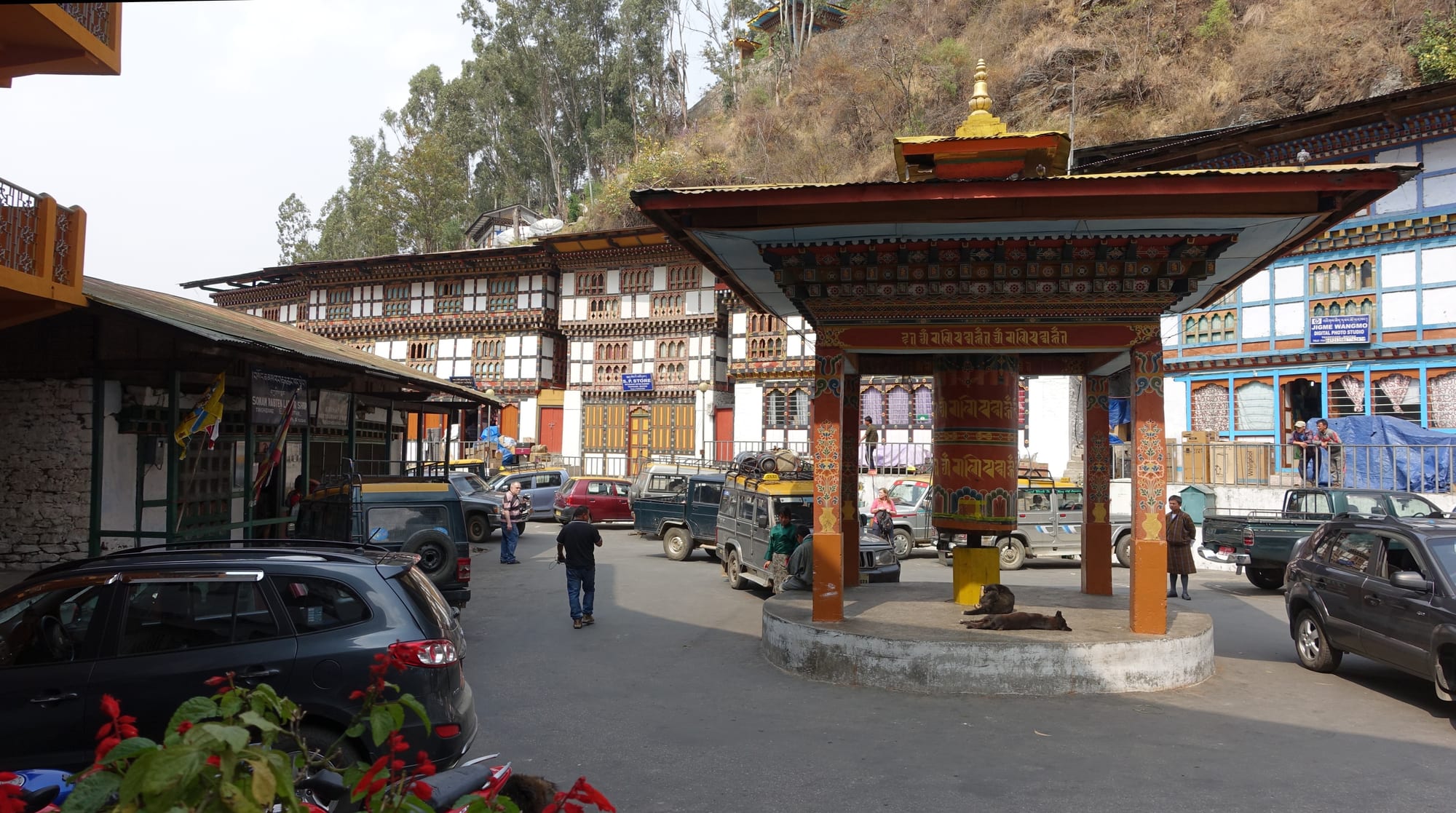
A small town square with parked cars, shopfronts with painted wooden windows and a large prayer wheel under a decorated canopy

Eastern Bhutan, Bhutan

Trashigang

The centre of Trashigang, with its covered prayer wheel and the shops of the main square. (Franzfoto / Wikimedia Commons · CC BY-SA 3.0)

The principal town of eastern Bhutan, built on a steep slope above the Drangme Chhu just below the mouth of the Gamri Chhu, with a 17th-century dzong on a spur beneath it. Trashigang is the administrative and trading centre of the Tshangla-speaking east and the usual base for journeys to the herding valleys of Merak and Sakteng.

Neighbourhoods

  • The town square and main bazaar
    • First-time visitors
    • Shops and services
    • Local life

    A compact square with a covered prayer wheel at its centre, ringed by shops, small restaurants, the taxi stand and offices. It is where eastern Bhutan does its business, busiest in the morning and when buses arrive from Mongar and Samdrup Jongkhar.

    Open in Maps
  • The dzong spur
    • Historic district
    • Views over the river

    Below the town, Trashigang Dzong stands on a promontory with the gorge on three sides, holding the district administration and a monk body. The approach road and the ground in front of it are the setting for the autumn festival.

    Open in Maps
  • The upper town
    • Quiet and residential
    • Hotels

    Above the square the lanes climb past guesthouses, staff quarters, schools and family houses on terraces cut into the slope, with long views down to the confluence of the rivers.

    Open in Maps
  • Rangjung and the road east
    • Villages
    • Weaving
    • Countryside

    East of the town the road follows the valley past farmhouses and maize terraces towards Radhi and Rangjung, weaving country and the starting point for the long journey up to Merak and Sakteng.

    Open in Maps

Things to do

In the town

  • Trashigang Dzonglandmark

    The fortress founded in 1659 on a spur above the rivers, still the district's administrative and monastic seat, with courtyards, temples and a commanding view of the gorge.

    Open in Maps
  • Yongphulla Airporttransit hub

    One of Bhutan's four domestic airfields, on a ridge above the valley south of the town, whose service has been interrupted more than once by the difficulty of its short hillside runway.

    Open in Maps

Short trips from the town

  • Chorten Koralandmark

    A large white stupa beside the Kholongchu river at Trashi Yangtse, north of Trashigang, built in 1740 on the model of the Boudhanath stupa in Nepal.

    Open in Maps
  • Sherubtse Collegeattraction

    Bhutan's first accredited college, founded in 1966 at Kanglung on the ridge south of the town, affiliated to the University of Delhi before it joined the Royal University of Bhutan in 2003.

    Open in Maps
  • Sakteng Wildlife Sanctuarypark

    The protected mountain country east of Trashigang, home of the Brokpa herders of Merak and Sakteng and reached by rough road or on foot.

    Open in Maps

Seasonal events

  • Trashigang Tshechuautumn or early winter

    The district's main festival, days of masked religious dance in the courtyard of the dzong, when families come in from the surrounding valleys in their best woven cloth.

  • LosarFebruary or March

    Bhutanese New Year, marked with family gatherings, offerings at the temples and archery matches in the villages.

  • Chorten Kora festivallate winter or early spring

    Two rounds of circumambulation at the stupa north of Trashigang, one of them drawing Dakpa pilgrims from across the border in Arunachal Pradesh.

Eat and drink

Long-standing places and food districts in Trashigang. Hours, ratings and directions come from your maps app, always current.

Where Trashigang eats

  • Main square restaurantsneighborhood

    Plain dining rooms around the square serve rice with ema datshi, potato and cheese dishes, dried pork with chillies and momos, along with Indian and Nepali plates for drivers and traders.

    Open in Maps
  • Trashigang marketmarket

    A small market selling maize, chillies, oranges, greens and cheese brought in from the surrounding hillsides, busiest when villagers come down to town.

    Open in Maps
  • Rangjung and the eastern villagesneighborhood

    Simple village kitchens east of the town cook maize dishes, ferns and cheese, and it is in these households that ara, the home-distilled grain spirit, is most often served to guests.

    Open in Maps

Experience Trashigang

History

Eastern Bhutan was for centuries a patchwork of small valley chiefdoms with their own ruling families, trading over the passes with Tibet and down into Assam. The Zhabdrung Ngawang Namgyal's government extended its authority here in the middle of the 17th century, and in 1659 Trashigang Dzong was built on a spur above the meeting of the Gamri Chhu and the Drangme Chhu, a site chosen so that the gorge guarded three of its sides. From it the government controlled the eastern valleys and the routes to the plains.

The dzong shaped everything that followed. Governors ruled the east from it, and the settlement above it grew as a market for the valleys around. The frontier with British India mattered too: fighting during the Duar War of 1864–65 reached Dewangiri, today's Dewathang on the road south, and the treaty that ended the war ceded territory on the plains.

Modern Trashigang was made by roads and schools. The east remained remote until the lateral road arrived from the 1960s, after which the town became the district headquarters, with offices, shops and a hospital. Sherubtse College at Kanglung, founded in 1966 on the ridge to the south, was the country's first accredited college and drew students from across Bhutan, giving the east an outsized place in Bhutan's civil service. Hydropower on the Kuri Chhu, roads to Merak and Sakteng and mobile coverage have since narrowed the distance, while emigration has thinned many of the villages.

Culture & Customs

Trashigang is the centre of Sharchop culture. Most residents speak Tshangla, often called Sharchopkha, at home, and the east has a reputation within Bhutan for directness, humour and open hospitality. Guests are pressed with tea and with ara, the home-distilled spirit, which in eastern households is often warmed with butter and egg and offered as a matter of course rather than as a treat.

Weaving is the region's great art and its main craft income. Women work at backstrap and pedal looms in villages around the town, above all at Radhi, where bura, raw silk cloth, is woven in patterns that Bhutanese recognise instantly; the finest pieces take months and command high prices in Thimphu. Religious life centres on the dzong's autumn tshechu and on pilgrimage to Gom Kora and Chorten Kora, the latter drawing Dakpa pilgrims from across the border in Arunachal Pradesh.

In the mountains east of the town live the Brokpa of Merak and Sakteng, semi-nomadic yak herders with their own dress, their own speech and their own festivals, who come down to Trashigang to trade butter, cheese and dried meat. Their presence in the bazaar, alongside students from Kanglung, officials from the dzong and traders from the Assam border, gives the town its particular mix.

Daily Life

Trashigang district is the country's most densely settled, but the town itself is small — around three thousand residents on a hillside — and functions as the service centre for a wide, scattered rural population. Government offices in the dzong, schools, the hospital, shops and transport provide most of the wage work, with the college at Kanglung a short way south.

Farming supports the villages. Maize is the traditional staple of the eastern hills, grown with rice, millet, potatoes and vegetables on steep terraces, with cattle kept for milk and butter and oranges and areca nut in the warmer valleys. Weaving brings cash to households through the winter, and cordyceps collection and yak herding sustain the high valleys of Merak and Sakteng.

The town's day is shaped by transport: buses and shared taxis leave early for Mongar and the border, and the square is quiet by evening. The long-standing issues here are distance and drift — roads that close in the monsoon, services concentrated far to the west, and steady migration of young people to Thimphu, Phuentsholing and abroad, which has left many eastern villages with empty houses and ageing households.

Food

The east eats more maize than rice, and Trashigang's cooking shows it. Kharang, cracked maize cooked like rice, and maize porridge are traditional staples, served with ema datshi, chillies stewed with soft cheese, and with potato, mushroom or fern dishes. Dried beef and sikam, dried pork belly, are cooked with chillies and radish, and river fish and wild greens gathered from the valley appear in season.

Chillies are eaten in quantity and dried on roofs and balconies in autumn; ezay, a raw relish of chilli with cheese, tomato or dried fish, accompanies most meals. Buckwheat and dairy dishes come down from the high country, and the Brokpa diet of Merak and Sakteng is built on yak products — butter, fresh and dried cheese, dried meat and butter tea, sometimes taken with tsampa, roasted barley flour.

Ara is central to eastern hospitality. Distilled at home from maize, rice or millet, it is offered to guests, used in offerings on auspicious days and often served warm with butter and a beaten egg. Suja, tea churned with butter and salt, and sweet milk tea are drunk through the day, doma — areca nut with betel leaf and lime — is chewed widely, and oranges from the lower valleys are sold in the square through the winter. Eating out means the plain restaurants around the bazaar.

Planning tools

Budget

Costs are set by national policy rather than by the town: most visitors pay the Sustainable Development Fee of USD 100 per person per night on top of accommodation, food and transport, and many book through a licensed Bhutanese operator who provides guide and driver. The east has few upmarket hotels, and most lodging here is simple and family-run, so daily totals sit at the lower end of the Bhutanese range.

Daily Budget Midrange
USD 380–500 (the fee, a modest hotel, guide and driver, restaurant meals and hand-woven textiles)
Daily Budget Shoestring
USD 280–360 (the nightly Sustainable Development Fee, a simple guesthouse, canteen meals and shared transport)

Hand-woven cloth is the main purchase here, and fine silk pieces can be expensive; buying from village weavers or cooperatives means the weaver benefits.

Best Time to Visit

October to April suits the east: clear air on the high passes in October and November, mild winter days in the valley, and the Chorten Kora festival at the end of winter. The monsoon, from June to September, brings heat, humidity and frequent landslides on the long roads in and out.

Suggested Number of Days

One or two days cover the town and the valley around it. Three or four allow the country north and east at the pace the roads impose. Travel time dominates any plan here, since every approach is a long mountain drive.

First Visit
1–2 days
With Surroundings
3–4 days

Transportation

The town is small and steep, and everything beyond it is reached by road. Tourist travel is normally in the operator's vehicle with a driver; buses and shared taxis connect Trashigang with Mongar, Trashi Yangtse and Samdrup Jongkhar from the square. Roads to Merak and Sakteng are rough and slow, and some stretches still need walking.

Plan the east as a one-way route, entering over the passes from Bumthang and leaving south through Samdrup Jongkhar, rather than retracing the long roads.

Airport & Station Connections

Trashigang lies at the eastern end of the lateral road: about three hours from Mongar, a full day beyond that from Bumthang over the Thrumshing La, and a long day south to Samdrup Jongkhar on the Assam border, the usual exit towards Guwahati. Yongphulla airfield nearby handles domestic flights, though its short hillside runway makes the service an uncertain alternative to the road.

Walkability

The square and the lanes around it are walked in a few minutes, but the town is built on a slope and every street is a climb. The dzong is well below the square on a steep approach road, and there are no pavements outside the centre, so anything further than the bazaar means a vehicle.

Safety

Trashigang is very safe and crime against visitors is rare. The practical risks are the roads — narrow, winding and prone to rockfall and landslides in the monsoon — along with steep unfenced ground above the gorge, heat and insects in summer, and the distance from a well-equipped hospital; the regional hospital is at Mongar, several hours away.

Allow generous time for road delays, keep back from unfenced edges, and carry insect repellent and basic medicines. Check current official travel advice before travelling.

Climate

Lower and warmer than the western valleys, with a hot, wet summer and mild winter days in the gorge, while the ridges and the country towards Merak stay cold. Mist and cloud fill the valley for long spells in the monsoon.

Summer
hot and humid — June to August days often reach 26–32°C in the valley, with heavy monsoon rain
Winter
mild and dry — December to February days are usually 15–20°C, with cool nights and frost only on the ridges

Local Customs

Most people here are Sharchop and speak Tshangla at home rather than Dzongkha, though Dzongkha and English are used in offices and schools. Hospitality is direct and generous, and a guest is usually offered tea or ara at once; refusing outright is awkward, so a token sip is the polite course. Temples and the dzong require modest dress, covered arms and legs and shoes removed at shrine doors.

Ask before photographing people, weavers at their looms, or religious dances, and walk clockwise around chortens and temples.

Common Payment Methods

The currency is the ngultrum, pegged one to one with the Indian rupee, which also circulates. Trashigang has banks and an ATM, but machines can be empty and card payment is uncommon outside a few hotels, so cash carried from Thimphu or Mongar is important, especially for buying textiles directly from weavers.