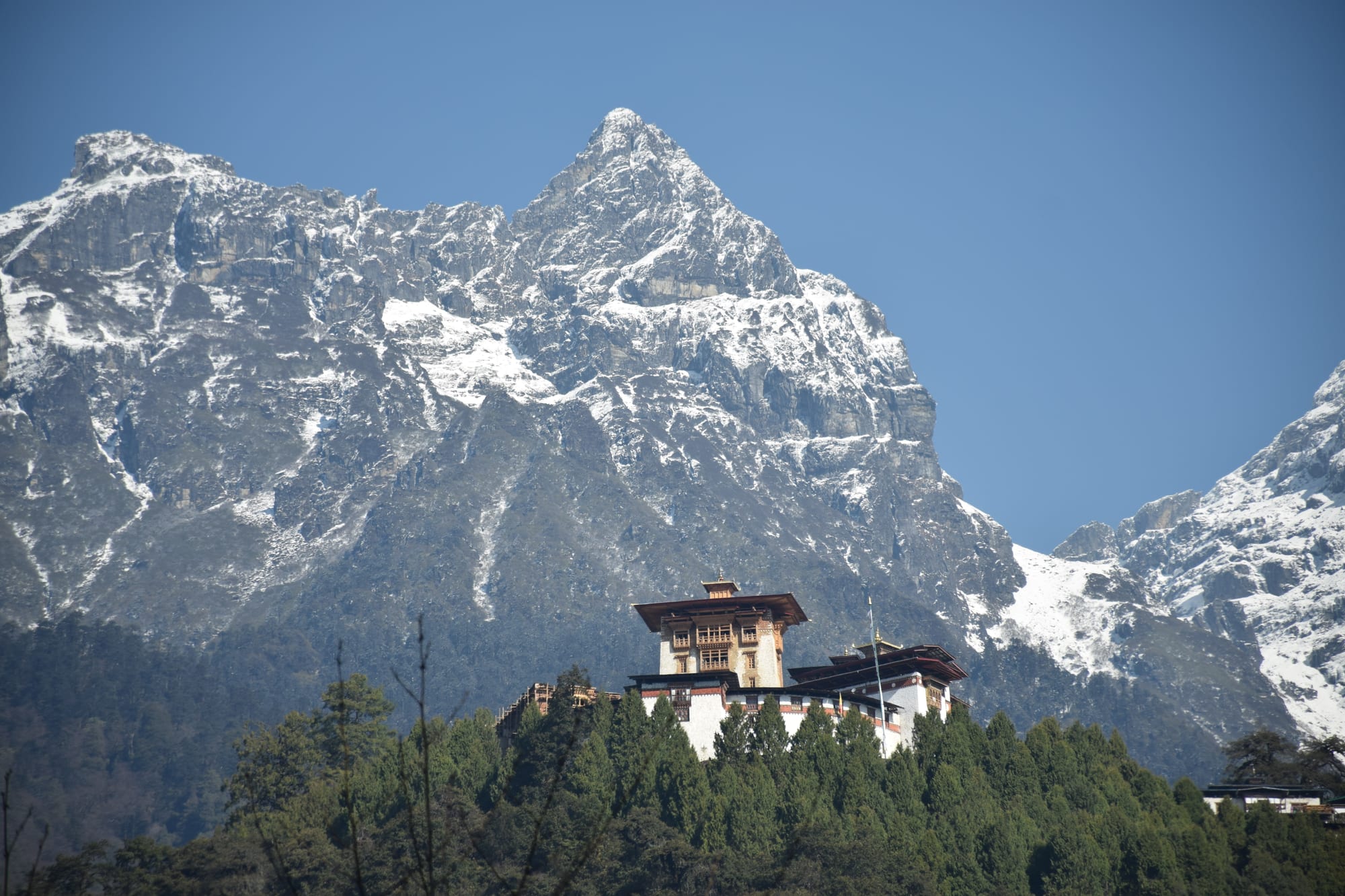
A white-walled fortress-monastery with tiered dark roofs rising above a pine forest, dwarfed by a sheer snow-streaked rock peak under a deep blue sky

Bhutan

Gasa Dzong in winter, its whitewashed tower rising from the forest beneath a wall of snow-covered peaks. (Tenlha123 / Wikimedia Commons · CC BY-SA 4.0)

A Buddhist kingdom in the eastern Himalayas that opened to the outside world only recently, limits tourism by design, and measures itself by Gross National Happiness.

Explore Bhutan

History

Bhutan was unified in the seventeenth century by Ngawang Namgyal, a Tibetan lama who fled sectarian conflict, repelled Tibetan invasions, and built the network of dzongs — fortress-monasteries — that still dominate every major valley. He created a dual system of religious and civil government that outlasted him by centuries.

The Treaty of Sinchula of 1865, after Bhutan lost the Duar War, ceded the Bengal Duars in return for an annual payment, and the Treaty of Punakha of 1910 had Bhutan accept British guidance in its foreign affairs in exchange for non-interference; newly independent India took over that role under a treaty signed in 1949. The Wangchuck dynasty was founded in 1907, when Ugyen Wangchuck became the first hereditary "Dragon King." Bhutan stayed closed and largely feudal — roads, schools, and hospitals arrived only from the 1960s, and television and the internet were legalised as late as 1999.

The fourth king voluntarily steered the country to constitutional democracy, abdicating in favour of his son in December 2006, and the first parliamentary elections and a written constitution followed in 2008. A darker chapter runs alongside this: in the late 1980s and 1990s, citizenship laws and a "one nation, one people" policy targeting the Nepali-speaking Lhotshampa of the south led to crackdowns and the flight or expulsion of roughly 100,000 people, most of whom spent about two decades in refugee camps in Nepal before resettlement abroad.

  • Bhutan: The Last Himalayan Kingdom — A Buddhist state unified by a fleeing lama, sealed off for centuries, ruled by kings since 1907, and a democracy since 2008 — the country that measures Gross National Happiness

Culture & Customs

Vajrayana Buddhism saturates daily life. Prayer flags line every ridge, prayer wheels turn in the streets, and the year is punctuated by tsechu festivals of masked cham dances re-enacting the deeds of Guru Rinpoche, credited with bringing Buddhism to Bhutan in the eighth century. Monasteries and monks are woven into the fabric of the country.

National dress is worn widely and required in official settings: the knee-length gho for men, the ankle-length kira for women, with a ceremonial scarf whose colour marks rank inside a dzong. Houses are built of rammed earth and painted timber, sometimes with a large phallus image on the wall for protection, a motif linked to an eccentric fifteenth-century saint.

Archery is the national sport, boisterous and social, and reverence for the king runs deep. Karma, rebirth, and merit-making frame how many Bhutanese understand misfortune and good luck alike.

  • Bhutan: The Discipline of Mind, Body and Speech — A kingdom that writes its Buddhist heritage into the constitution, teaches etiquette in every school, dresses for the occasion by law and custom, and gathers each year to watch the gods dance

Daily Life

Bhutan has about 800,000 people, most of them farmers in the temperate valleys growing rice, buckwheat, potatoes, apples, and chillies, or herders in the high country. Thimphu, the capital, is the only real city, and one of only two national capitals in the world with no traffic lights — a traffic policeman directs the cars by hand instead.

The state is guided by the idea of Gross National Happiness, an official development philosophy that weighs culture, environment, and wellbeing alongside economic growth. The country is committed to keeping at least 60 percent of its land under forest cover, and its forests absorb far more carbon than the country emits, making it carbon-negative.

Hydropower sold to India is the main export earner, along with tourism. Life is slow-paced and communal, organised around the farming year, the local temple, and the dzong that serves as both monastery and district administration.

  • Bhutan: A Country That Counts Its Days in Happiness — A farming nation where land often passes down through daughters rather than sons, a capital small enough to run without a single traffic light, and a government that surveys its own people's wellbeing as a matter of policy

Food

Chillies are treated as a vegetable rather than a seasoning. The national dish is ema datshi — chillies stewed in a soft, tangy cheese sauce — with variants made from potato (kewa datshi), mushroom (shamu datshi), or pork. Bhutanese red rice, nutty and the only rice that grows at these altitudes, is the staple.

Other common dishes are phaksha paa (dried pork cooked with chillies, spices and radish or turnip), jasha maru (a chicken dish), momos (dumplings), and buckwheat noodles and dumplings in Bumthang, where buckwheat rather than rice is the mainstay. A fiery chilli relish called ezay sits on most tables. Dairy matters as much as meat: datshi, the home-made cheese, goes into everything, and rock-hard cubes of dried cheese called chhurpi are chewed through the day.

Salty butter tea (suja) and locally brewed ara, a home-made spirit of rice or maize, are the traditional drinks, alongside milk tea and beer.

  • Bhutan: Food and the National Dish — A dish that treats chillies as the main vegetable rather than a seasoning, a distinctive red rice grown at altitude, and a Buddhist kingdom that eats meat it mostly imports

Attractions & Natural Wonders

Paro Taktsang, the "Tiger's Nest," is the country's defining image: a monastery built into a cliff 900 metres above the valley floor, where Guru Rinpoche is said to have meditated, reached by a steep uphill hike.

The dzongs are the other great sight. Punakha Dzong, at the meeting of two rivers and framed by jacaranda in spring, is the most admired, and the site of coronations and royal weddings; Trongsa Dzong is the largest, strung along a ridge; and Paro and Thimphu have their own. The Bumthang valleys in the centre are the spiritual heartland, dense with ancient temples and buckwheat fields.

The drives are part of the experience — the Dochu La, on the road from Thimphu to Punakha, with its 108 memorial chortens and its Himalayan panorama on a clear day, and the Chele La, at 3,988 metres the highest motorable point in the country. Phobjikha Valley, a broad marshy bowl, is where black-necked cranes spend the winter, arriving in the last week of October at the Gangteng monastery.

  • Bhutan: Ten Attractions and Natural Wonders — A monastery glued to a cliff 900 metres above the valley floor, fortress-monasteries at every river junction, and a Himalayan kingdom that measures itself in happiness

Planning basics

Budget

Bhutan is one of the most expensive countries to visit, by policy. On top of all trip costs, most visitors pay a Sustainable Development Fee per person per night. Since the 2022 reforms travellers can arrange their own accommodation and itinerary, but many still book through a licensed Bhutanese operator who sorts out guide, driver, hotels, and permits.

Source
Bhutan Department of Tourism, 2023–2024 — verify the current SDF before booking.
Typical Package
Roughly USD 250–450 per person per day all-in, on top of the SDF, depending on season and standard
Sustainable Development Fee
USD 100 per person per night for visitors aged over 5; under-5s exempt. Halved from USD 200 and set for four years, from 1 September 2023 to 31 August 2027

Indian, Bangladeshi, and Maldivian nationals travel under different, much cheaper rules — Indian nationals pay a permit fee of 1,200 rupees a night.

Source: Bhutan Department of Tourism, 2023–2024 — verify the current SDF before booking.

Visa Requirements

Everyone except citizens of India, Bangladesh, and the Maldives needs a visa, arranged before travel once the Sustainable Development Fee is paid. It is an e-Visa granted for a stay of up to 90 days, with a one-off visa fee of USD 40 per person, and applications are usually processed within about five working days.

Typical Validity
Up to 90 days

You can apply for the e-Visa yourself on the official portal, or have a licensed tour operator submit it for you.

Safety

Bhutan is one of the safest countries for visitors — very low crime, few scams, and usually a guide with you. The real considerations are altitude, winding mountain roads, the demanding Tiger's Nest hike, and basic medical facilities outside Thimphu.

Take comprehensive insurance with helicopter and overseas evacuation cover, acclimatise before high treks, and respect religious sites — dress modestly, walk clockwise around shrines, and ask before photographing altars or people.

Climate

Varies sharply with altitude. The central valleys where most visitors spend their time — Paro, Thimphu, Punakha, Bumthang — have a temperate, four-season climate: cold winters with frost and clear skies, mild summers, and pleasant springs and autumns. The high Himalaya to the north is alpine and glaciated.

Monsoon
leeches on trails, hidden mountains, and landslides on the roads
Valleys Summer
mild days; the monsoon brings rain and cloud roughly late June to September
Valleys Winter
cold, near or below freezing at night, often bright and dry

Transportation

Paro is the main international airport and has one of the world's trickiest approaches — hand-flown between mountains, daylight only, and easily delayed by weather. Drukair, the national carrier, and the private Bhutan Airlines fly the international routes, and since December 2025 Drukair has also flown between Gelephu in the south and Kolkata. Inside the country most tourist travel is by private vehicle with a guide and driver; there is no railway and no useful public transport for visitors.

Roads
Winding two-lane mountain roads; journeys take far longer than the distances suggest

Build slack into your plans around possible Paro flight delays.

Best Time to Visit

Spring (March–May) for rhododendrons, the Paro festival, and generally clear mornings, and autumn (late September–November) for the clearest mountain views, stable weather, and the Thimphu festival. Winter is cold but quiet, cheaper, and clear. The monsoon months are green, cheap, and often cloudy.

Festivals
The tsechu festivals of masked dances are a highlight if your dates line up

Currency

The currency is the ngultrum (BTN), pegged one-to-one to the Indian rupee, which also circulates. Much of a trip is usually pre-paid, so on-the-ground spending is mostly tips, drinks, and souvenirs.

Cards
Unreliable; bring US dollars cash for tips and exchange
Symbol
Nu.
Currency Code
BTN — ngultrum (1:1 with the Indian rupee)

Language

Dzongkha, a Tibetic language written in Tibetan script, is the national language, but Bhutan is highly multilingual — Tshangla in the east, Nepali in the south, and many valley languages. English is the medium of instruction in all schools and is very widely spoken, so communication is easy and guides are fluent.

English
Widely spoken; the language of schooling
Also Spoken
Tshangla (east), Nepali (south), and other valley languages
National Language
Dzongkha