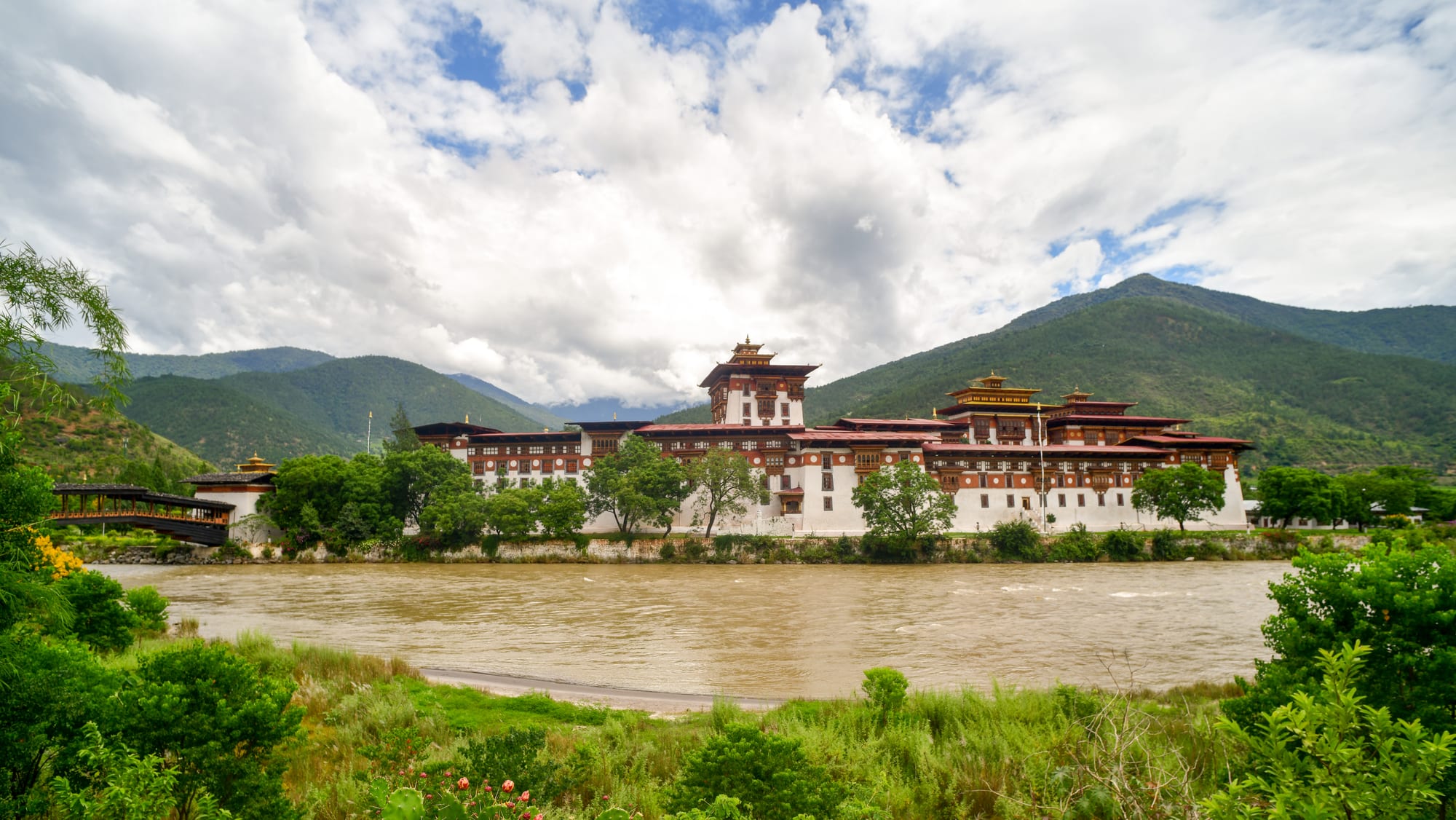
A long white fortress with red and gold roofs on a riverbank, with a covered wooden bridge to the left and green hills behind under cloud

Thimphu, Paro & Western Bhutan, Bhutan

Punakha

Punakha Dzong above the Mo Chhu, with the covered bridge that crosses to it. (Christopher J. Fynn / Wikimedia Commons · CC BY-SA 4.0)

A warm valley town in western Bhutan, about 1,200 metres up where the Pho Chhu and Mo Chhu rivers meet, roughly three hours by road from Thimphu over the Dochula pass. Punakha was the country's capital until the 1950s, and its great white dzong on the spit between the two rivers remains one of Bhutan's most important buildings.

Neighbourhoods

  • The dzong and the river confluence
    • First-time visitors
    • Historic district
    • Photography

    The heart of the valley — the fortress on its spit of land, the covered cantilever bridge across the Mo Chhu, the jacaranda trees along its walls and the paths on both banks. Almost every visit begins here, and the ground around it fills with crowds at festival time.

    Open in Maps
  • Khuruthang
    • Local life
    • Shops and services

    The valley's market town, a few kilometres downstream, built in a single traditional style with shops, offices, a bus stop and simple restaurants. It is where residents do their business rather than a sight in itself.

    Open in Maps
  • The upper Mo Chhu valley
    • Quiet and residential
    • Walks
    • River views

    North of the dzong the road follows the Mo Chhu past rice terraces, farmhouses and riverside lodges towards the long suspension footbridge and the path up to the Khamsum Yulley Namgyal chorten.

    Open in Maps
  • Lobesa and the lower valley
    • Farm country
    • Close to the Thimphu road

    Where the Punakha valley meets the road to Wangdue Phodrang, a spread of paddy fields and villages below the hill temple of Chimi Lhakhang, with guesthouses and small restaurants along the highway.

    Open in Maps

Things to do

Dzong and temples

  • Punakha Dzonglandmark

    Built in 1637–38 by the Zhabdrung Ngawang Namgyal at the meeting of the two rivers, the winter seat of the central monk body and the setting for royal coronations and weddings.

    Open in Maps
  • Chimi Lhakhanglandmark

    A small hilltop temple above Lobesa linked to the 15th-century saint Drukpa Kunley, the Divine Madman, visited by couples hoping for children and reached by a walk through paddy fields.

    Open in Maps
  • Khamsum Yulley Namgyal Chortenlandmark

    A four-storey temple-stupa on a ridge above the Mo Chhu, built in 2004 by the Queen Mother, reached by a climb of about half an hour from the footbridge through rice terraces and pine.

    Open in Maps

Short trips from the town

  • Wangdue Phodrang Dzonglandmark

    The fortress on a ridge above the Punatsangchhu south of the valley, destroyed by fire in 2012 and since rebuilt in traditional technique.

    Open in Maps
  • Phobjikha Valleyattraction

    A wide glacial valley two to three hours east, with marshland where black-necked cranes spend the winter and the Gangtey monastery above them.

    Open in Maps

Seasonal events

  • Punakha Drubchenlate winter, February or March

    A festival in the dzong in which local men in warrior dress re-enact a 17th-century defence of the valley against Tibetan forces.

  • Punakha Tshechulate winter or spring, directly after the drubchen

    Days of masked religious dance in the dzong courtyard, ending with the display of a large appliquéd scroll before dawn.

  • LosarFebruary or March

    Bhutanese New Year, when families gather, offerings are made at the temples and archery matches are held in the villages.

Eat and drink

Long-standing places and food districts in Punakha. Hours, ratings and directions come from your maps app, always current.

Where Punakha eats

  • Khuruthang restaurantsneighborhood

    The market town's simple dining rooms serve Bhutanese rice-and-curry meals, ema datshi and momos, along with Indian and Nepali dishes for the workers and traders passing through.

    Open in Maps
  • Lobesa roadside kitchensneighborhood

    Small restaurants at the junction below Chimi Lhakhang cook for drivers and walkers, usually red rice with cheese and chilli dishes and seasonal river-valley vegetables.

    Open in Maps
  • Punakha's oranges and valley producemarket

    The valley's warm climate produces mandarins in winter, chillies, bananas and vegetables, sold from stalls and roadside tables and sent on to Thimphu.

    Open in Maps

Experience Punakha

History

Punakha's importance begins with geography: a low, warm valley at the meeting of two rivers, sheltered from the winter that grips the higher west. A small temple is said to have stood on the spit of land long before the fortress, and in 1637 the Zhabdrung Ngawang Namgyal began building Punakha Dzong there, the second of his great fortresses after Simtokha. It became the seat of his dual religious and civil government, and his remains are still kept inside a sealed chamber.

For more than three centuries Punakha was Bhutan's capital in all but name, and the winter residence of the ruling hierarchy, who moved between here and Thimphu with the seasons — a migration the central monk body still makes. Tibetan armies attacked the valley several times in the 17th century, a defence remembered in the drubchen festival. In 1907 Ugyen Wangchuck was crowned the first king of Bhutan in the dzong, and the Treaty of Punakha with British India was signed there in 1910. The National Assembly first met in the valley in the 1950s, shortly before the government moved permanently to Thimphu.

The dzong has been rebuilt many times after fires, earthquakes and floods; a glacial lake outburst flood on the Pho Chhu in 1994 damaged it and killed twenty-three people at the dzong, and a long restoration followed. The valley remains a place of state ceremony: the fifth king was married in the dzong in 2011. Rice, oranges and, more recently, tourism and hydropower on the Punatsangchhu shape its modern economy.

Culture & Customs

The dzong sets the tone. Its winter role as the seat of the Je Khenpo and the central monk body fills the valley with monks between late autumn and spring, and the year's two big gatherings, the Punakha Drubchen and the tshechu that follows it, draw people from across the district. The drubchen is unusual among Bhutanese festivals in re-enacting history rather than only religious legend: local men dress as the pazaps, the militia who defended the valley, and process with swords and shields.

Chimi Lhakhang gives the valley its other reputation. The temple honours Drukpa Kunley, the 15th-century "Divine Madman", whose unorthodox teaching is remembered in bawdy stories and in the painted phallus motifs on farmhouses around Lobesa, understood locally as protection against gossip and ill fortune. Couples come to the temple to be blessed with a child, and the village walk to it passes through some of Bhutan's most photographed paddy fields.

Everyday manners match the rest of western Bhutan: national dress at offices and temples, the kabney or rachu scarf in the dzong, hands and heads kept modest before monks. Archery grounds sit beside most villages, and the valley's warmth means life is lived outdoors more than in the higher towns, with tea drunk on verandas and work in the fields at first light.

Daily Life

Punakha district is thinly settled, most of its people in villages rather than towns. The main settlement is Khuruthang, a planned bazaar built a short distance downstream from the dzong to move shops and houses away from it; it has the market, the bus stop, the schools and offices that serve the valley. Around it, farmhouses stand among terraces on both banks.

Farming dominates. The valley's low altitude and irrigation allow paddy rice as the main crop, with a second season of vegetables, and mandarin orchards on the slopes produce the oranges that appear in Thimphu's markets from November. Chillies dry on farmhouse roofs in autumn. Cattle are kept for milk and butter, and many households now earn also from hotels, driving, rafting and guiding.

The rhythm of the day follows the heat: early starts in the fields, a long midday, and an evening of visiting and television. Hydropower construction on the Punatsangchhu has brought years of work, Indian labourers and heavy traffic to the lower valley. The concerns residents raise are those heard across Bhutan — the cost of living, young people leaving for work abroad — with the added local worry of floods from glacial lakes at the head of the Pho Chhu.

Food

Punakha eats what its warm valley grows. Rice is the staple here in a way it is not in the highlands, served plain white or as the nutty red variety of the western valleys, with ema datshi, chillies stewed with soft cheese, as the standard accompaniment. Kewa datshi with potatoes and shamu datshi with mushrooms are the usual variations, and dried beef is cooked with chillies and radish when there is meat on the table.

The valley's own produce sets it apart from Thimphu and Paro: mandarins by the crate in winter, bananas, papaya, chillies, beans and leafy greens from the riverside plots, and wild ferns gathered in spring and served with cheese. Freshwater fish from the rivers appear occasionally, though many Bhutanese avoid fish on religious grounds. Momos, steamed dumplings filled with cheese, beef or vegetables, are eaten as a snack, and hot ezay, a relish of chilli, cheese and tomato, comes with almost everything.

Drinks follow the national pattern. Suja, tea churned with butter and salt, and sweet milk tea are offered at any hour; ara, the home-distilled grain spirit, is served at festivals and to guests. Doma, areca nut with betel leaf and lime, is chewed widely in the warm valleys. Restaurants are concentrated in Khuruthang and along the Lobesa junction, and the riverside hotels cook Bhutanese, Indian and Continental dishes for visitors.

Planning tools

Budget

The national rules apply here: most visitors pay the Sustainable Development Fee of USD 100 per person per night on top of hotels, food and transport, and many book the trip through a licensed Bhutanese operator who arranges guide and driver. Punakha has a handful of expensive riverside lodges alongside ordinary hotels and farm guesthouses, so the daily total depends more on the choice of room than on anything else.

Daily Budget Midrange
USD 400–600 (the fee, a mid-range valley hotel, guide and driver, restaurant meals and small purchases)
Daily Budget Shoestring
USD 300–400 (the nightly Sustainable Development Fee, a simple guesthouse, canteen meals and shared transport)

Extra spending goes on rafting, tips and handicrafts; visitors from India travel under separate, much cheaper rules.

Best Time to Visit

October to March suits Punakha best: clear air, warm days, mandarins in the market and the drubchen and tshechu in late winter. Spring brings jacaranda in flower along the dzong walls and green terraces after the rice is planted. June to August is hot, humid and wet, with landslides possible on the road over Dochula.

Suggested Number of Days

One full day covers the valley's main sights, and two allow a slower pace with walks on both rivers. Three make sense if the trip continues east to the crane valley. Festival dates and the drive over the pass change the number.

First Visit
1–2 days
With Surroundings
3 days

Transportation

Everything in the valley lies along one road between Lobesa, the dzong and the upper Mo Chhu. Tourist travel is normally in the operator's vehicle with a driver, and taxis and shared vehicles run from Khuruthang to Thimphu and Wangdue Phodrang. Distances are short but the roads are narrow and winding.

Rafting on the Mo Chhu is arranged locally through the operator and usually ends within sight of the dzong.

Airport & Station Connections

Punakha is reached by road from Thimphu, about 70 kilometres and around three hours over the Dochula pass at 3,100 metres, with a steep descent into the warm valley. Paro International Airport, the country's only international gateway, is roughly five hours away by the same road. Wangdue Phodrang, on the lateral road east, is about half an hour south.

Walkability

The valley is walked in stretches rather than as a whole: the paths around the dzong and its bridge, the field walk to Chimi Lhakhang, the riverside to the suspension bridge and the climb to the Khamsum chorten. The settled parts are spread over about 10 kilometres of road with no pavement, so getting between them means a vehicle.

Safety

Punakha is very safe, with little crime. The practical risks are heat and humidity in summer, strong currents in both rivers, steep unfenced paths at the chorten climb, and road conditions on the Dochula descent in rain or ice. Mosquitoes and biting insects are more of a nuisance here than in the higher valleys.

Carry water and sun protection for the field and ridge walks, do not swim in the rivers, and allow extra driving time in the monsoon. Check current official travel advice before travelling.

Climate

Warm and subtropical by Bhutanese standards, thanks to its low altitude: the valley grows rice, bananas and mandarins, and it is the usual winter escape from Thimphu's cold. Rain is heaviest from June to September.

Summer
hot and humid — June to August days often reach 28–32°C, with monsoon downpours
Winter
mild and dry — December to February days are usually 15–20°C, with cool nights and little frost on the valley floor

Local Customs

Punakha Dzong is a working monastery and government seat: modest dress with long sleeves and covered legs is required, shoes come off at shrine doors, and parts of the building are closed to visitors. Walk clockwise around chortens and prayer wheels. Chimi Lhakhang's phallus imagery, and the paintings on nearby houses, belong to the cult of Drukpa Kunley and are treated as protective rather than comic.

Ask before photographing people or monks, do not photograph inside shrines, and follow the guide on where visitors may go in the dzong.

Common Payment Methods

The currency is the ngultrum, pegged one to one with the Indian rupee, which also circulates. There are banks and ATMs in Khuruthang, but machines are few and can run out of cash, so notes brought from Thimphu are useful. Hotels take cards; small shops, stalls and drivers generally do not, and residents increasingly pay by mobile QR code.