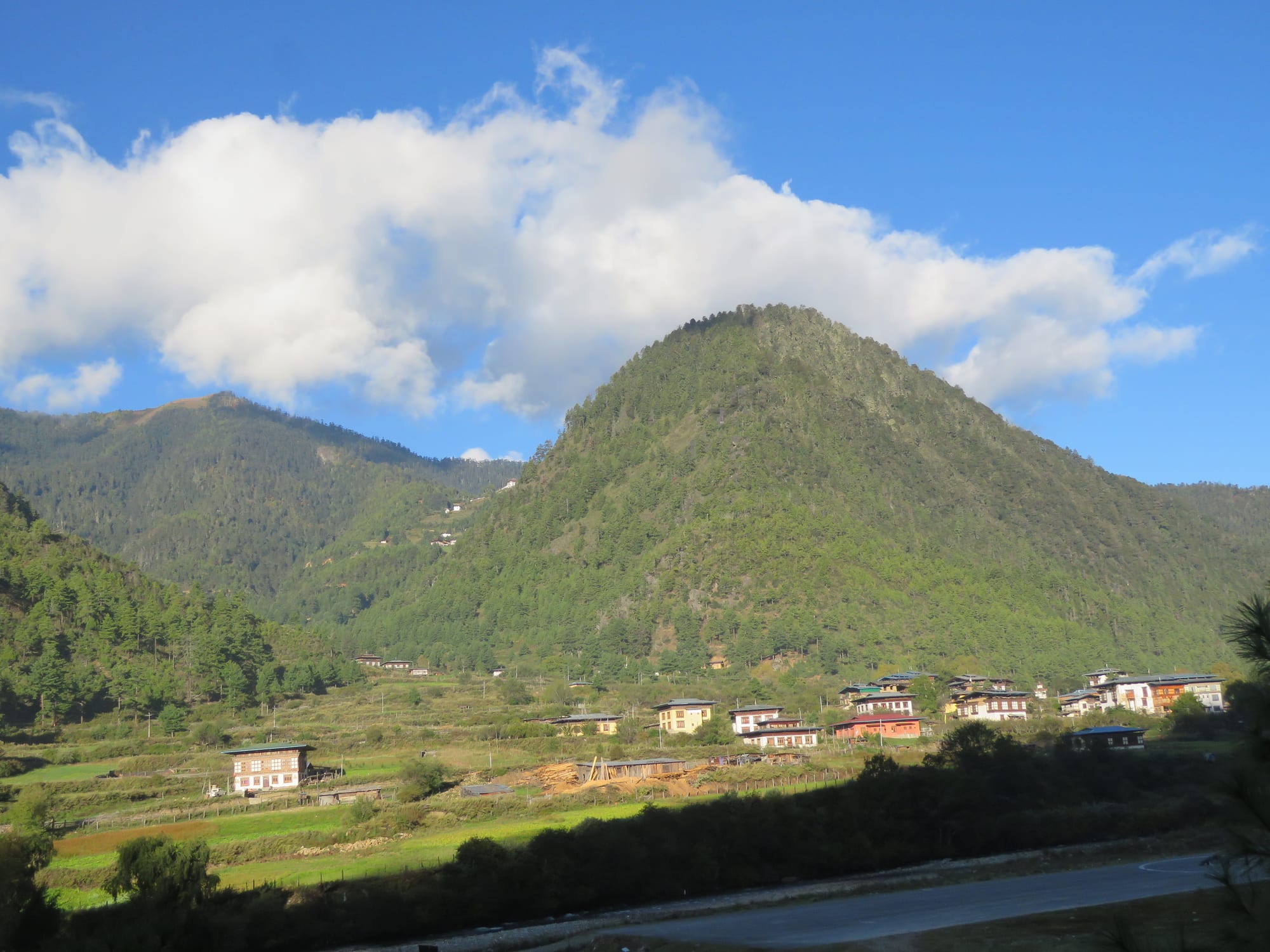
Traditional Bhutanese houses scattered across green fields at the foot of a steep forested hill, under a blue sky with a large white cloud

Bhutan

Thimphu, Paro & Western Bhutan

Farmhouses and fields in the Haa Valley, below the forested hills of western Bhutan. (Vinayaraj / Wikimedia Commons · CC BY-SA 4.0)

The western third of Bhutan, from the Indian border at Phuentsholing and Samtse up through the capital Thimphu and the Paro, Haa, Punakha and Wangdue valleys to the high Himalaya of Gasa — the heartland of the Ngalop people and of Dzongkha, and the part of the kingdom that almost every visitor sees.

Explore Thimphu, Paro & Western Bhutan

History

The western valleys were the stage on which Bhutan was created. Buddhism came early: Kyichu Lhakhang in Paro is traditionally dated to the 7th century and linked to the Tibetan king Songtsen Gampo, and Guru Rinpoche is said to have meditated at Taktsang in the 8th. For centuries the valleys were held by rival lamas and local lords.

In 1616 Ngawang Namgyal, a Drukpa lama from Tibet known as the Zhabdrung, arrived and began to unite the west under his rule. He built Simtokha Dzong near Thimphu in the late 1620s, then Punakha Dzong in 1637–38, Wangdue Phodrang and Rinpung Dzong at Paro, turning the dzongs into strongholds against Tibetan armies and the seats of his dual religious and civil government. Punakha was the winter capital, and the Zhabdrung's remains are still kept there. Drukgyel Dzong in upper Paro commemorated a victory over Tibetan invaders.

The west also shaped the modern kingdom. Ugyen Wangchuck was crowned the first king at Punakha in 1907, and Thimphu became the permanent capital in the 1950s and 1960s, when Tashichho Dzong was rebuilt. The hydropower plants at Chhukha and Tala, built with Indian help, became Bhutan's largest earners. In the late 1980s and 1990s, the Lhotshampa of the southern districts were hit hard by the citizenship campaign described on the Bhutan page.

Culture & Customs

The west is the land of the Ngalop, whose speech is the basis of Dzongkha, the national language, and whose dress, architecture and etiquette became the national norm under the "one nation, one people" policy. Houses here are typically of rammed earth with carved and painted timber upper storeys, and archery matches in Thimphu and Paro bring out singing, dancing and teasing between teams.

The religious calendar is dominated by the tsechu festivals. At the Paro Tsechu in spring, a giant thongdrel, an embroidered religious scroll, is unrolled at dawn on the last day; the Thimphu Tsechu in autumn fills the courtyard of Tashichho Dzong; and the Punakha Drubchen re-enacts a 17th-century battle against Tibetan forces. Chimi Lhakhang near Punakha is dedicated to the saint Drukpa Kunley, the "Divine Madman", and couples come to it seeking children.

Thimphu is the centre of the thirteen traditional arts, taught at the National Institute for Zorig Chusum: painting, carving, embroidery, weaving and more. In Gasa, the herders of Laya keep a distinct identity. In the south, Samtse and Chhukha have large Nepali-speaking, largely Hindu communities, and Dashain and Tihar are celebrated.

Daily Life

Thimphu, the capital, is Bhutan's largest city: a place of civil servants, students, monks and shopkeepers, of new apartment blocks up the valley sides and a weekend market by the Wang Chhu. Traffic is directed by hand at the main junction, office workers wear the gho and kira, and evenings are spent in cafes, karaoke bars and at archery ranges. Rising prices, housing costs and youth unemployment are daily concerns, and many young people have emigrated in recent years.

Paro is a quieter valley town of farmhouses, hotels and the airport, growing red rice, apples and potatoes. Punakha and Wangdue farm rice, oranges and vegetables in their warmer valleys. Phuentsholing, the main border town and commercial centre, sits directly against Jaigaon in India and handles much of Bhutan's trade; Samtse and Chhukha have industries, factories and hydropower plants.

In the high valleys of Haa, Phobjikha and Gasa, families raise yaks and cattle, grow buckwheat and potatoes, and in Laya gather cordyceps in spring.

Food

The west eats Bhutan's classic dishes, and the local markets show where they come from. Paro's valley is known for its red rice, and the Centenary Farmers' Market in Thimphu sells dried chillies, fresh cheese, butter wrapped in leaves and the hard, chewy chugo, dried yak cheese sold on strings.

Haa has its own speciality, hoentay: buckwheat dumplings filled with turnip greens, cheese and chilli. Other everyday dishes include kewa datshi, potatoes in cheese; shamu datshi, mushrooms in cheese; and dried beef or pork cooked with chillies and radish. Phobjikha, with its cool climate, is potato country, and Punakha grows oranges and vegetables for Thimphu.

Butter tea and sweet milk tea are drunk throughout the day, and homemade ara, made from rice or other grains, is offered at festivals. Thimphu has a small but growing restaurant scene, from Indian and Nepali canteens to cafes serving coffee and pastries, while bottled beer is widely drunk.

Attractions & Natural Wonders

Paro has the Tiger's Nest, Paro Taktsang, set on a cliff above the upper valley, as well as Rinpung Dzong, the National Museum in the old Ta Dzong watchtower above it, Kyichu Lhakhang and the ruins of Drukgyel Dzong near the start of the Jomolhari trek. Over the Chele La, the Haa valley has the White and Black temples, Lhakhang Karpo and Lhakhang Nagpo, and a summer festival of local culture.

Thimphu has Tashichho Dzong, the giant Buddha Dordenma statue above the valley, the Memorial Chorten where residents walk circuits all day, the takin enclosure at Motithang and the old Simtokha Dzong at the valley's southern end.

East over Dochula and its 108 chortens, Punakha Dzong stands where two rivers meet, reached by a covered cantilever bridge, with Chimi Lhakhang and the Khamsum Yulley Namgyal chorten nearby. Wangdue Phodrang Dzong, rebuilt after a fire in 2012, overlooks the road to Phobjikha, where Gangtey monastery looks down on the cranes' winter marshes. Gasa, to the north, has hot springs, the village of Laya and Jigme Dorji National Park.

In the south, the road in from Phuentsholing climbs from the plains through forest, waterfalls and the Chhukha hydropower zone to the cool valleys around Thimphu.

Cities in Thimphu, Paro & Western Bhutan

Planning basics

Budget

The Sustainable Development Fee and the operator's daily package apply here as everywhere in Bhutan, but the west is where the widest choice of hotels lies, from simple family-run places in Haa and Phobjikha to luxury resorts in Paro, Thimphu and Punakha that raise the daily cost steeply. Spending money goes on handicrafts in Thimphu, drinks and tips.

Daily Budget Midrange
Package of roughly USD 300–500 a day plus the SDF, and USD 20–50 for crafts, meals out in Thimphu and tips
Daily Budget Shoestring
Package of roughly USD 200–300 a day plus the SDF, and USD 10–20 for tips, drinks and small purchases

Visitors from India entering by road at Phuentsholing pay a lower fee and can obtain their permit at the border; everyone else arranges the trip in advance through an operator.

Safety

Western Bhutan is very safe. The practical risks are the steep climb to Taktsang at around 3,000 metres, cold on the passes, stray dogs barking at night in Thimphu, and landslides on the Phuentsholing road and the route to Phobjikha in the monsoon. Treks such as Jomolhari and the Snowman cross high, remote country.

Take the Taktsang hike slowly with water and good shoes, and carry warm layers for the passes. Check current official travel advice before travelling.

Climate

Altitude shapes the west. Phuentsholing and Samtse in the southern foothills are hot, humid and very wet in the monsoon. Thimphu, Paro and Haa, at about 2,300–2,700 metres, have cold, dry winters and mild summers, while Punakha and Wangdue, lower down, are warm enough for rice and oranges. Phobjikha, at about 3,000 metres, sees frost and snow.

Summer
mild and wet in Thimphu and Paro, 15–25°C; hot and humid in Phuentsholing; warm in Punakha
Winter
clear and cold in Thimphu, Paro and Haa, below freezing at night; mild days in Punakha; frosty in Phobjikha

Transportation

Paro airport is the country's international gateway, and Thimphu is about an hour's drive away. Punakha is about three hours from Thimphu over Dochula, and Phobjikha a further two to three hours. Overland travellers from India enter at Phuentsholing, a winding drive of around six hours up to Thimphu. Haa is reached from Paro over the Chele La. All tourist travel is in the operator's vehicle.

Visit Paro Taktsang at the end of the trip, when acclimatised, and allow a spare day around the Paro flight.

Best Time to Visit

Spring (March to May) brings the Paro Tsechu, rhododendrons on the passes and jacaranda at Punakha Dzong. Autumn (late September to November) has the clearest views from Dochula and the Thimphu Tsechu, and the black-necked cranes arrive in Phobjikha from late October. Winter is good for Punakha and the crane season; the monsoon months bring cloud and road blockages.