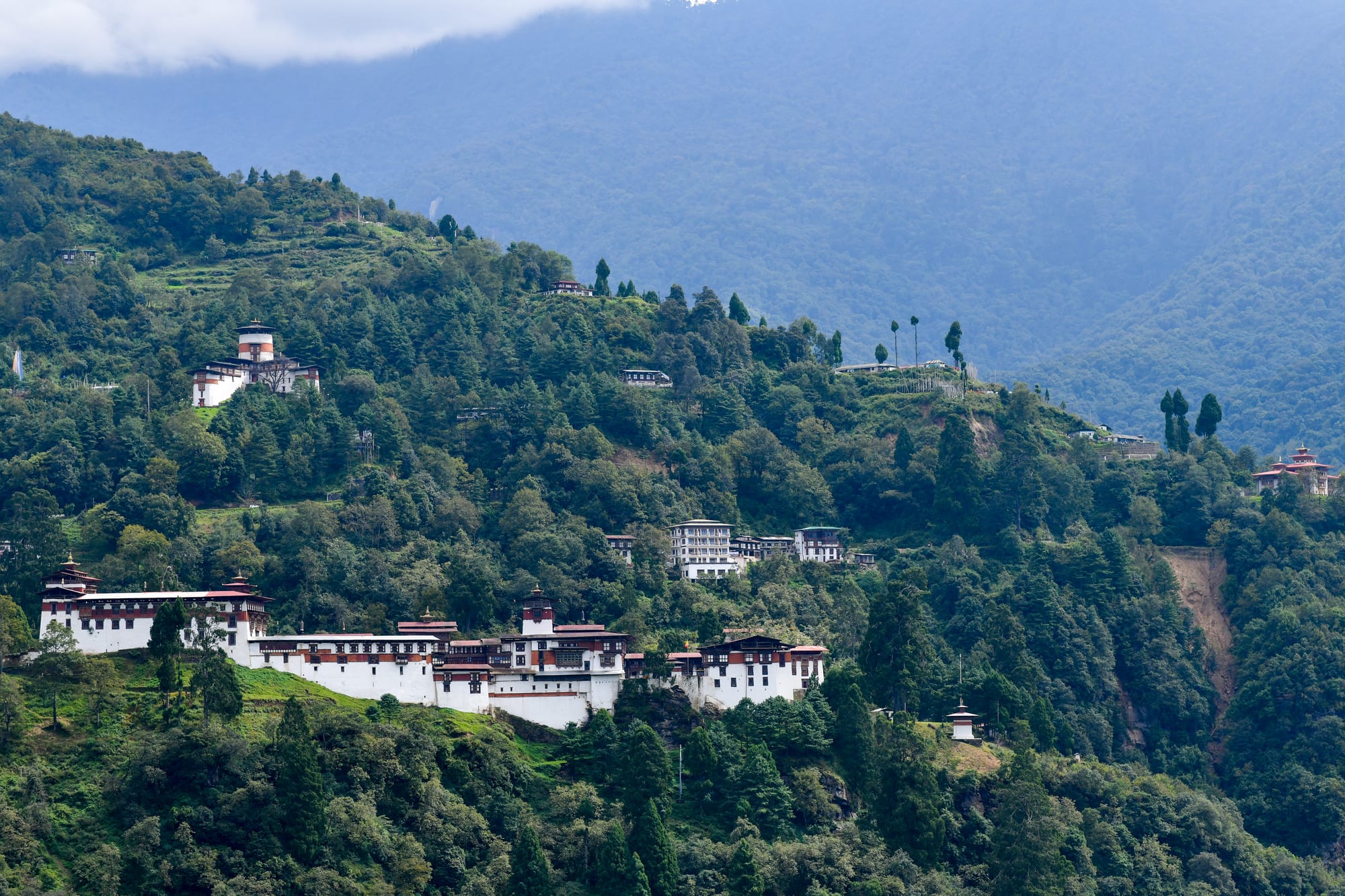
A long white dzong along a forested ridge, with a round watchtower higher on the hillside and cloud over the mountains

Bhutan

Bumthang & Central Bhutan

Trongsa Dzong on its ridge above the Mangde Chhu gorge, with the Ta Dzong watchtower on the slope above. (Christopher J. Fynn / Wikimedia Commons · CC BY-SA 4.0)

Central Bhutan, reached over the Pele La, runs from the sacred valleys of Bumthang and the Wangchuck dynasty's home at Trongsa south through the forests of Zhemgang to the lowland districts of Sarpang, Tsirang and Dagana and the Royal Manas park on the Indian border — the kingdom's spiritual heartland and the cradle of its monarchy.

Explore Bumthang & Central Bhutan

History

Bumthang is where Bhutanese Buddhism has its oldest roots. Jambay Lhakhang is traditionally one of the 108 temples founded in the 7th century by the Tibetan king Songtsen Gampo, and in the 8th century Guru Rinpoche is said to have come to Bumthang at the invitation of a local ruler, the Sindhu Raja, subdued a hostile deity and left the imprint of his body in the rock at Kurjey. In 1450 the saint and treasure-revealer Pema Lingpa was born in Bumthang; he recovered religious texts and objects at Membartsho and founded Tamshing Lhakhang in 1501, and several of Bhutan's noble lines, including the royal family, trace descent from him.

Trongsa rose in the 17th century when the Zhabdrung's government built a dzong there, controlling the only road between east and west. Its governors, the Trongsa Penlops, became the most powerful men in the country. In the 19th century Jigme Namgyal, the Penlop known as the Black Ruler, fought the British in the Duar War and became Druk Desi, and his son Ugyen Wangchuck, also Penlop of Trongsa, was chosen as the first hereditary king in 1907. Ugyen Wangchuck was born at Bumthang's Wangdicholing Palace, and each crown prince still becomes Penlop of Trongsa before taking the throne.

The southern districts of Sarpang, Tsirang and Dagana were settled largely by Nepali-speaking farmers, and were at the centre of the unrest and departures of the early 1990s. Gelephu, on the Indian border, was chosen in 2023 as the site of a planned special economic zone, Gelephu Mindfulness City.

Culture & Customs

Bumthang has its own language, Bumthangkha, and a sense of being Bhutan's religious core, with dozens of temples in a small area and families linked to Pema Lingpa's lineage. Its best-known festival is the Jambay Lhakhang Drup, held over five days each autumn in the temple courtyard in honour of Guru Rinpoche, who is said to have consecrated the temple.

Bumthang is known for weaving yathra, thick woollen cloth in bright geometric patterns made into jackets, blankets and scarves.

Further south, the Khengpa people of Zhemgang speak Khengkha, a language close to Bumthangkha, and are devout followers of the Nyingma tradition of Tibetan Buddhism. Sarpang, Tsirang and Dagana are home to Nepali-speaking Lhotshampa communities, largely Hindu, who celebrate Dashain and Tihar. Trongsa's tsechu in winter and the royal associations of its dzong make it a place of national ceremony; the five-day festival is held in the dzong's northern courtyard in December or January.

Daily Life

Central Bhutan is thinly populated. Jakar, Bumthang's main town, is a small bazaar of a few thousand people with shops, schools, a hospital and hotels. Trongsa is even smaller, strung along the road above its dzong. Gelephu, in Sarpang, is the region's largest town and a trading post facing Assam, and it is expected to grow if the planned special economic zone takes shape.

Bumthang's farmers grow buckwheat, barley, potatoes and apples in cold valleys. Yaks and sheep are herded in the higher pastures, and dairy farming and honey add to farm incomes. The valleys are also home to many monasteries.

Zhemgang has scattered villages reached by long roads, and the lowland districts of Tsirang and Dagana grow oranges, cardamom, rice and vegetables. Across the region, young people move to Thimphu or abroad, and new roads and hydropower projects are changing remote valleys.

Food

Bumthang is buckwheat country, and its best-known dishes come from it. Puta are buckwheat noodles, often served with butter and chilli, and buckwheat also goes into dumplings and porridge-like dishes eaten with ema datshi, the chilli-and-cheese stew. Potatoes and turnips, often cooked with dried pork or beef, are the other staples of the cold valleys.

Bumthang's farms also produce wheat, dairy goods, honey and apples. As elsewhere in Bhutan, most milk is turned into butter and cheese, including soft datshi and hard, dried chugo.

In the south, the Lhotshampa kitchen follows Nepali patterns, with rice, lentils, vegetable curries and sel roti at festivals, and the lowlands produce oranges, cardamom and ginger. Across the region, butter tea (suja) and homemade ara are the traditional drinks, and villagers dry chillies on their rooftops in autumn.

Attractions & Natural Wonders

Bumthang's valleys hold the greatest concentration of old temples in Bhutan. In the Choekhor valley around Jakar are Jakar Dzong on its ridge, Jambay Lhakhang, Kurjey Lhakhang, Tamshing Lhakhang with its old wall paintings, and the Wangdicholing Palace. The Tang valley has Membartsho, the Burning Lake; and Ura, over a high pass to the east, is a village of stone houses and cobbled lanes.

Trongsa Dzong, the largest dzong in Bhutan, sits above the gorge of the Mangde Chhu, and the Ta Dzong watchtower above it houses a museum. The road over the Pele La crosses dwarf bamboo and rhododendron forest in the Black Mountains, part of Jigme Singye Wangchuck National Park, before descending past Chendebji Chorten, a stupa in the Nepali style, to Trongsa. The Yotong La then leads on to Bumthang.

In the south, Royal Manas National Park, Bhutan's oldest protected area, adjoins India's Manas National Park across the border and protects tropical forest and grasslands with tigers, elephants, rhinos and the golden langur. Gelephu is the southern entry point.

Cities in Bumthang & Central Bhutan

Planning basics

Budget

The package and Sustainable Development Fee structure is the same as elsewhere, but central Bhutan has fewer luxury hotels than Paro or Punakha, and most stays in Bumthang and Trongsa are in comfortable mid-range lodges and farmhouses. Longer drives add days rather than cost. Spending money goes on Bumthang's cheese, honey and woven yathra.

Daily Budget Midrange
Package of roughly USD 300–450 a day plus the SDF, and USD 20–50 for textiles, local produce and tips
Daily Budget Shoestring
Package of roughly USD 200–300 a day plus the SDF, and USD 10–20 for tips and small purchases

Buy yathra directly from weavers in Bumthang, where prices are lower than in Thimphu's shops.

Safety

Central Bhutan is very safe. The main hazards are the long, winding roads with ice on the passes in winter and landslides in the monsoon, cold nights in Bumthang, and wildlife and malaria-season caution in the southern forests around Royal Manas. Medical care is basic outside Gelephu and Jakar.

Carry warm clothes for Bumthang, allow for road delays in the monsoon, and follow the guide in Royal Manas. Check current official travel advice before travelling.

Climate

Bumthang's valleys lie at about 2,600–3,000 metres and are the coldest that most visitors see, with snow in winter and cool summers. Trongsa is milder, while Zhemgang, Sarpang and Dagana drop into subtropical foothills, hot and very wet in the monsoon. The Pele La and Yotong La passes can be icy or snowbound in winter.

Summer
cool and damp in Bumthang, 12–22°C; hot, humid and very wet around Gelephu and in Royal Manas
Winter
cold in Bumthang, well below freezing at night, with occasional snow; mild in the southern foothills

Transportation

The lateral road runs east from Wangdue over the Pele La, at about 3,400 metres, to Trongsa, a long day's drive from Punakha, then over the Yotong La to Jakar in Bumthang in around three hours. Domestic flights serve Bathpalathang airport in Bumthang and Gelephu in the south. A north–south road links Trongsa with Zhemgang and Gelephu, from where Royal Manas is reached.

Flying one way to Bumthang and driving the other saves a day of mountain roads while still crossing the Pele La.

Best Time to Visit

Autumn (late September to November) brings clear skies and Bumthang's big festivals, including the Jambay Lhakhang Drup and the Jakar Tsechu. Spring (March to May) has rhododendrons on the Pele La. Winter is cold in Bumthang but good for Royal Manas, which is best visited between November and April.