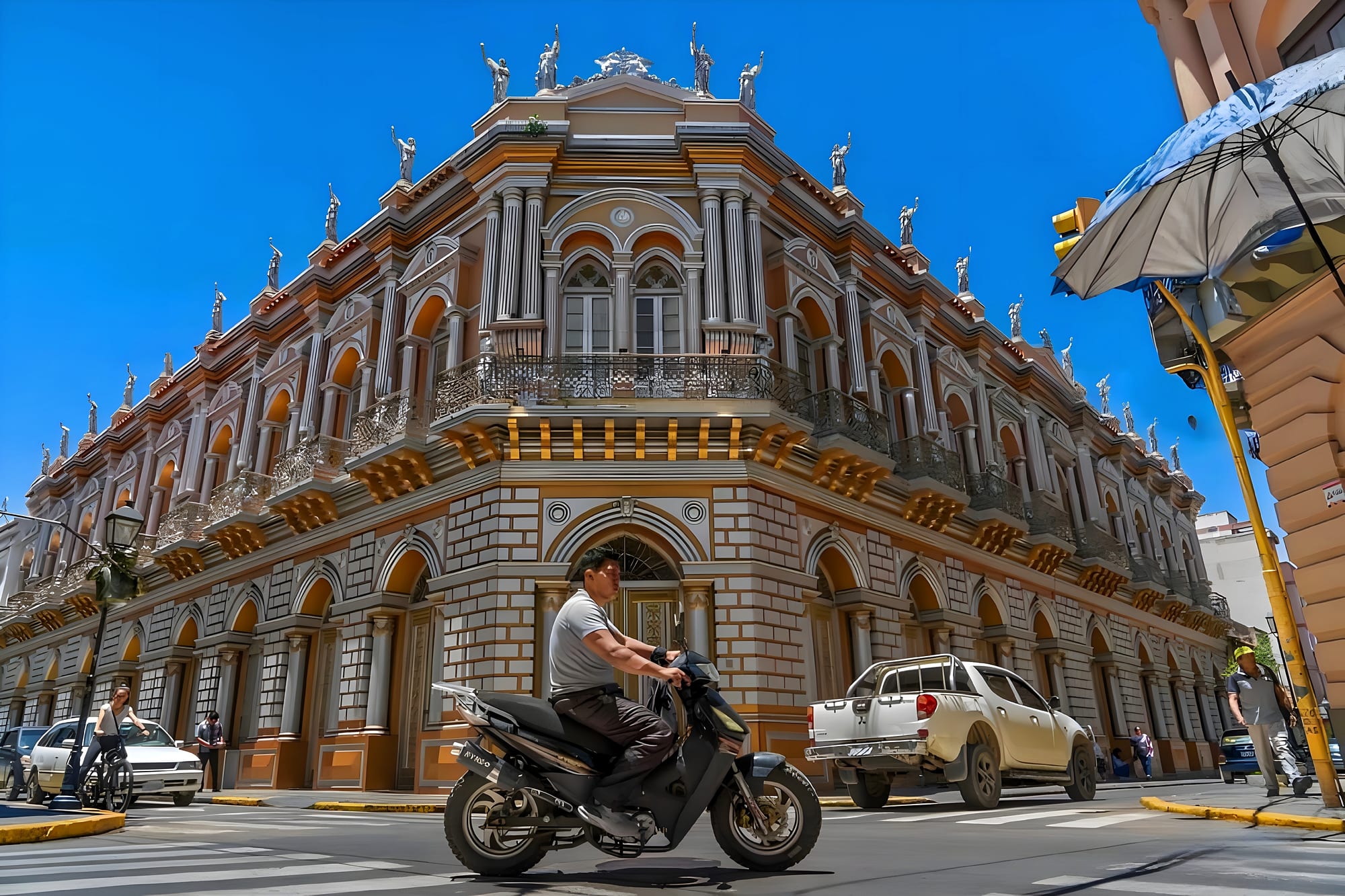
The ornate pink and cream facade of the Casa Dorada, topped with statues, on a street corner in Tarija under a blue sky

Sucre, Cochabamba, Tarija & the Valleys, Bolivia

Tarija

The Casa Dorada, an art nouveau mansion that is now Tarija's Casa de la Cultura. (Parallelepiped09 / Wikimedia Commons · CC BY-SA 4.0)

The capital of the Tarija department in southern Bolivia, in a mild valley at about 1,800 metres on the Guadalquivir River. Founded in 1574 as a frontier town facing the Chaco, it is known as the Bolivian Andalusia, and it is the centre of the country's wine and singani, with gas money from the Chaco behind its recent growth.

Neighbourhoods

  • Historic centre and Plaza Luis de Fuentes
    • First-time visitors
    • Historic district
    • Best for food

    The colonial grid around the main square, named after the city's founder and ringed by restaurants, craft shops and cafés. The paleontology museum, the public market and a university campus are all within walking distance.

    Open in Maps
  • Loma de San Juan
    • Views
    • Parks

    A hill with a lookout and a statue of Jesus, and the chapel of San Juan, founded in 1576 and the oldest church in the city.

    Open in Maps
  • Along the Guadalquivir
    • Quiet and residential
    • Walks

    The districts along the Guadalquivir River, named after the river of Seville, with riverside avenues and newer residential neighbourhoods spreading towards the edge of the valley.

    Open in Maps

Things to do

Famous landmarks

  • Plaza Luis de Fuentes y Vargaslandmark

    The main square, the heart of the historic centre, named after Luis de Fuentes, who founded the city in 1574, and surrounded by restaurants and craft shops.

    Open in Maps
  • Casa Doradamuseum

    An art nouveau building commissioned by Moisés Navajas and his wife, now the city's Casa de la Cultura with a historical museum about Tarija; it appeared on the older series of 20-boliviano notes.

    Open in Maps
  • Castillo Azullandmark

    The Blue Castle, an art nouveau mansion and, with the Casa Dorada, one of the two best-known buildings of its style in the city.

    Open in Maps
  • Iglesia de San Roquelandmark

    The church of the city's beloved saint, opened in 1632 and the focus of the Fiesta Grande de San Roque every August.

    Open in Maps
  • Convento de San Franciscolandmark

    The Franciscan convent, founded in 1606 by the order whose friars planted the first vines in the Tarija valley.

    Open in Maps
  • Loma de San Juanviewpoint

    A hill with a viewpoint over the city and the chapel of San Juan, founded in 1576 and the oldest church in Tarija.

    Open in Maps

Museums, markets and sport

  • Museo Nacional Paleontológico y Arqueológicomuseum

    The national museum of paleontology and archaeology, run by the city's university a short walk from the main square.

    Open in Maps
  • Mercado Centralmarket

    The oldest market in the city, more than 120 years old, rebuilt in a modern building opened in 2018, with groceries, local crafts and food.

    Open in Maps
  • Estadio IV Centenarioattraction

    The city's football stadium, home of Unión Central, Ciclón and Real Tomayapo, enlarged in 2024 to about 16,600 seats.

    Open in Maps

Short trips from the city

  • San Lorenzoattraction

    A town about 15 km north of Tarija with colonial houses, among them the house, now a museum, of Eustaquio Méndez, leader of Tarija's gaucho militias in the independence wars.

    Open in Maps
  • Valle de la Concepciónattraction

    A valley south-east of the city and one of Bolivia's wine regions, reached by trufi or colectivo from the city.

    Open in Maps
  • Uriondoattraction

    A small town about 25 km south of Tarija at the meeting of two rivers, the administrative centre of José María Avilés Province.

    Open in Maps
  • Cordillera de Sama Biological Reservepark

    A protected area in the mountains near the city, covering high puna grassland and dry montane forest.

    Open in Maps

Seasonal events

  • Fiesta Grande de San Roquefrom mid-August into September

    Tarija's great religious festival, beginning on 16 August, when chunchos in colourful costumes process through the streets in honour of the saint; UNESCO added it to the Intangible Cultural Heritage of Humanity in 2021.

  • Carnaval Chapaco and the Entrada de ComadresCarnival season, February or March

    Tarija's own carnival celebrations, with parades and the Entrada de Comadres, among the best-known folk events in the city.

Eat and drink

Long-standing places and food districts in Tarija. Hours, ratings and directions come from your maps app, always current.

Tarija classics

  • Saicerestaurant

    Tarija's signature stew of minced beef, peas and potatoes, spiced with chilli.

    Open in Maps
  • Singani and chuflayrestaurant

    Bolivia's national spirit, a brandy distilled from Muscat of Alexandria grapes grown at 1,600 metres or higher, drunk neat or in the chuflay cocktail.

    Open in Maps

Food districts, markets and wineries

  • Mercado Centralmarket

    The old central market, rebuilt in 2018, with groceries and food.

    Open in Maps
  • Around Plaza Luis de Fuentesneighborhood

    Restaurants of many cuisines, cafés and bakeries selling cakes and empanadas line the main square and the streets around it.

    Open in Maps
  • Valle de la Concepción wineriesneighborhood

    The wineries of a wine-growing valley south-east of the city.

    Open in Maps

Experience Tarija

History

Before the Spanish, the valley was home to the Tomatas, although some documents suggest the early conquerors found them further west, around the San Juan del Oro River, and brought them here. In 1574 the conquistador Luis de Fuentes founded San Bernardo de la Frontera de Tarixa and resettled Tomatas in the largely depopulated valley. The town was a frontier post facing the Chaco and its peoples, and religious orders soon left their mark: the chapel on the Loma de San Juan dates from 1576, the Franciscan convent from 1606 and the church of San Roque from 1632, and the Franciscans planted the first vines in the valley.

During the wars of independence Tarija's gaucho militias, linked to the Argentine leader Martín Miguel de Güemes, fought under Eustaquio Méndez, whose house in San Lorenzo is now a museum. After independence the city's ties to the south were strong, and the chapacos voted to belong to Bolivia rather than Argentina, a loyalty reflected in the cueca "Chapaco Soy".

For much of its history Tarija was a remote, agricultural corner of the country. In recent decades the natural gas fields of the Chaco, in the east of the department, made it one of Bolivia's richer regions; the falling output of recent years has squeezed public budgets. The population of the municipality more than doubled between 1992 and 2024.

Culture & Customs

Bolivians and visitors alike call Tarija the Bolivian Andalusia: its founder came from Seville, and its river, the Guadalquivir, is named after the Spanish river. Its people, the chapacos, hold contests of coplas, sung verses, at Carnival, and play the erque and the caja, typical instruments of Tarija.

The year is shaped by festivals. The Fiesta Grande de San Roque, one of the most important displays of religious faith in Bolivia, begins on 16 August with chunchos, dancers in colourful costumes, processing through the streets in honour of the saint; in December 2021 UNESCO inscribed it on the list of the Intangible Cultural Heritage of Humanity. Carnival brings the Carnaval Chapaco and the Entrada de Comadres, and the pilgrimage to the sanctuary of Chaguaya is another major religious event.

Wine is part of the identity as much as music. An annual Festival of Wine celebrates the vineyards, and singani, the national spirit, is treated as cultural heritage. In the east of the department, Guaraní communities of the Chaco keep their own language and customs.

Daily Life

About 240,000 people lived in the municipality of Tarija at the 2024 census, and the city is the capital of the department and its largest urban centre. It has grown fast, helped by the gas economy.

The main activities are tourism, the wine industry and food. Besides vineyards, the valley grows gherkins, garlic, blueberries, oregano and flowers for the national market and for export, and wineries and singani distilleries work in the surrounding countryside. The city has invested in new markets — the Mercado Central, rebuilt in 2018 and more than 120 years old, alongside the La Loma, Bolívar, Abasto del Sur and San Martín markets. The Juan Misael Saracho Autonomous University brings students to the city, and its television station was the first in Bolivia to broadcast in colour.

The days are relaxed: long lunches, evening walks around the plazas and weekends in the valley towns. The main worries are the national economic crisis, with its dollar and fuel shortages, the decline of gas revenues on which the department's budget depends, and water shortages in a dry valley that keeps growing.

Food

Tarija has dishes of its own. The signature dish is saice, a spicy stew of minced beef, peas and potatoes. Bakeries and cafés around the main square sell cakes and empanadas, and the Mercado Central sells groceries and food.

The Tarija valley is Bolivia's main wine-producing region, home to around 80 per cent of the country's wine industry. Bolivian law requires the vineyards for singani to be planted at 1,600 metres or higher, and the term "de altura", of altitude, is applied to the country's wines as well. Wineries lie around the city and in the Valle de la Concepción.

Singani is the drink that matters most: a clear brandy distilled from Muscat of Alexandria grapes, produced only in the high valleys of Bolivia since the 16th century, when religious orders first distilled it. It is drunk neat or as the base of the chuflay cocktail, and singani and wine are the drinks of every local celebration.

Planning tools

Budget

Tarija is cheap for eating and drinking, and the main extra costs are winery and singani tastings in the surrounding valleys, which are cheapest on a shared tour or with a local taxi for the day, and flights to the rest of the country. The national dollar shortage applies, so bring clean US dollar notes.

Daily Budget Midrange
USD 55–100 (central hotel, restaurant dinners with local wine, a winery day, taxis)
Daily Budget Shoestring
USD 25–40 (hostel or guesthouse, market and set-menu meals, trufis)

Visit the wineries on a shared tour or hire a local taxi for the day rather than driving after tastings.

Best Time to Visit

Tarija is mild most of the year. The dry season from April to October brings sunny days and open roads, and the Fiesta Grande de San Roque fills the city from mid-August into September.

Suggested Number of Days

Two or three days are enough for the city at its own relaxed pace. Allow four or five to add the wine valleys and the villages of the surrounding countryside, and more for the San Roque festival.

First Visit
2–3 days
With Surroundings
4–5 days

Transportation

The centre is compact and walkable. Micros, trufis and colectivos run across the city and out to the valley towns, including San Lorenzo and the Valle de la Concepción, and short taxi rides are cheap.

Fly or check the news before long road journeys, as blockades can close the highways.

Airport & Station Connections

Capitán Oriel Lea Plaza Airport, within the city, has regular flights to La Paz and other Bolivian cities. The bus terminal has domestic and international services, including night buses to Potosí and routes to Tupiza, and Tarija links south to the Argentine border at Bermejo and Yacuiba.

Walkability

The historic centre is flat, compact and shaded by trees around its plazas, and most sights, the market and the cafés lie within a few blocks of the main square. The wine valleys and the outlying neighbourhoods need transport.

Safety

Violent crime against tourists is relatively low, but manage the risks: fake-taxi and fake-police scams and express robberies occur in La Paz, Cochabamba, and on the Uyuni and Copacabana routes, and petty theft is common on overnight buses and in markets. Tarija itself is among Bolivia's calmer cities. The road protests and blockades that paralysed much of the country in May and June 2026 can still cut the highways.

Watch belongings in markets and on overnight buses, use registered taxis after dark and follow local news for blockades. Check current official travel advice before travelling.

Climate

A mild, semi-arid valley climate at about 1,800–2,000 metres, without the cold of the Altiplano or the humid heat of the lowlands, and an average temperature of about 20°C. Most rain falls in summer.

Summer
December to February: the warm wet season, when almost all the year's rain falls, in a city with a yearly average of about 20°C
Winter
June to August: dry, with pleasant days and cold nights; in July temperatures often drop below 9°C, and frosts occasionally occur

Local Customs

Tarijeños call themselves chapacos, whatever their background, and are known for an easy-going, Andalusian-influenced manner, long lunches and a strong local identity, celebrated in the cueca 'Chapaco Soy'. Sharing wine and singani is part of social life, and religious festivals, above all San Roque, matter a great deal.

Greet people when entering shops, dress modestly in churches, drink tastings in moderation if travelling by road, and round up or leave about 10 per cent in sit-down restaurants.

Common Payment Methods

The currency is the boliviano (Bs), which has floated against the US dollar since June 2026. Markets, trufis, taxis and small eateries take cash; some hotels, wineries and restaurants take cards, though payments sometimes fail. ATMs can run short, so carry clean US dollar notes and small boliviano notes.