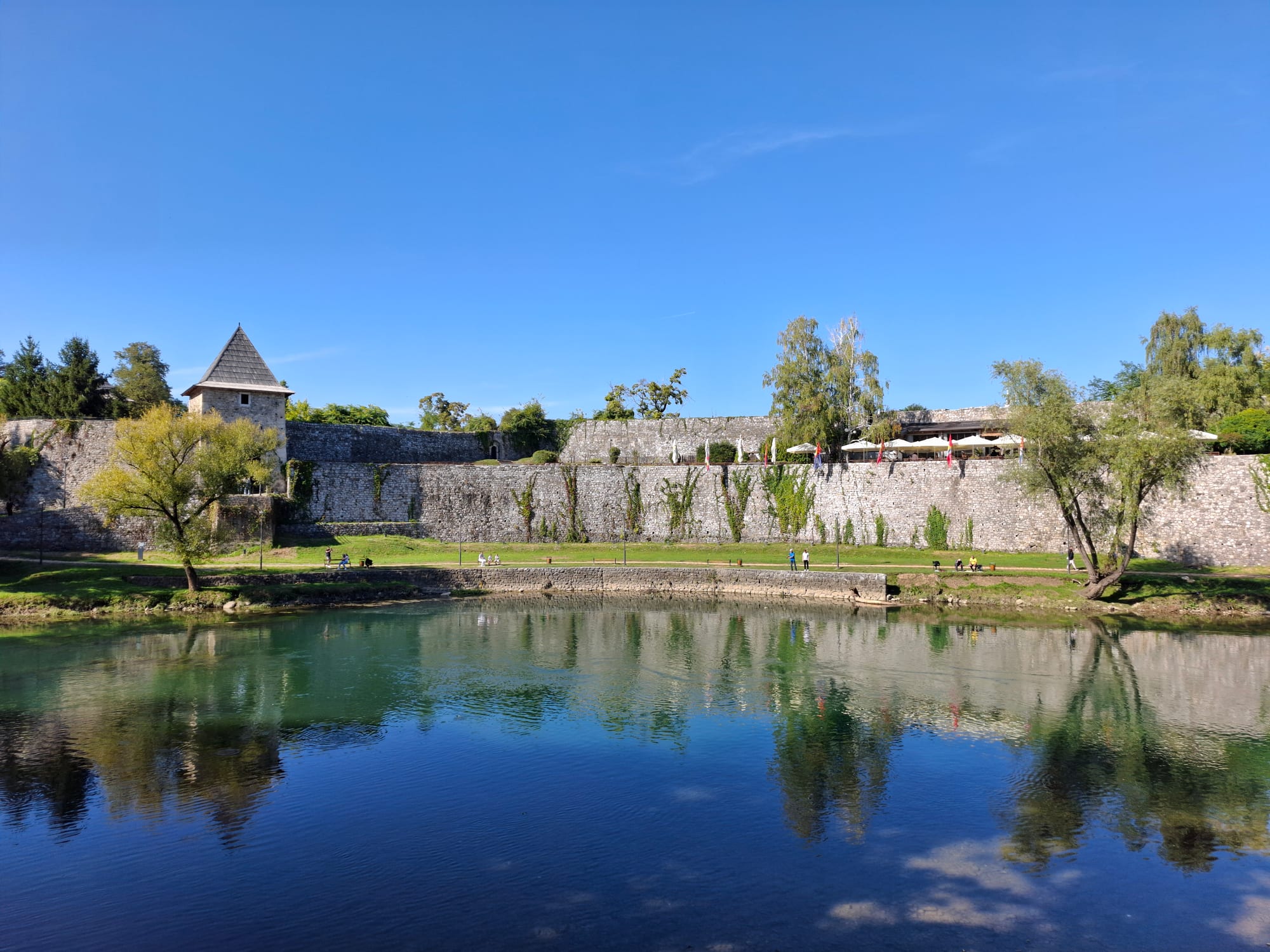
Long stone walls and a corner tower of a riverside fortress reflected in the calm green-blue Vrbas under a clear sky

Banja Luka & the Northwest, Bosnia and Herzegovina

Banja Luka

The walls of the Kastel fortress above the Vrbas in Banja Luka. (ArhistefoBL / Wikimedia Commons · CC0)

The second city of Bosnia and Herzegovina and the seat of Republika Srpska, spread across a flat valley on both banks of the Vrbas. A Roman camp, an Ottoman provincial capital and an Austro-Hungarian garden town in turn, rebuilt after the 1969 earthquake, it is today a leafy, low-rise city of avenues, café terraces, a riverside fortress and white-water rafting upstream.

Neighbourhoods

  • City centre and Gospodska street
    • First-time visitors
    • Cafés
    • Architecture

    The pedestrian Gospodska street, lined with ornamented neo-Renaissance and Secession buildings of the late 19th century, runs through a centre of parks and avenues. Banski dvor, the Palace of the Republic, the Orthodox cathedral and the rebuilt Ferhadija all stand within a few minutes' walk.

    Open in Maps
  • Kastel and the riverside
    • Historic district
    • Nightlife
    • Riverside walks

    The walled fortress on the left bank of the Vrbas, on the site of a Roman camp, with green lawns, summer festival stages and bars in and around its walls. Dajak boat tours run along the river below.

    Open in Maps
  • Borik
    • Quiet and residential
    • Sport

    A planned neighbourhood north-east of the old centre, built after the 1969 earthquake to house people who had lost their homes. The city stadium, home of FK Borac, is here among the apartment blocks.

    Open in Maps
  • Starčevica
    • Local life
    • Quiet and residential

    A residential neighbourhood on the right bank of the Vrbas, south-east of the centre.

    Open in Maps
  • Delibašino Selo
    • Religious sites
    • Local life

    The suburb on the Vrbas where Trappist monks settled in 1869, and where their abbey church still stands near the brewery they founded. The area is still known as Trapisti after them.

    Open in Maps
  • Srpske Toplice
    • Hot springs
    • Walks

    A spa quarter on the banks of the Vrbas in the south of the city, with thermal springs used since Roman times. Locals bathe in small pools by the river.

    Open in Maps

Things to do

Famous landmarks

  • Kastel Fortresslandmark

    A medieval and Ottoman fortress on the Vrbas, built over Roman and earlier fortifications, and the stage for the city's main summer music festival.

    Open in Maps
  • Ferhadija Mosquelandmark

    Ferhad Pasha Sokolović's classical Ottoman mosque of 1579, blown up in 1993 and rebuilt before reopening in May 2016.

    Open in Maps
  • Arnaudija Mosquelandmark

    A large mosque of the Ottoman period, destroyed in 1993, a national monument since 2003 and rebuilt and reopened in 2024.

    Open in Maps
  • Cathedral of Christ the Saviourlandmark

    The Serbian Orthodox cathedral in the centre, built in Serbo-Byzantine style in travertine with white Carrara marble details; destroyed in the Second World War and rebuilt from 1992.

    Open in Maps
  • Banski dvorlandmark

    The palace built in 1931–32 for the governor of the Vrbas Banovina, now a cultural centre with a concert hall and gallery.

    Open in Maps
  • Palace of the Republiclandmark

    The former mortgage bank of 1936 beside Gospodska street, flanked by bronze figures of Krajina peasants, now the seat of the President of Republika Srpska.

    Open in Maps
  • Cathedral of Saint Bonaventurelandmark

    The Catholic cathedral, built by Alfred Pichler in the 1970s after the earthquake damaged its predecessor, and reconsecrated in 2001 after war damage was repaired.

    Open in Maps

Museums and monasteries

  • Museum of Modern Art of Republika Srpskamuseum

    Exhibitions of local and foreign contemporary artists in the neo-Renaissance former railway station of 1891.

    Open in Maps
  • Museum of Republika Srpskamuseum

    The successor to the ethnographic museum founded in 1930, with archaeology, history, art history and natural history collections.

    Open in Maps
  • Mariastern Abbeylandmark

    The only Trappist monastery in the Western Balkans, founded beside the Vrbas in 1869, whose basilica is a national monument and whose monks became known for their cheese.

    Open in Maps

River, parks and sport

  • Srpske Toplice hot springspark

    Small pools of thermal water beside the Vrbas, used by locals, in a spa quarter that dates back to Roman times.

    Open in Maps
  • Banj brdo memorialviewpoint

    A large monument of 1961 on the hill south of the city to the fighters of the Bosnian Krajina killed in the Second World War.

    Open in Maps
  • Banja Luka City Stadiumattraction

    The stadium in Borik where FK Borac, one of the most popular clubs in Republika Srpska, plays its home matches.

    Open in Maps

Short trips from the city

  • Vrbas canyon at Krupa na Vrbasuattraction

    A village in the Vrbas canyon upstream of the city, with the waterfalls of the Krupa stream; rafting trips run in the canyon, which hosted the 2009 world rafting championships.

    Open in Maps
  • Gomionica Monasterylandmark

    A Serbian Orthodox monastery founded before 1536, with a treasury of icons from the 16th to 19th centuries; the writer Petar Kočić went to school here.

    Open in Maps
  • Kozara National Parkpark

    Forested hills where the Kozara Offensive was fought in 1942, with a memorial of 1972 to nearly 35,000 victims from the wider region and trails for walking, hiking, cycling and herb picking.

    Open in Maps
  • Jajceattraction

    A historic town to the south, whose walled core includes a waterfall and a medieval fortress.

    Open in Maps

Seasonal events

  • City Day22 April

    The city's day, marking its liberation at the end of the Second World War in 1945.

  • DemofestJuly

    A festival of unsigned bands from across the former Yugoslavia, with competition nights and headline concerts inside the Kastel fortress, founded in 2008.

  • Kratkofilsummer

    A festival of short films.

  • Banjalukanimayearly

    A festival of animated films.

Eat and drink

Long-standing places and food districts in Banja Luka. Hours, ratings and directions come from your maps app, always current.

Banja Luka classics

  • Banja Luka ćevapirestaurant

    The city's own ćevapi, pressed into slabs of four joined fingers rather than separate pieces, grilled and served in lepinja flatbread with chopped onion at grill houses across the centre.

    Open in Maps
  • Mariastern Abbey cheesemarket

    Trapist, a semi-hard cow's-milk cheese whose recipe arrived from a French abbey with the Trappist monks in 1869, still made at the abbey.

    Open in Maps

Markets and cafés

  • Market by the bus stationmarket

    A morning market next to the bus and train station selling produce from the countryside alongside hardware and second-hand goods.

    Open in Maps
  • Gospodska street caféscafe

    The pedestrian main street, where café tables fill the ground floors of the old buildings and the city comes out to walk, above all on Saturdays and warm evenings.

    Open in Maps

Experience Banja Luka

History

Stone tools and a prehistoric settlement have been found within the Kastel. The Romans built a camp, Castra, on the same spot, and a settlement grew on the road from Salona on the Adriatic to the Sava. The name Banja Luka, probably "the ban's meadow", first appears in a Hungarian document of 1494. The Ottomans took the town in 1528 and made it the seat of the governors of Bosnia until 1639. Between 1579 and 1587 Ferhad Pasha Sokolović built a commercial quarter of some 216 buildings, among them the Ferhadija and Arnaudija mosques.

Austrian armies burned the town in 1688 and fought around the fortress in 1737. Sephardic Jews and Trappist monks brought mills, breweries and factories in the 19th century. Under Austria-Hungary from 1878 the town gained roads, water, electricity, a railway to Vienna and Budapest, and the trees that gave it its avenues. Between the world wars it was the capital of the Vrbas Banovina, and Banski dvor and the theatre date from that building boom.

The Second World War brought the Independent State of Croatia, German bombing in April 1941, deportations of Serbs and Jews to Jasenovac and, in February 1942, the killing of between about 2,300 and 2,500 Serbs in villages on the city's edge; the partisans entered on 22 April 1945. The earthquake of October 1969 damaged much of the city, which was rebuilt with help from all over Yugoslavia. During the 1992–95 war there was no fighting in the city, but its Bosniak and Croat residents were expelled and its mosques blown up in 1993. Banja Luka became the seat of Republika Srpska; the Ferhadija reopened in 2016 and the Arnaudija in 2024.

Culture & Customs

Banja Luka is the political and cultural capital of Republika Srpska, home to its National Theatre, National Library, archives and university, and its population is now overwhelmingly Serb. The Orthodox cathedral dominates the centre, yet the rebuilt Ferhadija and Arnaudija mosques, the Catholic cathedral and the Trappist abbey keep visible traces of a more mixed city. The cultural society RKUD Pelagić, founded in 1927, is one of the oldest of its kind in the country, and the writer Petar Kočić, born on nearby Mount Manjača, remains a local hero.

Music has given the city an international label: UNESCO named it a City of Music in 2023. Demofest brings unsigned rock, punk, pop and hip hop bands from across the former Yugoslavia to the Kastel each July, and UNESCO listed it in 2010 among projects bringing the region's countries closer. The city also has an animated film festival and a summer short-film festival.

Sport runs deep. The football, basketball and handball clubs all carry the old name Borac, "fighter"; the handball side won the European Cup in the 1975–76 season, and FK Borac's home matches fill the stadium in Borik. The Vrbas canyon hosted the European rafting championships in 2005 and 2019, and the city was named a European City of Sport in 2018. Evening life centres on Gospodska street and the clubs near the Kastel.

Daily Life

About 139,000 people lived in the city proper and 185,000 in the wider city area at the 2013 census. Many arrived after the 1969 earthquake from the surrounding villages and from Herzegovina, and during the war its Bosniak and Croat residents were expelled. People live in the planned post-earthquake estates such as Borik, in older houses with gardens on both banks of the Vrbas, and in villages spreading into the hills.

Work means government above all — the Republika Srpska government and National Assembly, state agencies and consulates — along with the University of Banja Luka, with more than 10,000 students, and the University Clinical Centre. The Banja Luka Stock Exchange, opened in 2002, regulators, banks and insurers have made the city a financial centre, and the brewery founded by the Trappists, Banjalučka pivara, passed to the Finnish brewer Olvi in January 2026.

The day has a relaxed rhythm: coffee on a terrace, a walk along Gospodska street, a swim or a boat on the Vrbas in summer. The city's buses, run by private carriers that the city owes money to, are old and a running complaint.

Food

Meat is at the centre of the table. Banja Luka's own ćevapi are pressed into slabs of four joined fingers rather than served as separate pieces, grilled and tucked into a lepinja flatbread with chopped onion. Pies, or pita, are the everyday meal: burek with meat, krompiruša with potato, sirnica with cheese and zeljanica with spinach. Sarma, meat and rice rolled in cabbage or vine leaves, and bamija, meat cooked with okra, are home classics.

The Trappists of Mariastern have made trapist, a semi-hard cow's-milk cheese whose recipe came with them from a French abbey, since the 19th century, and the brewery they founded still makes Nektar, the city's lager. Uštipci, doughnut-like rolls, are eaten with kajmak as a starter, and janjetina is lamb grilled over an open fire.

Plums become šljivovica and grapes become lozova, both kinds of rakija, and the morning market by the bus station brings in produce from the countryside. Bosnian coffee closes the meal.

Planning tools

Budget

Banja Luka is cheaper than Sarajevo or Mostar, with good-value business hotels and low restaurant and café prices. Most of the sights — the Kastel, the mosques and churches, Gospodska street and the hot springs — are free. The main extras are a rafting trip in the Vrbas canyon and a hire car for the monasteries, Kozara and Jajce.

Daily Budget Midrange
USD 75–130 (mid-range hotel, restaurant meals, a day's rafting, a hire car)
Daily Budget Shoestring
USD 35–55 (hostel or guesthouse, ćevapi and bakery pies, city buses)

Carry convertible marks in cash for buses, markets and small grills; some hotels accept euro notes.

Best Time to Visit

May to September. Rafting on the Vrbas runs from spring to autumn, Demofest fills the fortress in July, and summer evenings are spent by the river. Winters are cold, with snow almost every year, though the cafés and theatres keep going.

Suggested Number of Days

The city's sights are compact and a day or two covers them. Allow three or four days to add a day on the river upstream and trips into the surrounding hills and towns. Without a car, the surroundings take longer.

First Visit
1–2 days
With Surroundings
3–4 days

Transportation

Public transport inside the city is by bus alone: some two dozen lines link the centre with the suburbs, from a fleet that is often old. Taxis are plentiful, there is a small bike-share network, and the centre is flat. Intercity and international buses leave from the bus station about 3 kilometres north-east of the centre, beside the railway station, where few trains run — only towards Doboj and Novi Grad.

Use a car or a local tour for the Vrbas canyon, Kozara and the monasteries, which are poorly served by buses.

Airport & Station Connections

Banja Luka International Airport, at Mahovljani, is about 18 kilometres north-north-east of the railway station, with a small number of low-cost and Belgrade flights; a minibus links it with the city's bus stations in about half an hour to 40 minutes. Most travellers arrive by bus from Sarajevo, Zagreb, Belgrade or other towns in the country, or drive in from Croatia through Gradiška.

Walkability

The centre is flat, shaded by avenues of trees and easy on foot: Gospodska street, the cathedrals, the mosques, Banski dvor and the Kastel are all within a short walk of each other. The bus station, Borik and the Trappist abbey are a bus or taxi ride away, and the hot springs are about an hour's walk along the river.

Safety

Everyday crime is low and violent crime against tourists is rare; the main nuisances are pickpocketing in Sarajevo's tourist crowds and taxi overcharging — use marked, metered cabs or an app. Banja Luka is a calm city, and political rhetoric from the entity government rarely touches visitors.

Raft only with licensed operators who issue helmets and lifejackets, and keep conversations about the war for when locals raise them. Check current official travel advice before travelling.

Climate

A moderate climate with warm summers and fairly cold winters, sitting at about 160 metres in a flat valley. Rain falls in every season, snow comes almost every winter, and southern winds sometimes bring hot air from the Adriatic.

Summer
warm, with July averaging about 22.5°C; heatwaves can pass 40°C
Winter
cool to cold, with January averaging about 1°C and snow almost every year

Local Customs

Most people are Serb and Orthodox and call their language Serbian; signs may be in Cyrillic as well as Latin script, and younger people usually speak English. Café life is central — the Gospodska street promenade is a ritual. Dress modestly in churches, the abbey and the mosques. Tipping is not compulsory, but about 10 per cent is appreciated for good service.

Let locals raise the subject of the war rather than probing, and treat memorials and places of worship with obvious care.

Common Payment Methods

The currency is the convertible mark (KM, BAM), pegged to the euro. Cards are readily accepted by larger businesses and ATMs are everywhere; some hotels take euro notes. Small bills are useful, as shops are often short of change, and cash is needed for markets, buses and small grills.