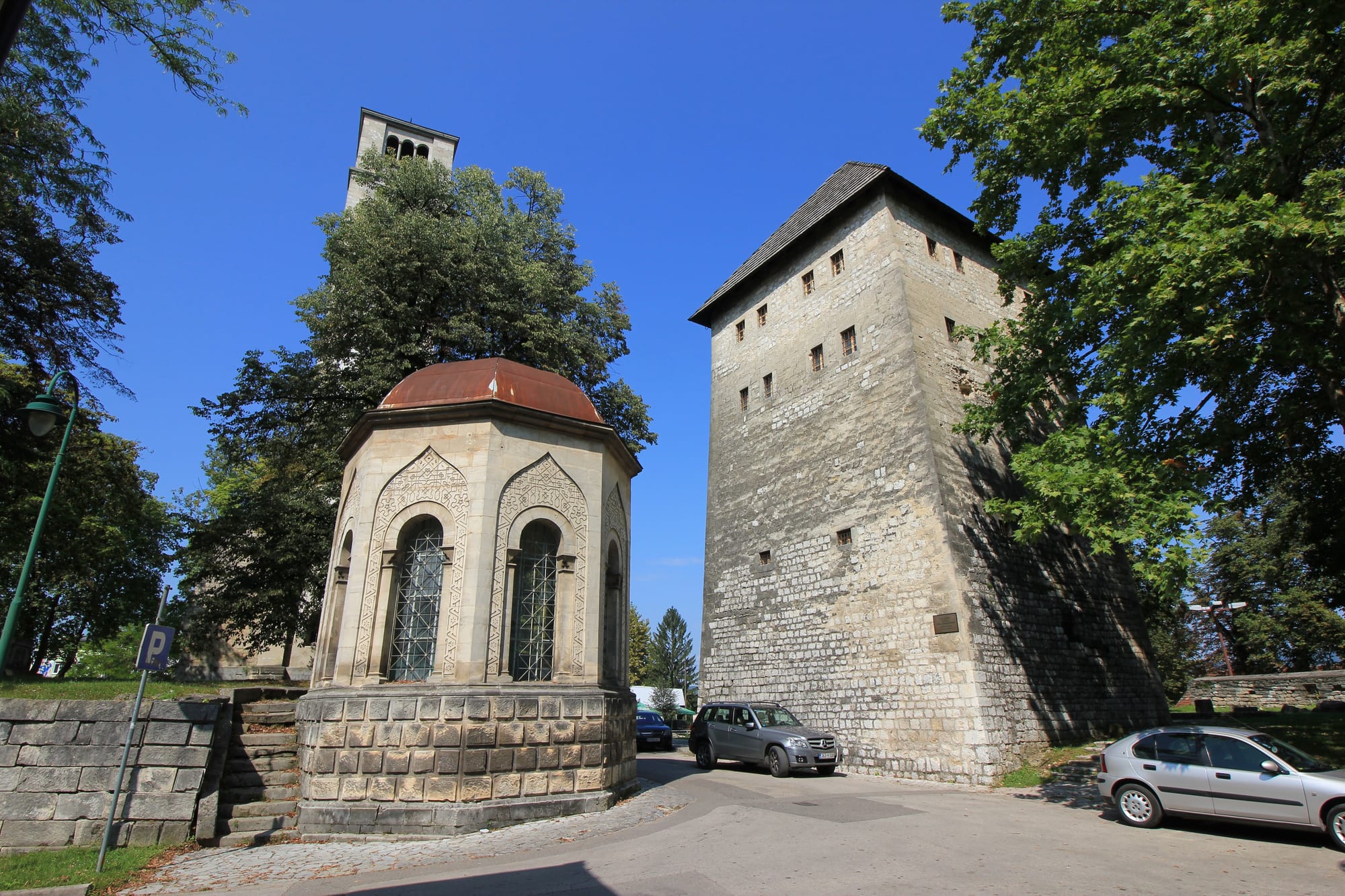
A tall square stone tower and a small octagonal domed mausoleum among trees, with a church bell tower behind, under a blue sky

Banja Luka & the Northwest, Bosnia and Herzegovina

Bihać

The Captain's Tower and the 19th-century turbe in the centre of Bihać. (Julian Nyča / Wikimedia Commons · CC BY-SA 3.0)

The main town of Bosnia's far north-west and the seat of Una-Sana Canton, built on and around the islands of the clear green Una close to the Croatian border. A medieval royal free town and for centuries a frontier fortress, it endured a three-year siege in the 1990s and is now the base for rafting and for the waterfalls of Una National Park.

Neighbourhoods

  • Old centre
    • First-time visitors
    • Historic district
    • Cafés

    The core of the old fortified town by the river, where the Fethija Mosque, the Captain's Tower, the turbe and a church bell tower stand close together. Cafés, the main shops and the town's administration are all a short walk away.

    Open in Maps
  • The Una islands and riverbanks
    • Swimming
    • Riverside walks
    • Quiet

    Inside the town the Una splits around islands of different sizes, edged by small waterfalls. Some are private, others are public bathing places that fill on summer afternoons, and paths and footbridges follow the water.

    Open in Maps
  • Kostela
    • Riverside
    • Quiet and residential

    A settlement and riverside resort on the Una a few kilometres downstream of the town.

    Open in Maps

Things to do

In the town

  • Fethija Mosquelandmark

    Built in 1266 as the church of Saint Anthony of Padua and converted into a mosque after the Ottoman conquest, it is the oldest Gothic building in the country and a national monument.

    Open in Maps
  • Turbe Mausoleumlandmark

    An octagonal domed mausoleum from the Austro-Hungarian period, raised in memory of the town's defenders who died fighting the Austro-Hungarian troops in 1878.

    Open in Maps
  • Captain's Towerlandmark

    A medieval tower of the old fortified town, still bearing the pelican of the Frankopan coat of arms, beside the turbe in the centre.

    Open in Maps
  • The Una in townbeach

    Public bathing places on the river islands and small waterfalls in the centre, where people swim in summer.

    Open in Maps
  • Sokolac Fortresslandmark

    A medieval fortress near the village of Sokolac, first recorded in 1395, fought over in the Ottoman wars and a national monument since 2008.

    Open in Maps

Short trips from the town

  • Una National Parkpark

    The country's largest national park, set up in 2008 around the upper Una, the Krka and the Unac to protect their waterfalls, canyons and forest, with several entrances and hiking trails.

    Open in Maps
  • Štrbački bukpark

    The highest waterfall in Una National Park, where the Una drops 25 metres on the border with Croatia.

    Open in Maps
  • Martin Brod and Rmanj Monasteryattraction

    A village where the Una breaks into cascades over sinter banks before meeting the Unac, beside the Orthodox Rmanj Monastery and a medieval fortress.

    Open in Maps
  • Ostrožac Castlelandmark

    A castle near Cazin dating back to the 13th century, whose courtyard holds more than 150 sculptures carved in local stone by a long-running sculptors' colony.

    Open in Maps
  • Plitvice Lakes National Parkpark

    Croatia's UNESCO-listed chain of tufa lakes, caves and waterfalls, just across the border.

    Open in Maps

Seasonal events

  • Una Regattasummer

    A regatta on the Una held in the town every summer, together with cultural events.

Eat and drink

Long-standing places and food districts in Bihać. Hours, ratings and directions come from your maps app, always current.

Bihać classics

  • Riverside restaurants on the Unarestaurant

    Restaurants along the banks of the Una, a river known for its brown trout and grayling.

    Open in Maps
  • Grills and bakeries of the centrerestaurant

    Ćevapi in flatbread with raw onion, and burek and other pies, the everyday food of the town.

    Open in Maps

Cafés and bars

  • Cafés of the old centrecafe

    Coffee terraces around the old centre and the river, serving Bosnian coffee and the town's own beers, Preminger and Unski biser, from one of the larger breweries in the country.

    Open in Maps

Experience Bihać

History

The Japodes, an Illyrian people, lived in the Una valley long before the town, building houses on stilts and leaving bronze, iron and silver jewellery at Bihać, Golubić, Ripač and Pritoka. Bihać itself first appears in a charter of the Hungarian king Béla IV of 26 February 1260, as a town on the river's island of Saint Ladislaus, and two years later Béla made it a royal free city answerable only to the crown, with its own elder, magistrates and notaries. Its Gothic church of Saint Anthony was built in 1266.

As the Ottomans advanced, Austria sent troops in 1530 to defend Bihać as one of the key strongholds of the Croatian frontier, ringed by a double wall with round and square towers. The town fell in 1592 after a ten-day siege, the church became the Fethija Mosque, and Bihać remained one of the most important forts in Bosnia until the 19th century. Marmont's French troops occupied it briefly in 1810, and Ottoman rule ended after the Congress of Berlin.

In the Second World War the town lay inside the Independent State of Croatia, and in 1941 thousands of Serbs, as well as Jews and Roma, were killed at Garavice nearby. From November 1942 to January 1943 Bihać was the centre of a liberated territory, the Bihać Republic, where Tito's movement held its first assembly. From 1992 to 1995 the town and its hinterland were besieged for three years. The University of Bihać opened in 1997, and Una National Park followed in 2008.

Culture & Customs

Bihać is the main town of the Bihać Krajina, the part of the Bosanska Krajina around the middle course of the Una, and its people are overwhelmingly Muslim. The town's monuments — the converted Gothic church, the Captain's Tower and a turbe honouring the defenders of 1878 — tell the story of a border fortress, the last town in Bosnia to fall to the Ottomans, in 1592.

Life follows the river. In summer the town swims from the islands and bathing places in the centre, and the Una Regatta is held each summer, together with cultural events. Rafting trips run on the river, anglers fish the Una and its neighbours for trout and grayling, and the national park has given the town a new role as an outdoor base.

Bihać has produced a long list of musicians, among them Alen Islamović, singer with Divlje Jagode and Bijelo Dugme, and Zele Lipovača of Divlje Jagode. Memory of the siege is strong, and visitors do well to listen rather than probe.

Daily Life

The city of Bihać, including its villages, had about 56,000 people at the 2013 census, and about 88 per cent of them are Muslim. It is the administrative centre of Una-Sana Canton, with the canton's government and a university, and much of the work is in public services, trade and river tourism. One of the larger breweries in the country is here, and farming is important on the fertile land around the town.

People live in the old centre and in the villages along the roads and riverbanks of the Bihać field, towards Ripač, Golubić and Pritoka.

Summer moves to the water, with bathing places on the river islands and long evenings in riverside cafés. Bihać is the largest city on the Una, and the river shapes the year: rafting is among the most popular outdoor pursuits in the country, and the Una is known for its brown trout and grayling.

Food

Bihać eats as the rest of Bosnia does — ćevapi, grilled fingers of minced meat served in flatbread with chopped onion and kajmak, and burek and other pies — and the Una, rich in brown trout and grayling, runs past its riverside restaurants.

Krajina home cooking is plain and filling. Kljukuša, a traditional dish of the Bosanska Krajina, is grated potato mixed with flour and water and baked in an oven, and uštipci, fried dough balls, come with kajmak or jam. Other Bosnian staples include grah, a bean soup, stuffed peppers, ajvar, and pies such as zeljanica with spinach and sirnica with cheese.

Classic Bosnian dishes appear on restaurant menus here as elsewhere: sarma, cabbage or vine leaves stuffed with meat and rice, and begova čorba, a "bey's soup" of chicken and vegetables. Sweets are syrup-soaked — baklava, tufahije, which are walnut-stuffed poached apples, and hurmašice.

The town's brewery makes Preminger and Unski biser beer, and Bosnian coffee closes every meal.

Planning tools

Budget

Bihać is cheaper than Sarajevo or Mostar, with inexpensive guesthouses in town and riverside camps in the Una villages. The town's sights and the river islands are free; the main extras are a rafting trip on the Una, the modest entry fees of Una National Park, and a hire car, which is hard to do without.

Daily Budget Midrange
USD 75–130 (mid-range hotel, restaurant meals, a day's rafting, a hire car)
Daily Budget Shoestring
USD 35–55 (guesthouse or riverside camp, ćevapi and bakery food, local buses)

Carry convertible marks in cash: card machines are scarce in the Una villages and at the park entrances.

Best Time to Visit

May to September. Summer brings swimming at the river's bathing places and the Una Regatta, and rafting trips run on the river. Winter is quiet, damp and often foggy.

Suggested Number of Days

The town needs a day at most. Allow three or four days to add the national park's waterfalls, a day on the river and a trip across the border. Without a car the waterfalls take longer to reach.

First Visit
1–2 days
With Surroundings
3–4 days

Transportation

The centre is small enough to walk. Local buses run up the Una valley to the villages on the way to the national park, but Štrbački buk, Martin Brod and the castles are poorly served, and a car or a local tour is the practical way to reach them. Rail services are few.

Carry passports: the Una forms the border with Croatia for long stretches, and Plitvice is across it.

Airport & Station Connections

The town is about 17 kilometres from the Croatian border. The nearest major airport is Zagreb, about 170 kilometres away, around three hours by car; Sarajevo is about 350 kilometres away by road. The town has a bus station, and one train a day runs from Sarajevo.

Walkability

The old centre, the mosque, the tower and the riverbanks are all a few minutes apart on flat ground, with paths along the water. The national park and the castles lie well outside walking distance.

Safety

Everyday crime is low and violent crime against tourists is rare; the main nuisances are pickpocketing in Sarajevo's tourist crowds and taxi overcharging — use marked, metered cabs or an app. Many landmines remain around the abandoned Željava air base under Plješevica, near the town.

Stay on marked paths near the border, never enter Željava or other abandoned military sites, and raft only with licensed operators who issue helmets and lifejackets. Check current official travel advice before travelling.

Climate

Moderate continental: warm summers, cold, damp winters with fog and snow most years, and rain in every season.

Summer
across the north-west valleys, 26–32°C by day with occasional hotter spells; the Una stays cold
Winter
around −3 to 5°C across the north-west, with fog, frost and periodic snow

Local Customs

Bihać is overwhelmingly Bosniak and Muslim, with small Catholic and Orthodox communities. Social life runs through the café and the river, and visitors are welcomed warmly. Dress modestly and remove shoes in mosques.

Let locals raise the subject of the war and the siege rather than probing, and treat memorials and places of worship with care.

Common Payment Methods

The currency is the convertible mark (KM, BAM), pegged to the euro. Cards work in hotels and larger restaurants in town, but cash is needed in small cafés, bakeries, buses, the Una villages and the park.