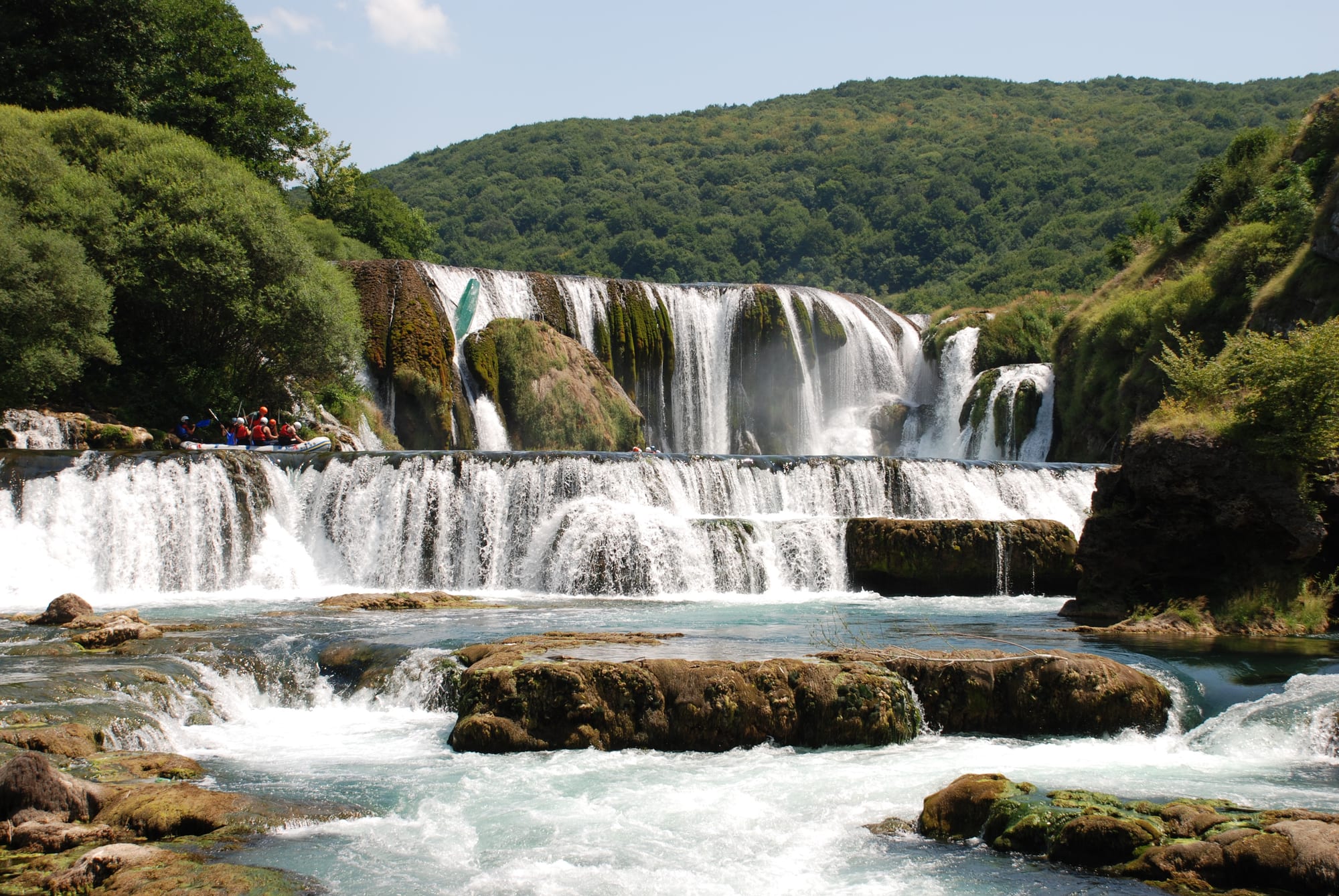
Broad tiers of white water pouring over mossy tufa ledges on the Una river, with forested hills behind and a small raft at the top

Bosnia and Herzegovina

Banja Luka & the Northwest

Štrbački buk, the highest waterfall in Una National Park, upstream of Bihać. (Nacionalni park Una / Wikimedia Commons · CC BY-SA 4.0)

Bosnia's north-western corner, the old Ottoman–Habsburg military frontier known as the Krajina — Banja Luka, the country's second city and the seat of Republika Srpska, on the Vrbas; the forested memorial mountain of Kozara; a scatter of castle-crowned hill towns; and, in the far west around Bihać, the emerald Una with its tufa waterfalls and national park.

Explore Banja Luka & the Northwest

History

The northwest is the Bosanska Krajina, the "Bosnian frontier", and for three centuries it was exactly that. The Illyrian Japodes lived around Bihać, which appears in 1260 and became a free royal town of the Hungarian crown in 1262, and it was in the castle of Ključ that the last Bosnian king surrendered to the Ottomans in 1463. Banja Luka, first recorded in 1494, fell in 1528 and became the seat of the Ottoman governors of Bosnia until 1639; Ferhad Pasha Sokolović built the Ferhadija Mosque there in 1579. Bihać held out until 1592. From then on the Una and the Sava were the armed border with the Habsburgs, and every hill town acquired a castle and a captain.

Austria-Hungary took over in 1878. Trappist monks who had settled outside Banja Luka in 1869 gave the town a brewery, a cheese dairy and its first hydroelectric plant, and the authorities planted the avenues that still shade it. In the Second World War the region lay inside the fascist Independent State of Croatia. In the summer of 1942 German and Ustasha forces surrounded the partisans on Kozara and deported thousands of Serb villagers to the camps of Jasenovac and Stara Gradiška, just across the Sava; that November Tito's movement held its first assembly in liberated Bihać.

An earthquake wrecked much of Banja Luka in October 1969, and the centre was rebuilt in concrete. In 1992 the city became the stronghold of the Bosnian Serbs: Bosniaks and Croats were expelled, all of its mosques, the Ferhadija among them, were blown up in 1993, and around Prijedor the camps of Omarska, Keraterm and Trnopolje became known to the world. Bihać and its hinterland endured a three-year siege, complicated by the breakaway fiefdom of the businessman Fikret Abdić at Velika Kladuša, until 1995. The Dayton line left Banja Luka as the seat of Republika Srpska and the Una valley in the Federation. The Ferhadija, rebuilt from its salvaged stones, reopened in 2016.

Culture & Customs

People on both sides of the entity line call themselves Krajišnici, frontiersmen, and share a reputation for bluntness, hospitality and stubborn courage. Around Banja Luka, Prijedor and Gradiška they are mostly Serb and Orthodox, and signs are in Cyrillic; the Una-Sana towns of Bihać, Cazin, Velika Kladuša and Sanski Most are overwhelmingly Bosniak. Prnjavor is nicknamed "Little Europe" for the Czechs, Ukrainians, Poles and Italians settled there under Austria-Hungary.

The Serb villages of the Zmijanje plateau, south-west of Banja Luka, produce a dark-blue cross-stitch embroidery on white linen that UNESCO listed in 2014, and were the home of the writer Petar Kočić, born at Stričići in 1877. On Grmeč bulls are matched against one another, not against men, at a fair held on the first Sunday of August for some two centuries. The Bosniak Krajina has its own epic songs about frontier heroes such as Mujo Hrnjica of Velika Kladuša.

Rivers shape local life. Banja Luka spends its summers on the Vrbas; Bihać lives on its river islands and sends rafts and kayaks downstream in the Una Regatta each summer. Memory is the difficult subject. Kozara and Jasenovac are central to Serb identity, while survivors of the Prijedor camps mark 31 May by wearing white armbands and still have no memorial at Omarska. Visitors are welcomed warmly everywhere and do well to listen.

Daily Life

Banja Luka, with about 185,000 people at the last census, is the country's second city and the political and university centre of Republika Srpska, a low-rise town of parks, avenues and café terraces along the pedestrian Gospodska street. Prijedor has about 80,000 people in its municipality, Cazin 65,000, Bihać 56,000, Gradiška 50,000, and Velika Kladuša and Sanski Most around 40,000 each.

Work in Banja Luka means government, the university, a growing software trade, the brewery and services. Prijedor mines iron ore at Omarska and Ljubija, the Lijevče plain towards the Sava is maize and orchard country, and the hills live on timber. In the Una-Sana canton Bihać has the administration, a university and the river tourism that has grown since the national park opened in 2008, while Cazin and Velika Kladuša depend heavily on wages sent home from Slovenia, Austria and Germany; the Agrokomerc food combine that once employed thousands there is a shadow of itself.

Summer life moves to the water: the Vrbas beaches and canyon villages for Banja Luka, the Una's islands and swimming platforms for Bihać, the Sana and its tributaries for fly-fishers after trout and grayling. Emigration is the constant worry, and in recent years the canton has also had to cope with thousands of migrants waiting near Bihać and Velika Kladuša to cross into Croatia.

Food

Banja Luka has its own ćevapi: the minced beef is pressed into slabs of four joined fingers rather than separate ones, grilled and served in a lepinja flatbread with chopped onion, and the city's grill houses defend the recipe against Sarajevo's. The Trappists of Marija Zvijezda have made trapist, a mild semi-hard cow's cheese on a French monastic recipe, since the 19th century. The brewery they founded still makes Nektar, the city's lager.

Krajina home cooking is plain and filling. Kljukuša is grated potato mixed with flour and water and baked in a wide tin; cicvara is maize meal cooked with kajmak; pura is a firm polenta; and uštipci, fried dough balls, come with kajmak or jam. On the Serb side, lambs and suckling pigs turn on roadside spits along the road north of Banja Luka towards Laktaši and Gradiška.

The rivers supply trout, served grilled or fried in maize flour at restaurants built over old mills on the Una, the Sana and the Pliva's headwaters. The sweet-chestnut woods around Cazin, Bužim and Velika Kladuša give roasted chestnuts in autumn, and the orchards below Kozara give plums, apples and pears, much of which becomes šljivovica and other fruit brandies. Bosnian coffee closes the meal on both sides of the line.

Attractions & Natural Wonders

Banja Luka's sights lie along the Vrbas: the Kastel, a walled fortress on Roman foundations; the Ferhadija Mosque; the Cathedral of Christ the Saviour with its gilded domes, destroyed in 1941 and rebuilt after 1993; the 1930s Banski dvor palace; and, in the suburb of Delibašino Selo, the Trappist abbey. Upstream the river enters a canyon rafted from spring to autumn, and at Krupa na Vrbasu a stream falls past wooden mills. North-west of the city, Kozara national park covers a forested massif above Prijedor; at Mrakovica, Dušan Džamonja's concrete cylinder of 1972 stands among walls carrying the names of nearly 10,000 fallen partisans. Donja Gradina, on the Sava, is the memorial field facing Jasenovac.

Bihać and the Una river are the other pole. The town keeps its Captain's Tower and the Fethija Mosque, a 13th-century Gothic church converted in 1592, beside islands threaded with footbridges. Una National Park begins just upstream: the river falls 24 metres over the tufa steps of Štrbački buk, reached by boardwalks, and breaks into dozens of cascades at Martin Brod, beside the Orthodox monastery of Rmanj. Rafting trips run on the river through the park.

The Krajina hill towns string out between the two cities. Ostrožac, near Cazin, is a medieval and Ottoman castle with a neo-Gothic manor added around 1900 and a sculpture park; Bosanska Krupa has a keep above the Una; Ključ's fortress overlooks the Sana; Velika Kladuša and Kotor Varoš have castles of their own. Sanski Most has the 56-metre Blihe waterfall, and Mrkonjić Grad and Šipovo, in the south, have Balkana lake and the clear Janj and Pliva springs.

Cities in Banja Luka & the Northwest

Planning basics

Budget

The northwest is cheaper than Sarajevo or Mostar. Banja Luka has good-value business hotels and low restaurant prices, Bihać and the Una villages have inexpensive guesthouses and riverside camps, and the smaller towns see so few tourists that prices are simply local. The main extras are rafting trips on the Una or Vrbas, the modest entry fees of Una National Park, and a hire car, which is hard to do without.

Daily Budget Midrange
USD 75–130 (mid-range hotel, restaurant meals, a day's rafting, a hire car)
Daily Budget Shoestring
USD 35–55 (guesthouse or riverside camp, ćevapi and bakery food, buses)

Carry convertible marks in cash outside Banja Luka and Bihać; card machines are scarce in the Una villages and the hill towns.

Safety

The northwest is safe and crime against visitors is rare. The ring of former front lines around Bihać has left minefields on Plješevica, around the abandoned Željava airbase on the Croatian border; the waymarked trails and boardwalks of Una National Park are clear. Rafting should be booked with licensed operators who issue helmets and lifejackets. Police checks are frequent near the Croatian border, where migrants heading for the European Union have gathered in recent years. Political rhetoric from Banja Luka rarely affects travellers.

Stay on marked paths near the border, never enter Željava or other abandoned military sites, and keep conversations about the war for when locals raise it. Check current official travel advice before travelling.

Climate

Moderate continental, shading into the climate of the Pannonian plain along the Sava. Banja Luka lies at only about 160 metres, so summers are hot and sometimes humid and winters cold, damp and foggy, with snow most years. Rain falls in every season and late spring brings the highest water on the Una, Sana and Vrbas, occasionally as floods. Kozara, Manjača and Grmeč are cooler in summer and snowbound for weeks in winter.

Summer
26–32°C by day with spells above 35°C in the valleys; cooler on Kozara and Grmeč; the Una stays cold
Winter
around −3 to 5°C with fog, frost and periodic snow; deeper snow in the hills

Transportation

The region looks to Zagreb as much as to Sarajevo: the Croatian capital is a few hours by road from either Banja Luka or Bihać, and Bihać is a short drive from Croatia's Plitvice Lakes. Banja Luka's small airport, north of the city, has a handful of low-cost routes. Buses link Banja Luka with Sarajevo, by way of Jajce and the Vrbas canyon, and with Bihać; Bihać to Sarajevo is a long ride. Trains are few and slow. Štrbački buk, Martin Brod, Kozara and the hill castles are poorly served by public transport, and a car or a local tour is the practical way to reach them.

Combine Bihać and the Una with a visit to Plitvice, and carry passports: the Una forms the border with Croatia for long stretches.

Best Time to Visit

May to September. Rafting on the Una is liveliest on the high water of April to June and gentler but warmer from July to September, when the river is also swimmable; the Vrbas runs from April to October. The Una Regatta brings rafts and kayaks to the river in summer, and the Grmeč bullfights are held on the first Sunday of August. October brings beech colours on Kozara and the chestnut harvest around Cazin. Winter is quiet and often foggy.