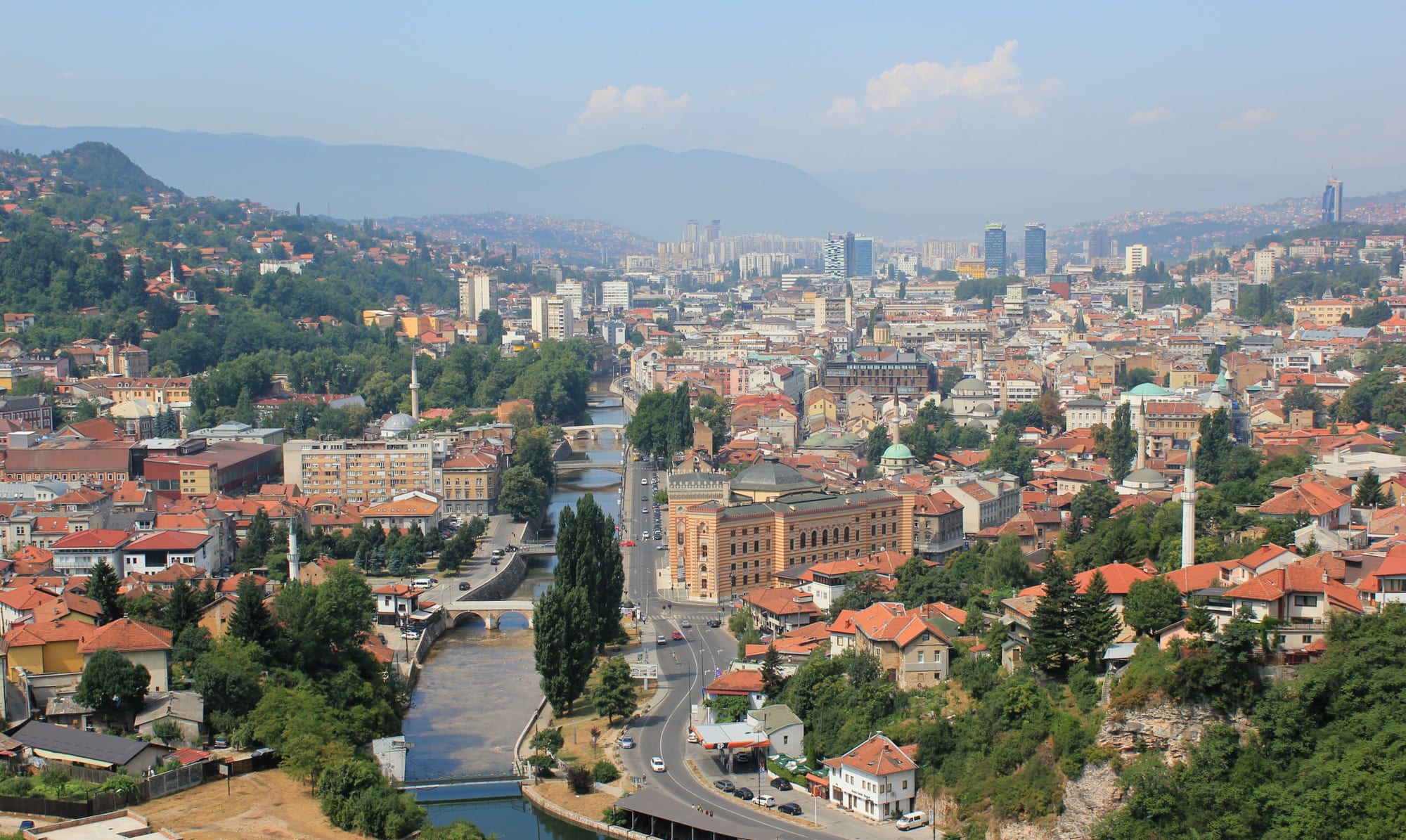
Red roofs, minarets and the striped City Hall of Sarajevo beside the Miljacka river, with hazy mountains beyond

Bosnia and Herzegovina

Sarajevo & Central Bosnia

Sarajevo seen from the east, with the City Hall beside the Miljacka and the modern city stretching away down the valley. (Julian Nyča / Wikimedia Commons · CC BY-SA 4.0)

The mountain-ringed heart of the country — the capital Sarajevo in the Miljacka valley, the old royal and Ottoman towns of the Bosna, Lašva and Vrbas valleys at Visoko, Zenica, Travnik and Jajce, the Olympic ski mountains, and, across the entity line to the east, the upper Drina with Višegrad's bridge and the primeval forest of Sutjeska.

Explore Sarajevo & Central Bosnia

History

The Sarajevo plain has been settled since the Neolithic Butmir culture, named after a site beside today's airport, and the Romans built baths at the sulphur springs of Ilidža. The medieval Bosnian state grew up a little to the north, in the valley of the Bosna. Its rulers were crowned and buried at Mile outside Visoko, kept their crown in the crag-top fortress of Bobovac and, as the Ottomans advanced, moved their court west to Jajce, where the last king, Stjepan Tomašević, was executed on the sultan's orders in 1463. Hungary then held Jajce as a frontier fortress until 1527.

Sarajevo is an Ottoman foundation. In the 1460s Isa-beg Ishaković endowed a mosque, a bridge, a market and the governor's court, the saray, that gave the town its name, and Gazi Husrev-beg, governor from 1521, added the mosque, madrasa, covered market and clock tower that still form the core of the Baščaršija. After Prince Eugene of Savoy burned the city in 1697, the viziers of Bosnia governed from Travnik until 1850. On the Drina, the grand vizier Mehmed Paša Sokolović had the court architect Sinan bridge the river at Višegrad in the 1570s. Austria-Hungary, arriving in 1878, gave Sarajevo trams and a pseudo-Moorish city hall, and Zenica its steelworks in 1892.

In June 1943 Tito's partisans broke out of an Axis encirclement on the Sutjeska at a cost of more than 6,000 dead, and that November, at Jajce, they proclaimed the federal Yugoslavia. Sarajevo hosted the Winter Olympics in February 1984. Eight years later it was under siege: for 1,425 days Bosnian Serb forces shelled and sniped from the surrounding hills, and nearly 14,000 people died, while Bosniaks were killed or driven out of Višegrad and Foča, Goražde held out as a surrounded enclave, and Croat and Bosniak forces fought each other in the Lašva valley in 1993–94. The Dayton line now runs through Sarajevo's southern suburbs, which form the separate city of East Sarajevo in Republika Srpska.

Culture & Customs

Sarajevo's old town packs four faiths into a few streets: the Gazi Husrev-beg Mosque of 1531, the Old Orthodox Church, the Catholic cathedral of 1889 and a synagogue founded by the Sephardic Jews who arrived from Spain in the 16th century. Their treasure, the Sarajevo Haggadah, a manuscript illuminated in Barcelona around 1350, was hidden from the Nazis by a Muslim librarian and is kept in the National Museum. The clock tower beside the mosque still keeps lunar time, its hands showing twelve at sunset.

Sarajevans prize a dry, self-mocking humour — it produced the 1980s television satire Top lista nadrealista and the rock bands of the Yugoslav "New Primitives" — and an unhurried sociability in which company matters more than status. The siege is remembered in "Sarajevo roses", mortar scars in the pavement filled with red resin.

Central Bosnia is the Catholic heartland of the interior. The Franciscans, the only Catholic clergy tolerated under the Ottomans, keep monasteries at Kraljeva Sutjeska, Kreševo and Fojnica; by tradition Mehmed II guaranteed their freedom in a charter of 1463, which survives in copies. Each June tens of thousands of Muslims walk to the rock of Ajvatovica at Prusac, one of the largest Islamic gatherings in Europe. East of the entity line the script turns Cyrillic and the churches Orthodox: Pale, Sokolac, Foča and Višegrad are Serb towns, and in Višegrad the film director Emir Kusturica has built Andrićgrad, a mock-historic stone quarter opened in 2014 in honour of the novelist Ivo Andrić, who was born in Travnik in 1892. The war is told differently on each side of the line, and visitors do best to listen rather than probe.

Daily Life

About 275,000 people live in Sarajevo proper and over 400,000 in its canton, strung along a narrow valley served by a single tram route. East Sarajevo, on the Republika Srpska side, has about 60,000. Zenica is the second city, with around 110,000 in its municipality; Travnik has some 50,000, Visoko 40,000, Jajce 27,000, Goražde 20,000 and Foča 18,000, villages included, and most have shrunk since the census of 2013 as the young leave for Germany, Austria and Slovenia.

The capital lives on government, embassies and international bodies, universities, a growing software sector and tourism, including many visitors and property buyers from Turkey and the Gulf states. Zenica still revolves around its steelworks, and Kakanj around its coal-fired power station. Visoko tans leather, and the Vlašić plateau above Travnik grazes sheep. Foča and Višegrad rely on forestry, hydropower and summer rafting.

The day is built around coffee — mid-morning, after work and again on the evening stroll down Ferhadija — and weekends around the mountains: the cable car up Trebević, reopened in 2018, the plane-tree avenue to the springs of Vrelo Bosne, or the ski slopes close by. Winter is the hard season, when smoke from coal and wood stoves settles over Sarajevo and Zenica for weeks. Traffic, a cumbersome cantonal bureaucracy and emigration are the other standing complaints.

Food

Sarajevo is the capital of the Bosnian grill and pie. Ćevapi here are small, made of beef and served five or ten to a portion in half a somun with raw onion; in Travnik the bread is first dipped in meat broth. A buregdžinica sells pies by weight, and only the meat one is called burek — cheese is sirnica, spinach zeljanica, potato krompiruša — best baked under a sač, an iron lid heaped with embers.

Cooked dishes are eaten at an aščinica, a canteen where the day's pots are displayed at the counter: begova čorba, sogan-dolma (onions stuffed with minced meat), japrak (stuffed vine or chard leaves), klepe (small meat dumplings under garlic yoghurt) and bosanski lonac, meat and vegetables layered in a clay pot and left for hours, a dish credited to the miners of central Bosnia.

Regional products are few but distinct: Vlašićki sir, a brined white sheep's cheese from the plateau above Travnik; Visočka pečenica, Visoko's protected cured meat; thick kajmak; and trout and huchen, the huge Danube salmon, from the Drina. Kiseljak bottles a naturally sparkling mineral water, and the Sarajevo Brewery dates from 1864. Old-town sweet shops still serve boza, a thick fermented maize drink, and hot salep in winter alongside baklava and tufahije. East of the entity line plum rakija takes over and pork returns to the menu.

Attractions & Natural Wonders

Sarajevo's old town is compact: the coppersmiths' lane of Kazandžiluk and the Sebilj fountain, the Gazi Husrev-beg Mosque with its madrasa and clock tower, the Morića Han caravanserai, the Latin Bridge and the rebuilt City Hall. The siege is documented at the Tunnel of Hope beside the airport, the War Childhood Museum and Gallery 11/07/95. The Yellow Bastion gives the classic sunset view, the cable car climbs Trebević to the Olympic bobsleigh track, and an avenue of plane trees leads to the springs of Vrelo Bosne at Ilidža. The Jahorina ski slopes, on the Republika Srpska side, held the women's Olympic alpine races and form the country's largest resort; Bjelašnica, at 2,067 metres, held the men's.

Visoko was the medieval royal heartland, though most visitors now come for the so-called Bosnian pyramids, wooded hills that archaeologists regard as natural; the monastery of Kraljeva Sutjeska and the ruins of Bobovac lie in the hills beyond. Zenica, a steel city, is the base for Vranduk, a royal fortress on a rock above the Bosna gorge. Travnik keeps the viziers' tombs, a hilltop castle, the painted Šarena Mosque and the cafés of Plava Voda, with the Vlašić ski plateau above. At Jajce the Pliva falls some 20 metres into the Vrbas in the middle of town, beneath a citadel with catacombs, a Roman Mithraeum and the hall where Yugoslavia was proclaimed; the Pliva lakes lie upstream.

In the east, Višegrad's Ottoman bridge, the Mehmed Paša Sokolović Bridge of 1577, crosses the Drina on eleven arches and is a UNESCO World Heritage Site. Foča, with its rebuilt Aladža Mosque, is the base for rafting the Tara canyon and for Sutjeska National Park: the Perućica primeval forest and its 75-metre Skakavac waterfall, the winged concrete war memorial at Tjentište, the glacial lakes of Zelengora and Maglić, at 2,386 metres the country's highest summit.

Cities in Sarajevo & Central Bosnia

Planning basics

Budget

Sarajevo is the dearest place in the country and still cheap by European standards; Travnik, Jajce, Visoko and the Drina towns cost less again. The exceptions are the ski hotels of Jahorina and Bjelašnica, where rates roughly double over New Year, Orthodox Christmas and the February school holidays, and Sarajevo during the film festival in August. Rafting camps near Foča sell inexpensive packages that include meals and a bed.

Daily Budget Midrange
USD 90–160 (mid-range hotel, restaurant dinners, museum tickets, a hire car or a guided day trip)
Daily Budget Shoestring
USD 45–70 (hostel or guesthouse, ćevapi, pies and aščinica meals, trams and buses)

Carry convertible marks in cash for bakeries, grill houses, trams and everything outside Sarajevo; book ski accommodation well ahead for January and February.

Safety

The region is safe for visitors. Pickpockets work the Baščaršija and the trams, and unmetered taxis overcharge from the airport. The specific hazard is landmines: the hills around Sarajevo were front lines, and marked or suspected minefields remain off the paths in parts of the surrounding mountains. Winter tyres are compulsory in winter, mountain roads ice over, and the winter smog is hard on anyone with breathing problems.

Keep to marked trails and hire a local guide for any mountain route that is not waymarked; never enter abandoned buildings or land marked with skull-and-crossbones signs. Check current official travel advice before travelling.

Climate

Sarajevo sits at about 500 metres in a basin ringed by mountains of over 2,000 metres, and the climate is closer to alpine than to the rest of the country: warm summers with cool nights, and cold winters with regular snow. From December to February a temperature inversion traps fog and smoke in the Sarajevo and Zenica basins, giving both cities badly polluted air while the ski slopes above sit in sunshine. Snow lies on Jahorina and Bjelašnica for much of the winter. The Drina valley at Višegrad and Foča is lower and noticeably hotter in summer.

Summer
24–30°C by day in Sarajevo with cool nights and occasional spikes to 35°C; fresh on the mountains, hotter on the Drina
Winter
around −4 to 4°C in the valleys with snow, fog and smog; well below freezing with deep snow above 1,500 metres

Transportation

Sarajevo's airport at Butmir lies on the south-western edge of the city. The tram runs the length of the valley from the Baščaršija to Ilidža, and a cable car climbs Trebević. The city has two bus stations: the main one beside the railway station serves Federation towns — Travnik and Jajce among them — while buses for Višegrad, Foča, Serbia and Montenegro leave from the East Sarajevo station at Lukavica, on the far side of the entity line. A motorway runs north past Visoko to Zenica, which is also served by a few daily trains. Jahorina is a short drive from the city, with ski buses in season; Sutjeska and the villages need a car or a tour.

Check which of the two bus stations a service uses before setting out, and allow extra time everywhere: mountain roads are two-lane and slow.

Best Time to Visit

May, June and September to early October are best for the cities and for walking, with the Tara and Drina rafting season at its liveliest on the high water of May and June. July and August are warm rather than scorching, unlike Herzegovina, and the Sarajevo Film Festival fills the capital in August. The ski season runs from mid-December to late March. Ramadan evenings in the Baščaršija are atmospheric whenever they fall; December and January in the city itself mean smog.