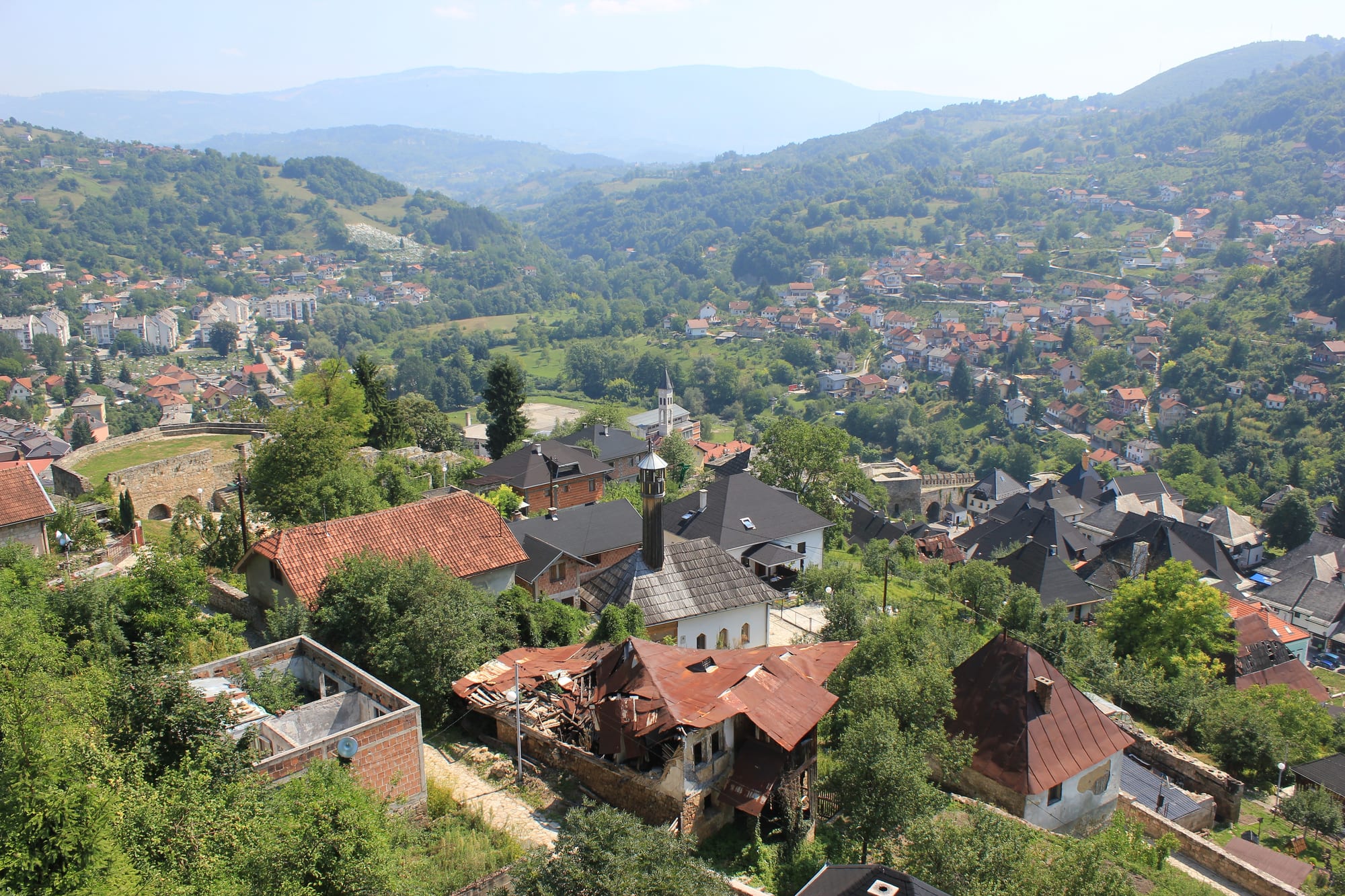
Old houses with dark and red roofs and a slim minaret below the fortress, with green hills and the newer town beyond

Sarajevo & Central Bosnia, Bosnia and Herzegovina

Jajce

Jajce's old town seen from the fortress, with the newer districts spreading over the hills beyond. (Julian Nyča / Wikimedia Commons · CC BY-SA 3.0)

A small hill town in central Bosnia where the Pliva river falls into the Vrbas in the middle of town. Founded around 1400 as a fortress of the Bosnian nobility, it was the last seat of the Bosnian kings, a Hungarian frontier stronghold and the place where Tito's partisans laid the foundations of federal Yugoslavia in 1943.

Neighbourhoods

  • The walled old town
    • First-time visitors
    • Historic district

    The medieval core on a steep, pyramid-shaped hill, enclosed by about 1,300 metres of walls and crowned by the citadel. Its lanes hold the catacombs, the ruined Saint Mary's Church, old houses and mosques, and lead down to the viewpoints over the waterfall.

    Open in Maps
  • The town centre and the rivers
    • Best for food
    • Close to public transport

    The flat ground below the walls, where the Pliva meets the Vrbas. The bus station, shops, cafés and restaurants are here, one with a terrace over the river canyon, and viewpoints on both sides look across to the falls.

    Open in Maps
  • The Pliva lakes
    • Nature
    • Quiet and residential

    A few kilometres up the Pliva, the river forms a series of lakes, with little watermills beside them. It is the place for swimming, fishing, walking and camping in summer.

    Open in Maps

Things to do

The royal town

  • Jajce Citadel and wallslandmark

    One of the best-preserved fortified capitals of the Bosnian Kingdom, its last stronghold before the Ottoman conquest, with wide views from the top of the hill.

    Open in Maps
  • Catacombs of Jajcelandmark

    An underground chapel and crypt carved around 1400 for Hrvoje Vukčić, the nobleman who founded the town, as his family's burial place.

    Open in Maps
  • Saint Mary's Churchlandmark

    A medieval church later turned into Sultan Suleiman's Mosque, now a roofless national monument beside the remains of Saint Luke's bell tower.

    Open in Maps
  • Jajce Mithraeumlandmark

    A Roman temple of the god Mithras, rediscovered in 1931 and renowned as one of the best preserved in Europe.

    Open in Maps

Water and nature

  • Pliva Waterfallattraction

    The tufa barrier where the Pliva drops about 22 metres into the Vrbas in the middle of town, lower than before the floods of the 1990s war.

    Open in Maps
  • Pliva Lakes and watermillspark

    Lakes on the Pliva about five kilometres upstream, formed by tufa barriers, with little watermills beside them.

    Open in Maps

Short trips from the town

  • Komotin Fortlandmark

    A ruined castle in Jajce municipality, older but smaller than Jajce, in the hills not far from town.

    Open in Maps

Eat and drink

Long-standing places and food districts in Jajce. Hours, ratings and directions come from your maps app, always current.

Eating in Jajce

  • Restaurants on Hrvatinića streetneighborhood

    The main street of the town centre has a number of reasonably priced restaurants and cafés, one with a terrace over the river canyon.

    Open in Maps
  • Grill housesrestaurant

    Ćevapi — small grilled fingers of minced beef served in somun flatbread with chopped onion and kajmak — are the everyday meal here as across the country.

    Open in Maps

Experience Jajce

History

Jajce first appears in written sources in 1396, though a fortress stood on the hill before that. Hrvoje Vukčić Hrvatinić, one of the most powerful Bosnian nobles, founded the town at the height of his power, rebuilt the fortress and carved an underground chapel and crypt as his family's tomb, finished before 1416. As the Ottomans advanced, the Bosnian kings made Jajce their seat. In 1463 the Ottomans took it and executed the last king, Stjepan Tomašević, but held it for only six months: the Hungarian king Matthias Corvinus recaptured it and set up the Banate of Jajce, a frontier stronghold that held out until 1527.

Austria-Hungary arrived in 1878, and the Franciscan monastery of Saint Luke was completed in 1885. In the Second World War Jajce was the centre of a large area held by Tito's partisans, and on 29 November 1943 it hosted the second session of the Anti-Fascist Council of National Liberation of Yugoslavia, which laid the foundations of the federal state. In Yugoslav times that made it a popular destination.

The 1990s war hit hard. When the town fell to Bosnian Serb forces in 1992, a column of 30,000 to 40,000 civilian refugees stretched 16 kilometres towards Travnik under sniping and shelling, and by November 1992 the pre-war population of 45,000 had shrunk to several thousand. Bosnian Croat forces retook Jajce in September 1995 after its Serb population had been evacuated. Floods from the damaged power plant upstream eroded the waterfall. Since the war the old houses facing the falls have been restored, and the walled town is on UNESCO's tentative list.

Culture & Customs

Jajce's identity rests on its layered past. The Roman Mithraeum, the medieval royal fortress and catacombs, the church that became Sultan Suleiman's Mosque and the Franciscan monastery all stand within a short walk of each other, and the whole ensemble of walled town, waterfall and outlying monuments is protected as a National Monument. Before the war people of all three communities lived here, and Bosniak refugees returned in 1996.

The town also carries a strong place in Yugoslav memory as the place where, in 1943, the AVNOJ decided that Yugoslavia should be a federal state, and the AVNOJ session was the main reason for its popularity as a destination in socialist times. Today the draw is the waterfall and the walled town, and tourism has restarted, with tens of thousands of visitors a year in a municipality of about 25,000 people.

Life outdoors centres on the rivers and the lakes upstream, where people swim, fish and walk in summer, and around the cafés of the town centre. Sights are small and often run by a single keyholder, and the atmosphere is unhurried.

Daily Life

About 7,200 people lived in the town itself at the 2013 census, and about 27,000 in the wider municipality of villages around it, a sharp fall from the pre-war population. Jajce lies in the Central Bosnia Canton of the Federation, on the crossroads of the roads to Banja Luka, Mrkonjić Grad and Donji Vakuf, and much of daily life is lived along the main road through the centre and in the newer districts on the hills around the old town.

The economy is small. Hydroelectric power on the Pliva, small businesses, public services and a growing tourist trade of guesthouses, cafés and restaurants provide work. The restored houses facing the waterfall were part of a heritage project backed by UNESCO and a Swedish organisation, and the bid for World Heritage listing remains a local hope.

The day follows the familiar Bosnian pattern of coffee mid-morning and in the evening, and summer weekends at the Pliva lakes.

Food

Jajce eats as central Bosnia does. Ćevapi, made from minced beef, are grilled and served five to ten at a time in somun flatbread with chopped onion and kajmak, a creamy dairy product similar to clotted cream, and grill houses are found throughout the centre. Pies made with thin, flaky dough are the everyday cheap meal, from burek to sirnica with cheese and zeljanica with spinach.

Home cooking leans on stuffed peppers, sarma, grah, a bean soup, and goulash, with the Ottoman bey's soup, begova čorba, of chicken and vegetables served at festive occasions. Sweets include baklava and tufahija, a whole stewed apple stuffed with walnuts.

The restaurants and cafés along the main street of the centre, one with a terrace over the river canyon, are where most visitors eat. Bosnian coffee, made from very finely ground beans and served unfiltered, ends a meal, and rakija, made from plums or apples, is the spirit.

Planning tools

Budget

Jajce costs less than Sarajevo. Rooms in guesthouses are inexpensive, meals in grill houses and cafés cheap, and the sights charge small entry fees. A car adds most to the bill but is useful for the lakes and the countryside.

Daily Budget Midrange
USD 80–140 (good guesthouse or small hotel, restaurant dinners, entry fees, a hire car)
Daily Budget Shoestring
USD 40–60 (guesthouse or hostel, ćevapi and pies, buses)

Carry convertible marks in cash: smaller restaurants, cafés and the sights may not take cards.

Best Time to Visit

Late spring and summer, when the waterfall is full, the lakes are warm enough for swimming and the café terraces are open. Autumn is quiet and colourful in the hills around the town. Winters are cold, with snow and frost.

Suggested Number of Days

The town is small, and one full day is enough for most visitors. Two days allow a slower pace, with time for the lakes upstream and the surrounding hills. Jajce lies on the bus route between Sarajevo and Banja Luka.

First Visit
1 day
With Surroundings
2 days

Transportation

The old town and the centre are walkable. Local transport is limited, so the lakes are reached on foot, by bicycle, by taxi or by car. Buses on the Banja Luka–Sarajevo line stop at the bus station, and there are services to Travnik.

Some sights are not always staffed; on quiet days the keyholder may need to be found.

Airport & Station Connections

Most visitors arrive by bus or car. Jajce lies at a crossroads between Banja Luka, Mrkonjić Grad and Donji Vakuf, and buses on the Banja Luka–Sarajevo line stop here; the bus from Travnik takes about an hour and a half. Banja Luka is about an hour and a half's drive away up the Vrbas gorges.

Walkability

The centre is compact, and everything in town is within a short walk, but the walled old town climbs a steep hill, with stepped lanes and uneven paving up to the citadel. The walk to the lakes upstream follows the Pliva.

Safety

Everyday crime is low and violent crime against tourists is rare; the main nuisances are pickpocketing in Sarajevo's tourist crowds and taxi overcharging — use marked, metered cabs or an app. Jajce itself is quiet. The town was on the front line in the war, and the country's landmine warnings apply to the surrounding countryside: towns, main roads and established tourist sites are in normal use.

Stay on marked paths when walking in the hills and never enter fenced or marked land. Check current official travel advice before travelling.

Climate

Central Bosnia has warm summers and cold winters with regular snow. In the valleys winter brings fog, and the hills above stay snowy for much of the season.

Summer
warm; in Sarajevo, the country's capital, August averages about 21°C
Winter
cold, with snow and fog; in Sarajevo January averages about 0.6°C

Local Customs

Jajce has mosques, Catholic churches and a Franciscan monastery within a short walk of each other. Coffee is the centre of social life. Dress modestly in mosques and churches and treat memorials with care.

Let locals raise the subject of the war rather than probing.

Common Payment Methods

The currency is the convertible mark (KM, BAM), pegged to the euro. Cards are accepted in larger hotels and some restaurants, but cash is the norm in small places; there are ATMs in the town centre.