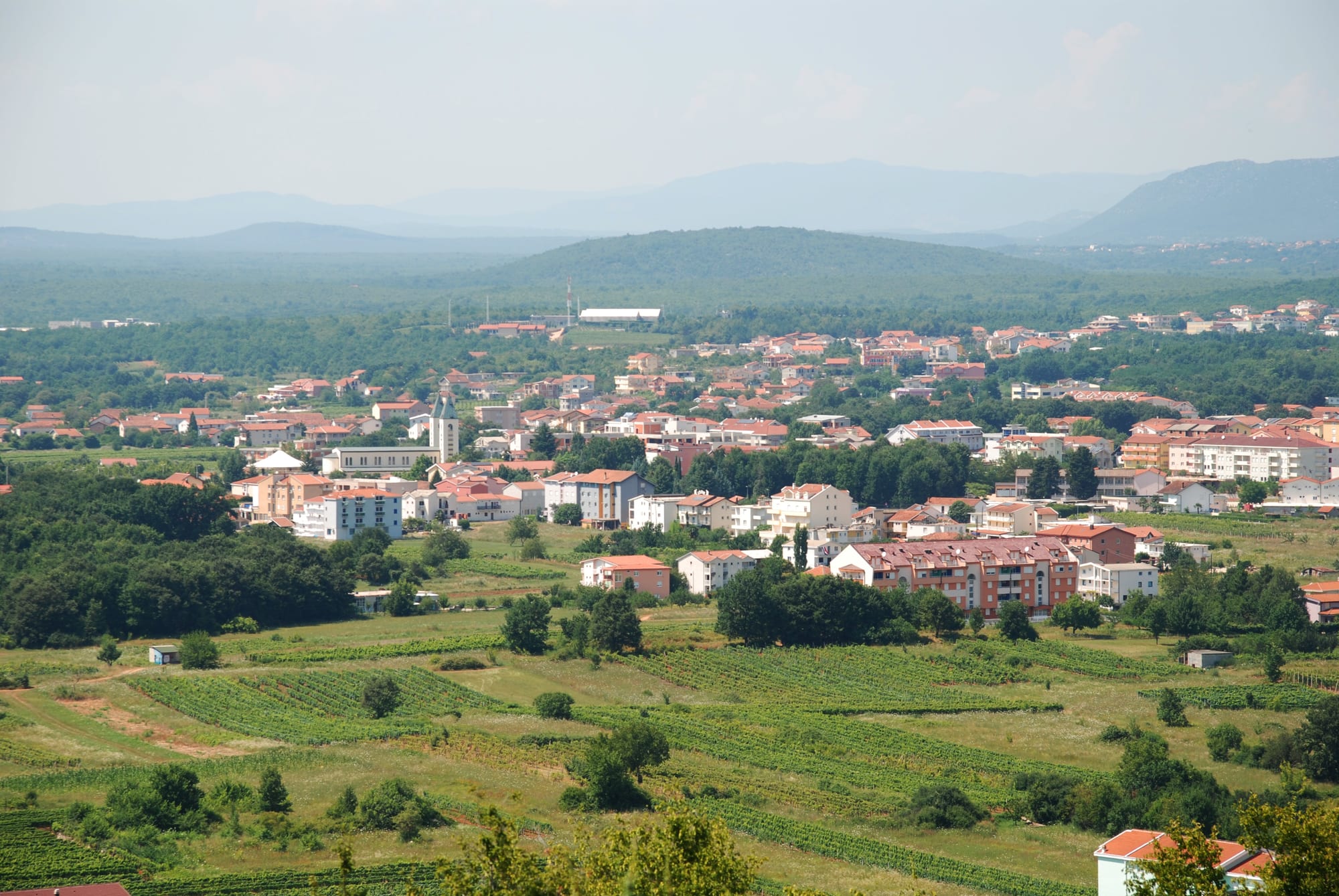
Vineyards and fields in front of the red-roofed houses of Medjugorje, with a twin-towered church and low mountains behind

Herzegovina, Bosnia and Herzegovina

Medjugorje

Medjugorje and its vineyards seen from the hillside of Podbrdo, with the church of St James among the houses. (Janmad / Wikimedia Commons · CC BY 3.0)

A village among vineyards in the municipality of Čitluk, south-west of Mostar, whose name means 'between mountains'. Since six local children reported seeing the Virgin Mary on a hillside in June 1981 it has become one of Europe's major Catholic pilgrimage sites, drawing about a million visitors a year to its parish church and hills.

Neighbourhoods

  • The village centre
    • First-time visitors
    • Pilgrims
    • Close to public transport

    The streets around the church of St James, where the evening services, the outdoor altar, the shops selling religious souvenirs and many of the family pensions and restaurants are found. The bus station is within walking distance.

    Open in Maps
  • Bijakovići and Podbrdo
    • Pilgrims
    • Walks and viewpoints
    • Quiet and residential

    One of the parish's neighbouring hamlets, at the foot of the stony hill of Podbrdo, where the first apparitions were reported in 1981. Paths lead up from the houses to the hillside, which looks over the vineyards and the village.

    Open in Maps

Things to do

Pilgrimage sites

  • St James's Churchlandmark

    The twin-towered Catholic parish church, consecrated in 1969 and run by the Franciscans, at the centre of the pilgrimage; the parish of Saint James dates from 1892.

    Open in Maps
  • Apparition Hilltrail

    Podbrdo, the hillside above Bijakovići where six children reported seeing the Virgin Mary in June 1981, climbed by pilgrims on a stony path.

    Open in Maps
  • Križevactrail

    Cross Mountain, crowned by a twelve-metre crucifix completed in 1934 to finish the parish's Stations of the Cross, reached by a steep, rocky path.

    Open in Maps

Short trips from the village

  • Kravica Waterfallattraction

    A tufa cascade about 25 metres high on the Trebižat south of Ljubuški, at its fullest in spring, with a lake for swimming beneath.

    Open in Maps
  • Počiteljlandmark

    A walled historic village on the Neretva, protected as a National Monument and kept as an open-air museum.

    Open in Maps
  • Mostarattraction

    The historical capital of Herzegovina, with its rebuilt Ottoman Old Bridge, a UNESCO World Heritage Site, a short drive to the north-east.

    Open in Maps

Seasonal events

  • Anniversary of the first apparitions24–25 June

    The anniversary of the reported apparitions that began on 24 June 1981, one of the busiest times of the year in the village.

  • Mladifest1–6 August

    The Medjugorje International Youth Festival, an annual gathering of young Catholics founded in 1989 by two Franciscan priests.

Eat and drink

Long-standing places and food districts in Medjugorje. Hours, ratings and directions come from your maps app, always current.

Food and wine

  • Restaurants of the village centreneighborhood

    Family-run restaurants and pensions around the church serve Herzegovinian grills, pies and home cooking to pilgrims from around the world.

    Open in Maps
  • Čitluk vineyardsneighborhood

    The municipality around Medjugorje has the largest vineyards in the country, planted mainly with Blatina, Žilavka and Vranac grapes.

    Open in Maps

Experience Medjugorje

History

Medjugorje, whose name means "between mountains", was for centuries a small farming village in the karst of western Herzegovina. In 1882 the railway between Mostar and the Dalmatian coast was built with a station in the hamlet of Šurmanci, connecting the area to the network, and in 1892 the Bishop of Mostar established the Catholic parish of Saint James. In 1934 the parish completed its Stations of the Cross with a twelve-metre crucifix on the mountain of Križevac. The present parish church was consecrated in 1969.

Everything changed on 24 June 1981, when six local children reported seeing the Virgin Mary on Crnica hill in the hamlet of Bijakovići. Crowds soon gathered, and the authorities of communist Yugoslavia reacted: pilgrims were forbidden from coming, donations were seized by the police and access to what became known as Apparition Hill was largely blocked. In the last years before the break-up of Yugoslavia, travel by pilgrims was no longer hindered, and the village grew into one of Europe's best-known Marian shrines.

The Catholic Church long held back from approving the pilgrimage. Pope Francis sent a special envoy in 2017, and in 2019 the Vatican authorised officially organised pilgrimages without confirming any supernatural origin. On 19 September 2024 the Holy See granted Medjugorje a nihil obstat, encouraging devotion to the Virgin Mary, Queen of Peace, while making no declaration that the reported apparitions took place and telling believers to come for her rather than for the alleged seers.

Culture & Customs

Life in Medjugorje revolves around the parish and the pilgrims. The six reported visionaries are now adults, some believers hold that the apparitions are still happening, and believers call the Virgin by the title Queen of Peace. Pilgrims attend services at the church of St James and the outdoor altar, pray the rosary on the way up Apparition Hill and follow the Stations of the Cross up Križevac.

The village is Europe's third most important apparition site, with more than a million visitors a year and an estimated 30 million since 1981. Pilgrim groups come from around the world, and the annual Medjugorje International Youth Festival, Mladifest, founded in 1989 by two Franciscan priests, is held from 1 to 6 August; in 2019, the first Vatican-sanctioned pilgrimage brought about 60,000 young Catholics from 97 countries.

The local community is Croat and Catholic, and the Franciscans run the parish. Manners follow from the village's purpose: modest dress, quiet on the hills and respect for those at prayer.

Daily Life

The 2013 census counted 2,265 people in Medjugorje, all Croats. The parish also takes in the neighbouring villages of Bijakovići, Vionica, Miletina and Šurmanci, and the village is part of the municipality of Čitluk in the Herzegovina-Neretva Canton. Its streets are lined with pensions, restaurants and souvenir shops, and in the main seasons pilgrim groups fill them from morning until the evening services.

Pilgrimage is the economy. With approximately a million visitors a year, Medjugorje has the most overnight stays in Bosnia and Herzegovina, and more than a thousand beds in hotels and hostels serve the pilgrims, along with family pensions, restaurants, souvenir shops and tour operators. Around the village, Čitluk municipality has the largest vineyards in the country, and wine-growing remains an important livelihood.

The year follows the church calendar and the pilgrim seasons: busy at Easter, the June anniversary, the youth festival and on 15 August, quiet in the wet winter months. Outside the main seasons, the village returns to the slower pace of the surrounding Herzegovinian countryside.

Food

Medjugorje eats as western Herzegovina does, with Mediterranean flavours alongside the Ottoman-influenced dishes of the rest of the country. Pensions serve pilgrims hearty home cooking — stuffed peppers, sarma, grah, a bean soup, and goulash — and grilled meat, including ćevapi, minced meat grilled and served in flatbread with chopped onion and kajmak, a creamy dairy product similar to clotted cream.

Pies of thin, flaky dough, from burek to sirnica with cheese and zeljanica with spinach, are everyday fare, and sweets such as baklava and tufahija, a whole stewed apple stuffed with walnuts, are sold in the village.

Wine is the local pride. The area around Čitluk and Medjugorje is the heart of Herzegovina's wine production, and its two main grapes are Žilavka, a white known for its freshness and acidity, often aged in oak to give fuller, nutty wines, and Blatina, a red with spice and coffee flavours that cannot pollinate itself and is always planted alongside other varieties. Bosnian coffee, made from very finely ground beans and served unfiltered, and rakija round off a meal.

Planning tools

Budget

Medjugorje is inexpensive. Family pensions sell rooms with half-board to pilgrims, and meals in the village restaurants cost little. Prices and demand rise around Easter, the June anniversary, the youth festival in early August and 15 August.

Daily Budget Midrange
USD 80–140 (good guesthouse or hotel, restaurant meals with local wine, a hire car for the surrounding area)
Daily Budget Shoestring
USD 40–65 (pension with half-board, bakeries, buses)

Book well ahead for the June anniversary and the youth festival in early August, when the village is full.

Best Time to Visit

April to June and September to October bring warm, comfortable weather for climbing the hills. The village is busiest at Easter, around the anniversary of 24–25 June, during the youth festival in early August and on 15 August. July and August are very hot; winter is quiet, mild and wet.

Suggested Number of Days

One or two days are enough to see the village at an unhurried pace. Many pilgrims stay for several days or a week, and three or four days allow time for the surrounding towns and countryside of western Herzegovina.

First Visit
1–2 days
With Surroundings
3–4 days

Transportation

Medjugorje is small and easily walked. City buses and intercity buses link it with Mostar, with fewer at weekends and none on Sundays on the city route, and a car is the easiest way to reach Kravica, Počitelj and the vineyards.

Carry passports on drives in the area, since several roads cross into Croatia.

Airport & Station Connections

Mostar International Airport is about 20 kilometres away, and its flights are mainly charters for pilgrims. Buses run from Mostar several times a day, and there are daily buses from Split and Dubrovnik on the Croatian coast.

Walkability

The village is compact, and the church, the bus station and most pensions are within walking distance. The paths up Apparition Hill and Križevac are steep and covered in loose, sharp stones; sturdy shoes are needed, and in summer the climbs are best made early or late in the day.

Safety

Everyday crime is low and violent crime against tourists is rare; the main nuisances are pickpocketing in Sarajevo's tourist crowds and taxi overcharging — use marked, metered cabs or an app. Medjugorje is calm and well used to visitors. The practical risks are heat and falls on the rocky hill paths.

Carry water and wear proper shoes on the hills, keep to marked paths in the karst, and never enter fenced or marked land. Check current official travel advice before travelling.

Climate

At about 200 metres, the village has a mild Mediterranean climate: hot, dry summers and mild, wet winters.

Summer
hot and dry — in the nearby lowland towns of Mostar and Čapljina, summer days reach 32–40°C
Winter
mild and wet, around 3–12°C in the valleys of Herzegovina

Local Customs

Medjugorje is a place of prayer, and its population is entirely Croat and Catholic. Modest dress is expected in the church and at the outdoor services, and silence on the hills. The Vatican authorised official pilgrimages in 2019 and approved devotion here in 2024 without ruling on the reported apparitions themselves.

Respect services and processions, ask before photographing people at prayer, and keep voices low on Apparition Hill and Križevac.

Common Payment Methods

The currency is the convertible mark (KM, BAM), pegged to the euro; euros are taken in some places, at a poor rate. Cards work in larger pensions and shops, but cash is useful for small restaurants, souvenirs and buses.