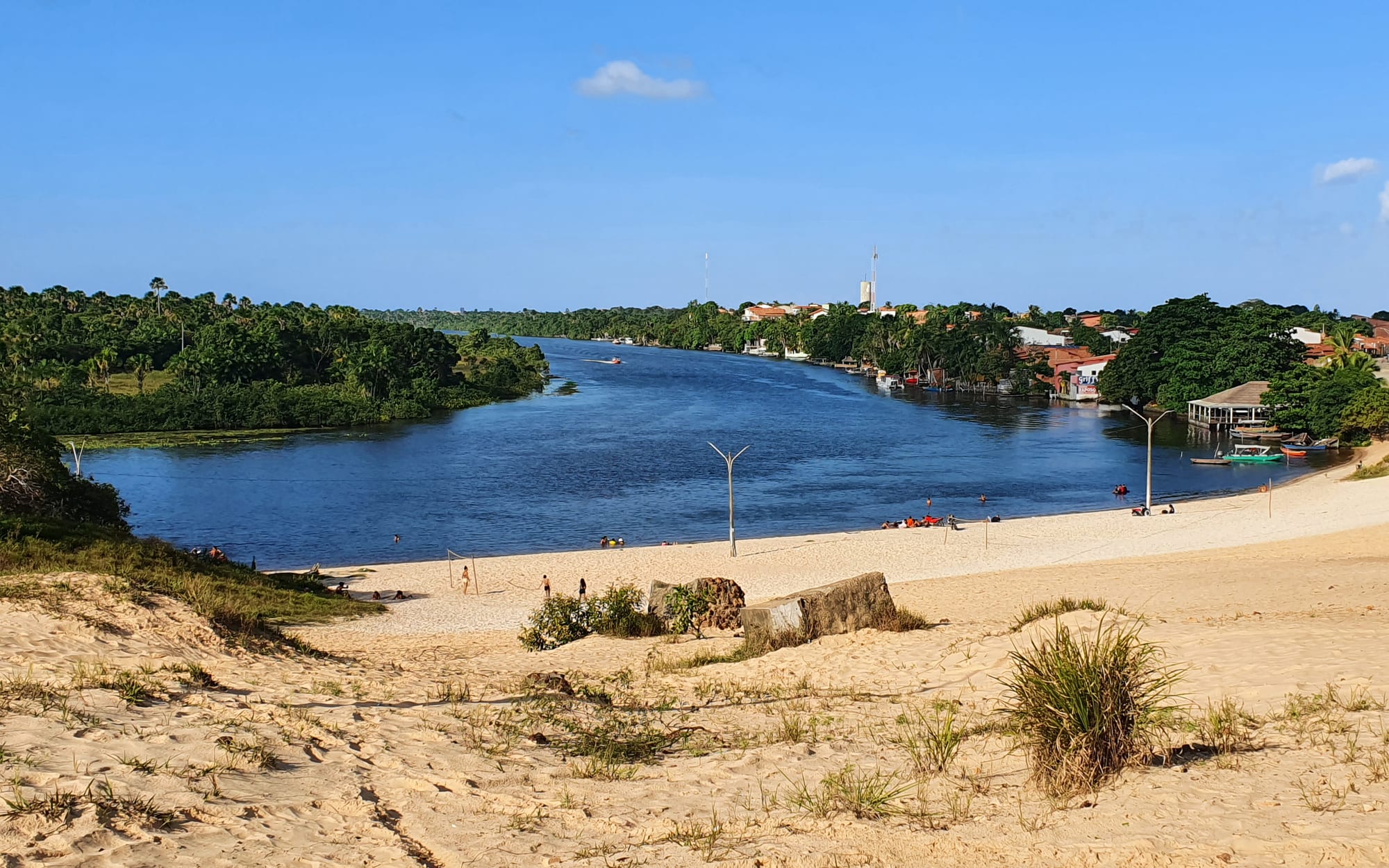
The blue Preguiças River curving past a sandy beach and dune, with houses and trees of Barreirinhas along the far bank

Fortaleza, the Lençóis & the Northeast Interior, Brazil

Barreirinhas

The Preguiças River flowing through Barreirinhas. (Esquilo / Wikimedia Commons · CC BY-SA 3.0)

A river town on the Preguiças in northern Maranhão, a small farming and fishing centre that became the main gateway to the Lençóis Maranhenses National Park. Its riverside is lined with pousadas, restaurants and tour agencies, and every day 4x4s leave for the white dunes and rain-fed lagoons while boats head downriver to the fishing villages near the sea.

Neighbourhoods

  • Town centre and riverfront
    • First-time visitors
    • Tours
    • Restaurants

    The compact centre around the main church square and the bank of the Preguiças, where most pousadas, restaurants and tour agencies are found and the boats and 4x4s for the park set off. It is busy in the mornings and evenings and quiet at midday.

    Open in Maps
  • Atins
    • Quiet stays
    • Beaches
    • Dunes

    A fishing village of about 1,500 people at the mouth of the Preguiças, within the municipality, set among the dunes of the national park. It is reached by 4x4 over sand or by boat downriver, in about two hours.

    Open in Maps
  • Caburé
    • Beaches
    • Remote stays

    A small fishing community on a narrow strip of sand between the river and the sea, now also a usual stop on the tours to the national park.

    Open in Maps

Things to do

The Lençóis Maranhenses

  • Lençóis Maranhenses National Parkpark

    A park of 155,000 hectares protected in 1981 and listed as a UNESCO World Heritage Site in 2024, where rain fills the hollows between white dunes up to 40 metres high with freshwater lagoons.

    Open in Maps
  • Lagoa Azulviewpoint

    One of the two standard 4x4 tours from town, ending at the foot of a medium-sized, gently sloping dune; its views are less sweeping than at Lagoa Bonita, but its individual lagoons are prettier.

    Open in Maps
  • Lagoa Bonitaviewpoint

    The other classic tour from town, with wide views over the dune field from a high point marked by a Brazilian flag, and a circuit of lagoons in the wet season.

    Open in Maps

Down the Preguiças River

  • Vassourasattraction

    The first stop on the river tours, a riverside settlement where the first dunes of the Pequenos Lençóis come into view.

    Open in Maps
  • Mandacaru and the Preguiças lighthouseviewpoint

    A village near the river mouth where the Brazilian Navy's Farol de Preguiças is open to visitors.

    Open in Maps
  • Caburébeach

    A beach and fishing village between the Preguiças and the Atlantic, a usual stop on the boat tours.

    Open in Maps
  • Atinsbeach

    The last village before the river mouth and a gateway to the national park, reached by boat or by 4x4 over sand in about two hours.

    Open in Maps

In town

  • Preguiças riverbankpark

    Sandy banks and a dune opposite the town, where residents and visitors swim and watch the river traffic.

    Open in Maps

Seasonal events

  • Bumba-meu-boiJune

    Groups of the orquestra and matraca styles perform Maranhão's ox pageant during the June festivals, alongside quadrilha dances.

  • ReisadoDecember–January

    Groups honouring the Three Kings visit houses with music around Christmas and Epiphany.

  • Passion playHoly Week, March or April

    A staging of the Passion of Christ, one of the town's main cultural events.

Eat and drink

Long-standing places and food districts in Barreirinhas. Hours, ratings and directions come from your maps app, always current.

Barreirinhas classics

  • Riverside restaurantsneighborhood

    Restaurants along the river serving fish, shrimp and crab with rice, beans and farofa, and regional dishes such as arroz de cuxá.

    Open in Maps
  • Caburé lunch stopneighborhood

    The fishing village of Caburé, on a strip of sand between the river and the sea, a usual stop on the river tours.

    Open in Maps

Food districts

  • Town centreneighborhood

    Snack bars, juice stands and set-lunch places around the main square and the streets leading to the river.

    Open in Maps

Experience Barreirinhas

History

The sandy lands near the mouth of the Preguiças were home to the Caeté people before Portuguese colonisation. Settlement in the area came slowly: good pasture for cattle and farmland along the Mocambo river drew settlers who founded small villages, and in 1835 a road was opened linking São Bernardo and São José do Periá, crossing the fertile Preguiças valley and encouraging new settlements along it.

Barreirinhas grew as a river and farming town and was raised to the status of a city in 1938. The dunes to the west were protected as the Lençóis Maranhenses National Park on 2 June 1981.

Tourism to the dune lagoons has since transformed the town. Pousadas, restaurants and tour agencies took over the riverfront, and a regional airport was built. In July 2024 the Lençóis Maranhenses was declared a UNESCO World Heritage Site, bringing the town new attention. Since the 1960s the Barreirinhas Basin has also been explored for oil and gas.

Culture & Customs

The town's culture is that of rural Maranhão. Bumba-meu-boi, the ox pageant of the June festivals, is performed here in the orquestra and matraca styles, alongside quadrilhas, the square dances of the festas juninas. Reisado groups honour the Three Kings at the turn of the year, the cordão de São Gonçalo is also performed, and the staging of the Passion of Christ in Holy Week is a major event. Catholicism is the faith of most residents, with an evangelical minority of about a fifth in the 2010 census.

The river shapes the identity of Barreirinhas and its villages. The Preguiças is the road to Vassouras, Mandacaru, Caburé and Atins, communities of fishermen. Atins, the largest coastal village in the municipality, has about 1,500 inhabitants.

Visitors and residents share a strong sense that the dunes and lagoons are the town's fortune and its responsibility. Local guides and drivers are part of daily life, and much of the town's working culture now revolves around the tours that leave each morning and return at dusk.

Daily Life

The 2022 census counted about 65,600 people in the municipality of Barreirinhas, which covers a large area of countryside, dunes and river villages; in 2010 most residents lived in rural areas rather than the town. Tourism to the Lençóis is central to the economy, alongside farming, fishing and public services, and many residents work as guides, drivers, boatmen and in pousadas.

The town wakes early. 4x4s fill up at the agencies in the morning and early afternoon, boats leave the riverbank for the trip downstream, and the evening brings people back to the riverfront and the square. Many of the outlying villages are reached only by sand tracks or by water, and life there follows the river and the tides.

The pressures are those of rapid tourism growth in a poor state: the strain of visitor numbers on the lagoons and dunes, and the gap between the riverfront's new businesses and the rural communities.

Food

The food of Barreirinhas is Maranhão's, built on rice, beans, fish and shellfish. Fish and shrimp from the river and the coast are fried, grilled or stewed, and crab is common. Arroz de cuxá, rice cooked with a sauce of vinagreira leaves (a sour hibiscus), dried shrimp and toasted sesame, is the state's signature dish, and shrimp, crab and sururu go into tortas, stews and fried dishes.

Farofa, toasted manioc flour, and manioc in many other forms accompany most meals. Açaí, known locally as juçara, is eaten as a thick purple pulp, and fruits of the region such as bacuri and buriti appear in juices, sweets and ice creams.

Guaraná Jesus, a sweet pink soda made in São Luís, is the traditional soft drink of Maranhão, and cachaça is the everyday spirit.

Planning tools

Budget

Barreirinhas itself is inexpensive, with simple pousadas, set lunches and cheap local transport. Most of the cost lies in the park: 4x4 tours to the lagoons and boat trips down the Preguiças are paid per seat, and private trips or flights over the dunes cost much more. Prices rise in July and at the year-end holidays.

Daily Budget Midrange
USD 80–170 (riverside pousada, restaurant meals, guided dune and river tours)
Daily Budget Shoestring
USD 30–60 (hostel or simple pousada, prato feito lunches, a shared 4x4 or boat tour)

Share 4x4 and boat trips with other travellers to split costs, and carry cash for village restaurants and boatmen.

Best Time to Visit

The lagoons depend on the rains, which fall mostly between January and May or June. They are fullest after the rains, around the middle of the year, and shrink quickly as the dry season goes on, losing up to a metre of depth a month. The second half of the year is dry, sunny and windy.

Suggested Number of Days

Two or three days are enough for the main lagoon circuits and the river trip. Allow four or five for a slower pace, a night in one of the river villages, or a second lagoon area.

First Visit
2–3 days
With Surroundings
4–5 days

Transportation

The town centre is walked. The park is entered only by 4x4 on sand tracks that include river crossings, and the villages down the Preguiças are reached by boat or by 4x4. A daily boat runs to Atins, and the tour agencies on the riverfront sell seats on daily trips.

Travel in the park only in licensed 4x4s with local drivers; the sand tracks and river crossings catch out hire cars.

Airport & Station Connections

Barreirinhas is about 270 km from São Luís by paved road, a journey of roughly three and a half hours by shared van, longer by bus, and vans pick up passengers at São Luís airport. The town also has a small regional airport. From Jericoacoara, 4x4 transfers take about seven hours.

Walkability

The centre and riverfront are small and flat enough to walk in a few minutes. Walking in the dunes is slow, hot work on soft sand, and the lagoon circuits involve climbs up steep dune faces.

Safety

Brazil has high rates of crime, including violent crime, and it is the main practical concern for visitors — though very unevenly distributed. Barreirinhas and Atins are calmer than the cities. The main risks are natural: getting lost or overheated in the dunes, and strong currents in the river and the sea.

Enter the dunes only with a guide, water and sun protection, and use repellent against dengue. Check current official travel advice before travelling.

Climate

Hot all year, around 26–32°C, with a rainy season from about January to May or June that brings most of the year's rain, and a dry, sunny and windy second half of the year. The lagoon water itself is warm, usually between about 27°C and 32°C.

Summer
hot and humid, around 27–33°C, with the rains starting from about January (summer is December–February)
Winter
dry, sunny and windy, around 25–31°C

Local Customs

Barreirinhas is a small, largely Catholic Maranhão town. A service charge is usually added to restaurant bills. Dress is casual, though beachwear belongs on the riverbank and the beaches. The park's rules apply to all visitors: vehicles keep to the authorised tracks, and swimming and sports are limited in some lagoons.

Carry out all rubbish from the dunes, keep to the routes the guides use, and ask before photographing people in the fishing villages.

Common Payment Methods

The currency is the Brazilian real (BRL, R$). Pousadas, agencies and most restaurants take cards and Pix phone payments, but the river villages and boatmen often need cash, so carry some, withdrawn in town before heading out.