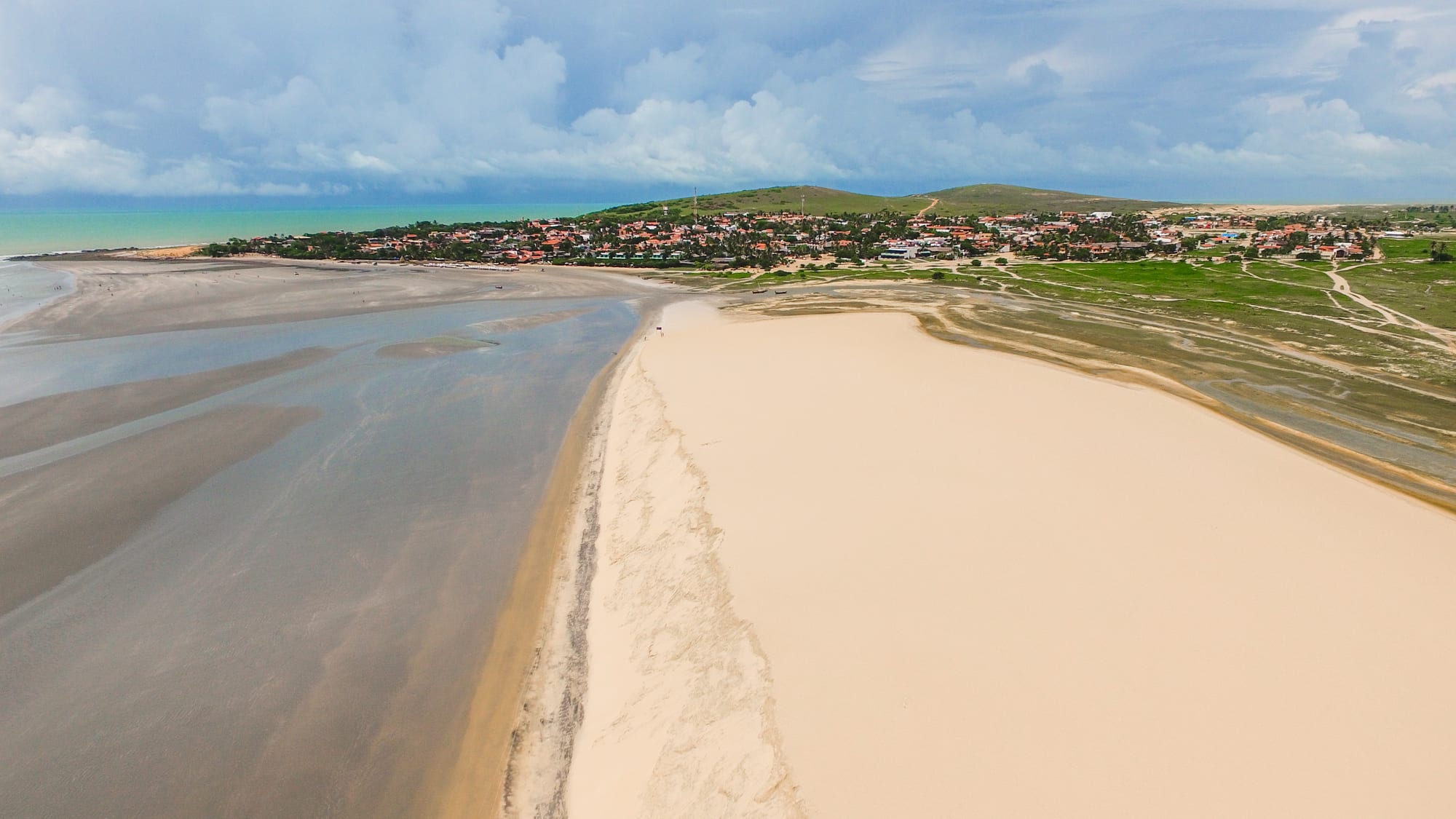
Aerial view of the pale Sunset Dune beside a wide tidal beach, with the red roofs of Jericoacoara village and a green hill beyond

Fortaleza, the Lençóis & the Northeast Interior, Brazil

Jericoacoara

The Duna do Pôr do Sol and the village of Jericoacoara, between the dunes and the Atlantic. (Jade Queiroz – MTur / Wikimedia Commons · Public domain)

A former fishing village on the far north-west coast of Ceará, set among dunes inside a national park and reached over sand. Isolated until the mid 1980s, when tourism discovered it, Jeri is now a resort of sand streets, pousadas and kitesurfers, where crowds climb a great dune every evening to watch the sun set into the sea.

Neighbourhoods

  • The village
    • First-time visitors
    • Nightlife
    • Beaches

    A small grid of sand streets between the Sunset Dune and the Serrote hill, packed with pousadas, restaurants, bars and shops. There is no paving and electric street lighting is not allowed, so the evenings are lit by shopfronts and the moon; Rua do Forró and the beachfront are the busiest strips.

    Open in Maps
  • Preá
    • Kitesurfing
    • Quiet stays

    A fishing village on the beach east of the national park, about 17 km from Jijoca's town centre and one of the gateways to Jericoacoara. Its long, windy beach is a favourite with kitesurfers.

    Open in Maps
  • Jijoca town
    • Lagoons
    • Local life

    The municipal seat inland, at the end of the paved road, where buses hand passengers over to 4x4s for the sand track. The Lagoa do Paraíso lies beside it.

    Open in Maps

Things to do

In and around the village

  • Jericoacoara Beachbeach

    The village's west-facing bay, one of the places in Brazil where the sun sets into the sea, and a base for windsurfing, kitesurfing and sailing.

    Open in Maps
  • Duna do Pôr do Solviewpoint

    The tall Sunset Dune beside the village, where visitors and residents gather every evening to watch the sun go down over the Atlantic.

    Open in Maps
  • Serrote and the lighthouseviewpoint

    Twin rocky hills north-east of the village, the highest point of the park, crowned by a lighthouse opened in 1952, with views over the dunes, the sea and the village.

    Open in Maps
  • Igreja de Nossa Senhora da Consolaçãolandmark

    The small village church, where Sunday masses are held.

    Open in Maps

The national park

  • Jericoacoara National Parkpark

    A park of dunes, mangroves, lagoons and beaches created in 2002 from an environmental protection area of 1984, with the village at its edge.

    Open in Maps
  • Pedra Furadalandmark

    A rock arch about five metres high on the rocky shore east of the village, the emblem of Jericoacoara and one of the best-known sights of Ceará.

    Open in Maps
  • Árvore da Preguiçaattraction

    The 'lazy tree', an oddly shaped button mangrove inside the park, a regular stop on tours from the village.

    Open in Maps
  • Guriú river mangrovespark

    Canoe trips through the mangroves at the mouth of the Rio Guriú, about 10 km west of the village, to see seahorses.

    Open in Maps

Lagoons and the coast beyond

  • Lagoa do Paraísobeach

    A freshwater lagoon at the town of Jijoca, also called Lagoa de Jijoca and popular for sailing, visited by buggy from the village.

    Open in Maps
  • Lagoa Azulbeach

    A clear freshwater lagoon surrounded by native vegetation, nicknamed the 'Caribe Nordestino'.

    Open in Maps
  • Tatajubaattraction

    A fishing village about 25 km west along the coast, near Camocim, that had to be moved to escape advancing dunes, a day-long buggy trip from Jeri.

    Open in Maps

Eat and drink

Long-standing places and food districts in Jericoacoara. Hours, ratings and directions come from your maps app, always current.

Jericoacoara classics

  • Tapioca stallsneighborhood

    Tapioca crêpes of manioc starch, filled with coconut, cheese, banana or chocolate, sold in the village streets and at breakfast in the pousadas.

    Open in Maps
  • Açaí na tigelacafe

    Frozen açaí pulp served in a bowl with cereal and banana, a favourite after a day on the beach.

    Open in Maps

Food streets

  • Rua do Forróneighborhood

    One of the village's main sand streets, lined with restaurants serving fresh fish, meat, pizza, pasta and crêpes.

    Open in Maps
  • The beachfrontneighborhood

    Bars and kiosks along the bay, at their busiest after sunset when people come down from the dune.

    Open in Maps

Experience Jericoacoara

History

The coast here was the land of the Tremembé people, and the name Jericoacoara comes from Tupi, usually explained as "lair of the turtles". The Spanish navigator Vicente Yáñez Pinzón is reported to have anchored in the bay in 1499, though under the Treaty of Tordesillas the landing carried no official weight. In the early 17th century, during the Portuguese campaign against the French colony in Maranhão, Jerônimo de Albuquerque built a small wooden fort at the foot of the Serrote, dedicated to Our Lady of the Rosary.

For the next three centuries Jericoacoara was a remote fishing settlement among moving dunes. A lighthouse was opened on the Serrote in 1952, but the village had no road, and its electricity came from diesel engines. In 1984 the area was declared an environmental protection area. Tourism began to grow in the mid 1980s, and grew rapidly after the Washington Post listed the beach among the ten most beautiful in the world.

Mains electricity reached the village in 1998. In 2002 the protected area became Jericoacoara National Park, and in 2005 a strip around the village was added to stop it spreading into the dunes. Road building and paving are banned inside the park, so the sand streets survive even as pousadas and restaurants have replaced most of the fishermen's houses. The regional airport at Cruz opened in 2017, shortening the journey from the rest of Brazil.

Culture & Customs

Jericoacoara's culture is a meeting of an old fishing community and an international beach scene. Tourism is now the main source of income for the whole municipality of Jijoca de Jericoacoara, and pousadas, restaurants and kite schools now line streets where fishermen's houses once stood.

The day turns on the sunset. In the late afternoon visitors and villagers climb the Duna do Pôr do Sol to watch the sun drop into the sea, a gathering the community treats as a daily ritual, and capoeira groups often play on the beach below. After dark the village fills with diners, music and dancing — forró, the accordion music of the Northeast, has given its name to one of the main streets.

Sport is part of the identity: the steady winds made Jeri one of Brazil's best-known places for windsurfing and kitesurfing, and the dunes are used for sandboarding. Rules born of the national park shape daily life — no paving, no electric street lamps and limits on building — and residents are protective of the place's informal, barefoot character.

Daily Life

Jericoacoara is a village within the municipality of Jijoca de Jericoacoara, the northernmost in Ceará, whose seat is the inland town of Jijoca. Tourism is by far the main business, and the village fills with visitors in high season.

Life follows the wind, the tides and the sun. Mornings are for the beach, the lagoons and the water sports; the sand streets are hot by midday; and everything converges on the dune at sunset before the restaurants fill. Supplies, workers and visitors come in over the sand by 4x4 and truck, and the 2017 airport has made Jeri reachable in a day from much of Brazil.

The main issues are the pressures of popularity: rising prices and property values, the strain of crowds on the dunes and lagoons, and the balance between the national park's rules and the village's growth.

Food

Seafood is the base of Jeri's cooking: fish grilled or stewed, shrimp and lobster, often with rice, beans and farofa, toasted manioc flour. The Ceará staples are everywhere too — baião de dois, rice and beans cooked together with queijo coalho cheese, and tapioca, crêpes of manioc starch filled with coconut, cheese, banana or chocolate, which are a breakfast and a street snack.

Açaí na tigela, frozen açaí pulp served in a bowl with cereal and banana, is a favourite after a day in the sun. Visitors from abroad have brought pizza, pasta, crêpes and other foreign cooking to the restaurants of Rua do Forró and the streets around it, and the beach bars serve cold beer, coconut water and caipirinhas made with cachaça and lime as the crowds come down from the dune.

Out at the lagoons, the bars beside the water serve fried fish and snacks to buggy passengers, and simple restaurants in the fishing villages along the coast cook the day's catch.

Planning tools

Budget

Jericoacoara has grown expensive in high season, and costs more than the rest of the Ceará coast. The transfer over the sand from Jijoca or the airport adds to the bill, and so do buggy trips to the lagoons and kitesurfing lessons or equipment hire. Sharing 4x4 and buggy trips with other travellers keeps costs down.

Daily Budget Midrange
USD 90–170 (pousada near the beach, restaurant dinners, a shared buggy trip to the lagoons)
Daily Budget Shoestring
USD 35–65 (hostel bed or simple pousada, tapioca and set meals, shared transfers)

Carry some cash for the transfer over the sand, buggy drivers and small stalls, as connections can be unreliable in the dunes.

Best Time to Visit

The windy second half of the year, from about July to December, is the kitesurfing and windsurfing season and the driest time on the coast. The rains fall roughly from January or February to May, when the lagoons fill. Brazilian holidays — July, Christmas to New Year and Carnival — are the busiest and dearest weeks.

Suggested Number of Days

The long journey in and out makes a short stay poor value; three or four days is a common first visit. Kitesurfers and those continuing along the coast towards the Delta do Parnaíba and the Lençóis often stay a week or more.

First Visit
3–4 days
With Surroundings
5–7 days

Transportation

There are no paved roads in the national park and no cars in the village streets. People walk everywhere in the village; trips to the lagoons, Tatajuba and the beaches beyond go by buggy or 4x4 with local drivers, and horses can be hired for rides along the beach.

Travel only in licensed 4x4s and buggies with local drivers; the sand tracks and river crossings catch out hire cars.

Airport & Station Connections

Jericoacoara is about 300 km west of Fortaleza. Buses and transfer vans run from Fortaleza to Jijoca, where the paved road ends; the last stretch, about 45 minutes, is off-road over dunes and beach in a 4x4 or a jardineira, an open truck with benches. The regional airport, opened in 2017 in the neighbouring municipality of Cruz, is about 31 km away and has domestic flights; transfers meet the planes.

Walkability

The village is small and entirely on foot, though walking in loose sand is slow and hot. The Sunset Dune is at the edge of the village, and the Pedra Furada can be reached on foot along the shore or by horse. Good sandals and a torch for the unlit streets help.

Safety

Brazil has high rates of crime, including violent crime, and it is the main practical concern for visitors — though very unevenly distributed. Tourist villages such as Jericoacoara are calmer than the big cities. Natural risks include getting lost or overheated in the dunes and strong currents.

Enter the dunes only with a guide or licensed driver, carry water and sun protection, and use repellent against dengue. Check current official travel advice before travelling.

Climate

Hot all year on the coast, around 26–32°C, with a rainy season roughly from January or February to May and a dry, sunny and windy second half of the year, when strong steady trade winds blow.

Summer
hot and humid, around 27–33°C, with the rains starting from about January (summer is December–February)
Winter
dry, sunny and windy, around 25–31°C, with the strongest trade winds from about July

Local Customs

Jeri is relaxed and informal: beachwear and bare feet are normal in the village. A service charge is usually added to restaurant bills. The evening gathering on the dune is a shared ritual, often with capoeira on the beach at sunset. The park's rules limit building and keep the streets unpaved and unlit.

Respect the park's rules — stay off fenced dune areas, never drive off the marked tracks, and never handle seahorses or other wildlife on mangrove trips.

Common Payment Methods

The currency is the Brazilian real (BRL, R$). Cards and Pix phone payments are widely accepted in the village, but connections can fail, so carry some cash, ideally withdrawn before arriving.