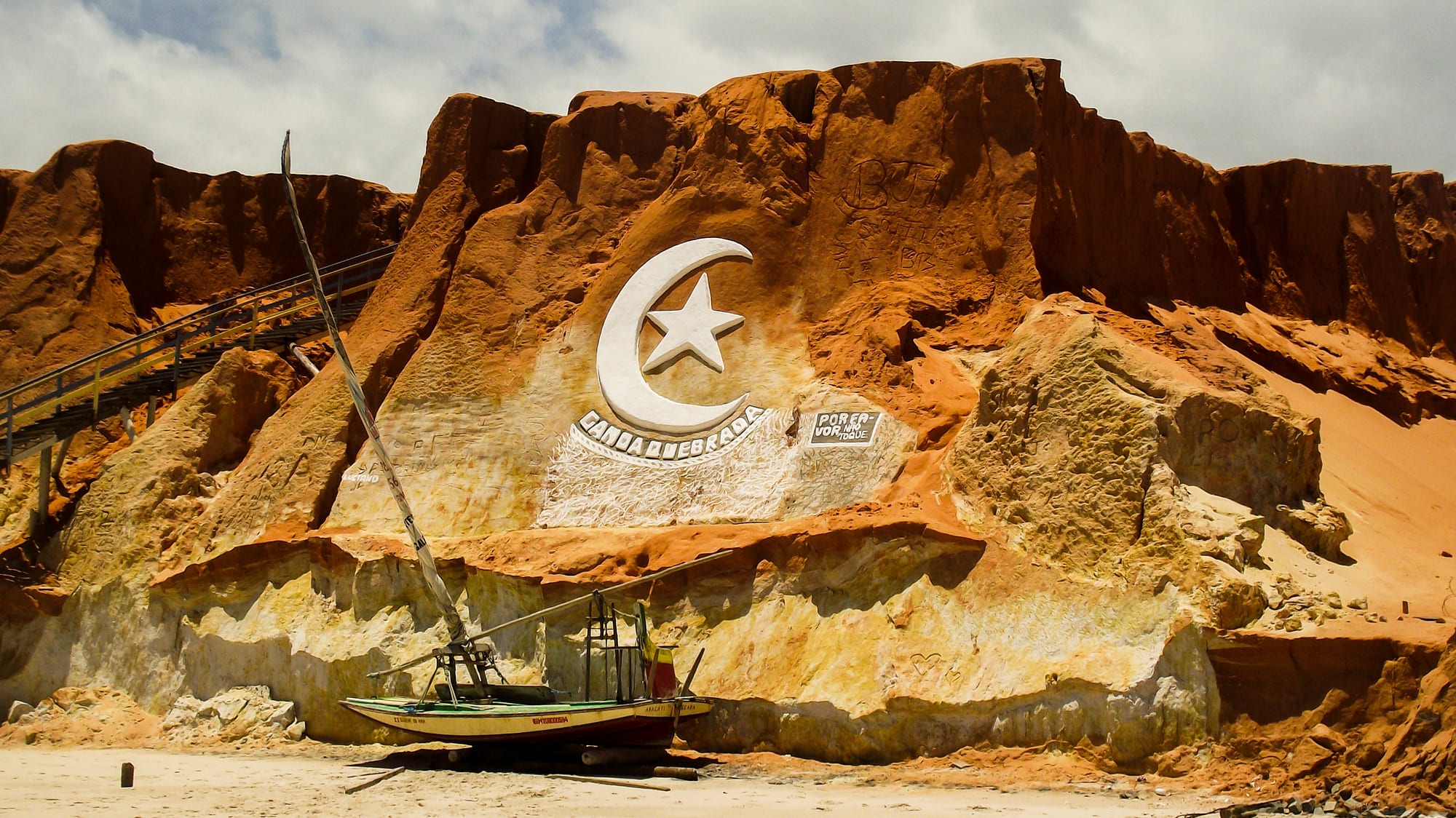
Red sandstone cliffs with a white crescent moon and star carved into the rock, above a beached jangada sailing raft

Fortaleza, the Lençóis & the Northeast Interior, Brazil

Canoa Quebrada

The red cliffs above the beach at Canoa Quebrada. (Rafa Tecchio / Wikimedia Commons · CC BY-SA 3.0)

A beach village on the east coast of Ceará, in the municipality of Aracati, set on red sandstone cliffs above a long beach. A remote jangada-fishing hamlet until hippies discovered it in the 1970s, it is now one of the state's main resorts, known for its moon-and-star cliff carving, dune-buggy rides, kitesurfing and a main street that turns into a party at weekends.

Neighbourhoods

  • Broadway and the village
    • First-time visitors
    • Nightlife
    • Restaurants

    The village on top of the cliffs, centred on Rua Dragão do Mar, known to everyone as 'Broadway', where most of the pousadas, restaurants, bars and shops stand. Quiet on weekdays outside January, it fills with crowds from across eastern Ceará on Friday and Saturday nights.

    Open in Maps
  • The beach below the cliffs
    • Beaches
    • Water sports

    A long beach at the foot of the red cliffs, reached on foot from the village, with beach bars, beached jangadas and the kitesurf and buggy operators. Some stretches flood at high tide.

    Open in Maps

Things to do

Cliffs, dunes and the beach

  • The red cliffs and the moon-and-star carvinglandmark

    Reddish cliffs rising up to about thirty metres above the sea, protected since 1998, with a crescent moon and star carved into the rock that has become the emblem of the village.

    Open in Maps
  • Sunset from the dunesviewpoint

    The dunes behind the village, the place to watch the sun go down over the coast.

    Open in Maps
  • Dune-buggy ridesattraction

    Buggy trips with a driver-guide along the beaches, dunes and cliffs of the coast, the most popular excursion from the village.

    Open in Maps
  • Jangada sailingattraction

    Short trips on a jangada, the traditional wooden sailing raft that local fishermen still use.

    Open in Maps
  • Kitesurfing, windsurfing and paraglidingattraction

    The beach has a kite school, windsurfing is popular, and tandem paragliding flights take off from the cliff tops.

    Open in Maps

Short trips from the village

  • Aracati historic centreneighborhood

    The colonial town about 12 km inland, founded in 1747 and grown rich on dried beef, whose centre of 17th- and 18th-century churches and tiled house fronts is protected as national heritage.

    Open in Maps
  • Majorlândiabeach

    A neighbouring beach in the municipality of Aracati, with its own bars, restaurants and places to stay.

    Open in Maps
  • Jaguaribe river cruiseattraction

    Boat trips on the Jaguaribe river near Fortim, combined with a buggy ride along the coast.

    Open in Maps

Eat and drink

Long-standing places and food districts in Canoa Quebrada. Hours, ratings and directions come from your maps app, always current.

Canoa classics

  • Broadway restaurantsneighborhood

    The main street's restaurants, many offering set lunches, serve regional cooking alongside steaks and grilled meats.

    Open in Maps
  • Beach barsneighborhood

    Beach shacks on the sand, where people drink and eat simple food through the day.

    Open in Maps

Food in the area

  • Aracati centreneighborhood

    The market town's centre, with everyday restaurants, snack bars and shops that serve the whole coast.

    Open in Maps

Experience Canoa Quebrada

History

Canoa Quebrada — "broken canoe" in Portuguese — grew from a small fishing hamlet, the Vila do Estevão, on the coast of Aracati. The surrounding area entered colonial history early: in 1603 Pero Coelho de Souza built a fort on the Jaguaribe river during a campaign against the French in Maranhão, and Aracati, founded in 1747, prospered from charqueadas, workshops that salted and dried beef for the cattle trade. The abolitionist raft man Francisco José do Nascimento, the Dragão do Mar, was born in Aracati.

For most of the 20th century the village was remote, home to a few fishing families who sailed jangadas. In the 1970s it was discovered by hippies, who found a beautiful, isolated place of fishermen and an Indigenous community; some stayed, married local people and raised families there. A crescent moon and star carved into the cliffs became the village's symbol.

Films brought wider attention — Canoa Quebrada was used again as a film location in 1997, for Bela Donna — and the village became one of Ceará's main tourist destinations, rated by the state tourism authority second only to Fortaleza. On 20 March 1998 Aracati created the Canoa Quebrada Environmental Protection Area to control building on the beach, dunes and cliffs, which the municipality monitors for erosion and irregular construction. Wind farms now stand on the coast nearby.

Culture & Customs

Canoa's culture mixes the old fishing community with the legacy of its hippie settlers and a steady flow of visitors from Brazil and abroad. Many local families still fish from jangadas, the wooden sailing rafts of the Ceará coast, and the rafts drawn up on the sand below the cliffs are part of the village's identity.

The hippie years left an informal, barefoot style, and the moon-and-star emblem appears on the souvenirs sold along the main street. The main street itself is officially Rua Dragão do Mar, named after the Aracati-born raft man who refused to carry enslaved people in 1881, but everyone calls it Broadway. At night residents and visitors meet there to the sound of reggae and forró, and at weekends it becomes one long street party, drawing crowds from across eastern Ceará and from neighbouring Rio Grande do Norte.

Outdoor sport shapes the rest of the day: buggy rides, sandboarding, horse riding, kitesurfing, windsurfing and paragliding from the cliff tops.

Daily Life

Canoa Quebrada is a district village of the municipality of Aracati, whose centre lies about 12 km inland. Tourism is the main business, and many residents work in pousadas, restaurants, bars, shops and the buggy and water-sports trade, alongside the fishermen. Foreign-born residents are increasingly common, running guesthouses and businesses.

The rhythm swings between quiet weekdays and busy weekends. Weekdays outside the January holiday season are calm; on Fridays and Saturdays visitors pour in and Broadway fills late into the night. Days begin with fishermen on the beach and end with people gathering on the dunes for the sunset.

Many basic goods are scarce or dear in the village, so residents shop in Aracati. Pressures include low wages and informal work in tourism, often without proper contracts, and the protection of the eroding cliffs and dunes from irregular building, which the municipality monitors. Wind farms on the nearby coast are part of a wider change along Ceará's shore.

Food

Food in Canoa Quebrada is the cooking of Ceará, with fish from the sea alongside the dishes of the interior. Peixada cearense, a fish stew served with pirão, a porridge of manioc flour, is a symbol of the state's cooking. Baião de dois is rice and beans cooked together, often with queijo coalho cheese added, and carne de sol, salted sun-dried beef served with pirão, is another Ceará classic.

Tapioca, a pancake of manioc starch with sweet or savoury fillings, is an everyday snack, and the cashew fruit, abundant in Ceará, goes into sweets and drinks. Many restaurants on Broadway offer set lunches, while the beach shacks serve drinks and simpler food through the day.

The village's mixed population has added international cooking, such as Argentine-style grilled meats and steaks, to the main street. Many goods are scarce or dear in Canoa itself, so residents who live and work in the village buy much of their everyday food in Aracati, the market town inland.

Planning tools

Budget

Canoa Quebrada has dozens of small pousadas and rooms for rent across a wide price range, and set lunches on Broadway keep food costs down. Buggy tours, paragliding and kitesurf lessons are the main extra costs. Prices rise in January and at weekends and holidays, when visitors arrive from across the region.

Daily Budget Midrange
USD 80–160 (pousada with a pool or sea view, restaurant dinners, a shared buggy tour)
Daily Budget Shoestring
USD 30–60 (simple pousada or rented room, set lunches, buses from Fortaleza)

Many goods are scarce or dear in the village; Aracati, a short ride inland, has a wider choice.

Best Time to Visit

The coast is sunny almost all year, with most rain falling between March and May, less than in Fortaleza. January is the busiest month, and weekends are lively all year.

Suggested Number of Days

Two or three days suit most visitors. Kitesurfers and those who want a slower beach stay often remain for several more.

First Visit
2–3 days
With Surroundings
3–5 days

Transportation

The village is small and walkable, and many people go barefoot. Minibuses link it with Aracati, and buggies with driver-guides are the way to explore the dunes and beaches along the coast.

Hire buggies only with licensed local driver-guides, and avoid driving on the beach yourself at high tide.

Airport & Station Connections

Canoa Quebrada is about 164 km south-east of Fortaleza along the CE-040, about three and a half hours by direct bus, and its nearest airport with scheduled flights is Fortaleza's. Buses along the coast stop at Aracati, where minibuses cover the last stretch. A small airport near Aracati, about 20 km away, opened in 2012 for general aviation.

Walkability

Everything in the village is within a few minutes' walk, and many people go barefoot. Walks along the beach are easy, but some stretches flood at high tide.

Safety

Brazil has high rates of crime, including violent crime, and it is the main practical concern for visitors — though very unevenly distributed. Canoa Quebrada is far calmer than a large city, but muggings have been reported, particularly of people walking home alone from beach parties late at night. Strong sun is the main natural risk.

Walk home in company after late nights on the beach, keep valuables out of sight, and use repellent against dengue. Check current official travel advice before travelling.

Climate

Semi-arid and sunny almost all year, with an average annual temperature of about 27°C and most of the rain between March and May. The second half of the year is dry and sunny.

Summer
hot and sunny, with daytime temperatures around 30°C and the rains arriving from about March (summer is December–February)
Winter
dry and sunny, with daytime temperatures around 30°C

Local Customs

The village keeps an easy-going, informal character from its hippie years, and beachwear and bare feet are normal. Many menus add a 10 per cent service charge; waiters appreciate a small tip in hand as well. Nights on Broadway move to reggae and forró.

Respect the protected cliffs — do not climb on them or carve into the rock — and ask before photographing fishermen and their jangadas.

Common Payment Methods

The currency is the Brazilian real (BRL, R$). Cards and Pix phone payments are widely accepted in pousadas and restaurants, but carry some cash for beach bars, buggy drivers and small shops.