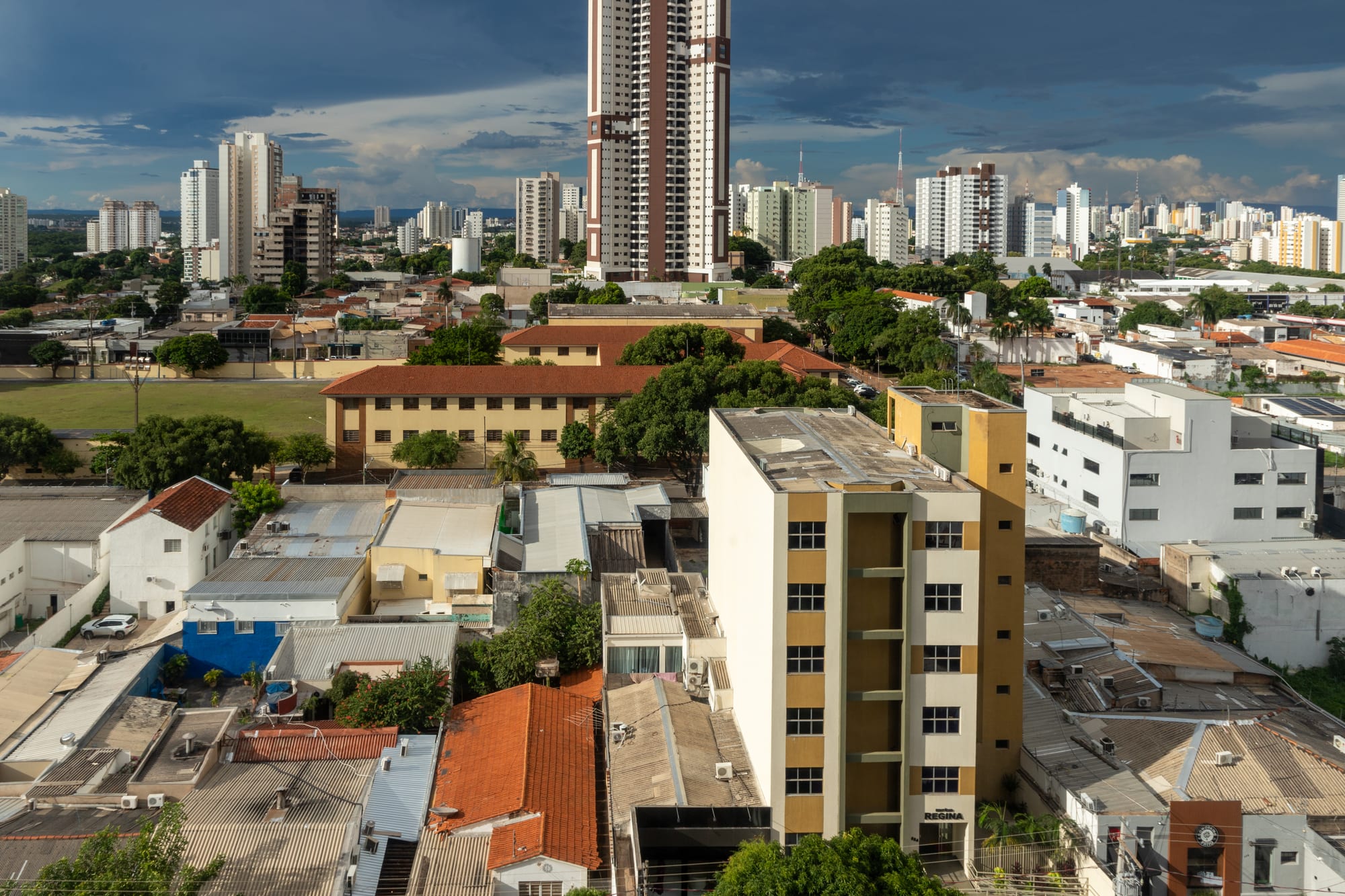
Tiled roofs and low buildings of central Cuiabá below a cluster of white high-rise towers under storm clouds

Brasília & the Central West, Brazil

Cuiabá

The historic centre of Cuiabá, with the newer high-rise districts behind. (Prburley / Wikimedia Commons · CC BY 4.0)

The capital of Mato Grosso, on the Cuiabá River near the geographical centre of South America, founded in the 1719 gold rush and capital of Mato Grosso since 1835. Famous across Brazil for its heat, it is a commercial city of about 650,000 serving the state's farm belt, and the gateway to the northern Pantanal and the cliffs of the Chapada dos Guimarães.

Neighbourhoods

  • Centro
    • First-time visitors
    • Historic district
    • Shopping

    The old town around the Praça da República, with the cathedral, the restored churches and palaces of the gold era, and the main commercial streets. Avenida Getúlio Vargas, about eight blocks from the square, has a cluster of hotels.

    Open in Maps
  • Porto
    • Riverside
    • Best for food

    The old river port on the Cuiabá River, where the town began. Its renovated waterfront has the river museum and the municipal aquarium, the Church of São Gonçalo stands in the district, and there are fish restaurants in the surrounding streets.

    Open in Maps
  • Bandeirantes
    • Budget stays
    • Close to the centre

    A neighbourhood on the ridge behind the Antônio Pires de Campos park, about 10–15 minutes' walk from the Praça da República, with a few cheaper hotels.

    Open in Maps
  • Praça Popular
    • Nightlife
    • Bars

    A square in a popular district of the city surrounded by restaurants and bars, one of the main places to go out in the evening.

    Open in Maps

Things to do

The old centre

  • Cathedral Basilica of the Good Lord Jesuslandmark

    The cathedral on the Praça da República, built after the old 18th-century mother church on the site was demolished in 1968.

    Open in Maps
  • Praça da Repúblicalandmark

    The small green square at the heart of the centre, surrounded by the cathedral and the main commercial streets.

    Open in Maps
  • Church of the Rosary and Chapel of São Beneditolandmark

    Founded by enslaved people in the 18th century, the only Baroque church left in the city and the scene of the Festa de São Benedito each July.

    Open in Maps
  • Geodesic Centre markerlandmark

    The obelisk on the Praça Pascoal Moreira Cabral marking the point that Cândido Rondon calculated in 1909 as the centre of South America; later measurements placed it in the Chapada dos Guimarães.

    Open in Maps

Museums

  • SESC Arsenalmuseum

    The restored former war arsenal, now a cultural centre run by SESC with exhibitions, shows and a museum.

    Open in Maps
  • Museum of the History of Mato Grossomuseum

    The state's history museum and library in the restored Palácio da Instrução in the centre.

    Open in Maps
  • Museum of the Cuiabá River and Municipal Aquariummuseum

    A museum of the river's life and fishing traditions, with an aquarium of local fish, on the renovated waterfront of the Porto.

    Open in Maps
  • Museum of Sacred Art of Cuiabámuseum

    The city's museum of sacred art.

    Open in Maps

Parks

  • Mãe Bonifácia Parkpark

    One of the city's main parks, with areas for walking and exercise.

    Open in Maps
  • Massairo Okamura Parkpark

    A city park with areas for walking and exercise.

    Open in Maps

Sport and nights out

  • Arena Pantanalattraction

    The 42,000-seat stadium completed in 2014, which hosted four group matches of that year's World Cup and is home to Cuiabá Esporte Clube.

    Open in Maps
  • Craft fair at Praça Santos Dumontmarket

    A weekend crafts market on the square at the corner of Avenida Getúlio Vargas.

    Open in Maps

Short trips from the city

  • Chapada dos Guimarães National Parkpark

    Sandstone cliffs, waterfalls and cerrado on the edge of a plateau, including the Mirante de Geodésia viewpoint near the geographical centre of South America.

    Open in Maps
  • Transpantaneiratrail

    The 147-km road from Poconé to Porto Jofre across the northern Pantanal, crossing 122 wooden bridges, for wildlife watching in the dry season.

    Open in Maps

Eat and drink

Long-standing places and food districts in Cuiabá. Hours, ratings and directions come from your maps app, always current.

Cuiabá classics

  • Maria Isabelrestaurant

    Rice cooked with charque, dried salted beef, a dish of the local cooking.

    Open in Maps
  • Ventrecha de pacurestaurant

    Fried ribs of pacu, a river fish, among many fish dishes born on the banks of the Cuiabá River and in the Pantanal.

    Open in Maps
  • Peixaria Popularrestaurant

    A fish restaurant serving the city's river-fish dishes.

    Open in Maps

Food districts

  • The Porto's fish restaurantsneighborhood

    Restaurants around the old river port, close to the waterfront and the river museum.

    Open in Maps
  • Praça Popularneighborhood

    A square ringed with restaurants and bars, busy in the evening.

    Open in Maps

Experience Cuiabá

History

The Bororo name of the place is usually translated as 'arrow-fishing'. In the early 18th century bandeirantes, expeditions from São Paulo, came up the rivers to capture Indigenous people, and found gold on the Coxipó River where it meets the Cuiabá. Pascoal Moreira Cabral reported the find to São Paulo in a letter of April 1719, and a gold rush followed at once, with prospectors coming mainly from the São Paulo region and enslaved Indigenous people, and later enslaved Africans, forced to work the mines. The town was formally founded on 1 January 1727 as Vila Real do Senhor Bom Jesus de Cuiabá; its Church of the Rosary was said to mark a rich seam of gold.

The mines declined, and the colonial governors moved the capital of the captaincy west to Vila Bela da Santíssima Trindade, but Cuiabá was raised to a city in 1818 and became the capital of the province of Mato Grosso in 1835. Far from the coast and reached by long river journeys, it remained isolated. The Paraguayan War of 1864–1870 brought a brief boom, as the town supplied sugar, food and timber to the Brazilian troops. In 1909 Cândido Rondon calculated the geodesic centre of South America and marked it in the city; later measurements placed it about 45 km away, near Chapada dos Guimarães.

In the second half of the 20th century the city grew quickly, merging with its neighbour Várzea Grande into a metropolitan area, and much of the colonial centre was demolished, including the old mother church in 1968; restoration of the surviving buildings began only in the 1980s. Since 1990 growth has slowed as other towns in the state draw migrants. In 2014 Cuiabá was one of the host cities of the World Cup, a choice criticised at the time.

Culture & Customs

Cuiabá's culture blends Indigenous, African and Portuguese roots, and the city keeps strong regional traditions. The siriri and cururu dances, performed at religious festivals, are accompanied by the viola de cocho, a small guitar carved from a single log and recognised as part of Brazil's national intangible heritage. Lambadão, a fast music and dance that grew from the lambada brought by prospectors from Pará and the local rasqueado, is the popular sound of the city and its neighbour Várzea Grande, with its own festival.

The Church of the Rosary and Chapel of São Benedito, founded by enslaved people in the 18th century, holds the traditional Festa de São Benedito every July. Catholicism is the faith of about half the population, with evangelical churches making up most of the rest, and Cuiabá also has a mosque.

The city has numerous museums reflecting its mix of influences, from sacred art and the history of Mato Grosso to the river's fishing traditions, and the SESC Arsenal, in the old war arsenal, is a busy cultural centre. Football centres on Cuiabá Esporte Clube at the Arena Pantanal. The heat shapes social life, and evenings outdoors in squares and bars are the norm.

Daily Life

Cuiabá had about 650,000 inhabitants at the 2022 census, and together with Várzea Grande, across the river, forms the main urban area of Mato Grosso. It is the state's centre of commerce and services, serving a population spread across many small farming towns, and its industry is mainly agribusiness, especially food processing, much of it in an industrial district founded in 1978.

The farm economy of Mato Grosso, one of the main soya and cattle producing states of Brazil, drives the city. New high-rise apartment districts and shopping centres have grown up away from the old centre, which is busy by day with shops and offices. The Federal University of Mato Grosso has its main campus here.

The day is organised around the heat. People start early, the middle of the day is spent indoors where possible, and life moves outdoors in the evening. The dry season brings smoke from fires in the surrounding countryside, which can hang over the city. Transport has long been a sore point: the light-rail line begun for the World Cup was abandoned, leaving buses and cars to carry the city's traffic.

Food

Fish from the rivers of the region — pacu, pintado, dourado, piraputanga and others — is the basis of Cuiabá's cooking, eaten with cassava flour, pumpkin and banana. Pacu is roasted or its ribs fried as ventrecha de pacu, piraputanga is grilled over coals or cooked in banana leaf, and mojica de pintado and caldo de piranha, piranha broth, are local favourites. Farofa de banana and pirão, a dish made from cassava flour, accompany them.

Maria Isabel, rice cooked with charque, dried salted beef, is a dish of the city's own cooking, also known as arroz carreteiro. Paçoca de pilão is charque pounded in a mortar with seasoned cassava flour.

Sweets are distinctive too. Furrundum is green papaya cooked with rapadura, unrefined cane sugar, and cinnamon; pixé is toasted maize pounded with cinnamon and sugar. The fish restaurants of the Porto, near the river, and the bars and restaurants around the Praça Popular are where many people eat out.

Planning tools

Budget

Cuiabá is a moderately priced business city: hotels are reasonable, taxis cheap and regional food good value. The big costs come with the trips out of town — Pantanal lodges with meals, boats and guides can cost more than the rest of a visit, and Chapada trips need a car or a tour.

Daily Budget Midrange
USD 95–190 (central hotel, restaurant meals, app taxis, a day tour to the Chapada); Pantanal lodges cost much more
Daily Budget Shoestring
USD 35–65 (hostel or simple hotel, por quilo lunches, buses and taxis)

Compare all-inclusive Pantanal packages with separate lodge and guide costs, and book the dry-season months early.

Best Time to Visit

The dry season, roughly May to September, is the time for Pantanal wildlife and for waterfall walks in the Chapada, and July is the month of the Festa de São Benedito. Late in the dry season smoke from fires and very high temperatures can be trying. The rainy months from about October to April are hot and humid, with storms.

Suggested Number of Days

The city itself needs a day or two. Most visitors come for what lies around it: allow a day or two more for the Chapada dos Guimarães and three or four for the northern Pantanal, which is reached by road and rewards several nights at a lodge.

First Visit
1–2 days
With Surroundings
5–7 days

Transportation

City buses link the neighbourhoods, but most visitors use taxis or app taxis, which are inexpensive and quick to the airport or bus station. A light-rail line to Várzea Grande and the airport, planned for the 2014 World Cup, was abandoned unfinished. For the Pantanal and the Chapada a tour, lodge transfer or hire car is needed.

Use a lodge transfer or a high-clearance vehicle on the Transpantaneira, and avoid driving it in heavy rain or after dark.

Airport & Station Connections

Marechal Rondon International Airport is in the neighbouring city of Várzea Grande, about 10 km from downtown Cuiabá. It is the main airport of Mato Grosso, with flights to many Brazilian cities. Long-distance buses arrive at the city's bus station.

Walkability

The centre is compact enough to walk between the Praça da República, the churches and the museums, and Bandeirantes and the Avenida Getúlio Vargas hotels are 10–15 minutes away on foot. The heat makes walking hard in the middle of the day, and the Porto, the parks and the arena are better reached by taxi.

Safety

Brazil has high rates of crime, including violent crime, and it is the main practical concern for visitors — though very unevenly distributed. The main hotel area and centre of Cuiabá are considered fairly safe, but robbery occurs, and quiet streets are best avoided at night. Heat, dehydration and dry-season smoke are the practical health risks.

Use app taxis at night, drink plenty of water, use repellent against dengue, and explore the Pantanal with licensed guides. Check current official travel advice before travelling.

Climate

Cuiabá is famous throughout Brazil as one of its hottest cities, with temperatures often above 40 °C. The mean maximum is around 34 °C. Rain falls mainly from about October to April; the long dry season brings smoke from fires. Summer is December to February.

Summer
hot and humid, with storms; on rainy days the maximum is often only about 28 °C
Winter
dry and hot by day; July is the coolest month, with an average low of about 17 °C, and cold fronts from the south occasionally drop it to around 10 °C for a day or two

Local Customs

Cuiabanos are proud of their regional culture — the siriri and cururu dances, the viola de cocho and lambadão music — and of their fish cooking. Dress is light and casual because of the heat, though churches expect covered shoulders and knees. A service charge is usually added to restaurant bills.

Ask before photographing people, and dress modestly in churches. Check current official travel advice for the Pantanal before travelling.

Common Payment Methods

The currency is the Brazilian real (R$). Cards and the Pix transfer system are accepted almost everywhere in the city. Carry cash for market stalls and for the Pantanal, where lodges accept cards but roadside stops may not; withdraw by day inside banks or malls, as many ATMs limit foreign cards.