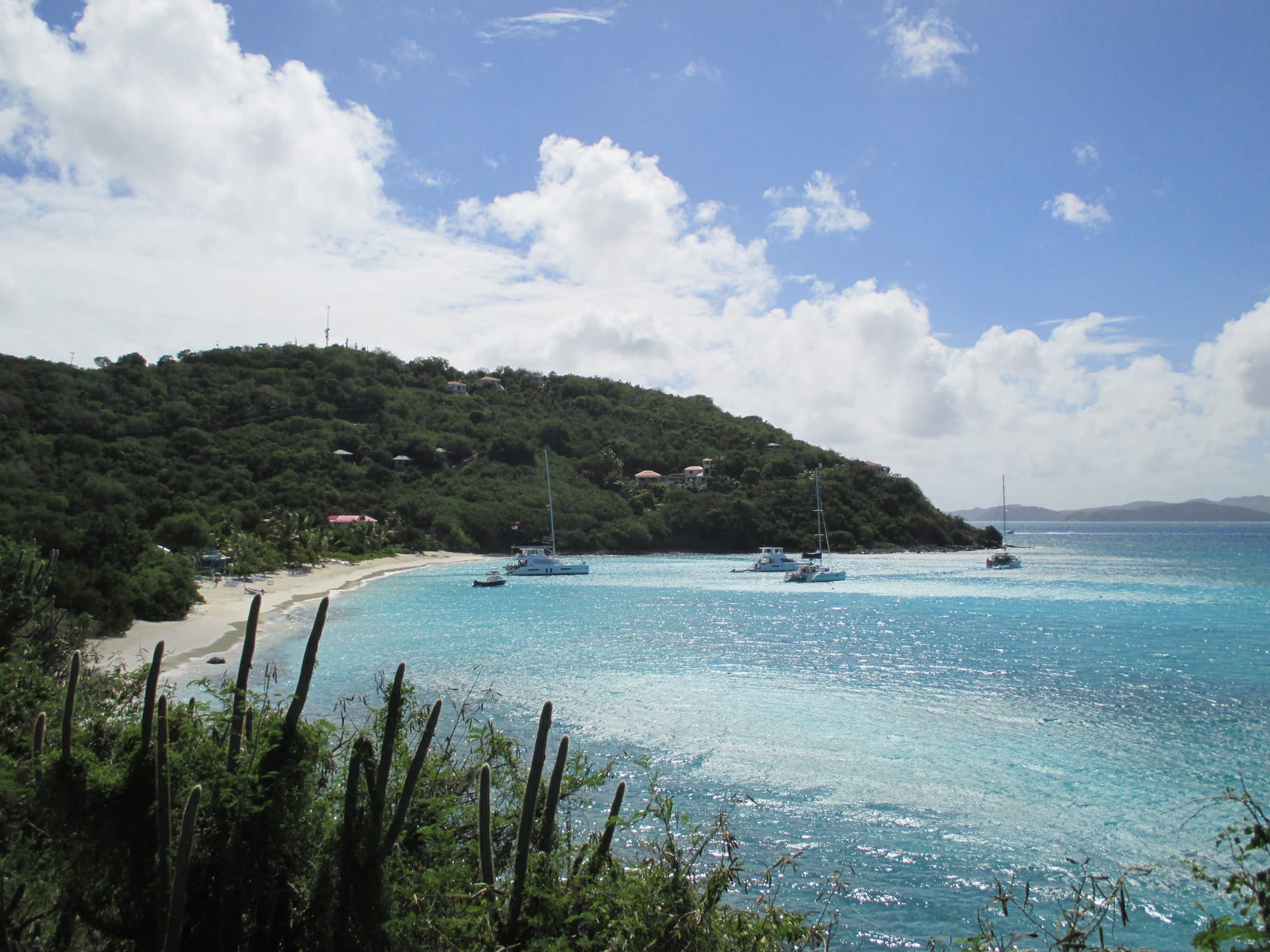
A curving sandy beach below green wooded hills, with catamarans and yachts anchored in turquoise water

British Virgin Islands

Jost Van Dyke

Yachts at anchor off a beach on Jost Van Dyke. (User:Mattes / Wikimedia Commons · CC BY 2.0 de)

The smallest of the four main British Virgin Islands, about 3 square miles of steep volcanic hills some 5 miles north-west of Tortola. A cotton island and then a community of fishers, boat-builders and charcoal makers, it now lives from yachting: its harbours fill with charter boats, and the beach bars of White Bay are where the Painkiller cocktail was created.

Neighbourhoods

  • Great Harbour
    • First-time visitors
    • Close to the ferries
    • Bars and restaurants

    The main settlement, also shown on maps as Belle Vue, with the clinic, police station, customs and the ferry pier on the western side of the bay. A sandy main street runs along the beach, lined with small bars, restaurants and shops, and a reef offshore makes the bay a popular anchorage.

    Open in Maps
  • White Bay
    • Beaches
    • Beach bars

    A bright white beach in the south-west, split in two by the Black Point rocks, 15–20 minutes' walk over the hill from Great Harbour. It is lined with beach bars, busy with day boats from Tortola, St Thomas and St John, and has places to eat, drink and stay.

    Open in Maps
  • Little Harbour and the east end
    • Quiet
    • Sailors' anchorages

    A small bay on Garners Bay in the south-east, with a few restaurants popular with charter crews and moorings for the night. Little Jost Van Dyke lies off the east end, and Diamond Cay and the Bubbly Pool are to the north-east.

    Open in Maps

Things to do

Beaches and walks

  • White Baybeach

    The island's best-known beach, named for its white sand, a popular daytime anchorage and a good place to dive, with beach bars along the shore.

    Open in Maps
  • Great Harbour to White Bay walktrail

    A short walk from the main settlement up over the hill to White Bay, with views across to Tortola and St Thomas.

    Open in Maps
  • Bubbly Poolattraction

    A natural rock pool near Diamond Cay at the north-east end of the island, named for the bubbles that form when waves crash over the rocks; it is at its liveliest when the swell is running.

    Open in Maps
  • Sugar works above Great Harbourlandmark

    The remains of sugar works on the ridge above Great Harbour, evidence that some cane was grown and processed on the island in the plantation era.

    Open in Maps

Short trips from the island

  • Little Jost Van Dykeattraction

    The uninhabited island off the eastern end, home in the 18th century to the Lettsom family and the people they enslaved; boats anchor off its southern end.

    Open in Maps
  • Sandy Caybeach

    A small uninhabited island between Jost Van Dyke and Tortola, owned by the National Parks Trust since 2008, with a beach, a salt pond and a short trail around it — and no bar.

    Open in Maps
  • Sandy Spitbeach

    An islet of less than half an acre, a ring of sand around light foliage, much photographed as the classic desert island; Hurricane Irma took away half its beach in 2017.

    Open in Maps

Eat and drink

Long-standing places and food districts in Jost Van Dyke. Hours, ratings and directions come from your maps app, always current.

Jost Van Dyke classics

  • Soggy Dollar Barrestaurant

    The beach bar at White Bay where the Painkiller — rum, pineapple juice, cream of coconut and orange juice topped with grated nutmeg — was created in the 1970s.

    Open in Maps
  • Foxy'srestaurant

    A bar and restaurant on Great Harbour, known for its barbecue nights, which served as the island's recovery centre after Hurricane Irma.

    Open in Maps
  • Ivan'srestaurant

    A bar and restaurant on White Bay that holds its own barbecue night.

    Open in Maps
  • Harris' Placerestaurant

    A restaurant on Little Harbour known for fresh lobster.

    Open in Maps

Food districts

  • Great Harbour beach stripneighborhood

    The bars and restaurants along the sandy main street of the island's main settlement, where most places are restaurant and bar in one.

    Open in Maps

Experience Jost Van Dyke

History

The island may be named after Joost van Dyk, a 17th-century Dutch settler and former privateer said to have used its harbours as a hideout, though there is no firm evidence for this. The English captured the Virgin Islands in 1672, but Jost Van Dyke was largely ignored until the mid-18th century; a map of 1717 does not show it at all. Sugar works on the ridge above Great Harbour show that some cane was grown and processed, but cotton mattered more: in 1815 about 140 acres were under cotton, and the population of 428 was mostly enslaved. Little Jost Van Dyke, off the east end, was the home of the Lettsom family; John C. Lettsome, founder of the Medical Society of London, is counted among the island's notable people, as is William Thornton, the architect who designed the US Capitol.

After emancipation the population kept growing, reaching about 1,235 by 1853, when a cholera outbreak killed 196 people. Islanders lived by fishing and subsistence farming, worked at the coaling wharves of St Thomas, and made charcoal, which the territory exported to the US Virgin Islands in large quantities between the 1920s and 1960s. Sailing, rowing and boat-building flourished, and locally built "Tortola boats" sailed until motor craft replaced them around the 1960s.

Yachting tourism grew into the mainstay of the economy. In September 2017 Hurricane Irma stripped the hillsides, damaged the school, clinic and petrol stations and destroyed most homes; with little outside help in the first week, residents ran their own recovery from Foxy's on Great Harbour.

Culture & Customs

Jost Van Dyke is known far beyond its size for its beach bars, and the Painkiller cocktail, created in the 1970s at the Soggy Dollar Bar on White Bay, is its signature. The bar scene is part of the island's identity: in 2017 it was Foxy's, with the island's only major surviving refrigerator and generators, that became the command centre for the recovery. The country singer Kenny Chesney filmed a music video on and around the island for his 2002 song "No Shoes, No Shirt, No Problems" and has mentioned it in other songs.

Beneath the visitor trade is an old seafaring culture. The island's people built and sailed their own boats for trade and social contact with neighbouring islands, and the collective making of charcoal pits — where women might bake bread or roast breadfruit in the heat while men played dominoes — still happens occasionally. The Jost Van Dykes Preservation Society, a local organisation, looks after the trail on nearby Sandy Cay for the National Parks Trust.

The community shares the territory's Belonger identity, English-speaking and Christian, and its traditional fungi music of calabash, washboard and ukulele. Life is informal: most places are restaurant and bar in one, and each keeps its own hours.

Daily Life

The 2010 census counted 298 people on Jost Van Dyke, more than double the 140 recorded in 1991, and the population is young: nearly half were under 35. Great Harbour is the main settlement, and paths and roads link it with the island's other bays and beaches.

Tourism, above all yachting, is the economy. Great Harbour is one of the busiest ports in the territory — nearly 7,000 boats cleared through it in 2008 — and day boats, group tours from the US Virgin Islands and small cruise ships visit the island.

Great Harbour holds the island's clinic, police station and customs office. The ferry shapes the day. The island's primary school also teaches the first two years of secondary school; older students travel to Tortola every weekday to attend high school, catching an early ferry and returning in the afternoon. The slow work of rebuilding after Irma, which destroyed most of the island's homes in 2017, has shaped recent years.

Food

Eating on Jost Van Dyke means eating at its bars, nearly all of which are restaurants too. Great Harbour, White Bay and Little Harbour each have their own, and barbecue nights are a fixture at Foxy's on Great Harbour and at Ivan's on White Bay. Lobster is the prize dish: Harris' Place on Little Harbour is known for big, fresh lobsters and unlimited-lobster nights, served with pea soup, homemade pies, bread and hot sauce.

The rest of the menu follows the territory's island cooking: fresh fish and conch, "fish and fungi" — fish with fungi, a cornmeal-and-okra dish rather like polenta — johnnycake, a fried bread, and roti. Historically islanders roasted breadfruit and baked bread in the heat of charcoal pits.

The drink is the Painkiller: rum shaken with four parts pineapple juice, one part cream of coconut and one part orange juice, served over ice under a heap of grated nutmeg. It was created in the 1970s at the Soggy Dollar Bar at White Bay — perhaps by Daphne Henderson, perhaps by George and Marie Myrick, previous owners of the bar.

Planning tools

Budget

There is little on the island to spend money on beyond food, drink and boat rides, but everything arrives by sea and prices reflect it. Many visitors come for the day by ferry or yacht. Water taxis are expensive, and groceries are best bought on Tortola before crossing.

Daily Budget Midrange
USD 400–900 (villa or cottage share, lobster dinners, taxis, a boat trip to the cays)
Daily Budget Shoestring
USD 150–280 (day trip by ferry from Tortola, or camping or a simple cabin, beach-bar meals)

Provision on Tortola before crossing, and agree pick-up times with a taxi driver in advance rather than relying on finding one.

Best Time to Visit

December to April is the dry, breezy peak sailing season, when the anchorages are fullest. May, June and November are quieter shoulder months. The hurricane season runs from June to November, peaking from August to October.

Suggested Number of Days

Most visitors come for a day from Tortola or the US Virgin Islands. A night or two allows for the quieter bays and evenings on the island; three or four days suit those who want to slow down. Ferry times and the weather at sea set the pace.

First Visit
1–2 days
With Surroundings
3–4 days

Transportation

Walking is the easiest way around, on paths and roads between each settlement, bay and beach, though the island is very hilly. Taxis wait at the ferry pier for White Bay but otherwise run erratically, so pick-ups are best arranged in advance. Cars can be hired for exploring beyond the main beaches.

Wear proper shoes on the hill walk to White Bay rather than going barefoot, and drive on the left.

Airport & Station Connections

The island can be reached only by sea, by ferry, water taxi or private boat. The most frequent ferries run from West End on Tortola, about 5 miles away, to the pier at Great Harbour, with several departures a day; some weekend ferries come from Red Hook on St Thomas via Cruz Bay on St John. The nearest airport is Terrance B. Lettsome International on Beef Island, off Tortola's east end.

Walkability

Great Harbour is a single strip along the beach, easily walked, and White Bay is 15–20 minutes away over the hill. Paths link all the settlements and bays, but the hills are steep and the east end and the Bubbly Pool make for a longer, energetic walk or a taxi ride.

Safety

Very safe for visitors. The main risks are at sea: White Bay is a daytime anchorage that may be uncomfortable or unsafe overnight in some conditions, Great Harbour has no moorings, and hurricanes are a risk from June to November. Petty theft from dinghies is the usual concern on land.

Secure dinghies and valuables, check anchorage conditions before staying overnight, and take out insurance that covers medical evacuation. Check current official travel advice before travelling.

Climate

Tropical and relatively dry, cooled by the trade winds, with temperatures across the islands around 81–88°F all year. September to November is the wettest stretch, and the hurricane season runs from June to November.

Summer
warm to hot across the islands, in the 81–88°F range, with the hurricane season under way
Winter
dry and breezy from December to April, with temperatures across the islands still in the 81–88°F range

Local Customs

A tiny, close-knit community lives alongside a constant flow of yacht crews and day visitors. Restaurants and bars keep their own hours, more or less at the owner's whim. Smoking is taboo in businesses and public areas across the territory.

Respect the residents' privacy away from the bars, keep beachwear for the beach, and expect island time.

Common Payment Methods

The currency is the US dollar. Cards are accepted at larger restaurants, but cash is needed for ferries, taxis and beach bars, and it is wise to bring enough from Tortola.