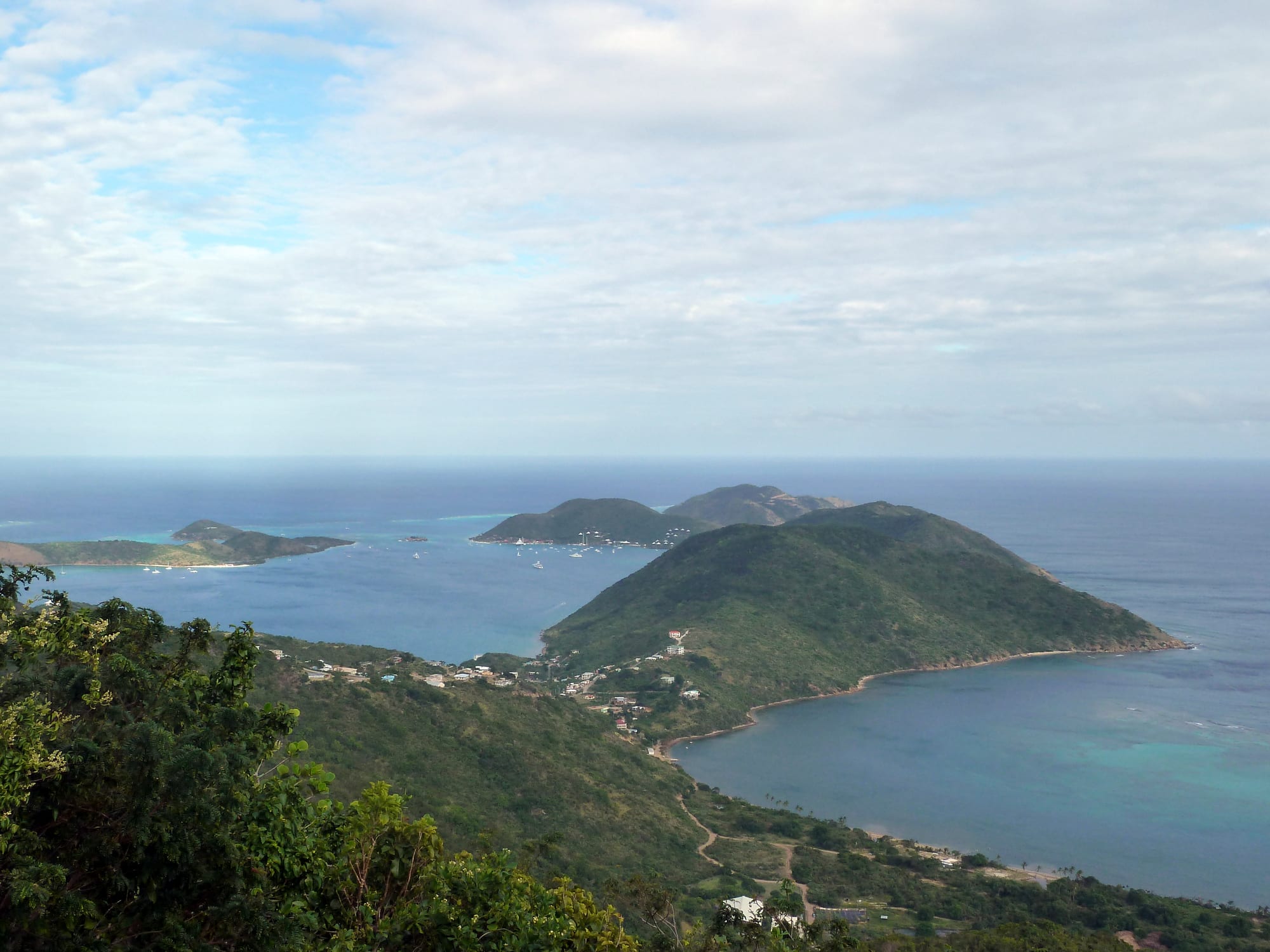
Green hills and a curving bay seen from above, with islands and anchored yachts in the blue waters of North Sound beyond

British Virgin Islands

Virgin Gorda

The view over North Sound from a hillside overlook on Virgin Gorda. (Gruepig / Wikimedia Commons · CC BY-SA 4.0)

The third-largest and second most populous island of the British Virgin Islands, about 8 square miles of hills and bays east of Tortola. Columbus is said to have named it the 'fat virgin' for its profile. Copper once drew miners from Cornwall; today The Baths, a shore of granite boulders and sea grottoes, and the sheltered waters of North Sound draw sailors and day visitors.

Neighbourhoods

  • Spanish Town and The Valley
    • First-time visitors
    • Close to the ferries
    • Shops and services

    The low, gently hilly south-west of the island, where most people live and most businesses and services are found. Spanish Town, the second-largest town in the territory, is small and relaxed, built around its yacht harbour marina, with the airport and ferries close by.

    Open in Maps
  • The boulder coast
    • Beaches
    • Snorkelling

    South of Spanish Town the shore is strewn with granite boulders the size of houses, which separate a string of small beaches with light surf and clear water. The Baths, Devil's Bay and Spring Bay are here, along Tower Road, with villas facing some of the beaches.

    Open in Maps
  • North Sound
    • Sailing and watersports
    • Quiet and remote

    A large natural harbour at the north-east end of the island, enclosed by four islands and their reefs, with more than 3,000 acres of calm, protected water. Its small waterside communities are reached by steep roads or, in places, only by ferry from Gun Creek.

    Open in Maps
  • Savannah Bay and the north-west shore
    • Beaches
    • Quiet and residential

    North of Spanish Town, the road runs past long, often empty beaches such as Savannah Bay, Pond Bay and Mahoe Bay.

    Open in Maps

Things to do

The Baths and the southern beaches

  • The Bathsbeach

    A beach about 1.2 miles south of Spanish Town where eroded granite boulders, the largest about 40 feet long, form tidal pools, tunnels, arches and grottoes open to the sea; a national park since 1990.

    Open in Maps
  • Devil's Baybeach

    A small beach next to The Baths, reached by a trail through the pools and caves of the boulder field or by a path from the car park at the end of Tower Road.

    Open in Maps
  • Spring Baybeach

    A beach with boulder scenery to rival The Baths but almost never crowded, with good snorkelling around the rocks at The Crawl.

    Open in Maps
  • Savannah Baybeach

    A long sweep of sand north of Spanish Town that may have a few people on it or none at all.

    Open in Maps

History and the hills

  • Copper Mine National Parklandmark

    The ruins of a mine sunk in 1838 and worked by Cornish miners and local labourers until 1862 — the stack, engine house and main building on a hurricane-exposed site at the south-east end of the island.

    Open in Maps
  • Gorda Peaktrail

    A peak reached by walking trails from North Sound Road, with an observation tower that looks over the whole island.

    Open in Maps
  • Nail Bay sugar mill ruinslandmark

    The remains of a sugar mill near Nail Bay, a short stop on the way along the north-west shore.

    Open in Maps

Short trips from the island

  • Fallen Jerusalem Islandattraction

    An uninhabited island south of Virgin Gorda, named for the huge boulders scattered over it like a ruined city, declared a wildlife sanctuary in 1959.

    Open in Maps

Seasonal events

  • Virgin Gorda Easter FestivalEaster weekend

    The island's own festival, held every Easter weekend; the week before Easter is one of the busiest of the year.

  • August FestivalEarly August

    The territory's emancipation carnival, held over three days from the first Monday in August to mark the end of slavery on 1 August 1834.

Eat and drink

Long-standing places and food districts in Virgin Gorda. Hours, ratings and directions come from your maps app, always current.

Food districts and markets

  • Virgin Gorda Yacht Harbourneighborhood

    The marina complex in Spanish Town, with a sailors' bar that has local entertainment most nights, places to eat and the island's main shops.

    Open in Maps
  • Buck's Food Marketmarket

    The supermarket at the Yacht Harbour where crews and villa guests stock up on food and drink.

    Open in Maps
  • Hog Heavenrestaurant

    A restaurant on the steep road above Leverick Bay, perched on a hill with a view over the water.

    Open in Maps
  • North Sound waterfrontneighborhood

    Waterside bars and restaurants around the sound, many reached by boat, where sailors come ashore for dinner.

    Open in Maps

Experience Virgin Gorda

History

The island's earliest known settlers were Taíno, or Arawak, people who arrived from South America between about 100 and 300 CE, and traces of their settlements have been found in Spanish Town. In the 15th century they were displaced by the Caribs. Christopher Columbus sighted the island in 1493 on his second voyage and, the story goes, called it Virgen Gorda, the "fat virgin", because its profile on the horizon resembled a woman lying on her side. Spain claimed it but never settled it, while English seamen used North Sound as a strategic anchorage: John Hawkins visited in the 1560s with a young Francis Drake aboard, Drake anchored there in 1585, and in 1595 twenty-six ships gathered in the sound before their attack on San Juan.

In 1631 the Dutch West India Company funded a settlement on the island, led by Joost van Dyk, to mine copper. The island came under British control, and its old name, Paneston or Peniston, was a corruption of "Spanish Town". Mining returned in the 19th century: the Copper Mine was built in 1837, its first shaft sunk in 1838, and over two periods 36 Cornish miners and about 140 local workmen dug ore that went by road to Spanish Town and then by ship to Wales. The mine was abandoned in 1862 and never reopened, and some of the miners' descendants still live in the islands.

In the 20th century the island turned to tourism and sailing, with marina services at Spanish Town and the sheltered waters of North Sound at the centre of it. Hurricane Irma devastated the territory in September 2017.

Culture & Customs

Virgin Gorda shares the territory's Belonger identity — English-speaking, Christian and descended from enslaved Africans and post-emancipation smallholders — in a smaller, quieter form than Tortola. Its own church, St Ursula's in The Valley, carries the name of the saint after whom Columbus named the whole archipelago. The island's main celebration is the Easter Festival, held every Easter weekend, and islanders join the territory-wide August Festival that marks emancipation in 1834.

The traditional music is fungi, played by "scratch bands" on calabash, washboard, bongos and ukulele as well as guitars, banjo and saxophone, with songs that often carry humorous social commentary and island history.

Life here is shaped by the water. North Sound, enclosed by islands and reefs, is one of the great watersports harbours of the Caribbean, and moorings and marinas draw yacht crews and charter guests. Visitors are welcome on every beach, all of which are public, but villa owners' privacy is expected to be respected, and the island's pace is slow and its manners conservative.

Daily Life

Virgin Gorda is the second most populous island in the territory after Tortola, though its population is small. Most residents live in the Valley in the south-west, in and around Spanish Town, where the businesses, shops and services are; the north and east are thinly settled apart from small communities around North Sound. Children attend Robinson O'Neal Memorial Primary School or the Bregado Flax Educational Centre, a combined primary and secondary school opened in 1982.

Tourism is the island's living: visitors arrive by ferry and boat for The Baths, yachts fill the moorings and the Yacht Harbour, and villas line the hills and beaches. The airport takes only small aircraft, in daylight, so most visitors come by sea. The airport was restricted to a short list of airlines in January 2010 by the territory's aviation regulator until it was brought up to international safety standards, reopening that December.

Daily life follows the ferry timetable and the tourist season, busiest from December to April and around Easter. Like the rest of the territory, the island spent years recovering from the damage of Hurricane Irma in 2017.

Food

The island eats like the rest of the territory, with the sea at the centre of the plate. Fresh fish and conch, "fish and fungi" — fish with fungi, a cornmeal-and-okra dish rather like polenta — callaloo, salt-fish pates and johnnycake, a fried bread, are the everyday classics, and roti, a flatbread wrapped around curry, is a popular lunch. Lobster, much of it from Anegada to the north, is the special-occasion dish, and some restaurants hold buffet nights built around it.

The Yacht Harbour in Spanish Town is the hub of eating and drinking for both residents and sailors, with a bar that has local entertainment most nights, and a supermarket and a wholesale market on Tower Road supply villa kitchens and yacht galleys. Around North Sound, waterside bars and restaurants serve crews who come ashore by dinghy, and on the hill above Leverick Bay a restaurant looks out over the water.

Rum is the drink. The Painkiller — rum with pineapple juice, orange juice and cream of coconut, dusted with nutmeg — was created in the 1970s on nearby Jost Van Dyke.

Planning tools

Budget

Virgin Gorda is pitched at the upper end of an expensive territory: villas and waterfront stays dominate, and eating out is costly. Groceries from the Spanish Town supermarkets, the safari buses and a day trip by ferry from Tortola keep costs down.

Daily Budget Midrange
USD 400–900 (villa share or small hotel, restaurant meals, taxis or a hired jeep, a boat trip)
Daily Budget Shoestring
USD 150–280 (day trip by ferry from Tortola, or a modest room, self-catering, safari buses)

Base on Tortola and come over by ferry for the day, or self-cater from the Spanish Town supermarkets on a longer stay.

Best Time to Visit

December to April is the dry, breezy peak season, with the highest rates and the busiest beaches; the week before Easter is especially popular because of the Easter Festival. May, June and November are good-value shoulder months. The hurricane season runs from June to November, peaking from August to October.

Suggested Number of Days

The island can be seen on a day trip from Tortola. A night or two gives time for the quieter beaches and the hills; four or five days suit a slower stay with time on the water. Ferry timetables and sea conditions decide much of the planning.

First Visit
1–2 days
With Surroundings
4–5 days

Transportation

Open-sided safari buses, shared taxis with room for about 22 people, run along the main road, and taxis are readily available. Jeeps can be hired in Spanish Town, where petrol stations stand at each end of town. The roads to Leverick Bay and Gun Creek are very steep, and some places on North Sound can be reached only by ferry from Gun Creek.

Drive on the left, take the steep hill roads slowly, and agree taxi fares before setting off.

Airport & Station Connections

Virgin Gorda is a few miles east of Tortola. Ferries run daily between Road Town and The Valley, and boats from Beef Island, near Tortola's main airport, serve Spanish Town and North Sound with several departures a day; there are a few direct sailings from St Thomas. Virgin Gorda Airport takes small planes from a short list of approved airlines, including flights from San Juan, and operates only in daylight. Many visitors arrive by yacht.

Walkability

Spanish Town is small and walkable around the Yacht Harbour, and The Baths lie about 1.2 miles south of town along Tower Road. Beyond the Valley the island is hilly and the roads are steep, so the north-west beaches, Gorda Peak and North Sound need a taxi, a safari bus or a hired jeep.

Safety

Very safe for visitors. Petty theft from dinghies, cars and villas is the main issue. Strong currents occur at some Atlantic-facing beaches, and hurricanes are a risk from June to November.

Secure the dinghy and valuables, respect current warnings at the beaches, and take out insurance that covers medical evacuation. Check current official travel advice before travelling.

Climate

Tropical and relatively dry, cooled by the trade winds, with temperatures across the islands around 81–88°F all year. September to November is the wettest stretch, and the hurricane season runs from June to November.

Summer
warm to hot across the islands, in the 81–88°F range, with the hurricane season under way
Winter
dry and breezy from December to April, with temperatures across the islands still in the 81–88°F range

Local Customs

The island community is small, English-speaking, Christian and conservative. All beaches are public, but some face private villas whose privacy should be respected. Smoking is taboo in businesses and public areas across the territory.

Keep beachwear for the beach, respect villa boundaries behind the beaches, and drive on the left.

Common Payment Methods

The currency is the US dollar. Cards are accepted at hotels and larger restaurants; cash is needed for ferries, taxis, safari buses and beach bars.