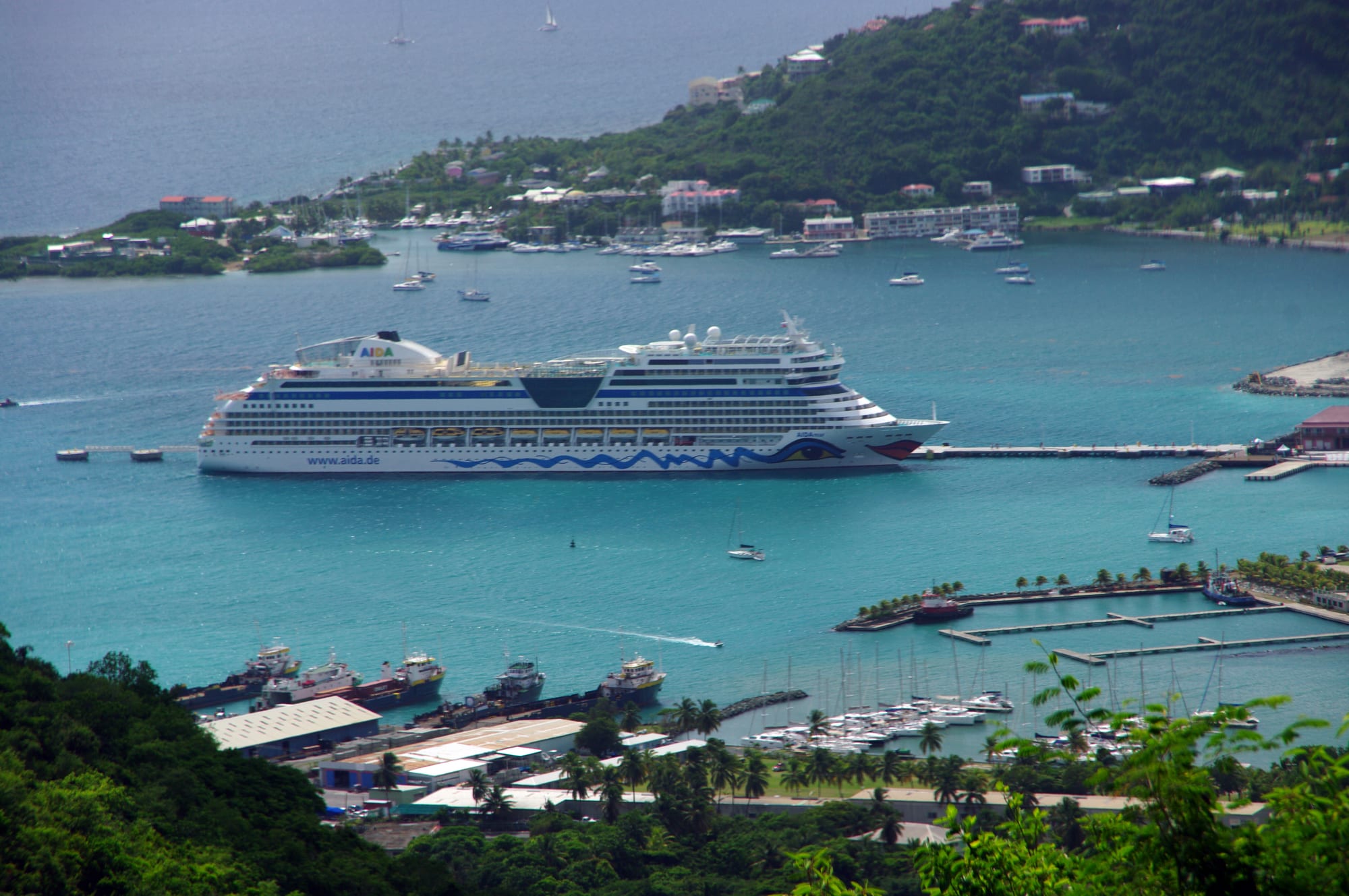
A large white cruise ship moored at a pier in turquoise Road Harbour, with marinas and green hills beyond

British Virgin Islands

Road Town

Road Harbour seen from the Ridge Road above Road Town, with a cruise ship at the pier. (Balou46 / Wikimedia Commons · CC BY-SA 4.0)

The capital and largest town of the British Virgin Islands, on the horseshoe-shaped Road Harbour in the middle of Tortola's south coast. A small colonial port of forts, a prison and a market street, it grew on land reclaimed from the sea into one of the Caribbean's main yacht-charter bases and the administrative and business centre of an offshore-finance territory.

Neighbourhoods

  • Main Street and the old town
    • First-time visitors
    • Historic district

    The narrow street behind the waterfront, with the 18th-century prison, small shops, a bakery and a roti house. It is the part of Road Town that still feels like a West Indian market town.

    Open in Maps
  • Wickhams Cay
    • Close to the ferries
    • Shopping
    • Marinas

    Two former islands in Road Harbour joined to the town by land reclamation, now the newest part of the capital and the hub of its commercial and government buildings. Its marina helped Road Town become a yacht-charter centre, and the ferry terminal sits at the north-west end of town.

    Open in Maps
  • Road Reef and the western harbour
    • Marinas
    • Harbour views

    The south-western edge of town around Road Reef and its marina, below Fort Burt, which traditionally marked the western limit of Road Town.

    Open in Maps
  • Port Purcell and Baughers Bay
    • Quiet and residential
    • Local life

    The eastern side of the harbour beyond the Port Purcell roundabout, below the hill where Fort George once guarded the town. Whether Baughers Bay counts as Road Town is a matter of local debate.

    Open in Maps

Things to do

Historic Road Town

  • HM Prison, Main Streetlandmark

    The oldest building in Road Town, built in 1774, on Main Street.

    Open in Maps
  • Old Government House Museummuseum

    The former residence of the territory's governors, on a site first built on in 1889, turned into a museum after a new residence went up next door in 2003.

    Open in Maps
  • Folk History Museummuseum

    A small folk history museum on Main Street.

    Open in Maps
  • Fort Charlottelandmark

    The ruins of a fort named after Queen Charlotte, high on Harrigan's Hill above the town, the uppermost of the defences that once ringed Road Harbour, with views over the water.

    Open in Maps
  • Joseph Reynold O'Neal Botanic Gardenspark

    The town's botanic garden, with a wide representation of the islands' vegetation and shade from the sun.

    Open in Maps

Beaches over the ridge

  • Cane Garden Baybeach

    The most popular and busiest beach on Tortola's north shore, with beach bars, chair-rental vendors and a supermarket close by; it fills up when cruise ships are in.

    Open in Maps
  • Brewer's Baybeach

    The only beach on the island without white sand, quieter than its neighbours and known for snorkelling straight off the shore.

    Open in Maps
  • Josiah's Baybeach

    A good-sized beach popular with surfers and local people, with heavy surf in season and a strong undertow at its corners.

    Open in Maps
  • Smuggler's Covebeach

    A beach at the far western tip of Tortola, difficult to reach.

    Open in Maps
  • Long Bay, Beef Islandbeach

    A long curved beach a few minutes from the airport, one of the more secluded and little-used on the island.

    Open in Maps

Hills and heritage on Tortola

  • Sage Mountain National Parkpark

    A protected area of semi-rain forest on the slopes of Mount Sage, the highest peak in the Virgin Islands, south-west of Road Town, with walking trails that are cooler than the coast.

    Open in Maps
  • Callwood Rum Distilleryattraction

    A historic rum maker at Cane Garden Bay.

    Open in Maps

Short trips from the town

  • Salt Islandattraction

    An almost uninhabited island south-east of Road Town, named after its salt ponds, whose tiny population pays the Crown a symbolic annual rent of a pound of salt.

    Open in Maps
  • Wreck of the RMS Rhoneattraction

    A Royal Mail steamer wrecked off Salt Island in a hurricane in 1867 with the loss of 123 lives, now one of the best-known wreck dives in the Caribbean.

    Open in Maps
  • Norman Islandattraction

    An island at the southern tip of the archipelago, one of several reputed to have inspired Treasure Island, visited by boat for its sea caves and snorkelling.

    Open in Maps

Seasonal events

  • BVI Spring Regatta and Sailing FestivalSpring, usually early April

    A week-long series of yacht races first held in 1972 and billed as the Caribbean's premier sailing event — part race, part party, part festival.

  • August FestivalEarly August

    The territory's emancipation carnival, held over three days from the first Monday in August to mark the end of slavery on 1 August 1834.

Eat and drink

Long-standing places and food districts in Road Town. Hours, ratings and directions come from your maps app, always current.

Road Town classics

  • Roti Palacerestaurant

    A Main Street eatery serving roti, the flatbread wrapped around curries that range from vegetables to goat.

    Open in Maps
  • Road Town Bakerycafe

    A bakery on Main Street known for its sandwiches and pastries.

    Open in Maps
  • Crandall'srestaurant

    A roadside stop on the main road west of town, known for johnnycakes and patties.

    Open in Maps

Food districts and bars

  • Main Street and the waterfrontneighborhood

    The old street and the harbour front hold many of the capital's cafés, bars and casual restaurants, from roti houses to waterfront bars.

    Open in Maps
  • Cane Garden Bay beach barsneighborhood

    The bars and grills along Tortola's busiest beach, over the ridge from town, serving burgers, chicken and lobster, some right on the beach.

    Open in Maps

Experience Road Town

History

The town takes its name from a sailors' term: "the roads" is an anchorage less sheltered than a harbour but easy for ships to reach, and the horseshoe of Road Harbour in the middle of Tortola's south coast gave the colony its port. Dutch settlers are thought to have fortified the shore first; the English, who took Tortola in 1672, rebuilt the defences at the outbreak of the American War of Independence. By the late 18th century a ring of forts guarded the town — Fort Burt to the south-west, Fort George above Baughers Bay to the north-east, a fort in the town itself and Fort Charlotte high on Harrigan's Hill. Fort Burt never fired a shot in anger under British command. The prison on Main Street, built in 1774, is the oldest building still standing.

On 1 August 1834 the Slavery Abolition Act was read aloud at the Sunday Morning Well in Road Town. Freedom did not bring prosperity: in 1853 rioters protesting against an increase in the cattle tax set a fire that destroyed nearly every building in the town, and went on to burn most of the plantations on the island.

Much of the modern town stands on reclaimed land. Wickhams Cay and Little Wickhams Cay, two islands in the harbour, were joined to the shore by land reclamation; the long leases granted to a British businessman caused protests led by Noel Lloyd, and the British government cancelled them and paid compensation. The reclaimed land became the commercial and government centre and the base of the charter-yacht fleet. In September 2017 Hurricane Irma, the most intense storm ever to hit the territory, devastated Road Town along with the rest of Tortola.

Culture & Customs

As the capital, Road Town is where the territory's long-settled families and its newcomers meet. Only 37 per cent of the territory's people were born in it, and many workers come from elsewhere in the eastern Caribbean. Belonger identity — English-speaking, Christian and descended from the enslaved Africans and post-emancipation smallholders — remains strong, and Methodism runs deep.

The traditional music is fungi, named after the cornmeal dish. Its "scratch bands" play calabash, washboard, bongos and ukulele alongside keyboards, banjo, guitar and saxophone, and the songs often carry humorous social commentary and pieces of island oral history. It is heard above all at the August Festival, the emancipation carnival held over three days from the first Monday in August, which recalls the reading of the abolition act in the town in 1834.

The sea shapes the rest of the calendar. Boat-building and sloop racing are part of the heritage, and since 1972 the Spring Regatta has brought a week of races, parties and crowds to the harbour each spring. It remains a small, conservative community, and smoking in businesses and public places is taboo.

Daily Life

About 15,000 people lived in Road Town in 2018, by far the largest settlement in the territory. Its boundaries are a matter of local debate: whether the town begins at Road Reef or at the sign at the foot of Slaney Hill to the west, and whether Baughers Bay to the east counts, depends on whom one asks.

The capital runs on two industries. Financial services — the registration and administration of the hundreds of thousands of companies incorporated in the BVI — fill the office buildings of Wickhams Cay and provide the bulk of government revenue. Tourism fills the marinas: Road Town is one of the principal bareboat-chartering centres in the Caribbean, ferries leave the harbour all day for the other islands and St Thomas, and cruise ships regularly tie up at the pier, bringing business that matters to the island's large and politically important taxi-driving community.

Life is car-dependent and tied to the ferry timetable, and the long recovery from Irma, which flattened much of the territory's building stock in 2017, still shows. Politics have been turbulent: in 2022, after the elected premier was arrested in the United States on drug-trafficking charges, a UK-appointed commission of inquiry recommended suspending the constitution; London held off pending governance reforms, and elected government has continued.

Food

Road Town eats like the rest of the territory, only with more choice. The local table is Caribbean and centred on the sea: conch, fresh fish, and "fish and fungi", fish served with fungi, a polenta-like dish of cornmeal and okra. Callaloo, a soup of leafy greens, salt-fish pates — fried pastries filled with salt cod — and johnnycake, a fried bread, are everyday food, and roadside stops west of town sell johnnycakes and patties.

Roti is a Road Town staple: a soft flatbread wrapped around curried vegetables, chicken or goat, sold from small places on Main Street. Bakeries supply sandwiches and pastries, and the big supermarkets stock everything a charter crew needs before setting sail. Much of the territory's fresh fish and lobster comes from Anegada, to the north.

Rum is the local spirit. At Cane Garden Bay over the hill, a historic distillery makes it, and the town's bars pour the Painkiller — rum with pineapple juice, orange juice and cream of coconut, dusted with nutmeg — which was created in the 1970s on Jost Van Dyke. Bars stay open late at weekends, and the waterfront is where the expatriate workers, yacht crews and visitors meet after dark.

Planning tools

Budget

Road Town is the cheapest base in an expensive territory. Tortola has guesthouses and small hotels as well as villas, the capital has supermarkets for self-catering, and the safari buses cost less than a taxi alone. Day sails, dive trips and boat outings to the other islands are the main extra costs, and a yacht charter is a different order of spending.

Daily Budget Midrange
USD 400–900 (small hotel or villa share, restaurant dinners, a day sail or dive trip, taxis)
Daily Budget Shoestring
USD 150–280 (guesthouse room, roti and bakery lunches, supermarket shopping, safari buses and ferries)

Share taxis to the beaches, confirm the fare before getting in, and stock up at the Road Town supermarkets before heading to the smaller islands.

Best Time to Visit

December to April is the dry, breezy peak sailing season, when prices are highest and the Spring Regatta fills the harbour. May, June and November are good-value shoulder months. August brings the emancipation festival, but the hurricane season runs from June to November, peaking from August to October.

Suggested Number of Days

Two or three days cover the town itself and a beach or two over the hill. Five to seven days allow for day sails and ferry trips to the other islands. Ferry timetables and the weather at sea are what usually stretch the number.

First Visit
2–3 days
With Surroundings
5–7 days

Transportation

Road Town has no public transport in the city sense. 'Buses' on Tortola are passenger vans or open-air pick-up trucks with bench seats and a canvas top, known as safaris, and they run from town to either end of the island. Taxis are plentiful and their fares are regulated and published by the tourist board. Many visitors hire a car; driving is on the left. Ferries from the harbour link Road Town with the other islands.

Agree the taxi fare before setting off, and check ferry timetables in advance, as sailings are rare at night and thin out on Sundays and holidays.

Airport & Station Connections

Terrance B. Lettsome International Airport, the territory's main airport, is on Beef Island, joined to the east end of Tortola by the Queen Elizabeth II Bridge and a short drive from Road Town; it handles regional flights, and American Airlines began nonstop regional-jet flights to Miami in 2023. Many travellers fly long-haul into St Thomas in the US Virgin Islands and take a ferry from Charlotte Amalie to Road Town or Tortola's West End. The ferry terminal is at the north-west end of town, and cruise ships dock at a pier near the entrance to the inner harbour.

Walkability

The centre is small: Main Street, the waterfront, the marinas and the ferry terminal can all be covered on foot, and the cruise pier is an easy walk from town. Beyond the harbour, roads climb steeply over the hills, often without pavements, and the beaches, the national park and the forts on the heights need a taxi, a safari bus or a car.

Safety

Very safe for visitors. Crime is fairly uncommon on Tortola; the main problem is petty theft from cars, villas and dinghies, and there have been a number of dinghy thefts at Cane Garden Bay. Some north-shore beaches have heavy surf and undertow, and hurricanes are a risk from June to November.

Lock up dinghies and cars, leave valuables out of sight, ask locally or read the signs before swimming at surf beaches, and take out insurance that covers medical evacuation. Check current official travel advice before travelling.

Climate

A tropical climate moderated by the trade winds, with little change in temperature through the year. Rainfall averages about 49 inches a year, more in the hills than on the coast; September to November are the wettest months and February and March the driest. The hurricane season runs from June to November.

Summer
hot — typical daily highs around 90°F and lows around 75°F
Winter
warm and breezy — typical daily highs around 84°F and lows around 70°F

Local Customs

The community is English-speaking, Christian and conservative, with Methodism running deep, and islanders are keen to distinguish themselves from the US Virgin Islands next door. Smoking is taboo in every business and public area, and cigarettes are kept in locked cabinets in the supermarkets. Bars stay open late at weekends, and it is acceptable to walk out of a bar with a beer.

Keep beachwear for the beach in a conservative community, and remember that driving is on the left despite the US cars and the US dollar.

Common Payment Methods

The currency is the US dollar. Cards are accepted at hotels and larger restaurants, but cash is needed for ferries, taxis, safari buses and beach bars, so it is worth carrying some.