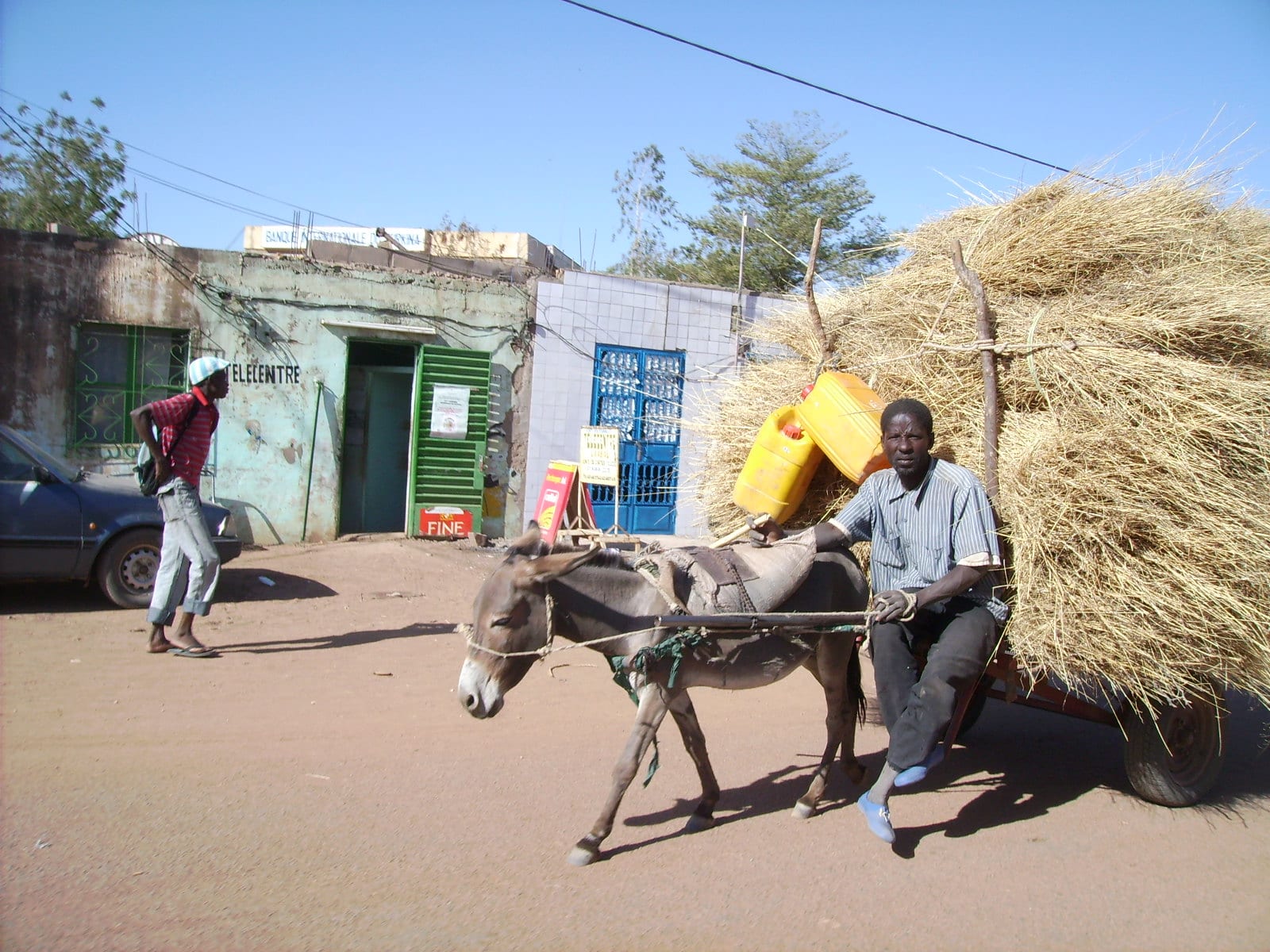
A donkey cart loaded high with straw passing low concrete shopfronts on a sandy street in Dori

Ouahigouya & the Sahel North, Burkina Faso

Dori

A donkey cart carrying fodder through the streets of Dori, in the Sahel region of Burkina Faso. (Baliola / Wikimedia Commons · CC BY 3.0)

The chief town of Burkina Faso's Sahel region, in the dry north-east near the border with Niger. Capital of the nineteenth-century Fulani emirate of Liptako, it has long lived from herds, a large livestock market and leatherwork, and now shelters many thousands of people displaced by the insurgency. This page is written to explain the city, not to encourage travel.

Neighbourhoods

  • The market quarter
    • First-time visitors
    • Markets
    • Local life

    The centre of Dori is the trading ground and the streets of shops, grain stores and transport yards around it. Leatherworkers, tailors and smiths keep workshops close by, and the administrative offices of the Sahel region and Séno province are a short walk away.

    Open in Maps
  • The old town and the mosques
    • Historic district
    • Quiet and residential

    The older quarters, associated with the families of the former emirate of Liptako, are a maze of sand lanes between walled compounds, small mosques and Quranic schools. Life here is domestic, and the streets are quiet outside prayer times.

    Open in Maps
  • The livestock ground and the outskirts
    • Local trade
    • Countryside

    On the edge of town the built-up area gives way to the stock market, water points and open ground where herds are held, and then to thorn scrub. Settlements of displaced families have grown along these fringes in recent years.

    Open in Maps

Things to do

In the town

  • Dori livestock marketmarket

    One of the main stock markets of the Sahel, where cattle, sheep, goats and camels are traded by herders and by buyers from the south and from neighbouring countries.

    Open in Maps
  • The leatherworkers' workshopsattraction

    Dori has long been known for tanning and leatherwork, with bags, sandals, cushions and harness made and sold around the market.

    Open in Maps
  • The Grand Mosquelandmark

    The main mosque of a strongly Muslim town whose religious life was shaped by the Liptako emirate.

    Open in Maps

Short trips from the town

  • Gorom-Gorommarket

    A Sahel market town whose weekly market, the largest in the country, drew Fulani, Tuareg, Bella and Songhai traders with livestock, grain, pottery, jewellery and salt.

    Open in Maps
  • Mare d'Oursi and the dunesattraction

    A small, shallow lake beside sand dunes, listed as a Ramsar wetland of international importance, that draws herders and large numbers of birds.

    Open in Maps

Eat and drink

Long-standing places and food districts in Dori. Hours, ratings and directions come from your maps app, always current.

Dori classics

  • Tô with Sahel saucesrestaurant

    Millet tô, a stiff porridge eaten with the hand, served with sauces of okra, baobab leaf or dried fish and seasoned with soumbala made from fermented néré seeds.

    Open in Maps
  • Grilled mutton and goatrestaurant

    Meat matters more here than in the south; sheep and goat are grilled over charcoal at stalls that open in the late afternoon near the market.

    Open in Maps

Markets and street food

  • Dori market food stallsmarket

    Cooked-food sellers offer rice with sauce, beans, beignets and dégué, millet grains stirred into sour milk, alongside dates and baobab fruit in season.

    Open in Maps
  • Milk, tea and kilishi sellersmarket

    Fulani women sell fresh and curdled milk from calabashes, tea stalls pour sweet green tea in several rounds, and kilishi, the dried spiced meat of the Hausa country to the east, is sold by the packet.

    Open in Maps

Experience Dori

History

Dori belongs to the Sahel rather than to the Mossi plateau, and its story is one of herders, traders and Islamic scholarship. The country around it, known as Liptako, lay on the routes between the Niger bend and the savanna to the south, and was inhabited by Fulani pastoralists, Tuareg and their former dependants the Bella, Songhai cultivators and Gurmanche communities.

In the early nineteenth century, in the wave of Islamic reform movements that reshaped the western Sahel, the Fulani of Liptako founded an emirate with its capital at Dori. The town became a seat of Muslim learning, a centre of authority over surrounding herding grounds and a market where livestock, salt, grain and craftwork were exchanged. Its leatherworkers and its stock trade date from that period.

French forces reached the area at the end of the nineteenth century, and Liptako was absorbed first into the colonies of the Niger and then into Upper Volta, with the emirate's titles retained in a reduced form. Under the republic Dori became the administrative capital of the Sahel region and of Séno province. The great droughts of the 1970s and 1980s destroyed herds and drove families into the town permanently. Since around 2015 the insurgency that began in this region has cut Dori off from much of its hinterland, closed rural markets, schools and clinics, and turned the town into a refuge for tens of thousands of displaced people from the surrounding Sahel.

Culture & Customs

Dori is a Fulani town above all, and Fulfulde is the language of the market and the street, alongside Songhai, Tamasheq, Mooré and the French of the offices. Islam is practised almost universally and has deep roots here: the emirate made the town a centre of Quranic teaching, and the rhythm of the day still follows the calls to prayer.

Pastoral values shape manners. Wealth is counted in animals, hospitality is offered before business, and a guest is given water, milk or green tea poured from a height in several small rounds. Reserve, restraint and careful greetings are admired, and questions about family, herds and the rains come before anything else. Tuareg and Bella families contribute their own crafts — silverwork, leather-covered boxes, mats and rope — and Songhai and Gurmanche communities farm alongside the herders.

Craft is the town's visible culture. Tanning and leatherwork have been made here for generations, in bags, sandals, cushions, sheaths and harness worked with geometric patterns, sold at the market and once carried south by traders. Music and praise-singing accompany naming ceremonies and weddings, and the Muslim festivals, above all Tabaski, are the great occasions of the year. The long conflict has thinned much of this public life, and the arrival of displaced families from many different communities has reshaped the town's social mix.

Daily Life

The 2019 census recorded about 46,500 people in Dori, though the number actually living in and around the town has risen far above that with the arrival of families displaced from the countryside. It is a low, sandy town of walled compounds, corrugated roofs and wide open trading grounds, the administrative centre of the Sahel region and the base for its schools, hospital and government offices.

Livestock is the economy. Cattle, sheep, goats and camels come in from the grazing lands to be sold to traders from the south and from Niger, Benin and Ghana; hides feed the tanners, milk is sold daily in calabashes, and millet, cowpeas and sorghum are grown where the rains allow. Gold mining, both industrial and artisanal, grew across the region in the 2010s. Small trade, transport and public employment account for most of the rest.

The conflict dominates everything. Roads out of town are dangerous or closed, some supplies have arrived by convoy or by air, herders have lost access to pasture and wells, and many rural schools and clinics have shut, concentrating their populations in the town. Aid agencies are a large presence. Where life continues it is organised around the market, the mosque, the water points and the movement of animals, with the year turning on the single short rainy season.

Food

Sahel food is built on millet and milk. Tô, a stiff millet porridge, is the daily dish, eaten with sauces of okra, baobab leaf, sorrel or dried fish and seasoned with soumbala, the pungent condiment made from fermented néré seeds. Dégué mixes cooked millet grains with sour milk or yoghurt and sugar, and is sold cold in the market; zoom-koom, a millet-flour drink flavoured with tamarind or ginger, is the common refreshment in the heat.

Milk is central in a herding town. It is drunk fresh or curdled, churned into butter, and sold in calabashes by Fulani women at the market. Meat is more important here than in the south of the country: mutton and goat are grilled over charcoal, and kilishi, thin strips of meat dried and spiced so that they keep in the heat, is a Hausa speciality from northern Nigeria and southern Niger, traded across the Sahel. At Tabaski a sheep is slaughtered in every household able to afford one.

Rice with sauce and riz gras, rice cooked in a tomato and meat sauce, are the standard cooked meals bought away from home, with beans and fried dough beignets at the stalls. Dates, baobab fruit and groundnuts fill out the market. In this Muslim town the drinks are green tea poured in several rounds, milk, and strong sweet coffee at roadside stands rather than the millet beer of the Mossi south.

Planning tools

Budget

Prices in Dori are low and lodging has always been basic, but cost is not what decides a visit. Tourism has stopped completely, and any movement in the Sahel region depends on vehicles, escorts and local arrangements that make a journey expensive whatever the room rate. Supplies reaching the town can be costly when roads are closed.

Daily Budget Midrange
USD 70–160 (best local hotel, a car with driver) — where travel is possible at all
Daily Budget Shoestring
USD 20–45 (basic hotel, local food) — where travel is possible at all

There are few or no reliable cash machines; CFA francs are carried in from Ouagadougou.

Best Time to Visit

In normal times the season was November to February, after the harvest and before the extreme heat, when the markets were busiest and the pond at Oursi still held water. April and May regularly pass 40°C. Today the security situation rules out visits to the region whatever the season.

Suggested Number of Days

The town is small and its interest is the market, the herds and the crafts rather than monuments, so a short stay covers it. The wider Sahel would add a day or two in other circumstances, but the roads out of town are the danger.

First Visit
1–2 days
With Surroundings
2–3 days

Transportation

Mopeds, bicycles, donkey carts and shared taxis do the work in and around town. A paved road runs south-west to Ouagadougou and carries coaches and bush taxis, and tracks lead north towards Gorom-Gorom and the Niger and Mali borders. Many of those routes have been closed, mined or ambushed, and army checkpoints control movement.

Road travel in the Sahel region is a matter for security forces and humanitarian agencies with specialist support, not for visitors.

Airport & Station Connections

Dori is reached by road from Ouagadougou, roughly 260 kilometres and several hours to the south-west on the main paved highway through Kaya, when the route is open. There is no passenger air service for travellers; flights into the region have been military or humanitarian. The Niger border lies to the east and the Malian border to the north-west.

Walkability

Dori is small, flat and walkable end to end, with sandy streets rather than pavements and little traffic beyond mopeds and carts. Heat and dust, not distance, set the limits: walking is done early and late, and shade is scarce in the open ground around the market.

Safety

Dori lies in the Sahel region, where Burkina Faso's insurgency began around 2015 and 2016 and where it has been worst. Armed groups have attacked army posts, villages, markets, mines and convoys, several towns have lived under long blockades, and kidnapping and roadside bombs are constant risks. The town functions as a garrison and administrative centre and hosts very large numbers of displaced people, but the surrounding countryside does not.

Globeway covers Burkina Faso so it can be understood, not to encourage travel there now. Most governments advise against all travel to the entire country, and this region is among the most dangerous in the Sahel. Check current official travel advice before travelling.

Climate

Semi-arid Sahel. A short rainy season falls between about July and September and brings a sudden greening of pasture; the rest of the year is dry, with the dusty Harmattan wind from the Sahara between December and February and extreme heat before the rains; Dori recorded 47.2°C in 1984, the highest temperature measured in Burkina Faso.

Summer
a short rainy season from about July to September, roughly 25–35°C, with violent storms and standing water in the ponds
Winter
dry, dusty and windy, warm days and cool nights, rising past 40°C from March to May

Local Customs

Dori is a Muslim town in a herding society. Fulfulde is the main language, with Songhai, Tamasheq, Mooré and French also heard, and greetings are long and formal. Hospitality is expressed through green tea poured in several rounds and through the sharing of milk. Modest dress covering shoulders and knees is expected of everyone, and alcohol is not part of public life.

Ask before photographing people, herds, mosques or anything military; a refusal is normal and final.

Common Payment Methods

The currency is the West African CFA franc, pegged to the euro. The town runs entirely on cash in small notes for the market, transport and livestock trade; cards are not accepted and cash machines cannot be relied on, so money is brought in from Ouagadougou.