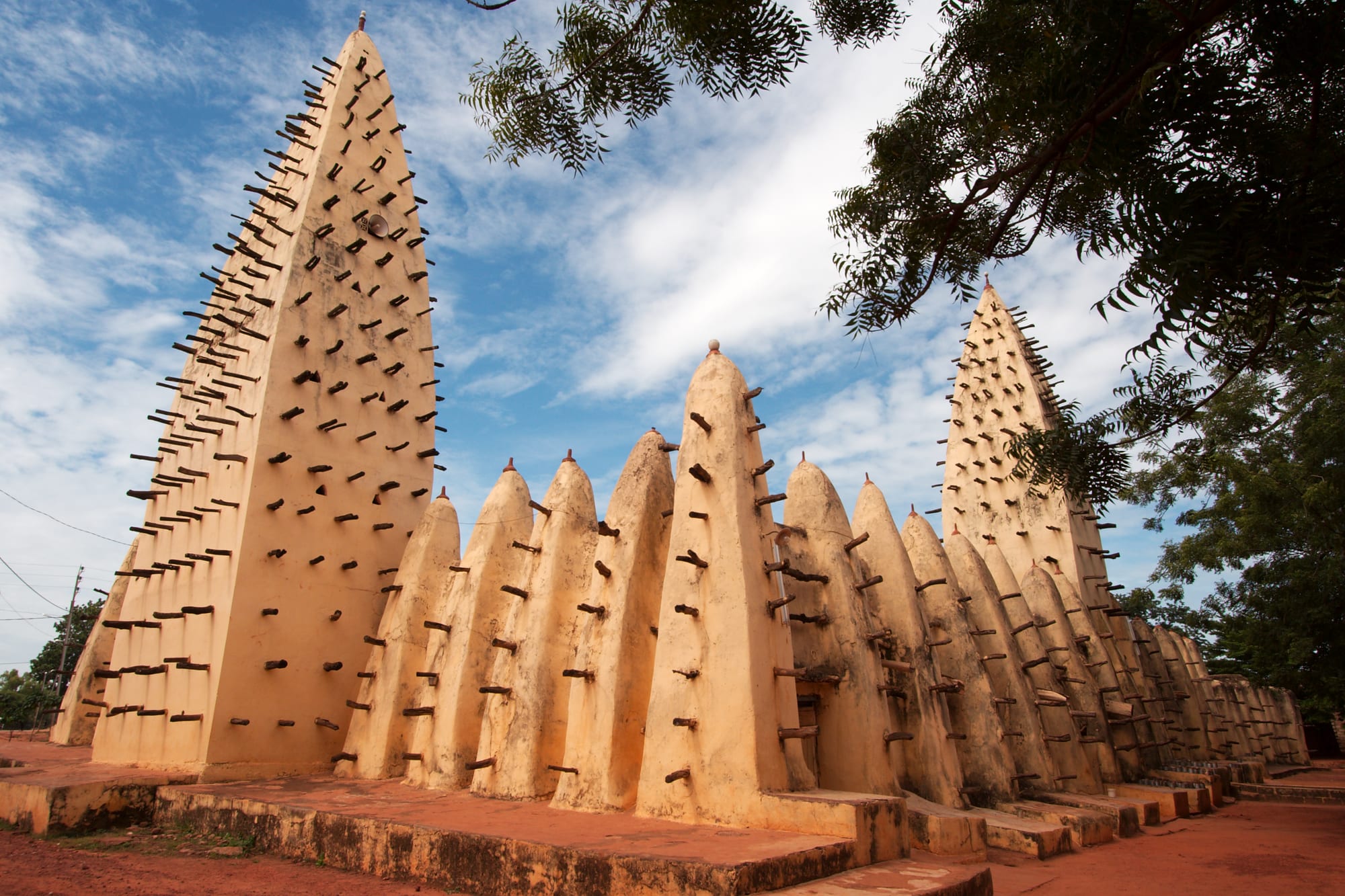
A large mud-brick mosque with tapering towers bristling with projecting wooden beams, under a hazy sky

Burkina Faso

The Grand Mosque of Bobo-Dioulasso, a nineteenth-century mud-brick structure in the Sudano-Sahelian style. (qiv / Wikimedia Commons · CC BY-SA 2.0)

A landlocked Sahelian country in West Africa, known for its music and film festivals and its mud-brick mosques, now gripped by a jihadist insurgency and military rule.

Explore Burkina Faso

History

The central plateau was long dominated by the Mossi kingdoms, notably Ouagadougou and Yatenga, which emerged from around the eleventh century and resisted absorption into the great Sahelian empires to the north. The west and southwest were home to other peoples and to trading towns linked to the trans-Saharan gold trade.

France conquered the region in the 1890s and administered it as Upper Volta. Independence came in 1960, followed by a series of coups. In 1983 a young army officer, Thomas Sankara, took power, renamed the country Burkina Faso — "land of upright people" — the following year, and launched an ambitious programme of self-reliance, mass vaccination, tree planting, and women's rights before he was killed in a 1987 coup led by his associate Blaise Compaoré.

Compaoré ruled for 27 years until a popular uprising forced him out in 2014. A fragile democracy followed, but the spreading Sahel insurgency and the army's frustration with it produced two coups in 2022. The military government now led by Ibrahim Traoré has broken with France, expelled its troops, and turned to Russia and Turkey for security support. With Mali and Niger, which are also under military rule, it formed the Alliance of Sahel States in 2023, and the three withdrew from the West African bloc ECOWAS in 2025.

  • Burkina Faso: The Land of Upright People — The Mossi kingdoms that held off empires, a French colony assembled and dissolved, Thomas Sankara's four-year revolution, and a country now fighting for its own territory

Culture & Customs

Burkina Faso is ethnically diverse, with the Mossi making up about half the population and dozens of other groups — Fulani, Bobo, Lobi, Gurunsi, Senufo, Mandé — each with its own languages, masks, and traditions. Religion is mixed: a Muslim majority, a substantial Christian minority, and widely practised traditional beliefs, often layered together.

Despite its poverty, the country built a strong reputation in the arts. FESPACO, held in Ouagadougou every two years, is the largest African film festival, and the SIAO is a major craft and design fair. Mask-making and masked dance, celebrated at the FESTIMA festival in Dédougou, and the balafon (a wooden xylophone with gourd resonators) are living traditions.

Social life runs on the extended family, respect for elders and chiefs, and long greetings. The Mossi emperor, the Mogho Naba, still holds a ceremonial court in Ouagadougou each Friday.

  • Burkina Faso: The Greeting Comes First — Three faiths often shared within one family, greetings that ask after health, household and work before anything else, and an old system of joking kinship that lets whole peoples tease one another in the name of peace

Daily Life

Burkina Faso is one of the least developed countries in the world and still overwhelmingly rural. Most people farm — millet, sorghum, maize, and cotton, the main cash crop — or herd livestock, and are highly exposed to drought and to the failure of the rains. Gold mining, both industrial and artisanal, provides most of the country's export earnings and is the other pillar of the economy.

The insurgency has upended rural life across much of the north and east and along the Sahel borderlands with Mali and Niger, displacing more than two million people into camps and swollen towns and cutting many communities off from markets, schools, and clinics. Ouagadougou and Bobo-Dioulasso remain relatively functional but absorb the strain.

Where daily life continues normally, it centres on the market, the mosque or church, the courtyard compound, and the shared evening meal, with the year turning on the single rainy season.

  • Burkina Faso: The Courtyard and the Market Day — One of the youngest populations on earth, households that run three generations deep, and a country where, for millions displaced by conflict since 2015, an ordinary day now has to be rebuilt from scratch

Food

Burkinabè cooking is Sahelian and grain-based. The staple is tô, a stiff porridge of millet, sorghum, or maize, eaten with a sauce of leaves, okra, groundnut, or soumbala, a pungent condiment made from fermented néré seeds. Rice dishes such as riz gras (rice cooked in a tomato and meat sauce) are common in town.

Grilled meat is everywhere in Ouagadougou, above all poulet bicyclette, the lean free-range chicken, grilled over charcoal, that is eaten right across West Africa. Brochettes and grilled fish are standard street food.

Dolo, a beer brewed from millet or sorghum, is drunk across the countryside; bissap (a sweetened drink made from hibiscus calyces) and tamarind juice are the everyday drinks.

  • Burkina Faso: Food and the National Dish — A stiff millet paste eaten with a well-seasoned sauce, rice cooked festive and red for special occasions, and free-range chicken said to be named after the bicycles that carried it to market

Attractions & Natural Wonders

In more settled times, Burkina Faso's draws were cultural and low-key. The Grand Mosque of Bobo-Dioulasso, a bristling mud-brick structure in the Sudano-Sahelian style, is the best-known monument, and Bobo-Dioulasso's old quarters and lively music scene made it the country's cultural capital.

Southwest of Bobo, the Sindou Peaks are a ridge of sharp sandstone pinnacles, and the Karfiguéla falls on the Komoé River and Lake Tengrela lie near Banfora to the south. In the far southwest, the stone Ruins of Loropéni, a walled settlement that grew rich on the trans-Saharan gold trade and was at its height between the fourteenth and seventeenth centuries, became the country's first UNESCO World Heritage Site in 2009. Three more have been added since: the ancient iron-smelting sites of the north, some of them dating to around 800 BC, listed in 2019, the W-Arly-Pendjari parks, and the Royal Court of Tiébélé, the Kassena royal compound known for its painted walls, listed in 2024.

The southeast held Burkina Faso's wildlife — the W and Arly parks, part of the transboundary W-Arly-Pendjari complex shared with Niger and Benin, with elephant, antelope, and one of West Africa's last lion populations. Access to all of these is now severely restricted or impossible because of the security situation.

Planning basics

Budget

Burkina Faso is inexpensive, but tourism has all but collapsed because of the security situation, so infrastructure outside the two main cities is limited. Costs are dominated by a hired vehicle with driver and, where relevant, security arrangements. Cash is essential, and ATMs are scarce outside Ouagadougou and Bobo-Dioulasso. Since February 2026 the war between Iran, the United States and Israel has pushed oil and gas prices up worldwide and disrupted aviation; Burkina Faso is far from the fighting, but imported fuel and air fares feel the effect.

Source
Limited recent traveller data — verify against a current source before relying on any figure.
Daily Budget Midrange
USD 70–150 (hotel, hired car with driver)
Daily Budget Shoestring
USD 25–45 (basic hotel, local food, bush taxis) — where travel is possible at all

Carry CFA francs in cash; euros are the easiest currency to exchange.

Source: Limited recent traveller data — verify against a current source before relying on any figure.

Visa Requirements

A visa is required for most nationalities and is obtained in advance from a Burkinabè embassy or through the eVisa portal launched in 2023; a few nationalities are exempt, and visas on arrival are now issued only in exceptional circumstances. Since 1 January 2026 Burkina Faso has suspended visas for United States citizens, in reciprocity for a US entry ban on Burkinabè nationals. Check the current vaccination requirements, including yellow fever, before you go.

Typical Validity
Up to three months, single or multiple entry, depending on the visa

Most foreign ministries advise against all or all-but-essential travel to the whole country; consular help is minimal.

Safety

This is the decisive planning fact for Burkina Faso. Since 2015 a jihadist insurgency linked to al-Qaeda and the Islamic State has spread across much of the country; large areas are outside government control, towns have been blockaded, and a displacement crisis has uprooted more than two million people. Attacks, kidnappings, and mass-casualty incidents are frequent.

Source
US Department of State, UK FCDO, and French diplomatic advisories — check for the latest wording.
Government Advice
Many governments advise against all travel to the whole country, others against all but essential travel; embassy services have been reduced.

Worldlore covers Burkina Faso so it can be understood, not to encourage travel there now. Anyone considering a visit should read their government's current advisory in full.

Source: US Department of State, UK FCDO, and French diplomatic advisories — check for the latest wording.

Climate

Hot and dry. There is a single rainy season from roughly June to September, heaviest in the south, and a long dry season the rest of the year, including the dusty Harmattan wind from the Sahara between late November and mid-March. The far north is semi-desert.

Harmattan
cooler nights but heavy dust haze, late November to mid-March
Dry Season
very hot; April and May can exceed 40°C before the rains

Transportation

Thomas Sankara International Airport in Ouagadougou is the main gateway. A single railway line runs from Ouagadougou through Bobo-Dioulasso to Abidjan in Côte d'Ivoire. Road travel between towns is possible on the main paved axes but is subject to checkpoints, convoys, and the risk of ambush on many routes.

Overland travel outside Ouagadougou and Bobo-Dioulasso is dangerous; check the current picture before any journey.

Best Time to Visit

The cooler dry months, November to February, are the least uncomfortable. Ouagadougou's SIAO craft fair (late October to early November, in even years) falls at the start of this window, and the biennial FESPACO film festival (odd years) just after it, in late February or March. Security, however, is the overriding consideration — see the safety note.

Avoid
The peak heat of March to May and the rains of July and August.

Currency

The currency is the West African CFA franc (XOF), shared across eight countries and pegged to the euro at a fixed rate.

Symbol
FCFA
Cash To Bring
Euros, to exchange in Ouagadougou or Bobo-Dioulasso
Currency Code
XOF — West African CFA franc

Language

French remains the language of government business and schooling, but a constitutional change that took effect in January 2024 demoted it to a "working language", alongside English, and raised the country's national languages to official status. The most widely spoken is Mooré, the language of the Mossi majority, followed by Dioula (a Manding language close to Bambara) in the west around Bobo-Dioulasso, and Fulfulde, out of some seventy languages in all. English is rarely heard.

English
Very limited
Official Language
The national languages; French and English are working languages
Main Local Languages
Mooré, Dioula, Fulfulde