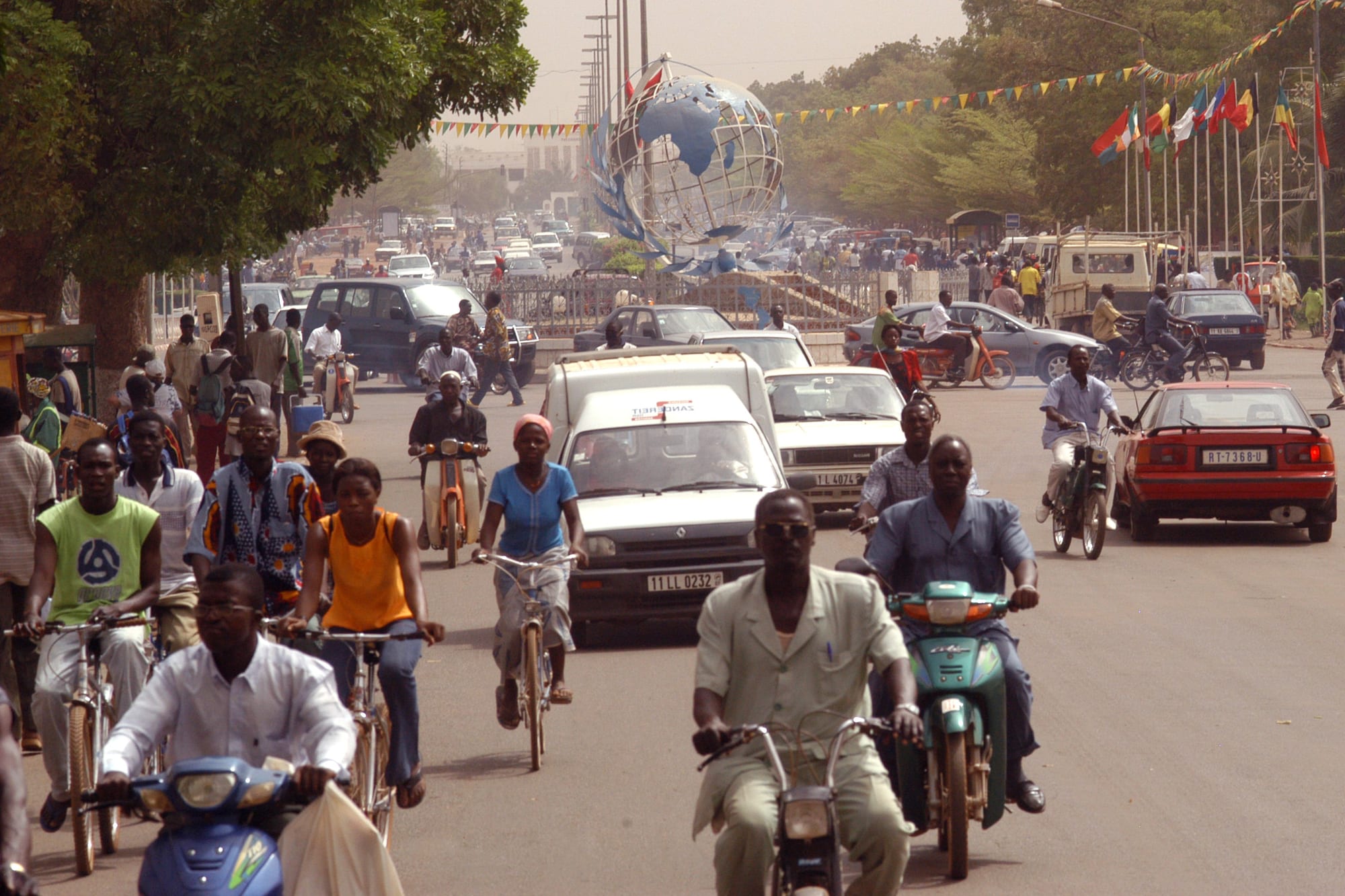
Mopeds, bicycles and cars filling a wide avenue beside a large metal globe sculpture and rows of flags

Ouagadougou, the Centre & the East, Burkina Faso

Ouagadougou

Traffic on the avenue at Place des Nations Unies in central Ouagadougou. (Helge Fahrnberger / Wikimedia Commons · CC BY-SA 3.0)

The capital of Burkina Faso and the seat of the Mossi emperor, the Mogho Naba, a low-rise city of red earth, wide avenues and mopeds on the central plateau. It built a reputation far beyond its size as an African cultural capital, home of the FESPACO film festival and the SIAO craft fair. This page is written to explain the city, not to encourage travel.

Neighbourhoods

  • The centre and Avenue Kwame Nkrumah
    • First-time visitors
    • Close to public transport
    • Restaurants

    The administrative and commercial core, built around the great market, the ministries and the wide avenue that carries most of the city's restaurants, banks and offices. It is where visitors usually stay, and it is busiest in the cool of the evening.

    Open in Maps
  • Ouaga 2000
    • Quiet and residential
    • Modern architecture

    A planned district laid out south of the centre from the late 1990s, with the presidency, conference buildings, embassies and large villas along broad empty boulevards. Ordered and spacious, it has little street life compared with the old city.

    Open in Maps
  • Gounghin
    • Nightlife
    • Best for food
    • Local life

    A dense working district west of the centre, known for its maquis, grilled chicken and music bars, and for the bus stations that serve routes west towards Bobo-Dioulasso. It is one of the liveliest parts of the city after dark.

    Open in Maps
  • Zone du Bois
    • Quiet and residential
    • Close to the university

    A leafy residential quarter in the north-east, close to the main university and the Bangr-Weoogo park, with trees, walled compounds, guesthouses and the homes of many expatriates and civil servants.

    Open in Maps
  • Dapoya and the northern quarters
    • Local life
    • Markets

    Old, tightly built neighbourhoods north of the centre, a grid of earth streets, small shops, tailors and courtyard bars. They show the ordinary life of the city away from the avenues and the administrative districts.

    Open in Maps
  • The outer sectors
    • Local life

    The unplanned quarters spreading across the plateau in every direction, where most of the city's people live and where families displaced by the conflict have settled. Services thin out quickly towards the edges.

    Open in Maps

Things to do

Landmarks and monuments

  • The Mogho Naba's palace and the Friday ceremonylandmark

    The court of the Mossi emperor, where a short ceremony each Friday morning re-enacts a legend of a king prevented from riding off to war.

    Open in Maps
  • Monument aux Héros Nationauxlandmark

    A tall modern monument to the country's national heroes, standing at a junction in the south of the city and used as a rallying point.

    Open in Maps
  • Ouagadougou Cathedrallandmark

    The Catholic cathedral of the archdiocese, built in the 1930s and dedicated in 1936, at the heart of the old colonial town.

    Open in Maps
  • The Grand Mosquelandmark

    The main mosque of a largely Muslim city, near the great market, with the Friday crowds spilling into the surrounding streets.

    Open in Maps
  • The Thomas Sankara memoriallandmark

    A memorial at the Conseil de l'Entente, the site where he was killed in 1987, with a statue of the revolutionary leader and a mausoleum where he and those killed alongside him were reinterred in 2025.

    Open in Maps

Museums and the arts

  • National Museum of Burkina Fasomuseum

    The country's national collection, covering the masks, textiles, tools and history of Burkina Faso's many peoples.

    Open in Maps
  • Musée de la Musiquemuseum

    A museum of the country's musical instruments, from balafons and drums to strings and flutes, with explanations of their place in ceremony.

    Open in Maps
  • Village Artisanal de Ouagadougouattraction

    A craft centre of workshops and stalls where bronze casters, weavers, leather workers and sculptors make and sell their work.

    Open in Maps

Markets and streets

  • Rood Woko, the grand marketmarket

    The city's central market, rebuilt after a fire in 2003, a vast enclosure of stalls selling cloth, food, hardware, crafts and everything else.

    Open in Maps
  • Avenue Kwame Nkrumahneighborhood

    The main avenue of the centre, lined with restaurants, banks, cafés and hotels, and the focus of the city's evening life.

    Open in Maps
  • The bronze casters' workshopsattraction

    Workshops in the artisan quarters where craftsmen cast small figures and animals by the lost-wax method, a long-standing local trade.

    Open in Maps

Parks, water and sport

  • Bangr-Weoogo urban parkpark

    A wooded park of a few square kilometres near the centre, land of the Mossi chiefs before the colonial period and laid out as a park in the 1930s, with shaded paths and birds inside the city.

    Open in Maps
  • The city damsattraction

    The chain of reservoirs across the middle of the city, built to supply water, with market gardens, fishing and walking along their banks.

    Open in Maps
  • Stade du 4-Aoûtattraction

    A multi-purpose stadium with an athletics track, holding close to 30,000 people, used for the city's biggest matches and ceremonies.

    Open in Maps
  • Université Joseph Ki-Zerboattraction

    The country's main university, founded in the 1970s and renamed in 2015 after the Burkinabè historian Joseph Ki-Zerbo.

    Open in Maps

Short trips from the city

  • Laongo sculpture parkattraction

    Granite carved in place by sculptors from Burkina Faso and abroad at a symposium founded in 1989 and held every two years.

    Open in Maps
  • Ziniaréattraction

    A provincial town on the plateau, capital of Oubritenga province and of the Plateau-Central region, and the nearest town to the Laongo sculpture site.

    Open in Maps
  • Bazoulé sacred crocodile pondattraction

    A pond at the centre of the village whose crocodiles, venerated locally and protected by customary rules, numbered 268 in a count made in 2016–17.

    Open in Maps

Seasonal events

  • FESPACOFebruary or March of odd-numbered years

    The pan-African film festival founded in 1969, which fills the city's cinemas and streets every two years and awards the Étalon d'or de Yennenga.

  • SIAO craft fairautumn of even-numbered years

    The international art and craft fair, a biennial trade gathering that brings artisans and buyers from across Africa to the city.

  • The Mogho Naba's Friday ceremonyweekly, on Friday mornings

    A short court ritual held at the palace each week, one of the few Mossi royal ceremonies regularly open to onlookers.

  • Eid al-Fitr and Eid al-Adhadates move through the year with the Islamic calendar

    The two great Muslim festivals bring mass prayer grounds, new clothes, visiting and shared meat to a mainly Muslim city.

Eat and drink

Long-standing places and food districts in Ouagadougou. Hours, ratings and directions come from your maps app, always current.

Ouagadougou classics

  • Poulet bicyclette grillsrestaurant

    Lean free-range chicken roasted over charcoal and served with chilli and onion, the city's signature dish, sold at roadside grills all over town.

    Open in Maps
  • Maquis of Gounghinrestaurant

    Open-air bar-restaurants in the western quarters serving brochettes, fried fish, riz gras and cold beer, with music late into the evening.

    Open in Maps
  • Restaurants on Avenue Kwame Nkrumahrestaurant

    The city's widest choice of sit-down eating, from Burkinabè dishes to Lebanese, French and West African cooking, along the central avenue.

    Open in Maps

Markets and street food

  • Rood Woko market food stallsmarket

    Cooked-food sellers around the central market offering tô with leaf sauce, benga rice and beans, gonré bean cakes and fried plantain.

    Open in Maps
  • Dolo courtyardscafe

    Courtyard cabarets where women brew and sell dolo, the millet beer of Mossi country, served warm in calabashes on market days.

    Open in Maps
  • Zoom-koom and juice standscafe

    Stalls selling zoom-koom, a drink of millet flour with tamarind and ginger, alongside bissap from hibiscus and strong sweet tea.

    Open in Maps

Experience Ouagadougou

History

Ouagadougou grew from a Mossi royal court. Mossi tradition traces the dynasty to Princess Yennenga, a warrior daughter of a Dagomba king, and her son Ouédraogo, and by roughly the fifteenth century the settlement on this part of the plateau had become the seat of the Mogho Naba, the ruler of the most powerful of the Mossi kingdoms. The court was an elaborate hierarchy of ministers and provincial chiefs, with mounted armies that held off the Sahelian empires to the north for centuries, and the town itself remained modest: a palace, its wards of court officials and craftsmen, and a market.

The French took Ouagadougou in 1896 and made it the administrative capital of the colony of Upper Volta, keeping the Mogho Naba in place with ceremonial authority. A colonial town of earth and brick grew beside the royal quarter, the cathedral was built in the 1930s, and the city became the centre of schooling and administration for the whole territory. Independence in 1960 confirmed it as the national capital, and its population multiplied many times over in the decades that followed.

Since then Ouagadougou has been the stage of the country's politics. Thomas Sankara led a revolution from here in 1983, renamed the country Burkina Faso and was killed in a coup in 1987; a popular uprising drove out his successor Blaise Compaoré in 2014; a further attempted coup was resisted in 2015. The city suffered major attacks in 2016 and 2018, and after two coups in 2022 a military government has ruled from here. Displaced families from the countryside have arrived in large numbers, swelling the outer sectors.

Culture & Customs

For a city of the Sahel with little money, Ouagadougou carries extraordinary cultural weight. FESPACO, founded in 1969, is the pan-African film festival and fills the cinemas, hotels and streets every two years; its Étalon d'or de Yennenga prize takes its name from the Mossi princess. The SIAO craft fair, held in the autumn of alternate years, draws artisans and buyers from across the continent, and the city's bronze casters, weavers and sculptors supply both. Theatre, dance and street murals have long had a strong following here.

This is Mossi country, and Mooré is the language of daily life alongside French, with Dioula and Fulfulde heard in the markets. The Mogho Naba still holds his court in the city, and his Friday ceremony, a brief re-enactment of a king turned back from war by his counsellors, is performed each week. Neighbourhood and village chiefs, the naba, retain real influence over land, marriage and disputes.

Islam is the largest religion, with a substantial Catholic and Protestant minority and traditional practice widely observed; mosques, churches and courtyard shrines sit close together. Politics is part of the atmosphere: Sankara's memory is strongly present in murals, songs and the memorial at the place where he died, and public rallies are a regular feature of life under the present government. Manners are formal and warm — long greetings, respect for age, and the obligation to feed a guest.

Daily Life

About 2.4 million people were counted in Ouagadougou at the 2019 census, and the city has grown since, above all through arrivals from the countryside. It is low-rise and very wide, laid out around the old centre with sectors spreading over the plateau, and its red laterite streets, moped traffic and dust are the first things visitors notice.

Work is mostly informal: market trading, transport, workshops, building and domestic service, alongside the government offices, banks, schools and aid organisations that give the city its salaried class. Market gardens along the dams supply vegetables, and millet, sorghum and maize are grown on the edges of the built-up area. Electricity cuts are common, water is rationed in the dry season, and rents in the central districts are far beyond most households.

The conflict shapes the city indirectly but constantly. Hundreds of thousands of displaced people have settled in the outer sectors and with relatives, straining schools, clinics and water supply; soldiers and checkpoints are visible; and political life is tightly controlled, with frequent rallies in support of the government. Everyday rhythms continue all the same: an early start before the heat, a long afternoon pause, and evenings spent at the maquis, the grill stands and the courtyard bars.

Food

The everyday meal is tô, a stiff porridge of millet, sorghum or maize eaten with a sauce of okra, baobab leaves or sorrel, sharpened with soumbala, the pungent condiment made from fermented néré seeds. Babenda, a Mossi dish of sorrel and other leaves cooked with soumbala, groundnuts and a little rice, is a family standard, and gonré, bean-flour cakes steamed in leaves, are sold at markets. Benga, rice and beans with oil and chilli, is the cheap plate of the working day.

Ouagadougou's reputation, though, rests on its grills. Poulet bicyclette — lean free-range chicken, flattened and roasted slowly over charcoal, then served with chilli, mustard and raw onion — is the city's dish, cooked at stands on almost every major street. Brochettes of beef, mutton and liver, fried fish from the dams, and riz gras, rice cooked in a tomato and meat sauce, fill out the menu of any maquis.

For drinking there is dolo, the millet beer brewed by women and sold warm in calabashes in courtyard cabarets, a social institution of Mossi country; the industrial lagers made in the city; and non-alcoholic zoom-koom, a millet, tamarind and ginger drink, bissap from hibiscus flowers, tamarind juice and strong sweet green tea, brewed slowly in small pots and poured from a height.

Planning tools

Budget

Ouagadougou has the country's full range of hotels, restaurants and cash machines, and prices are modest by regional standards. Street food and shared taxis cost very little; a comfortable hotel and a car with driver are what raise the figure. Security arrangements, and the high air fares that follow the disruption in global aviation, are larger costs than anything on the ground.

Daily Budget Midrange
USD 80–170 (comfortable Ouagadougou hotel, restaurant meals, a car with driver)
Daily Budget Shoestring
USD 25–50 (basic hotel or guesthouse, street food, shared taxis)

Carry CFA francs in cash; cash machines work in the capital but are scarce elsewhere in the country.

Best Time to Visit

November to February is the least uncomfortable period, dry with cooler nights, though the Harmattan fills the sky with dust. March to May is punishing, often near 40°C, and the rains from June to September flood streets and cool the air. FESPACO falls in February or March of odd-numbered years. Security matters far more than season in any decision.

Suggested Number of Days

Two or three days cover the museums, markets, monuments and the Friday court ceremony at an unhurried pace. A little longer allows the sculpture park and other places out on the plateau. What is reachable depends on the security situation rather than on time.

First Visit
2–3 days
With Surroundings
3–4 days

Transportation

The city runs on two wheels: mopeds and motorcycles dominate every avenue, and green shared taxis pick up and drop along fixed routes for a small fare. A municipal bus company covers some corridors, and hotels and agencies arrange cars with drivers. Distances are long and the city is flat, so many residents cycle.

Agree a taxi fare before getting in, avoid moving around after dark, and expect checkpoints on the roads out of the city.

Airport & Station Connections

Thomas Sankara International Airport lies inside the city, a short drive from the centre, and is the country's main gateway, with flights to other West African capitals and to Europe; a replacement airport has been built at Donsin, about 35 kilometres north-east, and is intended to take over from it. Coaches run west to Bobo-Dioulasso in about five hours and on towards Côte d'Ivoire, but road travel outside the capital is dangerous and depends on the current security picture.

Walkability

The centre can be walked — the market, cathedral, ministries and the main avenue are within a kilometre or two of each other — but the city is flat, wide and hot, with heavy moped traffic, patchy pavements and long gaps between districts. Most journeys beyond the centre are made by taxi or motorcycle. Early morning and evening are the tolerable hours on foot.

Safety

Since 2015 a jihadist insurgency has spread across much of Burkina Faso, and the country has been under military rule since the two coups of 2022. The capital is more secure than the countryside but has suffered major attacks, including on a hotel and café in 2016 and on the army headquarters and the French embassy in 2018. Kidnapping is a serious risk throughout the country, and most governments advise against all travel to the entire country, including the capital.

Globeway covers Burkina Faso so it can be understood, not to encourage travel there now. Anyone considering a visit should read their government's current advisory in full, avoid crowds, political gatherings and places frequented by foreigners, never photograph soldiers, checkpoints or government buildings, and not travel by road outside the city. Check current official travel advice before travelling.

Climate

A Sudano-Sahelian climate: one rainy season from about June to September, and a long dry season for the rest of the year. March to May is the hottest period, often near 40°C, and the Harmattan brings dust, haze and cooler nights between December and February.

Summer
the rainy season, roughly 25–33°C, with violent storms that flood the streets
Winter
dry and dusty in the Harmattan, around 30°C by day with cool nights; very hot from March to May

Local Customs

Greetings come first and are unhurried: health, family and work are asked after before any business. Elders and chiefs are treated with formal respect, the right hand is used for giving, receiving and eating, and dress is modest, particularly near mosques. Islam is the largest religion, with Christian and traditional practice alongside it, so Friday prayer, Ramadan and Sunday services all shape the week.

Tipping is modest and not obligatory; ask before photographing people, ceremonies or religious buildings, and never photograph military or government sites.

Common Payment Methods

The currency is the West African CFA franc, pegged to the euro. Cash is essential: cards work in some hotels and larger shops in the capital and almost nowhere else, cash machines are concentrated here and in Bobo-Dioulasso, and euros are the easiest currency to change. Mobile money is widely used for local payments.