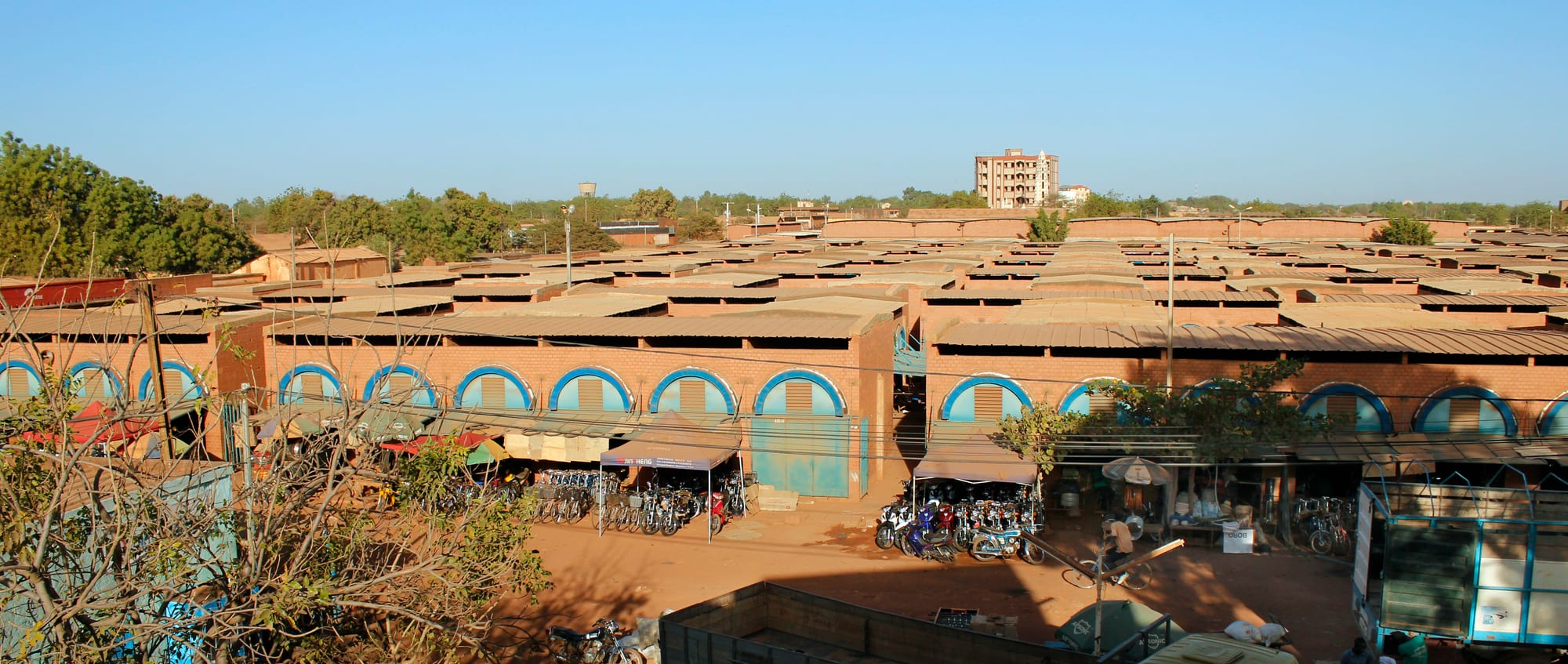
Rows of brick market halls with arched blue doorways and low roofs, with bicycles and awnings outside

Ouagadougou, the Centre & the East, Burkina Faso

Koudougou

The central market of Koudougou, a grid of brick halls in the middle of the town. (Jycé75 / Wikimedia Commons · CC BY-SA 3.0)

Burkina Faso's third city, on the plateau west of Ouagadougou and on the railway that runs down to Abidjan. A Mossi and Gurunsi trading town, it built its modern identity on cotton and textiles, on a university and a long record of protest. This page is written to explain the city, not to encourage travel.

Neighbourhoods

  • The centre and the market
    • First-time visitors
    • Markets
    • Close to public transport

    The heart of the town, built around the brick halls of the central market, with shops, banks, transport offices and small hotels in the streets that lead off it. Everything a visitor needs is within a short walk.

    Open in Maps
  • The station quarter
    • Historic district
    • Local life

    The area around the railway station and the goods yards, where the colonial town took shape. Warehouses, depots and old administrative buildings stand among low compounds, and freight still passes through.

    Open in Maps
  • The university district
    • Students and nightlife
    • Quiet and residential

    The newer quarters near the university, with student lodgings, cheap eating places, photocopy shops and small bars. It is quietest in the long holidays and busy in term time.

    Open in Maps
  • The craft and residential quarters
    • Local life
    • Crafts

    Earth-street neighbourhoods spreading out from the centre, where weaving, dyeing, metalwork and pottery are done in courtyards. They give the town its reputation for handmade cloth and everyday crafts.

    Open in Maps

Things to do

Markets and crafts

  • Koudougou central marketmarket

    The town's main market, a brick complex of halls and stalls covering some 29,000 square metres and opened in 2005, selling grain, vegetables, cloth, hardware and crafts, and the centre of trade for the province.

    Open in Maps
  • Weaving and dyeing workshopsattraction

    Courtyard workshops where cotton strips are woven on narrow looms and cloth is dyed, a trade that survived the closure of the Faso Fani textile works.

    Open in Maps

Landmarks and institutions

  • Koudougou railway stationtransit hub

    A station on the line between Ouagadougou and Abidjan, around which the modern town grew; the railway now carries little or no passenger traffic.

    Open in Maps
  • The royal palace at Issoukalandmark

    An earth-built royal palace in the Issouka quarter, listed among the town's notable buildings and a reminder of the chieftaincy that preceded the colonial town.

    Open in Maps
  • Université Norbert Zongoattraction

    The town's public university, founded in 2005 as the University of Koudougou and renamed in 2017 after the investigative journalist whose killing in 1998 set off nationwide protests.

    Open in Maps
  • The town's mosques and churcheslandmark

    Mosques and Catholic churches stand within a few streets of each other in the centre, reflecting a religiously mixed population.

    Open in Maps

Short trips from the town

  • Sabou crocodile pondattraction

    A pool whose crocodiles are treated as sacred and protected by the village, which has looked after them for generations.

    Open in Maps
  • Réoattraction

    The capital of Sanguié province, a market town in Gurunsi country and the centre of its own department.

    Open in Maps
  • Ouagadougouattraction

    The national capital and seat of the Mogho Naba, with the country's museums, monuments and its two great biennial festivals.

    Open in Maps

Seasonal events

  • Les Nuits Atypiques de Koudougoulate November, each year

    A music and arts festival founded in 1996 that has given the town a name for culture beyond its size, bringing performers from the region and further afield.

  • Eid al-Fitr and Eid al-Adhadates move through the year with the Islamic calendar

    The two great Muslim festivals, marked with mass prayer, new clothes, visiting between households and shared meat.

  • The market cycleall year, on fixed days

    Markets rotate between Koudougou and the surrounding villages on a regular cycle, and the town's own big day draws traders from across the province.

Eat and drink

Long-standing places and food districts in Koudougou. Hours, ratings and directions come from your maps app, always current.

Koudougou classics

  • Tô and sauce kitchensrestaurant

    Small kitchens serving tô, the stiff millet or maize porridge, with okra, baobab-leaf or sorrel sauce flavoured with soumbala.

    Open in Maps
  • Grill stands and maquisrestaurant

    Charcoal grills and open-air bar-restaurants doing poulet bicyclette, brochettes and riz gras, busiest in the evening.

    Open in Maps

Markets and street food

  • Koudougou central marketmarket

    Millet, sorghum, groundnuts, dried fish, shea butter and vegetables, with women selling gonré bean cakes and fried dough at the edges.

    Open in Maps
  • Dolo courtyardscafe

    Courtyard cabarets where women brew and serve dolo, the millet beer of Mossi country, from calabashes on market days.

    Open in Maps

Experience Koudougou

History

Koudougou grew where the Mossi plateau meets Gurunsi country. It was a chiefly settlement before the colonial period, and the earth-built royal palace in the Issouka quarter survives from that time. Gurunsi villages lay to the west and north, and the market that gathered between them traded grain, cotton, livestock and craftwork long before any colonial administration arrived.

The French, who took the region in the 1890s, made the town an administrative centre for the western plateau, and the railway decided its modern shape: the line pushing north from Abidjan reached Koudougou on its way to Ouagadougou, bringing warehouses, workshops and a station quarter. In the decades after independence in 1960 the town became a cotton and textile centre, home to the state textile company Faso Fani, the largest industrial employer in the town until it was wound up in 2001, and a generation of workers and trade unionists grew up around it.

That industrial base faded, but the town's reputation for protest did not. The killing of the investigative journalist Norbert Zongo in 1998 set off demonstrations across Burkina Faso, and Koudougou — his home region — became a centre of the movement; the public university here was renamed after him in 2017. The town took part in the uprising that ended Blaise Compaoré's rule in 2014. Since the coups of 2022 it has lived under military government, and, like every town on the plateau, has taken in families displaced from the more exposed regions.

Culture & Customs

The town sits on a cultural boundary. Mooré, the language of the Mossi, is heard alongside Lyélé and other Gurunsi languages, and French is used in offices and schools; markets mix all of them. Islam is the largest religion, with strong Catholic and Protestant communities and traditional practice continuing in the villages, and the three coexist within single extended families.

Craft is the town's signature. Cotton strips woven on narrow looms, indigo and mud-dyed cloth, pottery, basketwork and metal goods are made in courtyards and sold in the market, and the tradition outlasted the closure of the textile works. Koudougou also has a name for music and theatre out of proportion to its size, with a festival that has drawn performers from across West Africa, and student life gives it a steady cultural undertow.

Politics is part of local identity. The memory of Norbert Zongo, the long record of strikes and demonstrations, and the town's part in the 2014 uprising are all recalled with pride, and the naba, the traditional chiefs, keep a parallel authority over land and family matters. Social manners are those of the plateau: extended greetings, deference to elders, obligations to guests, and ceremonies — naming, marriage, funerals — that draw in the whole neighbourhood.

Daily Life

The 2019 census counted 160,239 people in Koudougou, the third most populous city in Burkina Faso after Ouagadougou and Bobo-Dioulasso and the capital of the Nando region, formerly called the Centre-Ouest. It is low and spread out, its brick market at the middle, earth streets running out to compounds and fields, and mopeds and bicycles doing most of the moving.

The economy rests on trade, farming and the institutions. Millet, sorghum, maize and cotton come in from the surrounding countryside, market gardens supply vegetables, and the market redistributes it all. The university, schools, hospital and administration provide salaried work, and craft workshops, repair shops and transport fill in the rest. Artisanal gold mining in the wider region draws young men away for part of the year, and many households depend on money sent from Ouagadougou or from abroad.

Life is hard and ordinary in equal measure: water and power are unreliable, the dry season brings dust everywhere, and the afternoon heat empties the streets before the evening fills the maquis and the dolo courtyards. The national crisis reaches the town through displaced families, soldiers, higher prices and a political atmosphere in which public meetings are watched closely.

Food

Koudougou eats what the plateau grows. Tô, a stiff porridge of millet, sorghum or maize, is the daily base, eaten by hand with a sauce of okra, baobab leaves or sorrel and given depth by soumbala, the fermented néré-seed condiment. Babenda, the Mossi dish of leaves cooked with soumbala, groundnuts and a little rice, is a household favourite, and gonré, bean-flour cakes steamed in leaves, are the classic market snack.

Grilled food is the treat. Poulet bicyclette, the lean free-range chicken roasted over charcoal, is as much a fixture here as in the capital, and brochettes of beef and mutton, fried fish from the region's dams and riz gras, rice cooked in a tomato and meat sauce, fill the menu of any maquis. Benga, rice and beans with oil and chilli, is the cheap plate of the working day.

Dolo, the millet beer brewed by women in family courtyards and drunk warm from calabashes, is the social drink of Mossi country and the reason for the cabarets that open on market days. Alongside it come zoom-koom, made from millet flour with tamarind and ginger, bissap from hibiscus, and strong sweet green tea brewed in small pots. Mangoes, shea fruit and groundnuts appear in the market in their seasons.

Planning tools

Budget

Koudougou is cheap. Lodging is basic and modestly priced, market food and grills cost very little, and shared taxis and mopeds are the local transport. The town has banks and a few cash machines, but travellers usually arrive with cash from the capital. A hired car with driver is the main expense for anyone moving around the province.

Daily Budget Midrange
USD 80–170 (the best hotel available, restaurant meals, a car with driver)
Daily Budget Shoestring
USD 25–50 (basic hotel or guesthouse, street food, shared taxis)

Carry CFA francs from Ouagadougou; cards are rarely accepted and machines are few.

Best Time to Visit

November to February is the least uncomfortable season, dry with cooler nights and hazy Harmattan skies. March to May is severely hot, and the rains from about June to September bring storms and green fields but make unpaved roads difficult. Security, not season, is the deciding factor for any journey.

Suggested Number of Days

A day covers the market, the station quarter, the palace ruins and the craft workshops. Two allow the surrounding villages and a stop on the road to or from the capital. The town is more often a halt on a longer journey than a destination in itself.

First Visit
1 day
With Surroundings
2 days

Transportation

The centre is walkable and everything else is done by moped, bicycle or shared taxi, which pick up along the main roads for a small fare. Coaches link the town with Ouagadougou and with Bobo-Dioulasso, and bush taxis serve the villages of the province. The railway runs through the town but carries little or no passenger traffic.

Agree taxi fares before setting off, do not travel by road after dark, and check the current security picture before any journey out of town.

Airport & Station Connections

Koudougou lies about 90 kilometres west of Ouagadougou on a paved road, roughly two hours by coach, with frequent departures in normal times; the railway between Ouagadougou and Abidjan also passes through. The nearest airport is in the capital. Roads outside the main axes are subject to checkpoints and to the risks set out in the safety section.

Walkability

The town is flat and compact enough to cross on foot, with the market, the station and the main streets close together, though the outer quarters are spread out and the earth roads are dusty in the dry season and muddy in the rains. Shade is scarce in the middle of the day, and most residents use a moped or bicycle.

Safety

Since 2015 a jihadist insurgency has spread across much of Burkina Faso, and the country has been under military rule since the two coups of 2022. Large areas are outside government control and kidnapping is a serious risk throughout the country. Towns on the central plateau are less exposed than the north and east, but most governments advise against all travel to the entire country, including the capital.

Globeway covers Burkina Faso so it can be understood, not to encourage travel there now. Anyone considering a visit should read their government's current advisory in full, avoid gatherings and political events, never photograph soldiers, checkpoints or government buildings, and not travel by road without current local advice. Check current official travel advice before travelling.

Climate

A Sudano-Sahelian climate with one rainy season, from about June to September, and a long dry season for the rest of the year. The hottest months are March to May, when temperatures approach 40°C, and the Harmattan brings dust, haze and cooler nights from December to February.

Summer
the rainy season, roughly 25–33°C, with heavy storms and green fields
Winter
dry and dusty in the Harmattan, around 30°C by day with cool nights; very hot from March to May

Local Customs

Greetings are long and come before any request, elders and chiefs are addressed with formal respect, and the right hand is used for giving, receiving and eating. The population is mixed Muslim, Christian and traditional, so Friday prayer and Sunday services both shape the week. Dress is modest, and photography of people is a matter for asking first.

Ask before photographing people, workshops or religious buildings, avoid photographing anything military or official, and greet before asking directions or prices.

Common Payment Methods

The currency is the West African CFA franc, pegged to the euro. Cash is what works: a few bank branches and machines serve the town, cards are accepted almost nowhere, and euros are best changed in Ouagadougou. Mobile money agents handle local payments and transfers, and small notes are needed for markets and taxis.