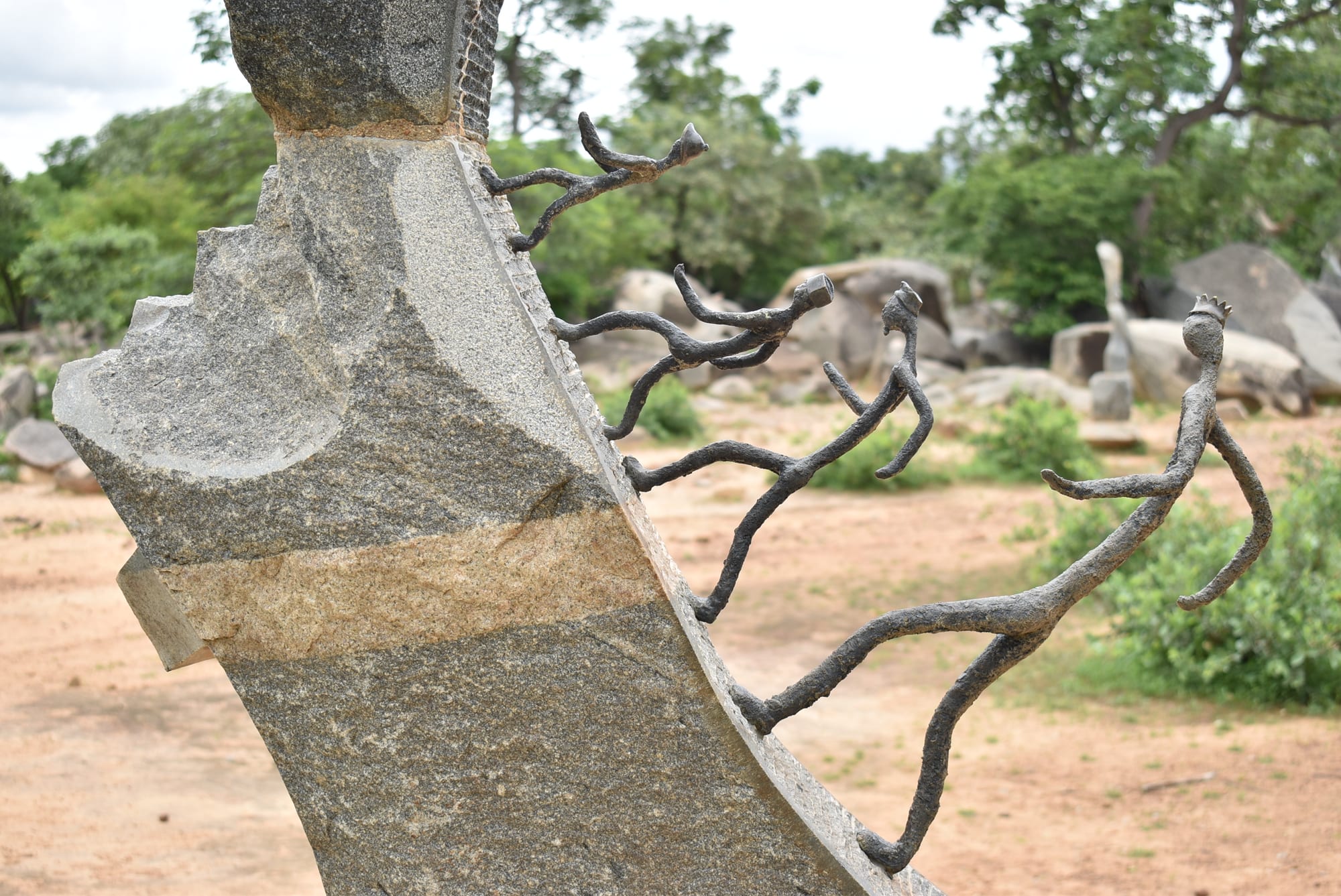
A carved granite sculpture with bronze-like branching figures in front of scattered boulders and green trees

Burkina Faso

Ouagadougou, the Centre & the East

A granite sculpture in the open-air park at Laongo, north-east of Ouagadougou. (Phovicom / Wikimedia Commons · CC BY-SA 4.0)

The Mossi heartland of Burkina Faso around the capital, Ouagadougou, spreading across the central plateau to Koudougou, Kaya and Tenkodogo, south to the Kassena country on the Ghanaian border and east through Fada N'Gourma to the savanna parks of Arly and W — the country's political and cultural centre, now also hit hard by the insurgency.

Explore Ouagadougou, the Centre & the East

History

The Mossi kingdoms that dominate this region trace their origin to Princess Yennenga, a warrior daughter of a Dagomba king in present-day Ghana, and her son Ouédraogo, remembered as the ancestor of the Mossi rulers. Tenkodogo, in the Centre-Est, is regarded as the oldest of the kingdoms, while Ouagadougou became the most powerful, its ruler the Mogho Naba. The Mossi, with their mounted armies and elaborate court hierarchy, resisted the Sahelian empires to the north for centuries. To the east, the Gourmantché built their own kingdom around Fada N'Gourma, and to the south lived the Gurunsi and Kassena, organised in smaller chiefdoms.

The French took Ouagadougou in 1896. It became the capital of Upper Volta. After independence in 1960 Ouagadougou grew rapidly and became the stage of the country's coups and uprisings, including Thomas Sankara's revolution of 1983 — he had commanded the commando training centre at Pô in the south — and the popular uprising that ended Blaise Compaoré's rule in 2014.

Since the late 2010s the insurgency has spread into the Est and Centre-Nord, where armed groups linked to al-Qaeda and the Islamic State have fought the army and its civilian auxiliaries, the Volunteers for the Defence of the Homeland. Rights groups have accused both the armed groups and government forces of killing civilians. The military government led by Captain Ibrahim Traoré has ruled from Ouagadougou since 2022.

Culture & Customs

This is Mossi country, and Mooré is the language of daily life across the centre. The Mogho Naba still holds a short ceremony in his Ouagadougou palace each Friday morning, re-enacting a legend of a king prevented from riding off to war, and local chiefs, the naba, keep an important role in land, marriage and dispute settlement. Muslims are the largest religious group, with Catholic and Protestant churches strong in the towns and traditional practice widespread.

Ouagadougou is one of Africa's film capitals. FESPACO, founded in 1969, fills the city every two years, and its Étalon de Yennenga prize is named after the Mossi princess. The SIAO craft fair, bronze casters in the city's artisan quarters and the granite sculptures of Laongo reflect a strong visual-arts culture, while Koudougou's Nuits Atypiques festival celebrates music from the region and beyond.

In the south, the Kassena of Tiébélé paint their houses with patterns and symbols handed down among women. In the east, the Gourmantché keep their own language and royal court at Fada N'Gourma, and Fulani herders live across the whole region.

Daily Life

Ouagadougou had about 2.4 million people at the 2019 census and continues to grow as displaced families and job seekers arrive. It is a low-rise city of wide avenues, mopeds and sprawling informal districts. Koudougou, with around 160,000, is the third-largest city; Kaya, Tenkodogo, Ziniaré, Manga and Fada N'Gourma are the main provincial centres.

Around the capital, people farm millet, sorghum, maize and vegetables, and market gardens along the dams supply the city. Artisanal gold mining employs many in the Centre-Nord and Est. Koudougou, once a cotton-textile town, is known for its university and its role in protest movements.

The insurgency weighs on everything. Kaya and other towns have taken in large numbers of displaced people, schools and clinics in the countryside have closed, and supply roads to towns in the east have at times been cut. In Ouagadougou, life continues in the markets, maquis and churches, under tight political control and with frequent rallies in support of the government.

Food

The meal of the centre is tô, a stiff millet, sorghum or maize porridge served with a sauce of okra, baobab leaves or sorrel, flavoured with soumbala, fermented néré seeds. Babenda, a Mossi dish of sorrel and other leaves cooked with soumbala, groundnuts and a little rice, is a traditional family favourite, and gonré, bean-flour cakes steamed in leaves, are sold at markets.

Ouagadougou is famous for its grills. Poulet bicyclette, lean free-range chicken, is roasted on charcoal along the city's roadside, and brochettes of beef, goat and liver, fried fish from the dams and riz gras, rice cooked in a tomato and meat sauce, are standard in the maquis. Benga, rice and beans with oil and chilli, is a cheap everyday meal.

Dolo, the millet beer brewed by women, is sold in courtyard cabarets on market days. Zoom-koom, a drink of millet flour, tamarind and ginger, bissap from hibiscus, and ginger juice are the everyday alternatives, alongside strong sweet green tea.

Attractions & Natural Wonders

Ouagadougou's sights are its institutions and street life: the Mogho Naba's palace and Friday ceremony, the National Museum, the Grand Mosque and the cathedral, the Village Artisanal and the Bangr-Weoogo urban park. The Thomas Sankara memorial, with its tall statue of the revolutionary leader, stands at the Conseil de l'Entente, where he was killed. About 30 kilometres north-east, near Ziniaré, the Laongo sculpture park displays works carved directly into granite outcrops by artists from Burkina Faso and abroad. Manéga, to the north, has a private museum of Mossi masks and funerary art.

West of the capital, Koudougou has the earthen royal palace of Issouka, its markets and its festival. The old Mossi kingdom towns of Tenkodogo and Ziniaré and the Kaya region complete the plateau.

In the south, Tiébélé's painted royal court is the region's best-known sight, and the Nazinga game ranch lies nearby in the south. In the east, Fada N'Gourma was the gateway to the Arly and W national parks, part of the W-Arly-Pendjari UNESCO World Heritage Site shared with Niger and Benin, with elephants, buffalo, antelope and lions. The parks and the Est have been at the centre of the fighting and are closed to visitors.

Cities in Ouagadougou, the Centre & the East

Planning basics

Budget

Ouagadougou has the country's full range of hotels, restaurants and cash machines, and costs there are modest by regional standards. Outside the capital, lodging is basic and cheap, but travel costs rise sharply where a vehicle, driver or security arrangements are needed. Tourism outside Ouagadougou has largely stopped.

Daily Budget Midrange
USD 80–170 (comfortable Ouagadougou hotel, restaurant meals, a car with driver)
Daily Budget Shoestring
USD 25–50 (basic hotel or guesthouse in Ouagadougou, street food, taxis)

Carry cash from Ouagadougou; cards and cash machines are scarce in the provincial towns.

Safety

Ouagadougou has suffered major attacks, including on a hotel and café in 2016 and on the army headquarters and the French embassy in 2018, but is more secure than the countryside. Centre-Nord and Est have been among the worst-affected regions of the insurgency, with repeated massacres, blockaded towns and large numbers of displaced people, and the deadliest attack of the conflict, the Barsalogho massacre, took place in the Centre-Nord in 2024. The parks in the east are active conflict zones. Kidnapping is a serious risk throughout.

Globeway covers Burkina Faso so it can be understood, not to encourage travel there now. Most governments advise against all travel to the entire country, including the capital. Check current official travel advice before travelling.

Climate

The central plateau has a Sudano-Sahelian climate, with a single rainy season from about June to September and a long dry season. Ouagadougou is very hot from March to May, often near 40°C, and hazy with Harmattan dust from December to February. The east and the south towards Pô and Tiébélé are greener and receive more rain than the north of the region.

Summer
the rainy season, June to September, 25–33°C, with storms that flood streets in Ouagadougou
Winter
dry and dusty in the Harmattan, around 30°C by day with cooler nights; very hot from March to May

Transportation

Ouagadougou's airport is the country's main gateway. Paved roads lead west to Koudougou, about two hours away, south to Pô and the Ghanaian border, and east to Fada N'Gourma, but many roads outside the capital are subject to checkpoints, military escorts and the risk of ambush, and some are closed. The railway to Abidjan runs through Koudougou but carries little or no passenger traffic. Inside Ouagadougou, shared taxis and mopeds are the usual transport.

Do not travel by road outside Ouagadougou without current local security advice, and never after dark.

Best Time to Visit

November to February is the least uncomfortable period. FESPACO takes place in Ouagadougou in February or March of odd-numbered years, and the SIAO craft fair in the autumn of even-numbered years. The Mogho Naba's Friday ceremony in Ouagadougou is held weekly. Security matters far more than season in any decision.