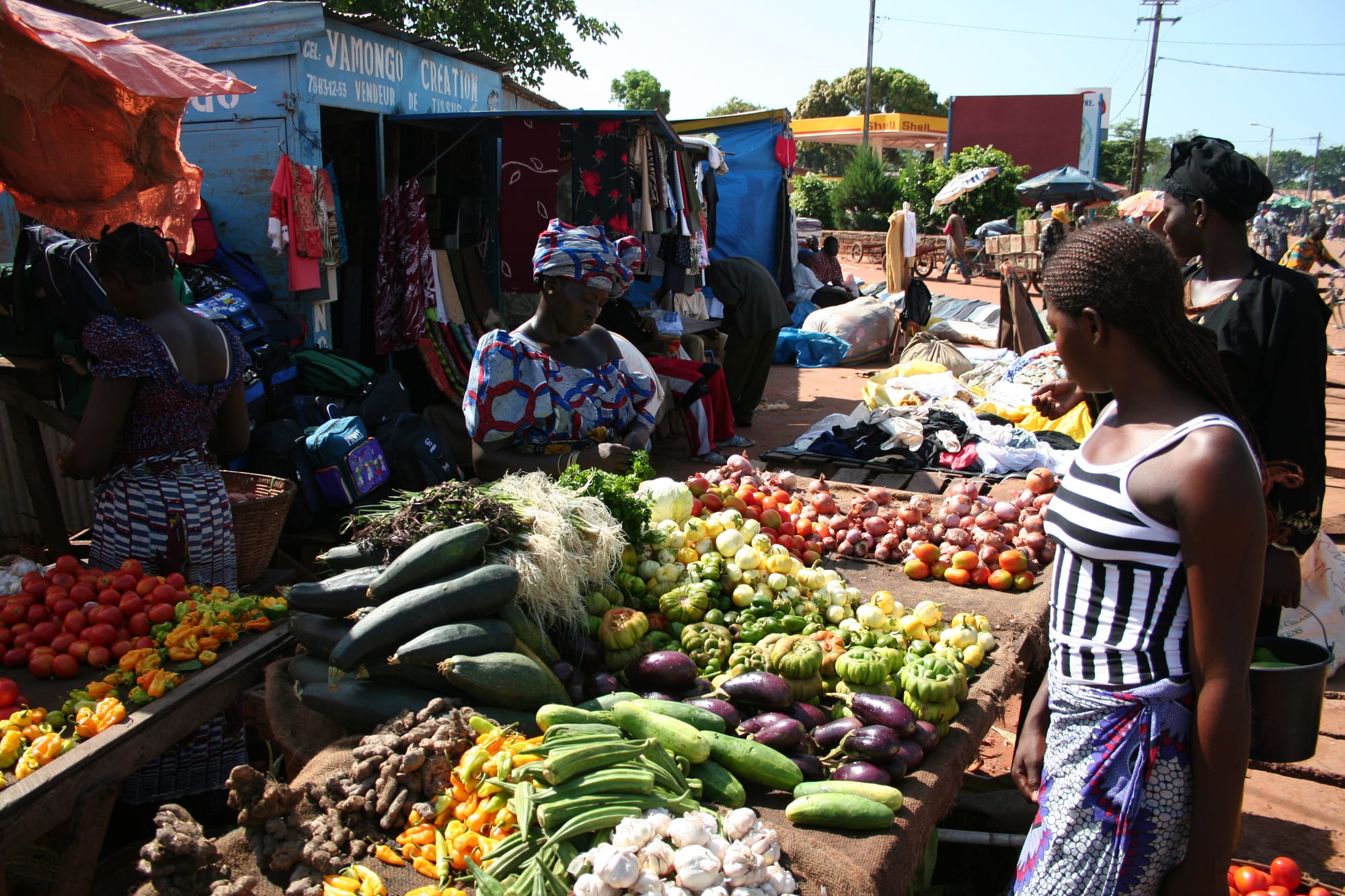
Market stalls in Banfora piled with tomatoes, aubergines, okra and garlic, with traders and shoppers behind

Bobo-Dioulasso & the West, Burkina Faso

Banfora

Vegetable stalls at the market in Banfora, in south-western Burkina Faso. (Marco Schmidt / Wikimedia Commons · CC BY-SA 2.5)

The capital of Burkina Faso's Tannounyan region, until recently called the Cascades, in the green, well-watered south-west near the borders with Côte d'Ivoire and Mali. A small colonial-era railway town that grew around sugar cane and mangoes, it sits below sandstone escarpments and was long the base for visiting the Karfiguéla falls, Lake Tengrela and the Sindou Peaks. This page is written to explain the city, not to encourage travel.

Neighbourhoods

  • The town centre and the market
    • First-time visitors
    • Markets
    • Local life

    The heart of Banfora is the grid of streets around the central market, where traders sell vegetables, mangoes, cloth and household goods. Administrative offices for the Tannounyan region, banks, small hotels and eating places are within a few minutes' walk, and mopeds are the main traffic.

    Open in Maps
  • The station quarter
    • Transport
    • Historic district

    Banfora grew as a stop on the railway between Abidjan and Ouagadougou, and the line still cuts through the town. The streets near the station keep low colonial-era buildings, goods yards and the warehouses that once handled cane, cotton and fruit.

    Open in Maps
  • The sugar estates and the plain
    • Countryside
    • Quiet and residential

    North and east of town the land flattens into irrigated cane fields, mango orchards and company housing built for plantation and refinery workers. It is a rural landscape of canals, dirt tracks and villages rather than a neighbourhood in the usual sense.

    Open in Maps

Things to do

Waterfalls, lakes and rock

  • Cascades de Karfiguélaattraction

    A series of cascades dropping over sandstone ledges into pools shaded by trees, about 12 kilometres north-west of the town, fullest at the end of the rainy season.

    Open in Maps
  • Lake Tengrelaattraction

    A shallow lake about 6 kilometres west of Banfora, known for its hippopotamuses, its water birds and the pirogues that carry visitors out from the shore.

    Open in Maps
  • Domes of Fabédougouattraction

    Rounded, layered sandstone formations weathered into stacked domes, standing among scrub near the village of Fabédougou, a short distance beyond the falls.

    Open in Maps

In the town

  • Banfora central marketmarket

    The town's main trading ground, busiest on market day, with vegetables, fruit, dried fish, cloth, enamelware and the mangoes the region is known for.

    Open in Maps

Short trips from the town

  • Sindou Peaksattraction

    A narrow ridge of wind- and water-eroded sandstone needles above the village of Sindou, with footpaths threading between the pinnacles.

    Open in Maps
  • Bobo-Dioulassoattraction

    Burkina Faso's second city, with its mud-brick Grand Mosque, old quarters and long-established music scene.

    Open in Maps

Seasonal events

  • FESTRIMJanuary, each year

    The festival of the arts, rites and music of the black peasantry, held in the town since 2004, with music, dance and village ceremonies.

  • The mango harvestabout March to June

    The orchards around the town come in, filling the market and the roadside stalls and keeping the drying workshops at work.

Eat and drink

Long-standing places and food districts in Banfora. Hours, ratings and directions come from your maps app, always current.

Banfora classics

  • Tô with local saucesrestaurant

    The staple of the region is tô, a stiff maize or sorghum porridge eaten with sauces of okra, baobab leaf or groundnut, sharpened with soumbala, the fermented néré-seed condiment.

    Open in Maps
  • Grilled chicken and brochettesrestaurant

    Charcoal grills along the main streets sell poulet bicyclette, the lean free-range chicken grilled whole, and skewers of mutton and beef, usually with chilli and raw onion.

    Open in Maps

Markets and street food

  • Banfora market food stallsmarket

    Cooked-food sellers at the market offer rice with sauce, riz gras, fried plantain and beignets, alongside the fruit for which the region is known.

    Open in Maps
  • Mangoes and dried fruitmarket

    Banfora sits in Burkina Faso's main mango country; fresh fruit fills the stalls in the harvest months and small workshops around the town dry mango slices for sale.

    Open in Maps

Experience Banfora

History

The land around Banfora belonged to Gouin, Turka, Karaboro and Sénoufo farming communities long before there was a town, with Dioula-speaking Muslim traders settled among them along the routes that carried kola nuts and gold. The escarpments and wooded valleys of the Comoé country were densely enough settled for villages to defend themselves through the nineteenth-century upheavals, when the campaigns of the Kénédougou kingdom of Sikasso and of Samori Touré reached the south-west.

French forces took the region in the 1890s and attached it to the colony of Upper Volta. Banfora's modern shape dates from the railway: the line pushed north from Abidjan reached the town in 1931 on its way to Bobo-Dioulasso and eventually Ouagadougou, and the station made it a collecting point for cotton, fruit and grain from a wide stretch of country.

The decisive change came after independence, when the well-watered plain north of the town was laid out as an irrigated sugar-cane estate with a refinery attached. Sugar made Banfora an industrial town in a farming region, drawing workers from across Burkina Faso and beyond, and mango orchards spread alongside it. By the late twentieth century the town had also become the base for visitors to the falls, the lake and the Sindou Peaks — a small tourist trade that has since ended with the spread of the insurgency into the west of the country.

Culture & Customs

Banfora is one of the most mixed towns in Burkina Faso. Gouin, Turka, Karaboro, Sénoufo, Dioula and Mossi live in the same streets, and Dioula serves as the common language of trade across the whole south-west. Islam is strong in the town, Christianity has a long presence through mission schools, and traditional religion remains part of village life, with sacred groves, shrines and initiation societies in the surrounding country.

The Sénoufo villages west of the town keep the best-known ceremonial traditions of the area, including masked dances tied to initiation, and regard the Sindou Peaks as a place of protection. Balafon music — the wooden xylophone with gourd resonators played across the south-west — is central to celebrations here as in Bobo-Dioulasso, along with drumming and dance at weddings, funerals and harvest festivals.

Everyday manners follow the wider Burkinabè pattern: elaborate greetings, respect for elders and for village chiefs, and hospitality offered as food or as water before anything else is discussed. Dolo, the millet beer brewed by women, is drunk in courtyard bars by those who are not Muslim, and the courtyards double as the meeting places where news and disputes are worked through.

Daily Life

The 2019 census counted 117,452 people in Banfora, the sixth most populous city in Burkina Faso and the administrative capital of the Tannounyan region, formerly called the Cascades, so its offices, schools and hospital serve a much larger rural population. It is a town of single-storey compounds, corrugated roofs, mopeds and market traders rather than of tall buildings.

The economy rests on the land. Irrigated sugar cane and its refinery provide the largest concentration of wage work in the region; mangoes, cashews, rice, maize and cotton come in from the surrounding plain; and small workshops dry fruit, press oil and repair machinery. Trade with Côte d'Ivoire, a short distance south, shapes prices and supply, and many families have relatives working there.

The day begins before dawn with prayer and the first mopeds, runs hard until the heat of the early afternoon, and picks up again in the cool of the evening around the market and the roadside grills. Electricity and water supply are uneven, and the rainy season can cut dirt roads to the villages. The national security crisis is felt here through checkpoints, the loss of tourism, the closure of some rural services and the arrival of families displaced from more dangerous regions.

Food

Banfora eats the food of the wet south-west rather than of the Sahel. Tô, the stiff porridge of maize or sorghum, is the staple, served with sauces built on okra, baobab leaf, groundnut or dried fish and seasoned with soumbala, the pungent condiment made from fermented néré seeds. Rice is widely grown nearby and widely eaten, often as riz gras, rice cooked in a tomato and meat sauce.

Closeness to Côte d'Ivoire shows on the plate. Yams, cassava and plantain appear more here than in the north, and alloco — ripe plantain fried and served with chilli and onion — is standard street food. Grilled meat is the other constant: poulet bicyclette, the lean free-range chicken, and brochettes of mutton or beef from charcoal grills set up at dusk. Fish from the lakes and dams is fried or grilled whole.

Fruit is the region's pride. Banfora sits at the centre of Burkina Faso's mango country, and the harvest between about March and June fills the market, feeds the drying workshops and supplies juice sellers. Cashew fruit, oranges and papaya follow the seasons. Dolo, millet or sorghum beer, is drunk from calabashes in courtyard bars, while bissap made from hibiscus, ginger drinks and strong sweet tea are the everyday alternatives.

Planning tools

Budget

Banfora is inexpensive by any measure — food, local transport and simple rooms all cost little. The real expenses are a hired vehicle, since the falls, the lake and the peaks all lie outside town, and the guides expected at each site. Tourism has collapsed with the country's security crisis, so the choice of hotels and restaurants is smaller than it once was.

Daily Budget Midrange
USD 70–160 (the best local hotel, restaurant meals, a car with driver)
Daily Budget Shoestring
USD 20–45 (simple hotel, street food, shared taxis and mopeds)

Cash machines are few; money is more reliably withdrawn in Bobo-Dioulasso before coming.

Best Time to Visit

November to February is the most comfortable season, dry and a little cooler, with the waterfalls still flowing after the rains. The mango harvest runs from about March to June, when the heat is at its worst. Security, not season, is the deciding factor here.

Suggested Number of Days

The town itself is small and quickly seen. The reason to stay longer is the surrounding country, since the falls, the lake and the sandstone peaks each need a half-day trip by road. Water levels and heat affect how long a visit is comfortable.

First Visit
1–2 days
With Surroundings
3–4 days

Transportation

Banfora is compact enough to cross on foot, and shared taxis and motorcycle taxis cover the rest. Everything of interest outside the town is reached by hired car, moped or bicycle on dirt roads that are rough after rain. Coaches link the town with Bobo-Dioulasso and Ouagadougou, and the railway to Abidjan passes through.

Travel between towns only in daylight and check the current situation on each route first.

Airport & Station Connections

Most arrivals are by road from Bobo-Dioulasso, about 85 kilometres and under two hours to the north-east, which is itself around five hours from Ouagadougou. The nearest airport of any size is at Bobo-Dioulasso. The Abidjan–Ouagadougou railway runs through Banfora, and the Ivorian border lies a short distance to the south.

Walkability

The centre is flat, small and easily walked, with the market, offices and lodgings within a few streets of each other. Pavements are limited and the midday heat is severe, so walking is done early or late. Nothing outside the town — the falls, the lake, the domes — is within walking distance.

Safety

The south-west was long the calmest part of Burkina Faso, but armed groups have attacked army posts, police and civilians in the region and its neighbours, and roads have been ambushed. Kidnapping is a risk across the country, and rural sites outside the town are the most exposed.

Globeway covers Burkina Faso so it can be understood, not to encourage travel there now. Most governments advise against all travel to the entire country. Check current official travel advice before travelling.

Climate

Hotter and wetter than most of Burkina Faso, with a single rainy season from about May to October and a long dry season after it. The Harmattan brings dust haze and cooler nights from December to February, and March and April are extremely hot.

Summer
rainy from about May to October, roughly 24–32°C, with green countryside and full waterfalls
Winter
dry and dusty, around 30°C by day with cooler nights, building to great heat before the rains

Local Customs

Greetings are long and matter more than the business that follows; a handshake and questions about family come first. Dioula is the language of the market, French of offices, and Gouin, Turka, Karaboro and Sénoufo are spoken in the surrounding villages. Muslims, Christians and followers of traditional religion live side by side, and modest dress is expected.

Ask before photographing people, shrines or sacred groves; tipping is not customary, but guides at the falls and the lake are paid a fee.

Common Payment Methods

The currency is the West African CFA franc, pegged to the euro. Banfora runs on cash; cards are accepted almost nowhere and cash machines are few and unreliable, so travellers bring CFA francs with them, in small notes for markets, transport and guides.