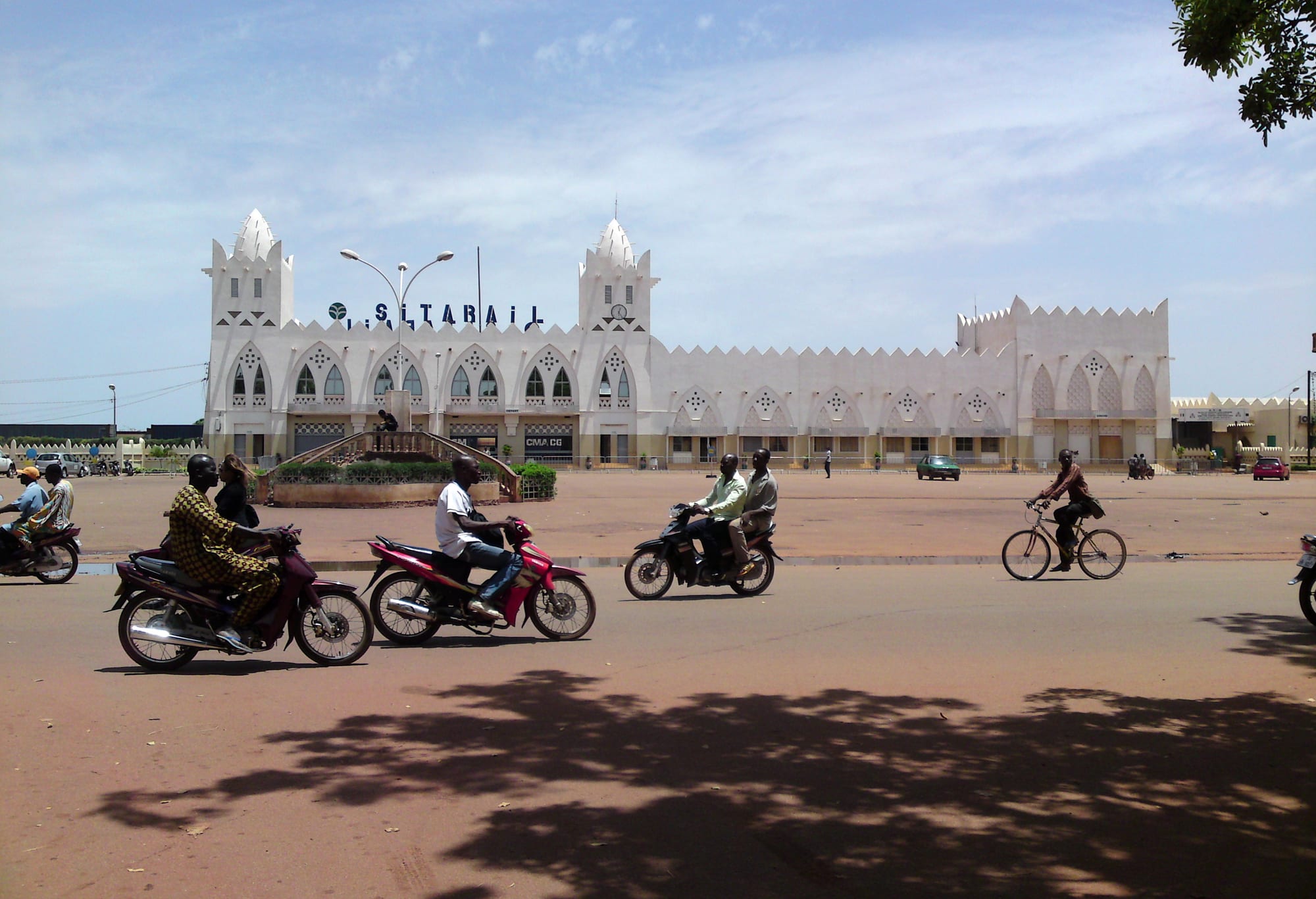
A long white station building with pointed turrets and arched windows, with mopeds crossing the square in front

Bobo-Dioulasso & the West, Burkina Faso

Bobo-Dioulasso

The railway station of Bobo-Dioulasso, built in the 1930s in a Sudanese-inspired style, on the line between Ouagadougou and Abidjan. (Maarten van der Bent / Wikimedia Commons · CC BY-SA 2.0)

Burkina Faso's second city, in the greener south-west, grown from the Bobo village of Sya beside a Dioula trading quarter. Shaded avenues, a mud-brick mosque in the Sudano-Sahelian style, the old Kibidwé lanes and a strong balafon and dance tradition made it the country's cultural capital. This page is written to explain the city, not to encourage travel.

Neighbourhoods

  • The colonial centre
    • First-time visitors
    • Architecture
    • Restaurants

    The grid of shaded avenues around the station, the town hall and the main market, laid out under French rule and still the commercial heart. Hotels, banks, restaurants and transport offices are concentrated here, and mango trees line many streets.

    Open in Maps
  • Dioulassoba and Kibidwé
    • Historic district
    • Local life

    The old quarters beside the Grand Mosque, where the city began as the Bobo village of Sya and a Dioula trading ward. Narrow earth lanes run between mud-brick houses, smithies and shrines, and a guide is the usual way to visit.

    Open in Maps
  • Accart-Ville and the western quarters
    • Nightlife
    • Best for food
    • Local life

    Busy residential districts west of the centre, with markets, workshops, maquis and music bars. They carry much of the city's evening life and are where many families live.

    Open in Maps
  • The station and industrial quarter
    • Close to public transport
    • Local life

    The area around the railway, the goods yards and the factories that made the city the country's economic capital, with depots, lorry parks and workers' housing.

    Open in Maps
  • The southern outskirts
    • Quiet and residential
    • Countryside

    Newer quarters spreading towards the sacred pool at Dafra and the farmland beyond, greener and quieter, thinning into orchards and market gardens.

    Open in Maps

Things to do

Landmarks and the old town

  • Grand Mosque of Bobo-Dioulassolandmark

    A mud-brick mosque in the Sudano-Sahelian style, possibly the largest of its kind in the country, its tapering towers bristling with projecting wooden beams, dating from the late nineteenth century and rendered smooth again after each rainy season.

    Open in Maps
  • Dioulassoba and Kibidwé old quartersneighborhood

    The oldest parts of the city, where the Bobo village of Sya and the Dioula trading ward grew together, with earthen houses, family shrines and blacksmiths' forges.

    Open in Maps
  • Bobo-Dioulasso railway stationtransit hub

    A white station in the neo-Sudanic colonial style, built after the railway from Abidjan reached the city in 1934, and still its best-known building after the mosque.

    Open in Maps

Museums and crafts

  • Musée communal Sogossira Sanonmuseum

    The city's municipal museum, opened in 1990 and named after its founder, the Burkinabè sculptor Sogossira Sanon, with masks, textiles and everyday objects of the region's peoples.

    Open in Maps
  • The artisans' workshopsattraction

    Bronze casters, weavers, leather workers, potters and instrument makers working in courtyards and craft centres around the city.

    Open in Maps

Markets

  • The grand marchémarket

    The city's central market, a large covered complex selling cloth, food, spices, hardware and crafts, and the busiest place in the centre.

    Open in Maps

Water, forest and sacred places

  • Dafraattraction

    A sacred pool in a rocky gorge south of the city, home to large catfish that receive offerings and are protected by custom.

    Open in Maps
  • La Guinguette and the Kou forestpark

    A natural bathing pool on the Guinguette river at the edge of the Kou forest, a gallery forest about 20 kilometres north of the city that has been protected since 1951.

    Open in Maps
  • Koroviewpoint

    An old village on the edge of the city's commune, with earthen houses and granaries above the surrounding farmland.

    Open in Maps

Short trips from the city

  • Banfora and the Karfiguéla fallsattraction

    A green provincial town near the Karfiguéla falls, which drop over sandstone ledges through woodland, and the rounded rocks known as the Domes of Fabédougou.

    Open in Maps
  • Lake Tengrelaattraction

    A lake with hippos, water birds and fishing villages, visited by pirogue from the shore.

    Open in Maps
  • Sindou Peaksattraction

    A narrow ridge of wind- and water-eroded sandstone pinnacles, the Pics de Sindou, beside the town that is the capital of Léraba province.

    Open in Maps
  • Mare aux Hippopotamesattraction

    A lake and national park of about 160 square kilometres, home to roughly a hundred hippos and the country's only UNESCO biosphere reserve.

    Open in Maps

Seasonal events

  • Semaine Nationale de la Cultureevery two years, in March or April

    The national culture week, a biennial festival of music, dance, theatre and crafts from all of Burkina Faso's regions, held in Bobo-Dioulasso since 1990.

  • The mango harvestabout March to June

    Mangoes from Orodara and the surrounding orchards fill the markets and the roadside stalls, the region's best-known crop.

  • Eid al-Fitr and Eid al-Adhadates move through the year with the Islamic calendar

    The two great Muslim festivals bring mass prayer, new clothes, visiting between households and shared meat to the city's quarters.

  • Mask ceremonies in the villagesdry season

    Bobo and Bwa communities around the city hold masked dances at funerals and at the end of the agricultural year, held for the community rather than for visitors.

Eat and drink

Long-standing places and food districts in Bobo-Dioulasso. Hours, ratings and directions come from your maps app, always current.

Bobo classics

  • Grilled chicken and brochette standsrestaurant

    Charcoal grills all over the city doing poulet bicyclette, the lean free-range chicken, and skewers of beef and mutton with chilli and onion.

    Open in Maps
  • Maquis and music barsrestaurant

    Open-air bar-restaurants, many with live balafon or djembe, serving riz gras, fried fish, alloco and cold drinks into the night.

    Open in Maps
  • Alloco and street-food stallsrestaurant

    Stands frying ripe plantain in palm oil and serving it with chilli sauce, alongside fried yam, beignets and grilled fish.

    Open in Maps

Markets and drinks

  • The grand marché food hallsmarket

    Rice, maize, shea butter, soumbala, dried fish, spices and heaps of mangoes, oranges and papaya in season, with cooked food at the edges.

    Open in Maps
  • Dolo courtyardscafe

    Family cabarets where millet or sorghum beer is brewed and drunk warm from calabashes, a social fixture in the older quarters.

    Open in Maps

Experience Bobo-Dioulasso

History

The city began as Sya, a village of Bobo farmers, joined in time by Dioula traders, Muslim merchants speaking a Mande language who settled beside it on the routes that carried gold, kola nuts and salt between the forest and the Sahel. The two communities gave the place its name — Bobo-Dioulasso, the house of the Bobo and the Dioula — and their quarters, Dioulassoba and Kibidwé, remain the oldest part of the city. The Grand Mosque, raised in mud brick in the Sudano-Sahelian style in the late nineteenth century, belongs to that trading world.

The nineteenth century brought pressure from outside: the Kénédougou kingdom based at Sikasso, in present-day Mali, and the campaigns of Samori Touré reached this country before the French occupied Sia in 1897. Under colonial rule the town grew into the business and industrial centre of the colony, and the decisive moment came in 1934, when the railway from Abidjan arrived and a grand station was built to mark it. Warehouses, factories, offices and a planned town of avenues grew around the old quarters.

After independence in 1960 the city kept its economic weight, with textile, agricultural and food industries, even as Ouagadougou concentrated political power; rivalry between the two cities is an old theme of Burkinabè life. The 2014 uprising against Blaise Compaoré was felt strongly here. More recently the insurgency has spread into the west, tourism to the region has collapsed, and displaced families from the countryside have arrived in the city.

Culture & Customs

Bobo-Dioulasso is widely regarded as the cultural capital of Burkina Faso. Its music is the main reason: the balafon, a wooden xylophone with gourd resonators, has one of its heartlands here, and djembe drumming, griot singing and dance troupes have long had a professional life in the city. Live music in the maquis and bars is ordinary rather than exceptional, and the National Culture Week, held here every two years since 1990, fills the streets with performers from every region.

The city is the meeting point of many peoples — Bobo, Bwa, Dioula, Senufo, Fulani, Mossi and others — and Dioula serves as the common language. Mask societies are central to Bobo and Bwa life in the surrounding villages, with fibre masks, tall painted plank masks and masked funerals that belong to the community rather than to any audience. In the old quarters, family shrines, blacksmiths' forges and the offerings made at the sacred pool of Dafra, where large catfish are fed and protected, show how much older practice continues beneath a mainly Muslim and partly Christian surface.

Manners follow the region: long greetings, respect for elders, food shared with whoever is present, and a slower, more sociable pace than the capital, which locals mention with some pride. Tailors, dyers and craftsmen work in view on the street, and the city's shaded avenues encourage the evening walking and sitting that give it its reputation for ease.

Daily Life

The 2019 census counted 904,920 people in Bobo-Dioulasso, and the city was put at about 1.1 million in 2023, comfortably the country's second city. It is greener and lower than Ouagadougou, laid out in a grid of avenues around the station and the market, with the old quarters at its centre and wide residential districts spreading outwards.

This is the country's agricultural and industrial hub. The surrounding Guiriko region, until recently called the Hauts-Bassins, grows cotton, maize, rice, fruit and vegetables, and the city processes and ships them: cotton ginning, oil pressing, flour, drinks and other food industries sit beside the railway that carries freight to Abidjan. Mangoes from Orodara, cashews and sesame pass through in season, and trade with Côte d'Ivoire and Mali is a constant. Around the formal economy works a much larger informal one of market traders, mechanics, tailors, musicians and taxi drivers.

Daily life runs from the call to prayer and the moped rush to the market in the early morning, through a long pause in the afternoon heat, to evenings in the maquis. Water and electricity cuts are common, and the pressure of displaced families arriving from the countryside is felt in rents, schools and clinics. The security situation has emptied the hotels that once served travellers heading for the falls and the peaks to the south-west.

Food

The western diet is broader than the Sahelian north. Tô, the stiff maize or sorghum porridge, remains the everyday base, eaten with okra, baobab-leaf or groundnut sauce and seasoned with soumbala, the fermented néré-seed condiment, but rice is grown and eaten widely here, and yams, cassava and plantain come up from the Ivorian border country. Riz gras, rice cooked in a tomato and meat sauce, is the standard plate of a working lunch.

The city's street food shows its position. Alloco — ripe plantain fried in palm oil and served with chilli and onion — is everywhere, along with brochettes, grilled and fried fish from the region's rivers and dams, fried yam and beignets. Poulet bicyclette, charcoal-grilled free-range chicken, is as much a fixture as in the capital. Shea butter is used in cooking, and soumbala is sold in dark balls in the market.

Fruit is the region's pride: mangoes from the orchards around Orodara and Banfora in their season, oranges, papaya, bananas and the sharp juice of the cashew apple. For drinking there is dolo, the millet or sorghum beer brewed by women and served warm in calabashes in courtyard cabarets, the lagers brewed in the country, and bissap from hibiscus, ginger juice and strong sweet tea.

Planning tools

Budget

Bobo-Dioulasso is cheaper than Ouagadougou and has a reasonable choice of hotels and guesthouses, banks and cash machines. Food and local transport cost very little; guides for the old quarters and the villages, and a hired vehicle for anything beyond the city, are the main extra costs. Tourism has fallen sharply with the insurgency, so services are thinner than they once were.

Daily Budget Midrange
USD 70–160 (comfortable Bobo-Dioulasso hotel, restaurant meals, a car with driver)
Daily Budget Shoestring
USD 20–45 (basic hotel, street food, shared taxis)

Withdraw cash here before heading to Banfora or the smaller towns, where machines are few or absent.

Best Time to Visit

November to February is the most comfortable season, dry and a little cooler, with the waterfalls of the region still flowing early on. March and April are very hot, and the rains from about May to October make the countryside green and the dirt roads slow. The mango harvest runs from about March to June. Security, not season, is the deciding factor.

Suggested Number of Days

Two days suit the mosque, the old quarters, the market and the museums at an unhurried pace. Three or four allow the forest, the sacred pool and the Banfora area. How much of the region is reachable depends on the security situation rather than on time.

First Visit
2 days
With Surroundings
3–4 days

Transportation

Green shared taxis run along the main roads for a small fare, mopeds and motorcycles dominate the streets, and bicycles are common on the flat grid of the centre. Coaches leave for Ouagadougou and Banfora from stations near the centre, and a hired car with driver is the practical way to reach the forest, the villages and the Tannounyan region to the south-west.

Agree taxi fares before setting off, avoid moving around after dark, and check the security picture for every road out of the city.

Airport & Station Connections

Bobo-Dioulasso is roughly five hours from Ouagadougou by coach on the main paved highway, and lies on the railway between the capital and Abidjan, which continues through Banfora to Côte d'Ivoire. The city has an airport a short drive from the centre with limited scheduled traffic, and the main international gateway is Ouagadougou.

Walkability

The colonial centre is flat, shaded by mango and neem trees and easily walked: the station, the market, the mosque and the old quarters lie within a kilometre or two of one another. Beyond that the city spreads widely and the heat is heavy in the middle of the day, so most journeys are made by shared taxi or moped.

Safety

Since 2015 a jihadist insurgency has spread across much of Burkina Faso, and the country has been under military rule since the two coups of 2022. The west was long the calmest part of the country, but armed groups have attacked army posts, police and civilians in the surrounding regions and roads have been ambushed. The city itself is more secure than the countryside, and kidnapping is a risk across the country.

Globeway covers Burkina Faso so it can be understood, not to encourage travel there now. Anyone considering a visit should read their government's current advisory in full, travel only in daylight on main roads, avoid crowds and political gatherings, and never photograph soldiers, checkpoints or government buildings. Check current official travel advice before travelling.

Climate

The wettest and greenest part of Burkina Faso, with a rainy season from about May to October and more rainfall than the plateau. It is slightly cooler than Ouagadougou but still very hot in March and April, and the Harmattan brings dust and cooler nights from December to February.

Summer
rainy from about May to October, roughly 24–32°C, humid with heavy storms
Winter
dry and dusty in the Harmattan, around 30°C by day with cooler nights; very hot before the rains

Local Customs

Dioula is the everyday language of the streets and markets, and greetings are long and expected before any business. Islam is the largest religion, with Christian and traditional practice alongside it; the old quarters contain family shrines and sacred places where entry, behaviour and photography are governed by custom. Dress modestly, especially near the mosque.

Visit the old quarters and the sacred pool with a local guide, ask before photographing people, shrines or the mosque, and use the right hand for giving and receiving.

Common Payment Methods

The currency is the West African CFA franc, pegged to the euro. The city has banks and cash machines, the best outside the capital, but cash is what markets, taxis, guides and most hotels use. Cards are accepted in only a few places, euros are the easiest currency to change, and mobile money is widely used locally.