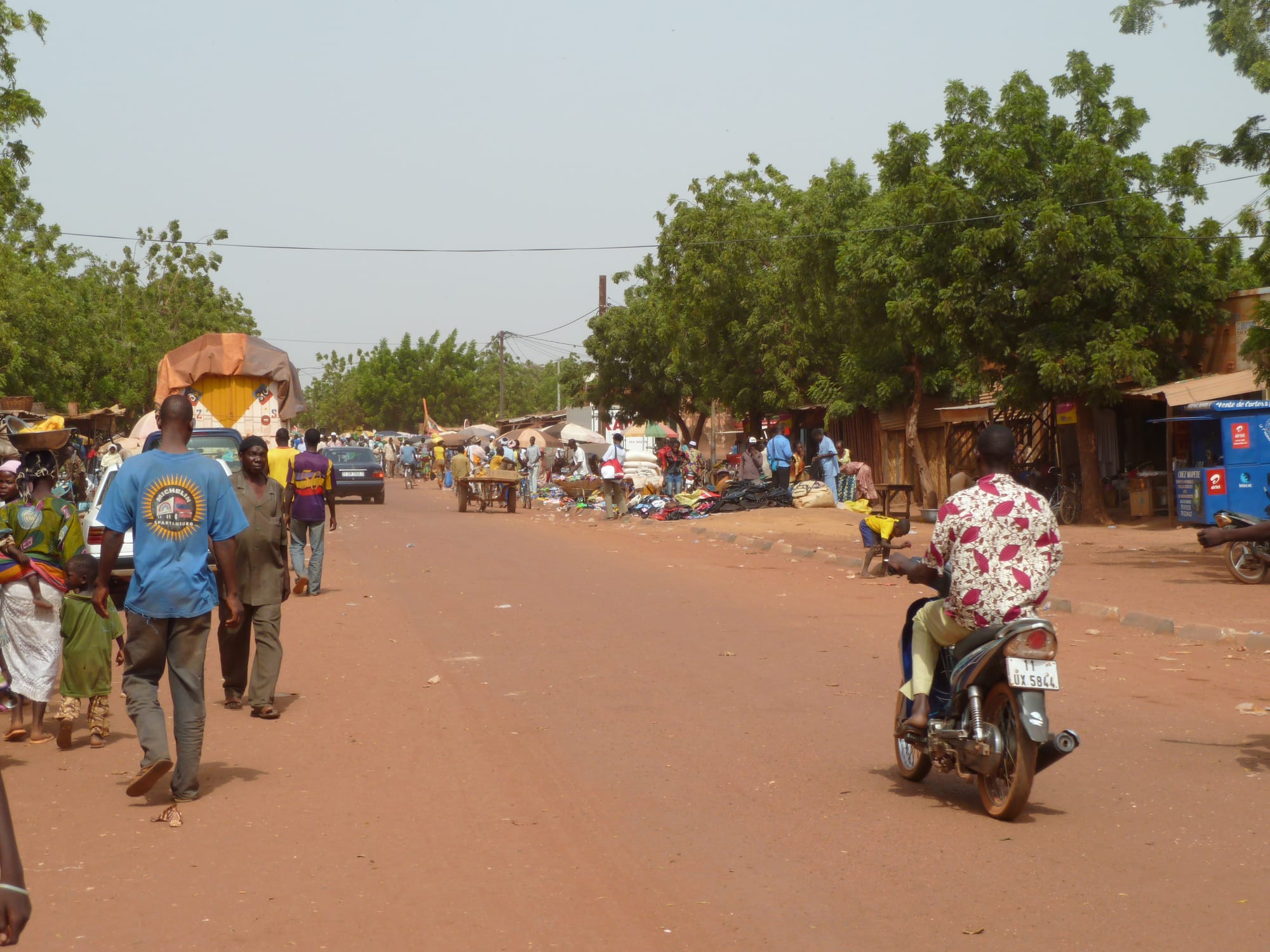
A wide red-earth street in Ouahigouya with people walking, a moped, market stalls and shade trees along one side

Ouahigouya & the Sahel North, Burkina Faso

Ouahigouya

A street in Ouahigouya, the main city of northern Burkina Faso. (Fernando Hidalgo Marchione / Wikimedia Commons · CC BY-SA 2.0)

The largest city of northern Burkina Faso and the seat of Yatenga, one of the great Mossi kingdoms, whose naba still holds court here. A market town on the road towards Mali, it lives from trade, millet farming and the crafts of weaving and dyeing, and has absorbed large numbers of people displaced by the insurgency. This page is written to explain the city, not to encourage travel.

Neighbourhoods

  • The market quarter and the centre
    • First-time visitors
    • Markets
    • Local life

    The grand market and the streets around it are the busiest part of the city, with cloth sellers, grain traders, workshops and transport yards. Banks, administrative offices for Yatenga province and the Yaadga region, formerly called Nord, and most lodgings are within walking distance.

    Open in Maps
  • The royal quarter
    • Historic district
    • Local traditions

    The compound of the naba of Yatenga and the households attached to the court form an old quarter of low earthen and concrete buildings. Court ceremonies keep their weekly rhythm here, and the district remains the symbolic centre of the kingdom.

    Open in Maps
  • The outer sectors and the Mali road
    • Quiet and residential
    • Transport

    Beyond the centre the city spreads into numbered sectors of walled family compounds, small mosques, schools and gardens, thinning into millet fields. The road north towards the Malian border runs through them, lined with garages and freight depots.

    Open in Maps

Things to do

The royal court

  • The palace of the naba of Yatengalandmark

    The residence and court of the ruler of the Mossi kingdom of Yatenga, whose ceremonial authority over the region survives alongside the modern administration.

    Open in Maps

Markets and crafts

  • Ouahigouya grand marketmarket

    The city's main market, trading grain, livestock, cloth, leather and household goods for a wide rural hinterland.

    Open in Maps
  • The weaving and dyeing workshopsattraction

    Small courtyard workshops around the city weave narrow strips of cotton and dye cloth, a craft long associated with Yatenga.

    Open in Maps

Farming country around the city

  • The zaï fields at Gourgaattraction

    Farmland just outside the city where planting pits filled with manure, a technique revived in the region, were used to bring hardened ground back into cultivation.

    Open in Maps

Short trips from the city

  • Yakoattraction

    A town on the Ouagadougou road, known as the birthplace of Thomas Sankara, the officer who led Burkina Faso's revolution in the 1980s.

    Open in Maps

Eat and drink

Long-standing places and food districts in Ouahigouya. Hours, ratings and directions come from your maps app, always current.

Ouahigouya classics

  • Tô with saucerestaurant

    The staple of Yatenga is tô, a stiff millet or sorghum porridge eaten with sauces of okra, baobab leaf, sorrel or dried fish, flavoured with soumbala made from fermented néré seeds.

    Open in Maps
  • Grilled meat and brochettesrestaurant

    Charcoal grills near the market sell mutton, goat and poulet bicyclette, the lean free-range chicken eaten across the country, usually with onion and chilli.

    Open in Maps

Markets and street food

  • Ouahigouya grand market food stallsmarket

    Cooked-food sellers at the market offer rice with sauce, beans, beignets and dégué, millet grains stirred into sour milk and often sweetened.

    Open in Maps
  • Courtyard dolo barsneighborhood

    In Mossi country dolo, the millet beer brewed by women, is sold in family courtyards that serve as the informal meeting places of a quarter.

    Open in Maps

Experience Ouahigouya

History

Ouahigouya is the capital of Yatenga, one of the great Mossi kingdoms that took shape on the plateau from around the thirteenth century and that held out for centuries against the Sahelian empires to the north. Yatenga's rulers, the nabas, governed through a hierarchy of chiefs and cavalry and raided north towards the Niger bend; the kingdom's court traditions, titles and royal drums are still recited today.

The town itself came later than the kingdom. Naba Kango, one of Yatenga's most forceful rulers, established Ouahigouya as his capital in the eighteenth century, moving the seat of power to a new site and building it up as a court and market centre. It grew as a place where the kingdom's authority, long-distance trade in salt, kola and cloth, and the crafts of weaving and dyeing came together.

French troops reached Yatenga in the 1890s, and the kingdom was absorbed into Upper Volta while the naba's office was retained under colonial supervision. Ouahigouya became the administrative town of the north and the terminus of the road from Ouagadougou. The city's marketplace was bombed by Malian forces during the brief border war of December 1985. The droughts of the 1970s and 1980s hit the surrounding farmland hard and sent many of its people to the coast for work; the same years saw the region pioneer the soil-restoration techniques for which it later became known. Since around 2015 the spreading insurgency has made the city a refuge for families from the countryside, and the seat of the army and administration for a region much of which is beyond their reach.

Culture & Customs

The court of the naba of Yatenga is the city's defining institution. Its office-holders, praise-singers and drummers keep a ceremonial calendar of weekly audiences and annual rites that predates both the colony and the republic, and the naba's word still carries moral weight in disputes that never reach a courtroom. Mossi respect for elders, for hierarchy and for the elaborate greeting runs through ordinary life from that root.

Mooré is the language of the street and the market. Islam is the majority faith, with a Christian minority and a continuing traditional religious practice attached to the earth, the ancestors and the naba's authority; the three are often layered in the same family. Weaving of narrow cotton strips and indigo dyeing are old Yatenga crafts, alongside pottery, basketry and metalwork sold through the market.

The city is also known for what its farmers did to their land. In the villages around Ouahigouya, growers revived zaï, the digging of small pits filled with manure to catch water and seed, and built stone lines along the contours to hold the soil. Yacouba Sawadogo, of Gourga just outside the city, became known internationally for restoring woodland by these means. The practice has become a point of local pride and a subject taught well beyond Burkina Faso.

Daily Life

About 125,000 people were counted in Ouahigouya at the 2019 census, making it the fourth largest city in the country, the largest of the north, and the administrative centre of Yatenga province and the Yaadga region, formerly called Nord. It is a low-built city of walled family compounds, corrugated roofs and wide red-earth streets, with mopeds and bicycles doing most of the moving about.

The economy is trade and farming. Millet, sorghum, cowpeas and sesame come in from the surrounding country, livestock is bought and sold for buyers further south, and the market supports a dense layer of small workshops — weavers, dyers, tailors, smiths, mechanics. Public employment, schools and the regional hospital account for much of the rest, and money sent home by relatives in Ouagadougou, Côte d'Ivoire and Europe has long been important.

The conflict has changed the city more than anything else in a generation. Tens of thousands of people displaced from villages across the north have settled in and around it, straining housing, water, schools and clinics, while the farmland and markets that many of them depended on lie in areas that cannot be reached. Where life continues normally it follows the market, the mosque and the fields, with the day's work done early and late to avoid the heat.

Food

Ouahigouya eats the food of the dry north. Tô, a stiff porridge of millet or sorghum, is the everyday dish, eaten with the hand and dipped in sauces built on okra, baobab leaf, sorrel or dried fish, and seasoned with soumbala, the strong condiment made from fermented néré seeds. Shea butter and groundnut paste give body to the sauces, and the whole is cooked over wood or charcoal in the courtyard.

Millet appears in other forms too. Dégué mixes cooked millet grains with sour milk or yoghurt and sugar, sold cold in the market; zoom-koom, a millet-flour drink flavoured with tamarind or ginger, is the common refreshment in the heat. Rice with sauce and riz gras, rice cooked in a tomato and meat sauce, are the standard cooked meals bought away from home, along with beans, fried dough beignets and fried fish.

Meat is grilled: mutton, goat and poulet bicyclette, the lean free-range chicken, over charcoal at stalls that open in the late afternoon. At the Muslim festival of Tabaski a sheep is slaughtered in every household that can afford one. Dolo, the millet beer brewed by women in Mossi country, is drunk from calabashes in courtyard bars, while green tea poured in several rounds, and strong sweet coffee at roadside stands, serve everyone else.

Planning tools

Budget

Prices in Ouahigouya are low, but cost is not what governs a visit here. A few simple hotels, local eating places and shared transport make daily spending small; anything beyond the city depends on a vehicle and on local arrangements that make journeys expensive and, in much of the region, impossible. Tourism has stopped.

Daily Budget Midrange
USD 70–160 (best local hotel, a car with driver) — where travel is possible at all
Daily Budget Shoestring
USD 20–45 (basic hotel, local food) — where travel is possible at all

Cash machines are unreliable outside the main towns; CFA francs are carried from Ouagadougou.

Best Time to Visit

November to February, after the harvest and before the great heat, is the least difficult season, though the Harmattan fills the air with dust. March to May regularly passes 40°C, and the short rains of July to September turn earth roads to mud. Security overrides season entirely.

Suggested Number of Days

The city is compact and its interest lies in the market, the court and the crafts rather than in a list of monuments, so a short stay covers it. The surrounding countryside would add a day or two, but access to most of the region is closed.

First Visit
1–2 days
With Surroundings
2–3 days

Transportation

Mopeds, bicycles and motorcycle taxis dominate; shared taxis and carts cover the rest. Coaches run from the city to Ouagadougou on the paved road, and the road north to the Malian border passes through. Many other routes in the region have been closed, mined or ambushed, and army checkpoints control movement.

Road travel in the wider region is a matter for security forces and humanitarian agencies with specialist support, not for visitors.

Airport & Station Connections

Ouahigouya is reached by road from Ouagadougou, about 180 kilometres and roughly three hours to the south-east on the main paved highway, which carries coaches and bush taxis. There is no passenger airport; the nearest international one is in Ouagadougou. The Malian border lies to the north, and the crossing is affected by the conflict.

Walkability

The centre is flat and small enough to cross on foot in half an hour, with the market, offices and lodgings close together. Streets are of packed red earth, dusty in the dry season and rutted after rain, and there are few pavements. Heat rather than distance limits walking between about eleven and four.

Safety

Ouahigouya lies in the north, the part of Burkina Faso worst affected by the insurgency that began around 2015. Armed groups have attacked army posts, villages, markets and convoys across the region, roads have been closed or ambushed, and kidnapping and roadside bombs are constant risks. The city itself functions and hosts large numbers of displaced families, but the countryside around it does not.

Globeway covers Burkina Faso so it can be understood, not to encourage travel there now. Most governments advise against all travel to the entire country, and this region is among the most dangerous in the Sahel. Check current official travel advice before travelling.

Climate

Hot and dry, on the edge between the Sudanian savanna and the Sahel. A single short rainy season falls between about June and September, and the rest of the year is dry, with the dusty Harmattan wind blowing from the Sahara from December to February.

Summer
a short rainy season from about June to September, roughly 25–35°C, with storms and a sudden greening of the fields
Winter
dry, dusty and windy in the Harmattan, warm days and cool nights, building to over 40°C from March to May

Local Customs

Yatenga is Mossi country: Mooré is the everyday language, French the language of offices, and greetings are long, unhurried and expected before any business. Age and rank are treated with care, and the naba and his court are respected institutions. The city is largely Muslim with a Christian minority and older traditional practice alongside both; modest dress is the norm for everyone.

Ask before photographing people, the royal compound, mosques or military checkpoints; tipping is not customary.

Common Payment Methods

The currency is the West African CFA franc, pegged to the euro. Cash is used for almost everything, cards are accepted virtually nowhere, and the few cash machines cannot be relied on, so travellers bring notes with them and keep small denominations for the market and transport.