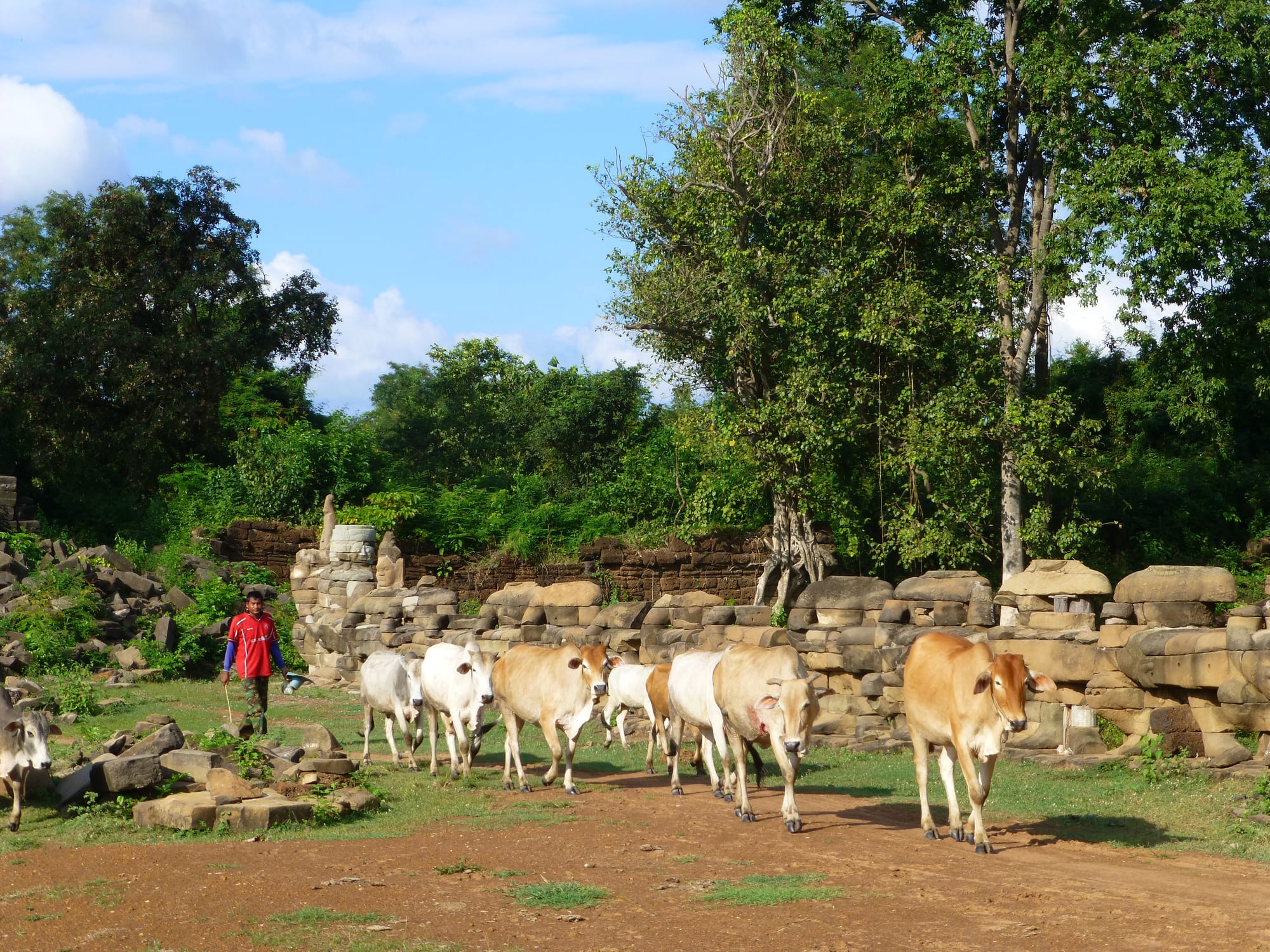
A herdsman driving pale cattle along a dirt track past tumbled sandstone blocks and carved stones under green trees

Siem Reap, Angkor & the Northwest, Cambodia

Banteay Chhmar

Cattle driven past collapsed temple stonework at Banteay Chhmar in north-west Cambodia. (Photo Dharma from Penang, Malaysia / Wikimedia Commons · CC BY 2.0)

A farming village in Banteay Meanchey province, near the Thai border in north-west Cambodia, built beside a vast temple complex of the Khmer Empire. Raised under Jayavarman VII in the late 12th century and left to collapse, the temple lies in heaps of sandstone among trees, and the village runs a community-based tourism and homestay scheme.

Neighbourhoods

  • The village by the temple
    • First-time visitors
    • Quiet and residential

    Wooden houses on stilts, a pagoda, a school and a few shops stand along the lanes beside the temple's moat and outer wall. Almost all the homestays are here, and daily life — cattle, motorbikes, drying rice — goes on within sight of the ruins.

    Open in Maps
  • The baray and the farming hamlets
    • Quiet and residential
    • Local life

    East of the temple the ground opens into the old reservoir and the rice fields, with smaller hamlets on the tracks between them. This is working country rather than a place to stay, crossed by ox carts and farm machinery in the planting and harvest seasons.

    Open in Maps
  • Thma Puok
    • Close to public transport

    The small district town a short drive south, with the market, the health centre, fuel and the road connections that the village depends on. Most transport to and from Banteay Chhmar passes through it.

    Open in Maps

Things to do

The temple and its outliers

  • Banteay Chhmar templelandmark

    A vast temple complex built under Jayavarman VII in the Bayon style, largely collapsed and unrestored, with bas-relief walls of the war against the Cham, including a naval battle, and panels of a many-armed Avalokiteshvara.

    Open in Maps
  • The barayattraction

    The temple's great reservoir beside the enclosure, part of the moats, channels and catchments that carried this dry plain through drought and flood, reached across the fields.

    Open in Maps
  • Banteay Torplandmark

    A smaller temple of the same period standing in open country south of the village, its high towers leaning among fallen blocks.

    Open in Maps

Village life

  • The village pagodalandmark

    The modern wat beside the ruins, where the commune's ceremonies and festivals are held and monks collect alms in the early morning.

    Open in Maps
  • The silk and scarf weaversattraction

    Weaving workshops in the village produce silk and cotton scarves, part of the community enterprises that grew up alongside the homestay scheme.

    Open in Maps

Short trips

  • Ang Trapeang Thmapark

    A reservoir and protected landscape about 30 kilometres south-east of the village, set aside in 1999 for the rare eastern sarus crane and other waterbirds.

    Open in Maps
  • Sisophonattraction

    The provincial capital about 60 kilometres south, on the highway between Siem Reap and the Thai border, the nearest town of any size and the usual transfer point.

    Open in Maps

Seasonal events

  • Khmer New Yearmid-April

    The village pagoda fills for three days of ceremonies, games and water throwing at the hottest time of year.

  • Pchum BenSeptember or October

    Families bring offerings of rice to the pagoda before dawn during the fifteen-day festival of the ancestors.

Eat and drink

Long-standing places and food districts in Banteay Chhmar. Hours, ratings and directions come from your maps app, always current.

What is eaten here

  • Homestay kitchensrestaurant

    Meals in the community homestays are cooked by the host families — rice with grilled or fried freshwater fish, vegetable soups, curries and whatever the garden and the fields are giving.

    Open in Maps
  • The village stallsmarket

    A handful of stalls and shophouses near the temple sell noodle soup, rice dishes, grilled meat, fruit, drinks and dry goods; there is little choice after dark.

    Open in Maps
  • Thma Puok marketmarket

    The nearest full market, with fish, meat, vegetables, palm sugar and prepared food from early morning.

    Open in Maps

Experience Banteay Chhmar

History

The village takes its name from the temple beside it: Banteay Chhmar, usually translated as the narrow or the cat fortress. The complex was built in the late 12th or early 13th century under Jayavarman VII, the king who raised Angkor Thom, the Bayon and a network of temples and hospitals across his empire. Archaeologists read the site as a planned Angkorian centre, probably a fortress, and unlike the open cities of the period. An inscription names the prince Srindrakumara, one of his sons, and the galleries were carved with scenes of the war against the Cham, including a naval battle, and with images of a many-armed Avalokiteshvara, the bodhisattva of compassion.

Set far from Angkor on the route towards the Dângrêk range and the western frontier, the temple was abandoned with the rest of the empire's western holdings, and the forest and the rains brought its towers and galleries down. The village that grew around it farmed among the ruins for centuries. In the 20th century the area lay in the disputed north-west: it was fought over during the war, held by the Khmer Rouge and later by border factions, mined heavily, and emptied and resettled more than once, and its people were among those who crossed into Thai refugee camps in the 1980s.

The temple has been heavily looted in recent decades, robbed of reliefs and statues that were traded into art markets across South-East Asia, and many of those pieces remain lost. Conservation teams have since worked on the galleries, Cambodia has put the complex forward for World Heritage listing without it being inscribed, and the village has built its community tourism scheme around the ruins with the Global Heritage Fund and Heritage Watch.

Culture & Customs

Life in Banteay Chhmar is organised around the pagoda, the farming calendar and the extended family, as in most Cambodian villages. The commune's ceremonies — Khmer New Year in April, Pchum Ben in the autumn, ordinations, weddings and funerals — are held at the wat beside the ruins, and monks walk the lanes at first light for alms. The old temple is treated as a living sacred place as well as an archaeological site, with offerings left at shrines among the fallen stone.

What sets the village apart is its collective approach to visitors. The community-based tourism scheme, developed with conservation and development organisations, trains local guides, rotates guests between homestay families and puts part of the income into a village fund, so that a stay is a transaction with the commune rather than with a hotel. Weaving groups make silk and cotton scarves, and other households supply food, transport and guiding.

Border life shapes the culture too. Many families have relatives working in Thailand, Thai goods and television are common, and a good number of people speak some Thai. Memories of displacement and of the mine-clearing that followed are recent enough to be part of ordinary conversation. Visitors are expected to dress modestly, greet elders and monks with the sampeah, and ask before photographing people, houses or ceremonies.

Daily Life

Several thousand people live in the commune, one of six in Thma Puok district, in hamlets of stilt houses spread between the temple, the reservoir and the fields. The day starts before dawn with cooking, the market run and the walk or ride out to the rice, and slows to almost nothing in the middle hours of heat; work resumes in the late afternoon, and by mid-evening the lanes are dark and quiet. Electricity, mobile signal and piped water have arrived within living memory, and the road from Sisophon has been improved, which has shortened the trip that once took most of a day.

Rain-fed rice is the main crop, with cassava, maize, vegetables and fruit trees, cattle for ploughing and cash, and fishing in the baray and the seasonal ponds. Incomes are low and irregular, and many young adults spend part of the year working in Thailand or in Cambodian towns, sending money home; migration and the debts that fund it are a constant subject. Tourism adds a small, seasonal income to a limited number of households.

The temple is a working part of the village's economy and landscape rather than a fenced-off monument. Conservation work, guiding, cooking and weaving provide jobs, while the surrounding countryside still carries the legacy of the war years in mine-cleared land and in the pattern of settlement.

Food

Meals here are village food, eaten with the rice harvested nearby. A household meal is a bowl of rice with two or three shared dishes: a soup, a stir-fry of vegetables from the garden, grilled or fried freshwater fish from the reservoir and ponds, and a small dish of prahok, the fermented fish paste that seasons much of Khmer cooking, or of tuk trey, the fish sauce used at the table. Beef and chicken appear at festivals and for guests.

Breakfast is usually noodles — nom banh chok, rice noodles in a green fish gravy of lemongrass and turmeric, or kuy teav, a clear soup with rice noodles — bought from a stall or made at home. Samlor korko, the thick mixed soup of fish or pork with green papaya, jackfruit and roasted ground rice, is the everyday country dish, and samlor machu, a sour soup with tamarind, is common in the hot months.

Field and forest foods matter on this plain: bamboo shoots, wild greens, water lily stems, small crabs and snails from the flooded rice, frogs in the wet season, and ants, which are eaten fried and used to season meat. Sugar palms supply palm sugar and fresh palm juice, and kralan, sticky rice with coconut roasted in a bamboo tube, is sold by the roadside. Drinks are green tea, sugarcane juice and iced coffee with condensed milk.

Planning tools

Budget

Costs here are low and mostly fixed by the community-based tourism scheme, which sets prices for homestay rooms, meals, guides and ox-cart or bicycle trips and shares the income among village families. The real expense is getting to the village and back, since it lies well off the main road and usually needs a hired car or a driver for the day.

Daily Budget Midrange
USD 45–90 (homestay or a hotel in Sisophon, meals, a local guide and a car with driver)
Daily Budget Shoestring
USD 20–35 (homestay bed, family meals, shared transport from Sisophon)

Book a homestay through the village tourism office rather than on arrival, bring cash in small dollar notes and riel, and carry a torch, as street lighting is limited.

Best Time to Visit

November to February, when the air is dry and relatively cool and the tracks around the temple and the baray are firm. March to May is punishing on this open plain. The rains from June to October turn the surrounding fields brilliant green but make the unpaved approaches and field paths muddy.

Suggested Number of Days

A day covers the temple and the village for most visitors. An overnight stay in a homestay, adding the outlying temples, the reservoir and the farmland, is what brings people here rather than on a detour from Siem Reap.

First Visit
1 day
With Surroundings
2 days

Transportation

There is no public transport into the village. Visitors arrive by hired car, minivan or motorbike from Sisophon, about an hour away, or direct from Siem Reap in around three hours. Once here, everything is walked, or covered by bicycle, moto-taxi or ox cart arranged through the tourism office.

Agree the driver's waiting time and return trip before leaving the main road, as it is hard to arrange transport out of the village at short notice.

Airport & Station Connections

The village lies roughly 60 kilometres north of Sisophon on National Road 56, the provincial road that runs on to Banteay Ampil in Oddar Meanchey province. Siem Reap, about three hours away by road, is the usual starting point, and its airport is the nearest with international flights. Buses and minivans serve Sisophon; the last stretch is by private car or motorbike.

Walkability

The village is small and flat, and the temple, pagoda, homestays and shops are all within a short walk of each other. The temple itself is hard going: much of it is a field of fallen blocks crossed on narrow paths and boardwalks, with loose stone underfoot. Lanes are dirt, there is little shade in the middle of the day, and there is no street lighting outside the centre.

Safety

The village is quiet and crime against visitors is rare. The main risks are practical: unstable stonework and uneven ground at the temple, snakes and insects in the grass, heat, and the distance to medical care, which is in Sisophon. Landmines and unexploded ordnance remain in parts of this border zone away from roads and marked paths. Cambodian and Thai forces fought along their shared border in 2025: heavy fighting in July, a ceasefire on 28 July, renewed fighting in December and a further ceasefire on 27 December that remained in effect as of May 2026, with sporadic incidents since.

Stay on marked paths at the temple and in the fields, take a local guide, carry water, and check the state of the border area before travelling in this part of the province. Check current official travel advice before travelling.

Climate

Tropical monsoon on an open plain. The dry season runs from November to April, the wet season from May to October with heavy afternoon storms, and humidity stays high for most of the year.

Summer
very hot before the rains — commonly 35–38°C in March to May; wet, humid and around 30–33°C from May to October
Winter
dry and warm — 22–32°C from November to February, with cool early mornings

Local Customs

This is a conservative farming village and guests are close to family life. Shoulders and knees should be covered at the temple and the pagoda, shoes are removed on entering a house or a shrine, and the sampeah — palms together with a slight bow — is the greeting. Ask before photographing people or houses, and do not climb on carvings or move loose stones at the temple.

Homestay households rise and sleep early, so keep noise down after dark; small gifts to the community fund are usual, and tipping guides and drivers is appreciated rather than expected.

Common Payment Methods

Cash only. The riel and the US dollar both circulate, with dollars used for larger amounts and riel as small change, and the nearest reliable cash machines are in Sisophon. Bring enough clean, untorn notes for the whole stay, as neither cards nor mobile payment are of much use here.